


See how Tomi built a documented S&P 500 trading edge.
Compare plans to track liquidity, order flow, and market structure with clearer context.
Interviews
September 28, 2026
From No Edge to a Documented One: How Tomi Built Consistency Trading the S&P 500 with Bookmap

Trading roughly 8 months · S&P 500, crude oil, gold, stocks · Bruce Pilot Program & Bookmap Academy
Tomi’s problem, before Bookmap, wasn’t a lack of effort. He was trading ICT concepts off candlestick charts, doing the work, and still losing. The issue, as he now describes it plainly, was that he didn’t have an edge, so when a trade went against him, he had no real reason to get out. He’d just stay in it, hoping.
A Conservative Trader Looking for a Reason to Act
Tomi describes his current trading style as fairly conservative. He waits for a retest and only takes A+ setups, capping his maximum daily loss at 2% of his account. Because he’s selective, he’s comfortable risking the full 2% on a single high-conviction trade, which means one good trade can end his day.
My maximum daily loss is capped at 2% of the account, and I typically only take one or two trades a day. Because I’m being selective and only taking A+ setups, I can afford to risk the full 2% on a single trade.
– Tomi
He mainly focuses on the S&P 500 but is extending his scope to crude oil, gold, and a handful of stocks. He’s been trading for roughly eight months in total, and using Bookmap for about the same stretch.
Trading Without a Reason to Get Out
Before Bookmap, Tomi used classic candlestick charts on TradingView and traded ICT concepts, the same starting point a lot of retail traders take. His biggest problem wasn’t any single mistake. It was the absence of an edge entirely.
My biggest problem before Bookmap was that I didn’t have an edge. I was mostly trading out of emotion because I had no clue what was going on. I held onto losing trades, ended up losing a lot of money, and it was really mentally demanding.
– Tomi
Asked what market behavior was hardest to read at the time, his answer was blunt: everything was hard to read, because there was no edge underneath any of it. Results were poor and confidence followed them down.
Discovering Bookmap
Tomi came across Bookmap on YouTube while watching an order flow trader, Bruce, whose Pilot Program he’d eventually join. Going in, he expected the platform to be complicated simply because it looked that way. What surprised him was how much the built-in education and the community around the platform did to flatten that learning curve.
Even though Bookmap seemed like complicated software at first, the education out there and the community made it much easier to pick up.
– Tomi
When It Clicked: Understanding Market Mechanics

For Tomi, no single feature was the turning point. What actually clicked was more fundamental: understanding best bid, best offer, and the basic mechanics of buyers versus sellers, concepts he picked up through Bookmap’s Market Mechanics education course. Before that, he says, he never really understood how markets worked at all.
That foundation directly corrected a habit left over from his ICT days. ICT traders, in his experience, are constantly assuming where liquidity sits and targeting swings based on that assumption. Bookmap let him see it directly instead of guessing.
Bookmap helped me understand where liquidity actually is. ICT and retail traders are always assuming where the interest is. I could see it exactly.
– Tomi
Building an Edge Around Two Setups
Tomi deliberately doesn’t use CVD, absorption, or icebergs. He prefers pure order flow, watching the orders and the aggressors directly, a preference shaped mainly by the strategies taught in Bruce’s Pilot Program.
His process now centers on two setups: Low Volume Pullback (LVP) for trend continuations, and Trendline Break Accumulation (TLBA) for reversals. Entries come on structure breaks backed by high volume, exits sit in front of heavy liquidity, and risk management runs off a grading system rather than gut feel.
That grading system also corrected a specific misconception he’d carried over from his ICT days about how stop losses actually work.
One misconception is that a stop loss is a limit order you can see sitting in the order book. That’s not true. It’s a market order, only visible through the stop run indicator.
– Tomi
Trade Breakdown: A Textbook TLBA
The trade Tomi walked through was significant enough that Bookmap featured it on the Insights dashboard, a near-perfect example of the TLBA setup taught in the Pilot Program. Even though the underlying trend was modest, roughly ten points, every element of the setup lined up cleanly.
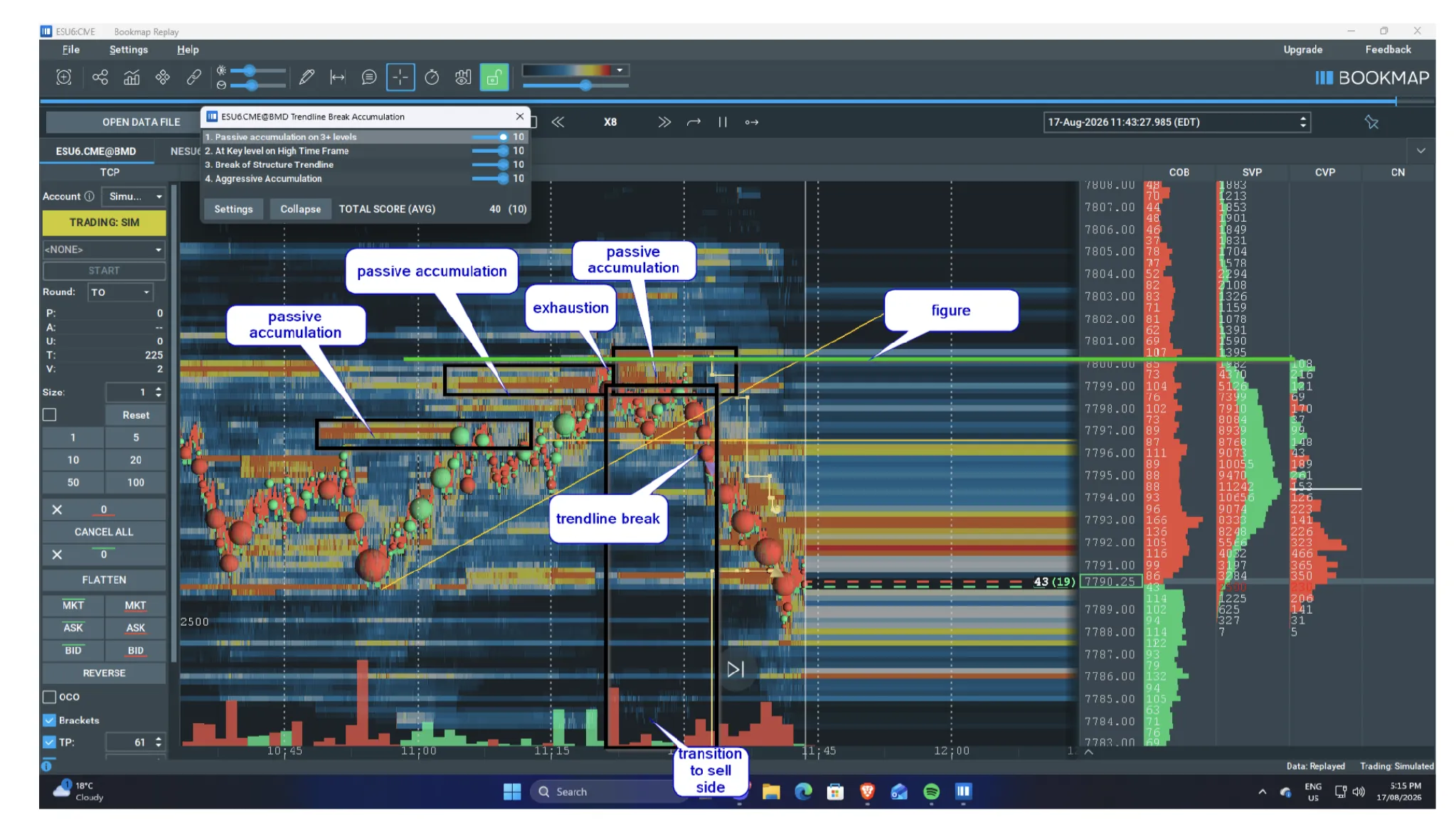
Tomi’s TLBA checklist inside Bookmap Replay: three levels of passive accumulation, a break at a key psychological level (the “figure”), exhaustion, and a clean transition to the sell side, scoring a perfect 10 across all four criteria.
The setup builds around four elements. First, passive accumulation: large players building resting limit orders across three or more levels near a key price, effectively trying to draw price into their own positions since they can’t trade directly into their own orders. Second, that key level itself, in this case a round-number “figure,” a level enough higher-timeframe traders are watching that a reversal there tends to draw in broader participation. Third, a visible shift in the delta bars as aggressive sellers start outweighing the earlier buying. Fourth, a structure break: a lower low, a broken trendline, and exhaustion where buyers simply stopped showing up to defend the level.
This is a classic TLBA trade. The net delta bars, combined with the orders coming in below, plus the passive accumulation of buyers transacting with resting liquidity on the offer, gave me more conviction on this trade.
– Tomi
Tomi closed the trade for roughly 1 to 1.5R. He also described how the setup extends into continuation trades: if a trader missed the initial reversal, low-volume buying on a retest back into the broken range, followed by sellers stepping back in at that retest, is itself a valid re-entry signal, with the same heavy liquidity pocket below serving as the target.
The Playbook That Made It Click
Understanding the individual setups wasn’t what finally made Bookmap work for Tomi. It was building a playbook that assigned a specific setup to a specific zone, rather than watching for every setup everywhere at once.
Early on, he’d catch himself second-guessing between TLBA and LVP in the same zone, adding noise rather than clarity. A coach in the Bookmap Academy, DNT, pushed him toward marking out his levels before the session and deciding in advance: if price reacts at a level, he’s looking for a reversal; if it doesn’t, and the initial balance forms with price still pushing higher, he’s looking for a continuation instead. One setup, one zone, no second-guessing mid-session.
Combining too many setups at once just complicates things and creates noise. You can almost always spot an LVP trade, but if you’re also taking TLBAs in the same zone, that’s not great.
– Tomi
That change is what he credits with actually making him profitable, not just understanding order flow, but structuring exactly when to apply which piece of it.
A Measurable Shift, Built on Patience
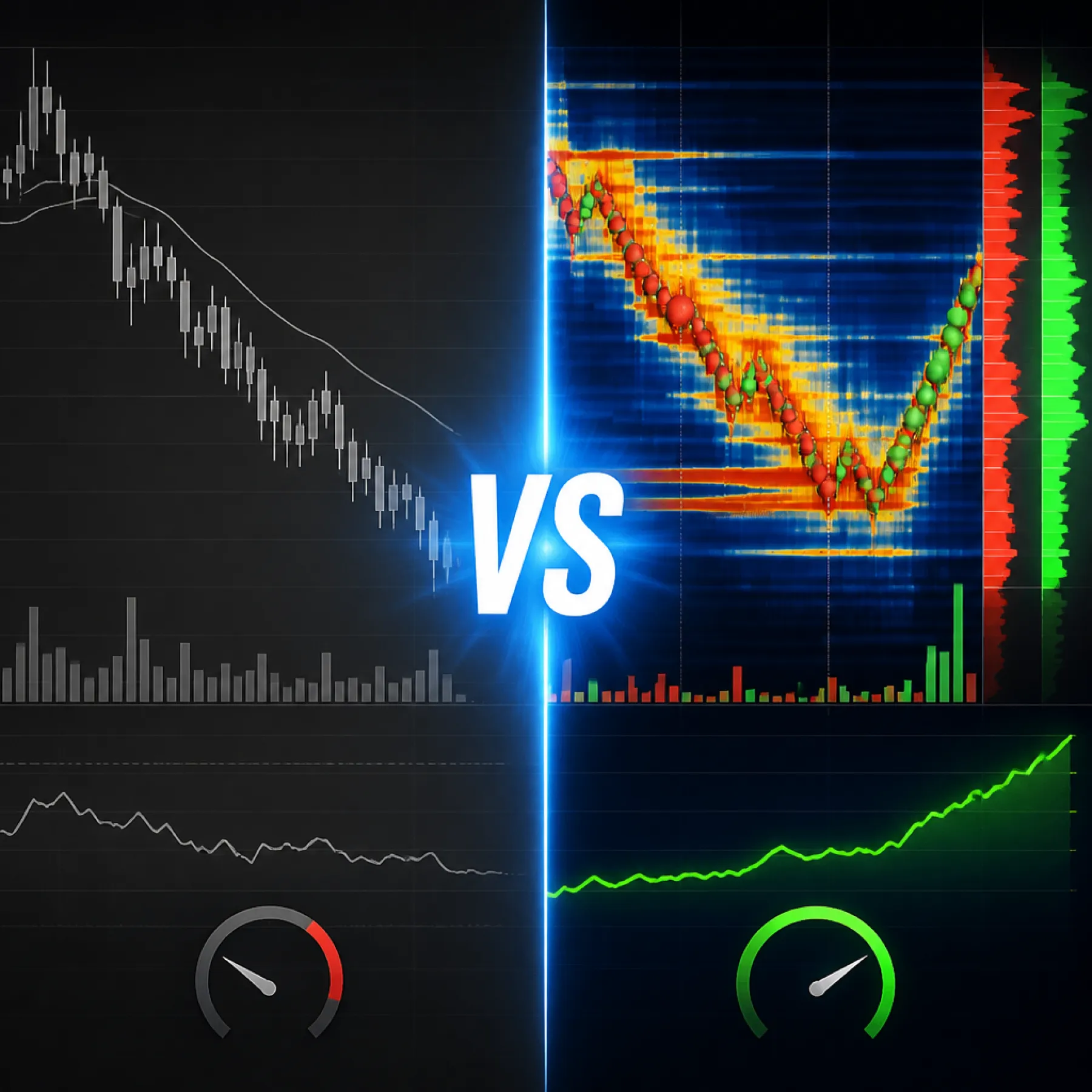
Tomi is candid that he initially moved to live trading faster than he should have. Coaches in the Bookmap Academy pushed him to spend more time backtesting before going live, and looking back, he agrees they were right. His own estimate now, for a new trader following the same path, is two to three months of dedicated backtesting before confidently moving into forward testing.
My consistency has improved a lot. Really small losses, and I’m holding onto winners by trailing my stop and watching the order flow. The biggest thing is consistency and confidence now. I actually trust my edge.
– Tomi
His current profit ratio sits around 75 to 80%, and he’s clear that the number matters less than what produced it: cutting losses quickly because the order flow tells him when a read was wrong, and trailing stops on winners rather than capping them at a fixed target.
A Routine Built on One Session and a Hard Daily Cap
Tomi’s day now runs on a fixed structure. Before the market opens, he marks out a limited set of key levels, roughly eight to ten, deliberately avoiding the temptation to plot dozens of them. Too many levels, in his view, just gives a trader a reason to trade every time price moves a single point.
There’s no point having 10,000 different key levels. That’s going to give you a reason to trade every single time the market moves one point, and that’s just noise. It doesn’t help.
– Tomi
He trades the AM session, from the open through lunch, and stops immediately if he hits his 2% daily loss cap or simply doesn’t see an A+ setup. If ES isn’t showing him anything, he’s willing to check gold, crude, or NQ instead rather than force a trade on an instrument that isn’t cooperating. After each session, he documents and backtests the trades he took, a habit that’s become fully routine rather than optional.
He relies on Bookmap almost exclusively, with TradingView kept around only for marking out key levels.
Accountability Through the Community
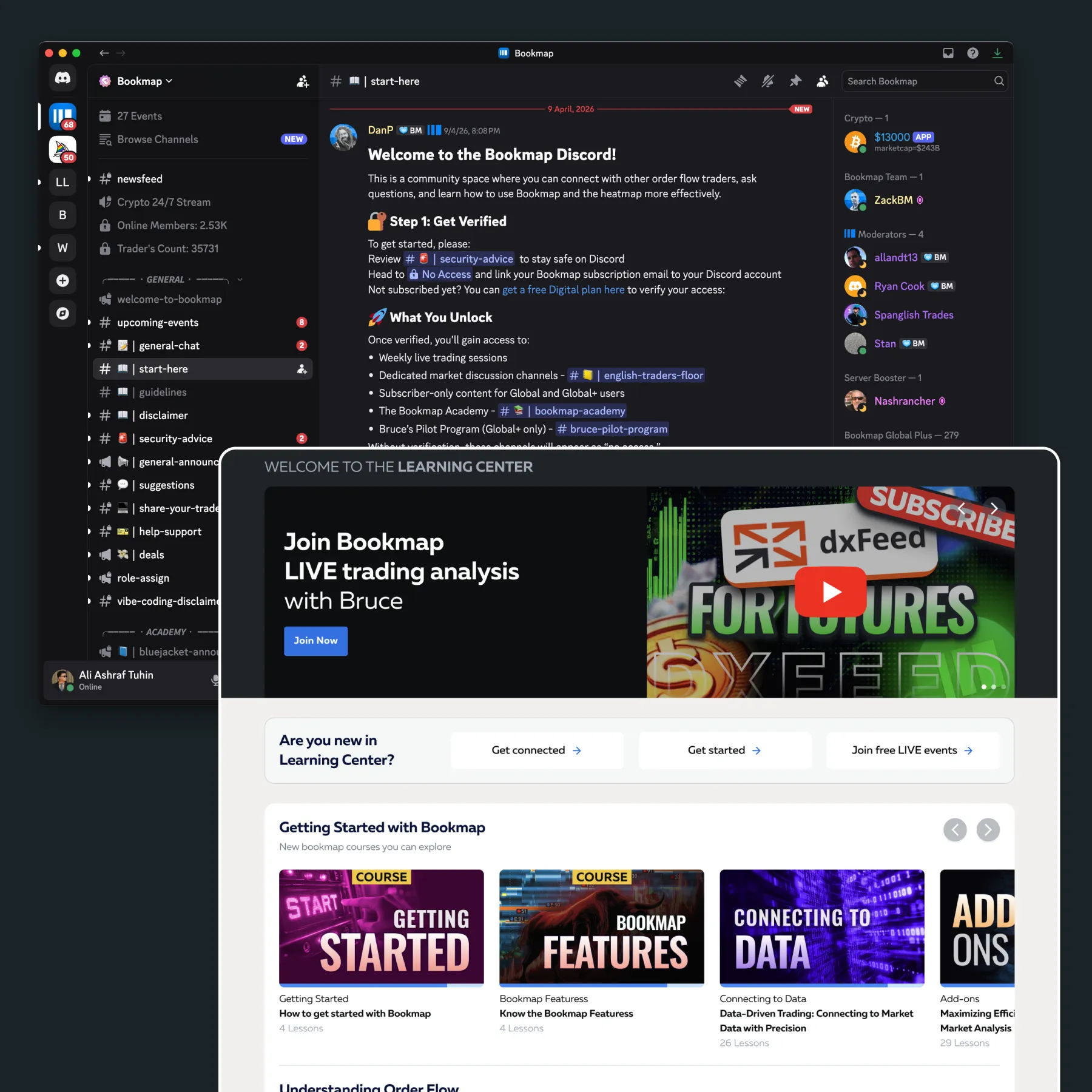
Posting every trade to the Bookmap community, rather than just the winners, is what Tomi credits with keeping him honest. Coaches and fellow traders will call out a setup that doesn’t meet the standard, and watching how other traders reason through their own charts has sharpened his own reads.
The Bookmap community is the most awesome thing ever. I have to be accountable, since I’m sharing all my trades, and I know if my quality isn’t up to standard, fellow members will call me out.
– Tomi
He points to Bruce’s live order flow webinars as the most useful sessions he attends, and also credits Scott Pulcini, an institutional trader with real ES trading experience, for a different angle on where large players are positioning, particularly around icebergs and stop orders.
Advice for New Traders
Tomi’s advice to anyone starting out is to resist the pull toward more: more indicators, more key levels, more educators, more setups. In his experience, that’s exactly what prevents a trader from ever proving out a real edge.
My biggest piece of advice is to keep things simple. There are so many distractions in trading: news, key levels, indicators, different things people look at. Stick to one or two setups on one instrument for a long time to see if you actually have an edge. Constantly changing things will make it impossible to document your edge.
– Tomi
- Pick one or two setups on one instrument and stay with them long enough to actually know if they work.
- Build a playbook that assigns a specific setup to a specific zone, so you’re never choosing between two setups mid-trade.
- Spend two to three months backtesting in Replay before trusting yourself in live markets.
- Follow one educator at a time. Combining several at once, in Tomi’s experience, leaves you with no consistent, recorded edge at all.
- Don’t force trades. A missed day costs less than a low-probability trade taken out of impatience.
He’s also direct about what doesn’t move the needle: more screen time and more news reading aren’t the answer. In his view, the only thing that actually moves price is the orders and the aggressors behind them, and that’s where attention belongs.
Conclusion
Tomi’s turnaround wasn’t really about discovering order flow as a concept. It was about turning that concept into something narrow enough to test: two named setups, a fixed set of key levels, a hard daily loss cap, and a playbook that tells him exactly which setup applies in which zone before the session even starts.
What he has now, roughly eight months in, is something he didn’t have when he was trading candlesticks and hoping: a documented, repeatable reason to get in, and just as importantly, a reason to get out.
Sign Up Now
Latest Articles