


See how reading the order book changed the trading process.
Compare plans to track liquidity and order flow instead of relying on price alone.
Interviews
September 28, 2026
From Watching the Stars to Reading the Book: How Daddy Day Trader Traded His Way Out of a $16K Hole and Into Two Mornings a Week
Full-time trader since 2023 · ES futures exclusively · Bookmap Academy & Discord community
Parker, who trades under the name Daddy Day Trader, didn’t set out to become a professional trader. He was a certified arborist, climbing trees for a living, when a family emergency forced a career change almost overnight. What followed was a familiar arc for a lot of self-taught traders: an overconfident start, a painful stretch of losses, and eventually a slower, steadier climb back once the right tool and the right mentor entered the picture.
From the Treetops to the Ticker
Parker grew up around construction. His dad owned a construction company, but it never appealed to him, so on a friend’s recommendation he became a certified arborist instead, a trade that let him earn while he learned and gave him years of genuinely enjoyable, physical work.
He started dabbling in markets in 2019, right as Robinhood was opening up trading to a much wider, less capitalized audience. Like a lot of people who got their start that way, his early trading was volatile and largely unstructured, swing trading names like AMC and catching an early Dogecoin run more on momentum and luck than process.
Everything changed in early 2023. His wife had serious pregnancy complications with their first child and was largely bedridden. Around the same time, he’d just finished helping his tree service through a major buyout and transition. With his career at a natural stopping point and his wife needing him at home, he made the decision to leave arboriculture and trade full time. As he puts it, it was less a plan than a forced startup.
Jumping From Strategy to Strategy

Parker’s biggest early problem wasn’t a lack of effort. It was consistency. Like a lot of new traders, he bounced between strategies, trying nearly every popular indicator that showed up on social media: EMA crosses, 15-minute opening range breakouts, MACD, RSI. He estimates he tried most of the mainstream approaches at one point or another, without ever sticking with one long enough to actually master it.
The deeper issue underneath that was more fundamental. He was skipping the question of why price actually moves. He was watching traders online who made it look easy and assumed that copying an indicator or buying a course would get him there. It took real losses to realize that wasn’t the case.
Climbing Mount Stupid
Parker describes his early trading through the lens of the Dunning-Kruger effect, which he calls, borrowing a phrase from a former boss, climbing Mount Stupid. A trader jumps into something new, builds confidence fast on a handful of early wins (for him, that was the AMC swing trades and a lucky run in Dogecoin), and starts taking bigger positions on the strength of that false confidence.
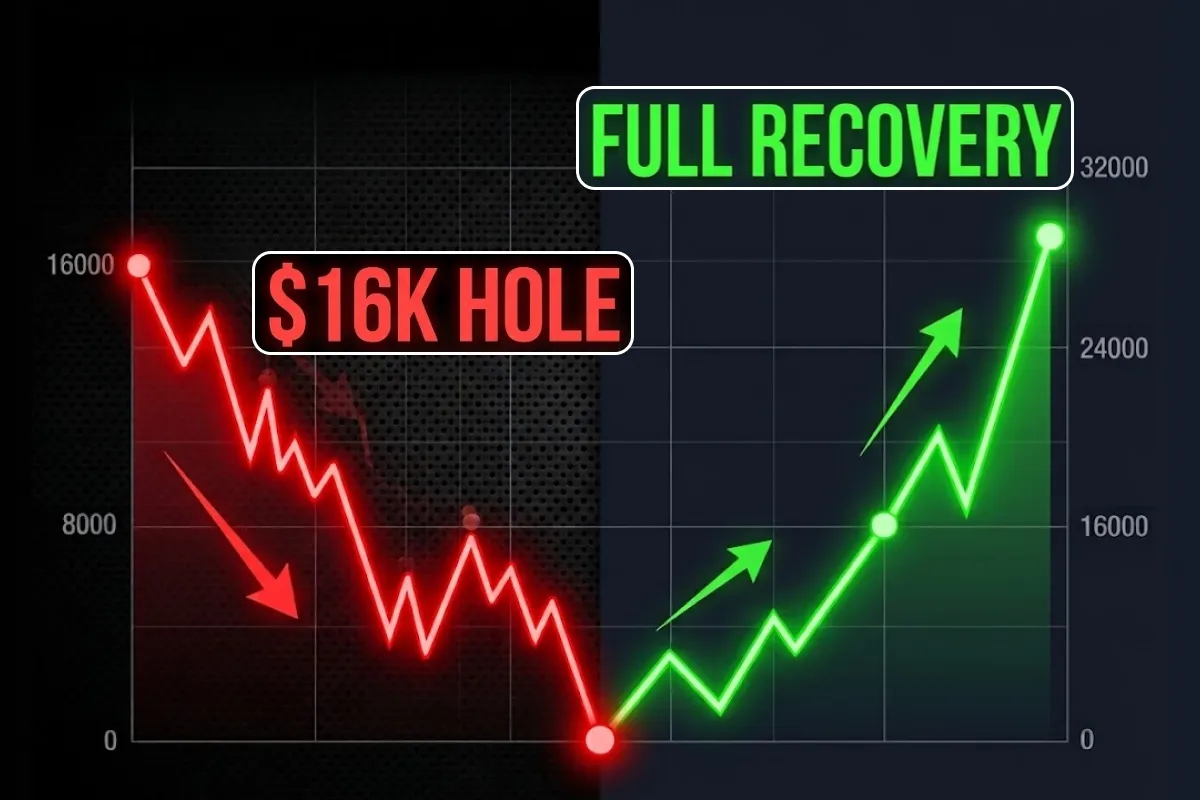
That overconfidence caught up with him. As losses mounted, he found himself around $16,000 in the hole, a low point he now describes candidly as part of the process rather than something to be ashamed of.
“That’s where a lot of traders jump off. But if you choose not to hop off, that’s where most people are going to find their knowledge, in the valley of despair, because it humbles you. It’s not until you’re humbled that you’ll actually start to gain the proper amount of knowledge, or go at the right speed.”
– Parker (Daddy Day Trader)
That humbling period pushed him toward prop firm accounts and futures, where the same overconfidence cost him again. Buying a batch of prop firm accounts on the assumption he already knew what he was doing, he wrecked several of them in a row before the losses forced a real change in approach.
Finding a Mentor, Then Finding Bookmap
Parker’s path into Bookmap came through a mentor rather than the software itself. He first came across Bookmap through other traders using it online, but it was his mentor, Carmine Rosado, who made the tool click by showing him how to actually use it.
His first exposure to the heatmap was overwhelming. Watching an experienced trader like Carmine use it made it look simple, but on his own screen it was, in his words, an explosion of color with no obvious starting point for reading it.
That reaction is one he now recognizes constantly from other traders. Posting his own trade reviews to the day trading and Bookmap subreddits, the most common feedback he gets is that the chart looks like it has too many indicators on it, when in reality it’s just volume.
“It’s just volume, and volume to me is the simplest thing to read. I tell people it’s like looking at a child’s coloring book once you figure it out.”
– Parker
When It Clicked: Understanding the Auction First
For Parker, the breakthrough wasn’t a single feature. It was going back and building a real understanding of market auction theory before trying to interpret what Bookmap was showing him. Once he understood the market as a simple exchange between buyers and sellers, where liquidity rests, where it dries up, the heatmap stopped being noise and started being a visual representation of exactly that auction.
Combining that theoretical grounding with Bookmap’s free educational webinars and his mentor’s guidance is what finally made the tool click. He could see where passive buyers and sellers were resting in the order book waiting to be filled, how aggressive the market was being on either side, and when that aggression was fading or reversing.
Trade Breakdown: Before and After
Parker put together a side-by-side comparison from the same trading day, his first day back after a long break, to show exactly what changed. First, the setup as he would have traded it years earlier on another platform, layering trendlines, an opening range box, a resistance line, and a 9/21 EMA cross on top of 5-minute candles.
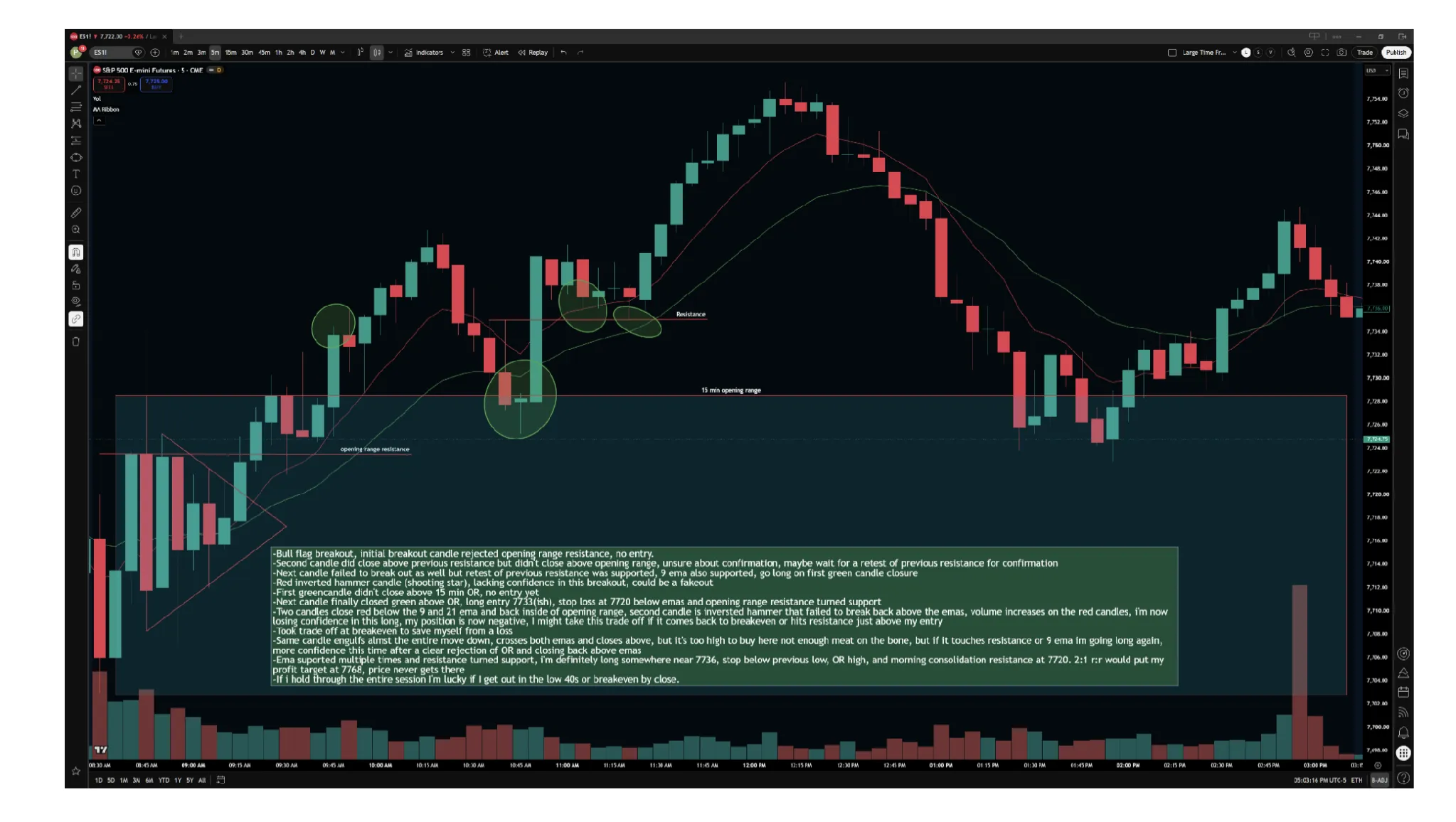
Parker’s reconstruction of how he would have traded this breakout years ago: an overnight range, a bull flag, an opening range box, and a 9/21 EMA cross, none of it agreeing cleanly with the others.
By his own account, the setup was a mess of competing signals. The bull flag breakout closed above the flag but not above the opening range. The next candle broke the opening range but wicked on both sides. A reversal hammer then made him doubt the whole thesis. By the time a confirmation candle finally closed cleanly above everything, he’d already missed the best part of the move, and holding the resulting position through the rest of the session would have closed out roughly breakeven.
Here’s the same day, same instrument, traded on Bookmap instead.
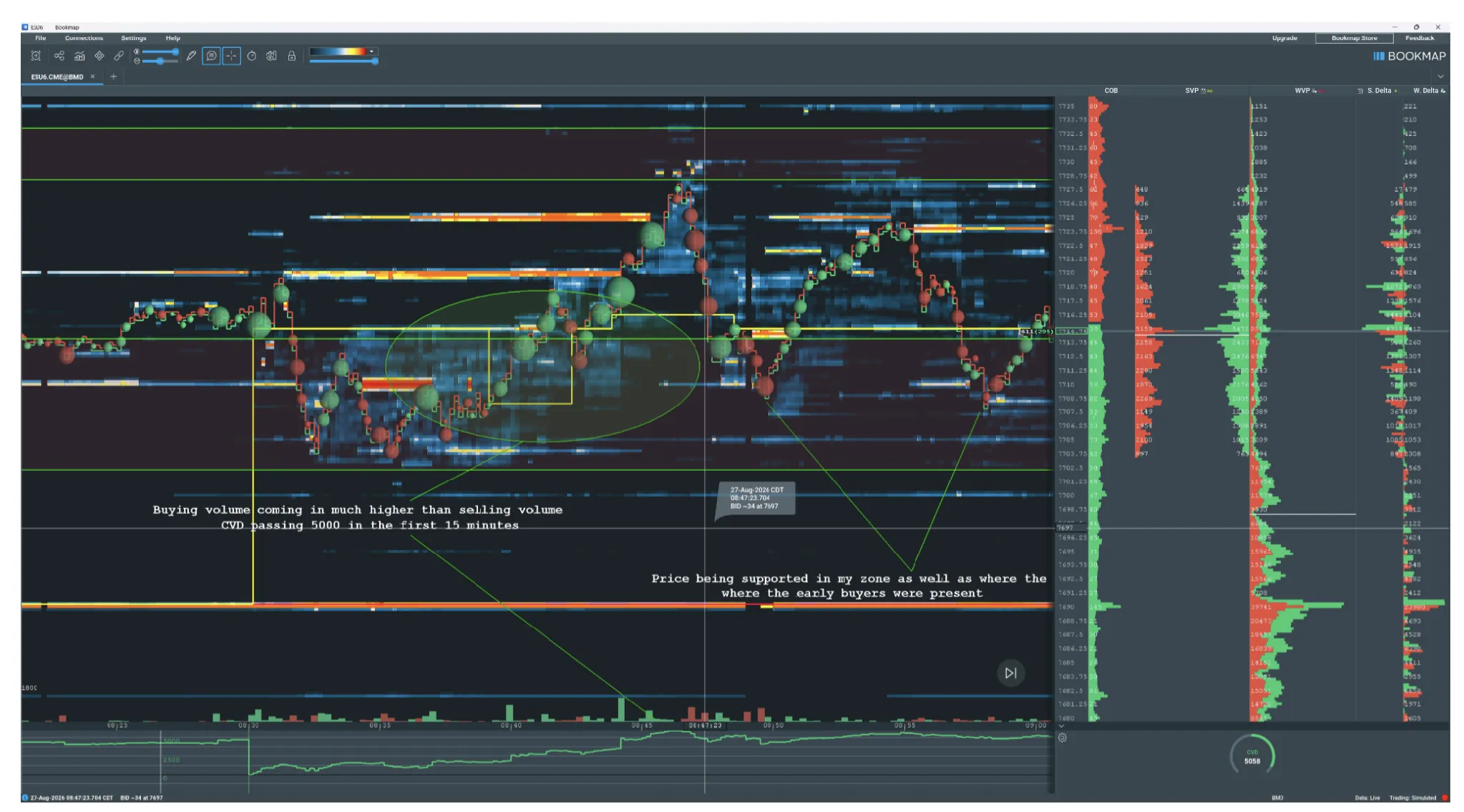
Aggressive buying at the open, with cumulative volume delta climbing past 5,000 in the first 15 minutes, well before any candle-based confirmation would have triggered an entry.
Right at the open, Parker saw large buyers stepping in around the prior week’s breakout range. Cumulative volume delta went from zero to roughly 5,000 in the first 15 minutes, a clear sign of aggressive buying with real participation behind it, not just a candle closing in the right direction.
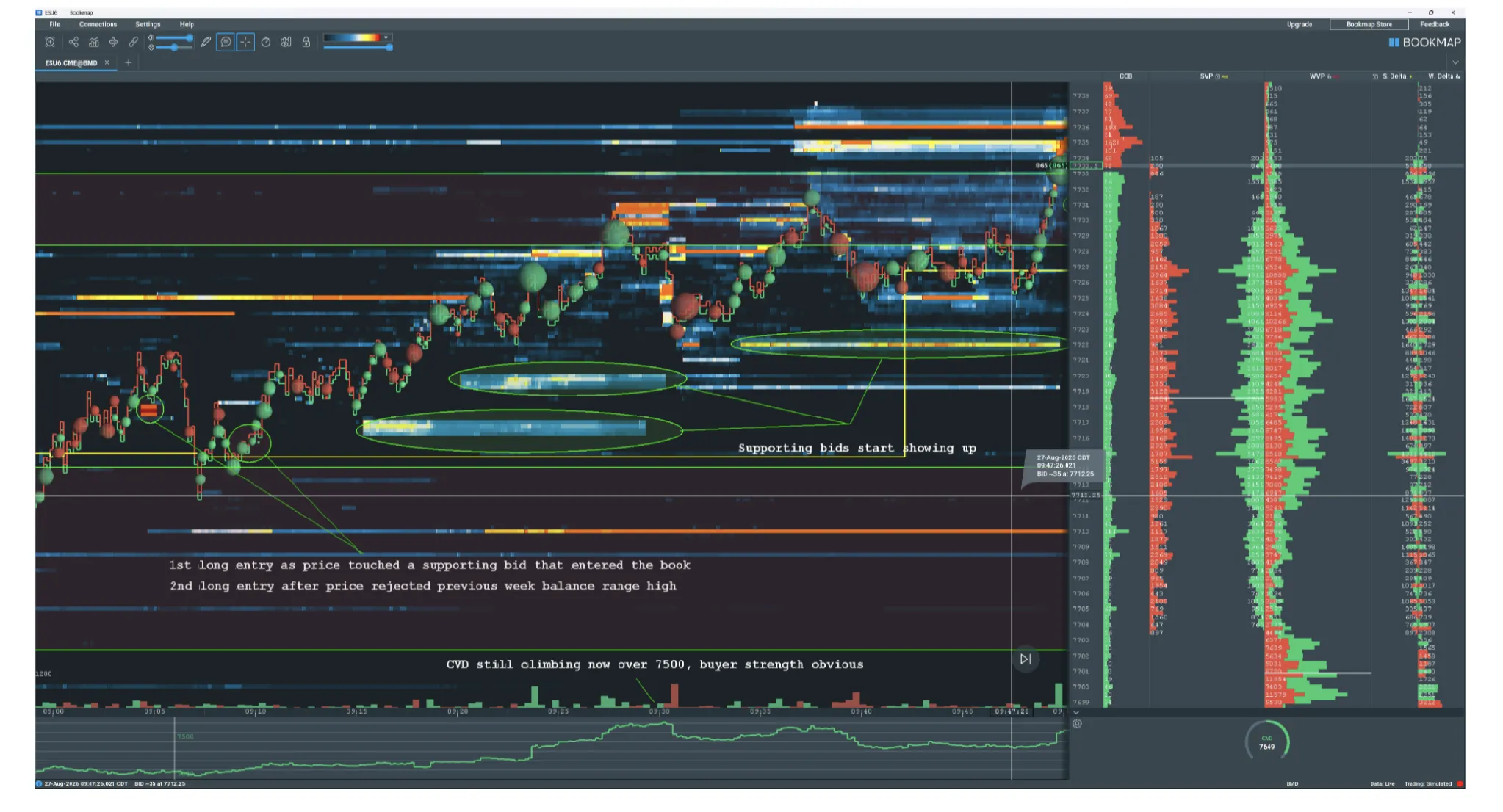
First long entry as a supporting bid entered the book; second entry after price rejected the prior week’s balance range high.
About half an hour into the session, a large passive bid showed up in the book to support price. That was his first confirmation to go long. He scaled in a second position lower, after price dipped, found no sellers willing to press it further, and bounced off a fresh supporting bid. Cumulative delta kept climbing, giving him another layer of confidence in the position.
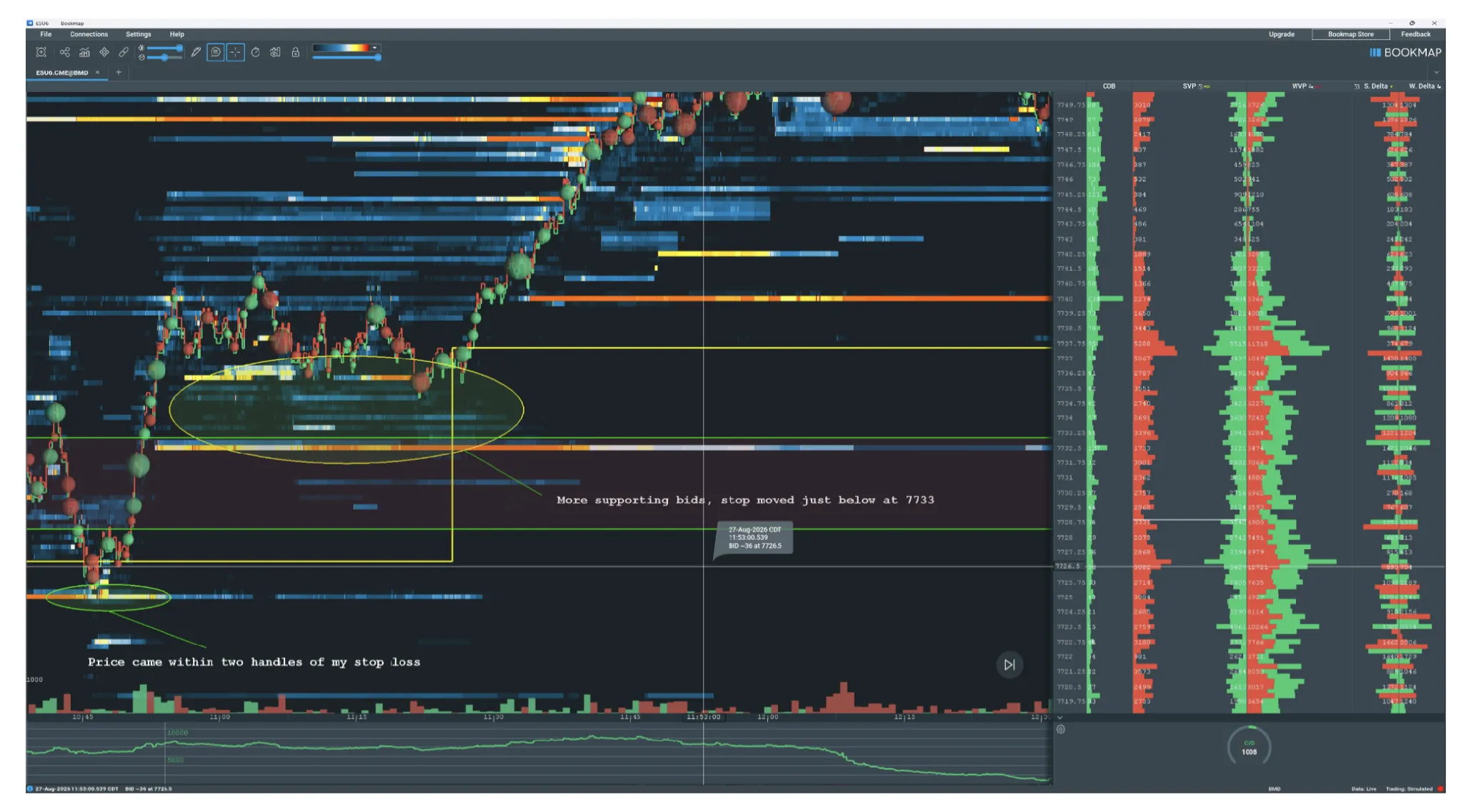
Supporting bids kept appearing under price, which let Parker trail his stop off real order book activity. Price came within two handles of that stop before the bids held and the move continued.
As the trade developed, Parker used the same resting liquidity to manage risk. Rather than placing a stop at an arbitrary technical level, he trailed it just underneath the supporting bids he could see actively defending price. At one point the market came within two handles of that stop before those same bids held and pushed the trade back in his favor.
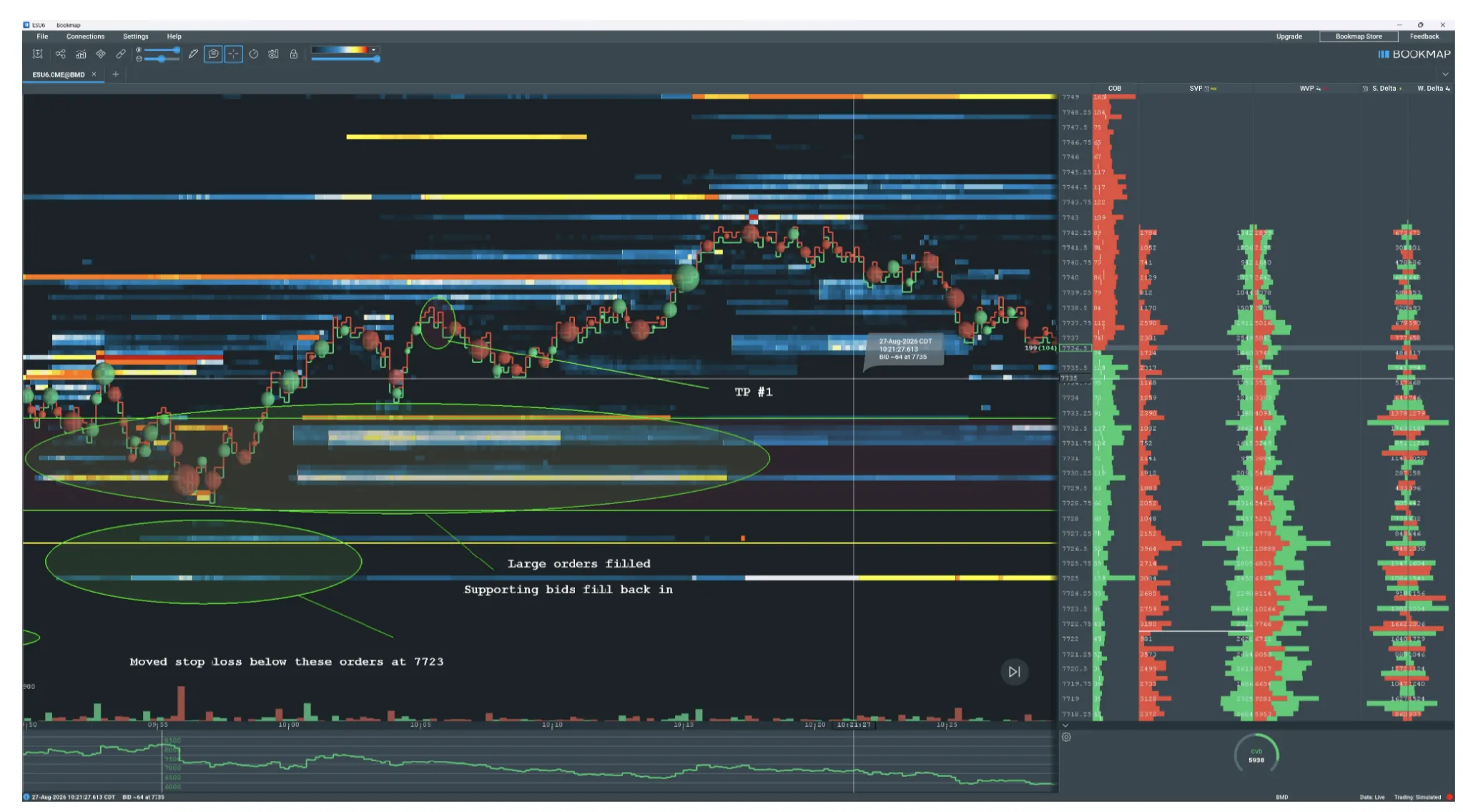
First profit target taken as large resting orders filled; stop moved to protect the runner as fresh supporting bids filled back in beneath price.
He took his first profit target as a cluster of large resting orders finally filled, then moved his stop under a fresh set of supporting bids to protect the remaining runner. When those bids eventually gave way later in the session, he was stopped out on that runner, already well ahead for the day from the first target.
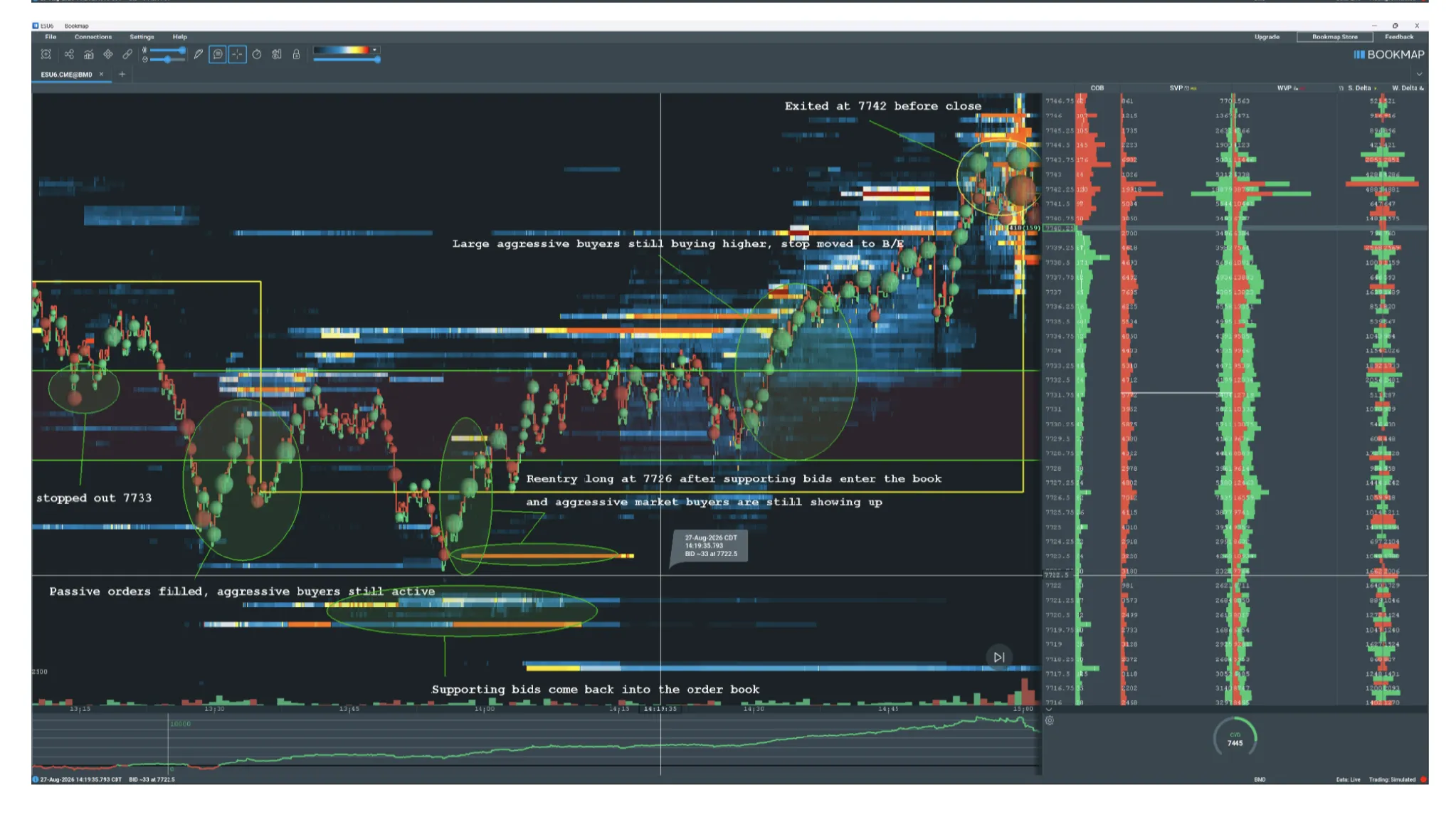
A second setup later in the day: re-entry at a fresh supporting bid, aggressive buyers still active into the close, exit taken near the day’s high.
Price came back down into a different zone he was watching, and a similar pattern played out: passive orders filling, aggressive buyers still active, and then one more supporting bid convincing him to re-enter long. He rode that position through a grinding, low-volatility afternoon and into the closing chaos, exiting near the session high.
Two clean, well-supported trades, entered and managed off what the order book was actually doing rather than a stack of lagging indicators. That’s the same day that, traded the old way, would have closed out flat.
How He Uses Bookmap Now
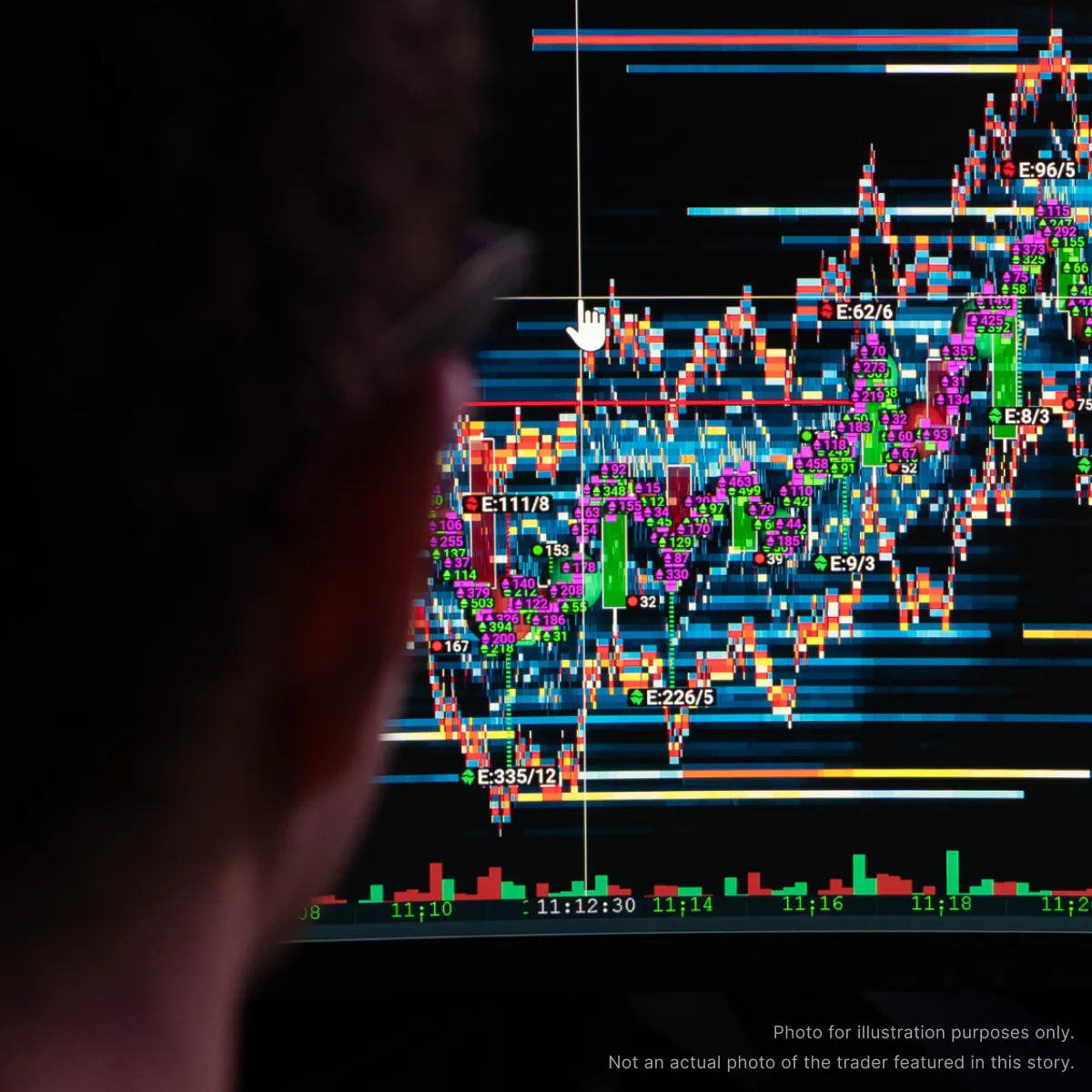
Parker’s approach today still starts with a corrected misconception from his early order flow days. He used to assume a large outlier order in the book would automatically act as support or resistance. Time behind the screen taught him that isn’t always true. He still uses the order book heatmap to confirm entries and exits, but now reads it more as an indication that resting orders want to get filled, and treats passive orders that show up out of nowhere near an area of interest as a signal worth acting on.
“That, to me, is Bookmap’s greatest advantage: being able to see the microstructure activity to snipe better entries.”
– Parker
One entry method he uses that he says isn’t common is tracking weekly cumulative volume delta accumulation at price, watching for outliers that may get revisited later in the week. Those areas often mark where large market makers are hedging against options flow, and volume there tends to be noticeably higher when price returns.
For exits, he leans on the same idea from the other side: large resting orders in the direction he’s trading act as natural magnets for price. Viewed as a liquidity exchange, high-volume nodes, large book orders, and low-volume nodes all become places price is likely to want to visit, whether that’s an entry or an exit.
Asked how Bookmap compares with other heatmap tools he’s seen, he hasn’t found anything that would convince him to switch. In his view, the interface is unmatched, highly customizable and intuitive once you’re familiar with it, with no noticeable lag.
A Morning Routine Built Around Freedom
The biggest lifestyle shift Bookmap gave Parker wasn’t a feature. It was time. His routine now starts 30 to 45 minutes before the open, enough time to make coffee and glance at a higher timeframe candlestick chart for general market structure, plus whatever context carried over from watching Bookmap the day or week before, where the big buyers or sellers showed up, levels that wouldn’t be visible on a candlestick chart at all.
That preparation is enough for him to identify high-volume levels that align with the broader sentiment and trade once or twice a week rather than every session.
The business itself, which he now runs as an LLC, grew directly out of his family’s circumstances. Rather than pay for daycare while trading from home, he set up monitors in an open kitchen and living room area so he could watch volume bubbles from across the room while making breakfast for his kids. The visual simplicity of the heatmap made that possible in a way that stacking small timeframe candlestick charts never would have.
“It’s given me the freedom to start this adventure, to raise my kids, which is a freedom that a lot of people don’t get, and I’m very blessed for that.”
– Parker
Learning From the Community
Parker is quick to credit Bookmap’s free education alongside his own mentor. His advice to any new user is to start with the free webinars on the Bookmap website before spending money on anything else, then join the Thursday Discord Academy sessions, where the community reviews trades and walks through concepts together.
He found his own mentor, Carmine Rosado, through that same community, and credits Carmine’s teaching style as the thing that finally made order flow concepts make sense for him personally. He’s careful to note that isn’t a knock on Bookmap’s own education, just a reminder that different people click with different teachers.
A Measurable Shift, and a Better Metaphor
Since trading around Bookmap became second nature, Parker says his win rate has improved dramatically and he rarely has a losing day anymore. Some of that comes from better risk management, sensible profit targets, trailing stops on runners, but a lot of it traces back to how much lower risk Bookmap makes his entries in the first place, so that even a loss tends to be small and gets recovered before the day is over.
He describes the shift with a metaphor he’s fond of: trading used to feel like astrology, watching the stars and hoping his risk management would cover for bad execution. Now, having taken the time to understand market mechanics and apply Bookmap on top of that understanding, he calls himself an astrophysicist instead, someone who understands the underlying mechanics well enough to read outcomes rather than hope for them.
“My confidence used to swing wildly between overconfidence and doubt. Now it’s not about the stars aligning. I understand why a star burns, and I can reliably predict the outcomes of the cosmos.”
– Parker
Advice for New Traders
Parker’s advice for anyone starting out mirrors his own path: don’t skip the humbling part, and don’t spend money before you’ve exhausted the free resources.
- Start with Bookmap’s free webinars and educational material before paying for any course.
- Paper trade first, through a free account or a prop firm’s demo mode, to build discipline before real money is on the line.
- Focus on learning the skill, not on the money. Chasing profit before competence is exactly how traders climb Mount Stupid.
- Avoid comparing your results to traders further along than you are. Comparison, as he puts it, is the thief of joy.
“This tool is extremely powerful and enlightening if you use it wisely. But Bookmap is not the tool that will magically make you profitable. It takes hard work, dedication, and sacrifice to get good at this game.”
– Parker
He’s also candid about the part of trading that has nothing to do with any platform: the psychological toll of real losses. Having been in a $16,000 hole himself, his advice to anyone who finds themselves in a similarly bad spot is to stop, take a breath, talk to someone who cares about them, and seek professional support if they need it, and to remember that no amount of money or debt changes how valuable they are.
Conclusion
Parker’s story isn’t really about a single feature or a single trade. It’s about what changed when he stopped guessing at why price moves and started watching the mechanics behind it directly. Bookmap didn’t make him profitable on its own. Understanding market auction theory, finding a mentor who could translate that understanding into a working process, and putting in the screen time to make it second nature did that. Bookmap was the tool that let him see it happening in real time.
Today, that shows up less as a dramatic before-and-after and more as something quietly ordinary: a couple of focused mornings a week, a business built around being present for his kids, and a process he trusts enough to no longer need the market to be watched every day to feel in control of it.
Sign Up Now
Latest Articles