


See order flow more clearly in real time.
Compare plans to access deeper market visibility for order flow.
Trading Basics
January 26, 2026
Updated
How Bookmap Order Flow Provides Stock Traders With An Edge?
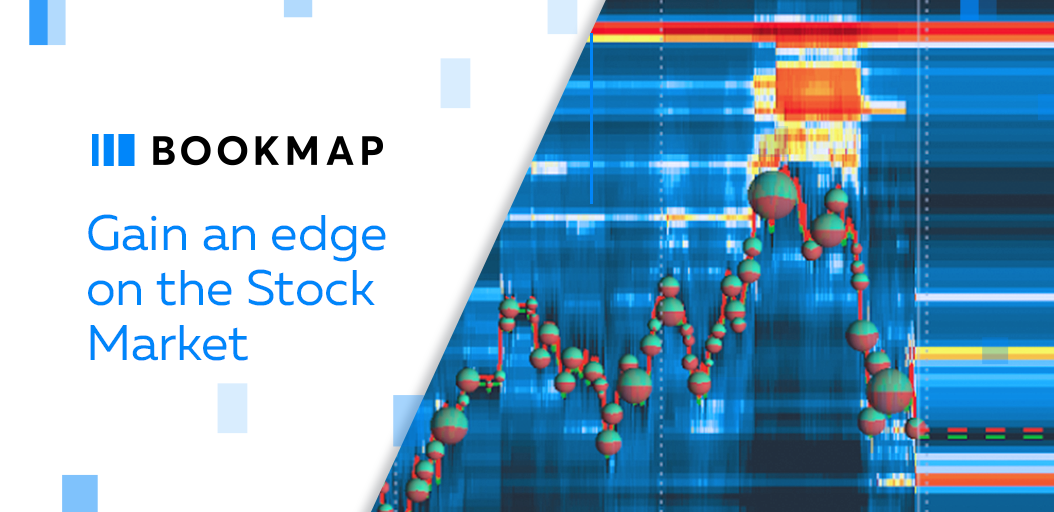
Most trading platforms have well-known candlestick charts. On their basis, traders make technical analysis using indicators, drawing tools, looking for candlestick patterns and price formations. But despite their popularity, the candlestick chart shows OHLC prices. This limits the vision and understanding of the causes of price movement.
Table of Contents
- What Is an Order Flow Chart and Why It Matters
- Best Order Flow Software
- Trading Tape Reading Software
- How to Interpret Heatmaps with Bookmap
- Order Flow vs. Footprint Charts and DOM
- Latest Order Flow Strategies 2026
- Order Flow Patterns in Stocks
- Trade Data Visualization
- Bookmap vs Other Trading Platforms
- FAQ
Watch: Order Flow Trading Explained
This short video provides a visual introduction to how order flow works in real markets, including how traders interpret liquidity, execution, and price movement in real time.
Bookmap platform, in collaboration with the dxFeed data provider, provides stock traders the visualization of extended market data. Right on the chart traders can enable unfiltered Best Bid/Ask lines, Volume Dots, an evolution of current and historical Limit Order Book as a heatmap, and much more.
Best Order Flow Software
When traders look for the best order flow software, they are typically searching for tools that provide real-time visibility into liquidity, execution, and market depth.
Unlike traditional charting platforms, order flow software focuses on:
- How orders are placed and executed
- Where liquidity is building or disappearing
- How aggressive buyers and sellers interact
This level of detail allows traders to move beyond price-based analysis and focus on the drivers of price movement.
Top-Rated Tape Reading Platforms
Tape reading platforms are designed to help traders interpret the flow of executed trades and understand short-term market behavior.
Modern platforms extend beyond traditional time-and-sales by combining:
- Trade execution data
- Order book depth
- Liquidity visualization
Superior Market Depth Utilities
Advanced platforms provide full depth-of-market visibility, allowing traders to:
- Track large resting orders
- Identify liquidity shifts
- Monitor how price reacts to supply and demand
This is critical in fast-moving markets where price alone does not provide enough context.

Candlestick chart does not show the most important trading information
Using these features traders will see:
- full market transparency and actions of all traders
- at what levels large orders are concentrated
- how changes in liquidity affect the future price movements
- how large traders set traps and how to avoid them
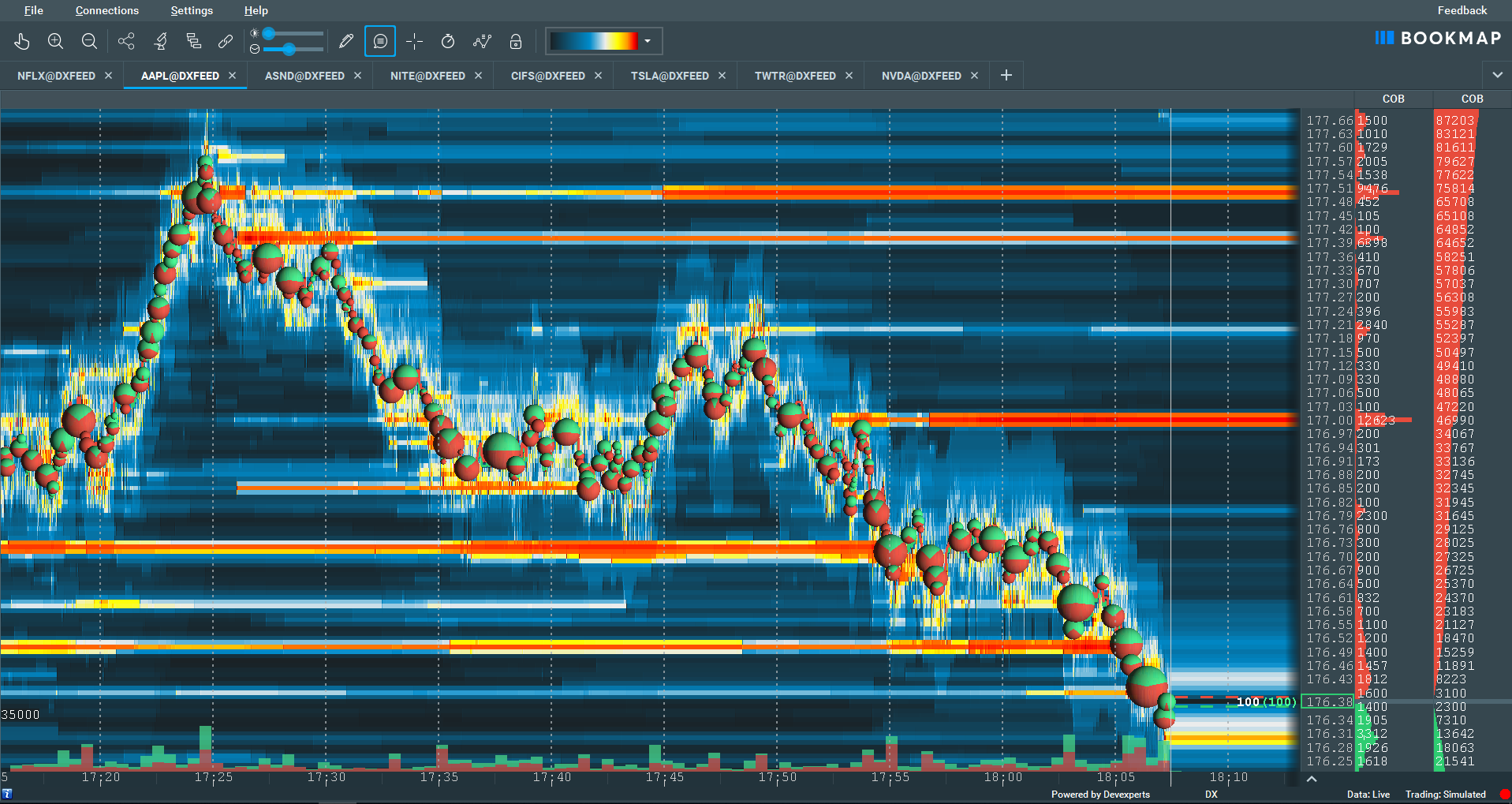
General view of Bookmap platform
Trading Tape Reading Software
Trading tape reading software helps traders follow real-time transaction flow rather than relying only on completed candles. Traditional tape reading focused on time and sales, but modern tools now combine trade execution data with order book depth, liquidity maps, and bid-ask behavior.
For stock traders, this is useful because it helps answer questions such as:
- Are buyers lifting offers aggressively?
- Are sellers hitting bids repeatedly?
- Is liquidity absorbing the pressure?
- Is the move supported by real participation or just a short-term sweep?
Bookmap builds on tape reading by showing executed trades alongside the evolving limit order book, so traders can see both transaction flow and the liquidity behind it.
Real-Time Bid-Ask Spread Visualization
Real-time bid-ask spread visualization helps traders understand how liquidity and execution quality change throughout the session. A widening spread can signal uncertainty, reduced liquidity, or increased volatility, while a tighter spread often reflects more stable conditions.
In Bookmap, traders can watch the best bid and ask evolve over time instead of seeing only the current quote. This historical view makes it easier to understand how spread behavior changes around news events, liquidity shifts, and aggressive trading activity.
Transaction Flow Charting Tools
Transaction flow charting tools show how trades are executed over time, including whether activity is dominated by aggressive buyers or sellers. This is important because price movement alone does not show who is initiating trades.
Bookmap’s volume bubbles provide a visual way to read this activity. Larger bubbles show heavier volume, while color balance helps traders understand whether the executed flow leaned more toward buying or selling pressure.
Market Depth and Liquidity Maps
Market depth and liquidity maps help traders see where large resting orders are placed and how those orders change as price approaches. This matters because liquidity often acts as a short-term support or resistance reference.
Unlike a standard DOM, Bookmap records liquidity over time. Traders can see whether a level has been sitting in the order book for a while, whether it suddenly appears, or whether it disappears before price reaches it.
Intra-Bar Order Flow Analysis
Intra-bar order flow analysis helps traders understand what happened inside a move rather than only looking at where a candle opened and closed. A candle may look bullish, but the order flow inside it could show absorption, exhaustion, or weak participation.
By combining volume bubbles, liquidity heatmaps, and bid-ask behavior, Bookmap helps traders interpret the behavior behind each move with more context than a candle alone can provide.
What Is an Order Flow Chart and Why It Matters
An order flow chart shows the real-time interaction between liquidity, limit orders, and executed trades. Traders use it to read order flow patterns, understand shifts in buying and selling pressure, and identify where liquidity is forming or disappearing. Unlike traditional charts, an order flow chart highlights the cause of price movement rather than only the outcome.
Heatmap is the key element of Bookmap
Most platforms that provide an Order Flow analysis show market activity in the form of Footprint chart. This allows you to see the actual execution and the number of aggressive buyers and sellers. But this type of chart does not show the levels of limit orders accumulation and the place of liquidity formation.
Order Flow Analysis Visualizations Explained
Order flow analysis visualizations, such as heatmaps and volume-based markers, help traders interpret market behavior with far greater clarity. These visual tools reveal whether liquidity is adding, pulling, or holding firm at key levels. They also highlight how executed volume interacts with resting orders, allowing traders to anticipate potential continuation or reversal zones.
With Bookmap, any change in the order book — placement, change, cancellation, or execution — is displayed on the chart as Heatmap view. The more limit orders placed on a certain level, the brighter the level displayed on the map. Thus, the trader sees the full picture of the market, the current mood and the intention of other participants in the trading process.
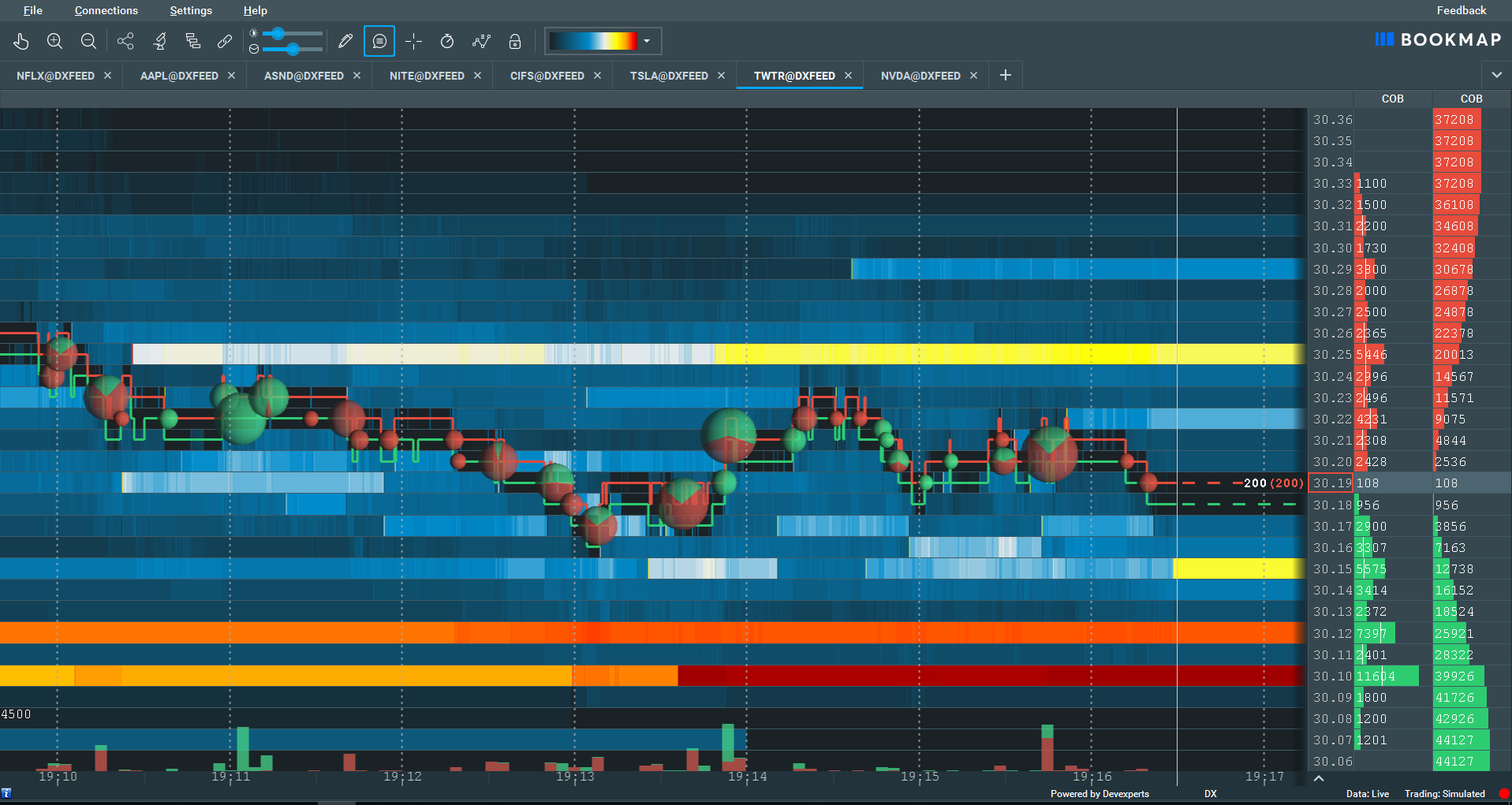
Brighter heatmap fields symbolize a large number of shares in the order book
In addition to basic market data, Bookmap provides traders a full Order Depth in real-time. Chart scaling to nanoseconds allows you to see the sequence and exact time of order execution. By default Bookmap chart updates at a rate of 40 frames-per-second, displaying the market in real-time with a CPU consumption of 1-3% per chart. This has become possible thanks to advancements in video-card GPU technology.
Best Bid and Offer lines represent the highest buyers and the lowest sellers price. This helps to see how the spread changed over time and under what market actions.
Seeing how the market liquidity is changing gives you a huge advantage. If you add executed trades to the chart, you will see how the price reacted to the liquidity levels. Volume Bubbles shows the volume of executed trades in a specific period. Its size depends on the number of executed contracts. The division of the circle into the red and green sections indicates how much of the total amount refers to buy or sell aggressive trades. Thus, traders receive important information about who controlled the market situation. Increasing the chart to millisecond allows you to see how orders were executed.
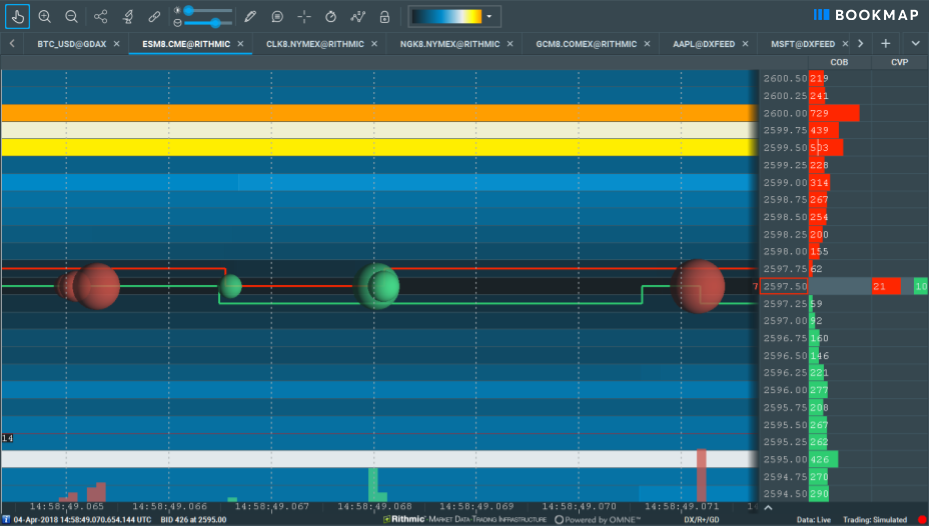
Volume Bubbles represent the executed trades at a specific point
How to Interpret Heatmaps with Bookmap
Heatmaps are one of the most powerful ways to visualize market depth.
In Bookmap, the heatmap shows:
- Where limit orders are placed
- How liquidity changes over time
- Where large participants may be active
Key principles when interpreting heatmaps:
- Brighter areas = higher liquidity concentration
- Liquidity holding = potential support/resistance
- Liquidity pulling = potential breakout or shift
Traders combine heatmaps with executed volume to understand how price reacts at these levels.
Automated Charting Environments
Some platforms rely heavily on automated indicators and overlays. While these can simplify analysis, they often abstract away the underlying market behavior.
Order flow tools prioritize transparency over automation, allowing traders to interpret data directly.
Exchange Statistics Viewers
Some tools focus on aggregated exchange statistics such as volume summaries or trade counts.
While useful for context, these do not provide the same level of detail as real-time order book visualization.
Order Flow vs. Footprint Charts and DOM
Order flow tools, footprint charts, and DOM views all help traders understand market activity, but they each show a different layer of information.
A DOM shows current resting liquidity, but not its full history.
A footprint chart shows executed volume inside a bar, but not the resting liquidity behind it.
Bookmap combines executed volume with current and historical depth, helping traders understand both what traded and what liquidity was available before the trade happened.
This is especially useful when interpreting fast moves, absorption, spoofing behavior, or failed breakouts.
How to Spot Iceberg Orders on a DOM
Iceberg orders can be difficult to spot on a standard DOM because only part of the full order size is visible. Traders may notice repeated execution at the same level without the displayed liquidity disappearing as expected.
Bookmap helps make this behavior easier to identify by showing repeated interaction between aggressive trades and hidden or replenishing liquidity. This can reveal areas where larger participants may be working orders without showing their full size.
Bookmap Footprint and Depth of Market Setup
Traders who are used to footprint charts and DOM tools can use Bookmap as a more visual setup for reading similar order flow behavior. Volume bubbles help interpret executed trades, while the heatmap shows current and historical liquidity.
This allows traders to track:
- aggressive buying and selling
- liquidity absorption
- order book changes
- potential spoofing behavior
- supply and demand shifts around key levels
How Order Flow Charts Compare to Footprint Charts
A footprint chart shows executed volume inside each price bar, while an order flow chart displays both executed volume and the evolving depth of the order book. Traders analyzing futures often combine a footprint chart with an order flow chart for cumulative delta, but Bookmap simplifies this by visualizing depth, liquidity shifts, and trade aggression in one view.
It’s not a secret that large order size on the stock market has a significant effect on price. Therefore, to minimize this effect, large traders use different trading algorithms and special order types like Iceberg order. Using such orders, a market maker or large trader can divide the full order size into parts, and hides the real volume from other participants. With the help of the Iceberg Detector functional, all hidden orders are visible on the chart. Such orders are shown on the chart, as numbers near Best Bid & Offer lines.
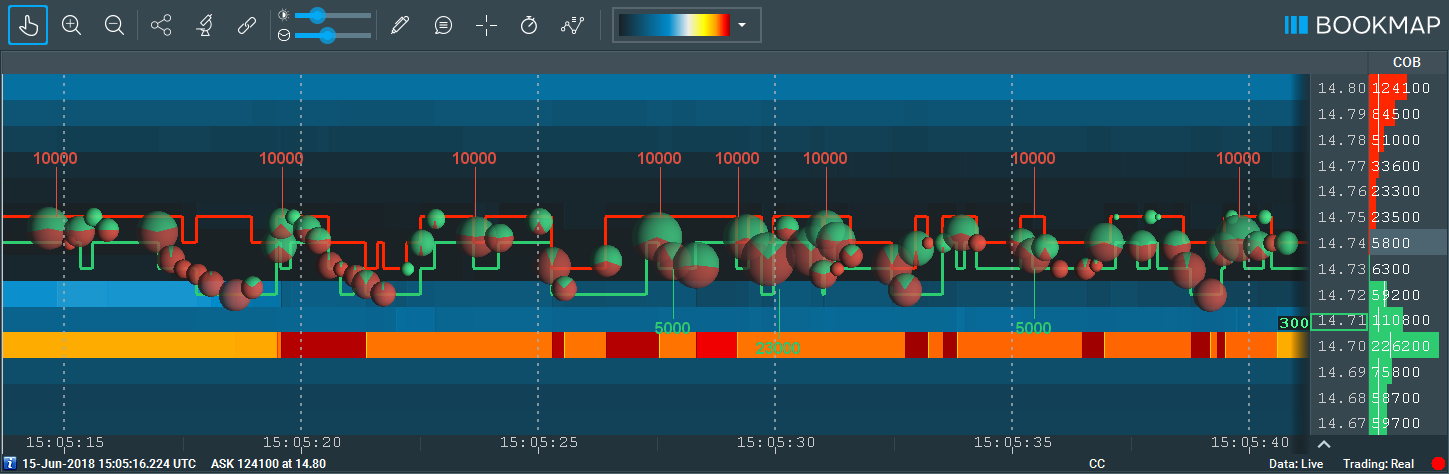
Bookmap uncovers Iceberg orders and displays them on a chart
In the example below, you can see how a large trader sets significant amounts of buy orders near the best ask price, causing the price to move up. You can see how the trader placed orders of different sizes, at different prices, and various time, to be undetected by other algorithmic traders. But this activity is easily spotted with a single glance at Bookmap chart.
Rather than choosing one over the other, many traders look for tools that combine both perspectives — showing executed volume alongside evolving liquidity in a single view.
How to Read Order Flow Patterns in Stocks
Reading order flow patterns involves tracking how liquidity behaves at key levels and how aggressive buyers or sellers interact with that liquidity. For stock traders, recurring patterns include absorption at major levels, liquidity sweeps, spoofing activity, and sudden shifts in depth that precede breakouts or reversals. An order flow chart helps expose these behaviors in real time.
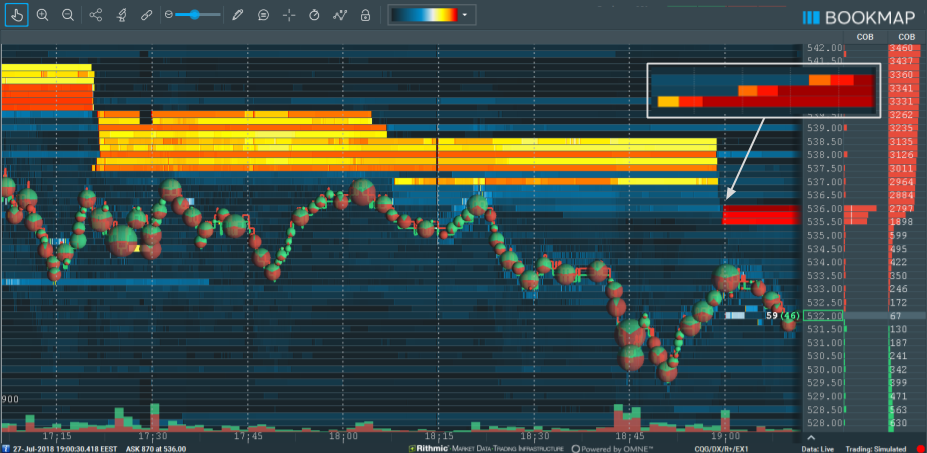
Large Trader placed orders with various size, price and on different time
By using the Imbalance indicators, the trader will at a glance understand who influences the price – buyers or sellers. For instance, if the Order Book Imbalance shows + 50%, this indicates the interest of buyers to raise the price higher. On the other hand, this may indicate the intention of sellers to push price higher to facilitate their short positions.
If the Volume Imbalance value is in the positive zone, it will tell about the overbalance of buy market orders and vice versa.
Interpreting Absorption and Exhaustion Signals
Absorption and exhaustion are two of the most important order flow signals traders watch.
Absorption occurs when aggressive buyers or sellers hit a level repeatedly, but price does not continue in that direction. This can suggest that passive liquidity is strong enough to absorb the pressure.
Exhaustion occurs when price continues to move, but aggressive participation starts to fade. In Bookmap, this may appear as shrinking volume bubbles, weaker follow-through, or a lack of new liquidity supporting the move.
These signals help traders avoid chasing price and instead focus on how participants behave at key levels.
Identifying Spoofing Patterns in the Limit Order Book
Spoofing patterns can appear when large visible orders are placed to influence market perception, then canceled before execution. Traders may see a large liquidity wall appear, attract attention, and disappear as price approaches.
Bookmap’s heatmap can help traders identify this behavior because it shows how liquidity forms, holds, pulls, or reappears over time. This gives traders more context than a static DOM snapshot.
Latest Order Flow Strategies 2026
Order flow strategies continue to evolve as markets become more competitive and data-driven.
Common approaches include:
- Identifying absorption at key levels
- Tracking liquidity sweeps and stop runs
- Monitoring imbalance shifts
- Reading exhaustion during trend moves
For a deeper breakdown of modern approaches, see:
https://bookmap.com/blog/the-best-way-to-learn-order-flow-in-2026
These strategies rely on understandi
Trade Data Visualization for Better Market Analysis
Modern traders increasingly rely on tools that combine:
- Real-time execution data
- Liquidity tracking
- Historical context
This shift reflects a move away from static indicators toward dynamic market observation.
Modern trade data visualization tools help traders move beyond static charts by displaying how the order book evolves second by second. This supports traders who rely on volume trading techniques, liquidity tracking, and microstructure-based decision making. Seeing these dynamics in real time helps clarify whether participants are absorbing, initiating, or avoiding trades at specific prices.
All these tools provide stock traders with excellent clues to what the market might be trying to do and how it might react to certain prices. By analyzing the Order Flow, it becomes clear the intentions and expectations of market participants to future price movements.
Connectivity to major US stock exchanges & ECNs provides full market depth data that enable you to stay one step ahead in the highly competitive markets.
Discover more profitable trades with powerful order flow analysis tools. Start using reliable stock market data with Bookmap and dxFeed.
Order Flow Trading Strategies for Small Accounts
Small-account traders can still use order flow effectively, but they need to focus on precision, risk control, and selective trade selection. The goal is not to copy institutional size, but to understand where larger participants may be active and avoid entering at poor locations.
Useful small-account order flow strategies include:
- waiting for absorption before entering near support or resistance
- avoiding breakouts when liquidity disappears too quickly
- using smaller size around volatile liquidity sweeps
- confirming entries with executed volume, not just price movement
Order flow gives smaller traders a way to improve timing and reduce emotional decision-making, especially in fast-moving markets.
Order Flow Analysis for Scalping Crypto Pairs
Crypto pairs often move quickly and can show sudden liquidity gaps. Order flow analysis helps scalpers monitor whether aggressive buying or selling is supported by real depth, or whether price is moving through thin liquidity.
Bookmap can help crypto traders watch volume bubbles, heatmap levels, and liquidity shifts in real time, making it easier to react to fast changes without relying only on candle patterns.
Platform Comparison Context
Most traditional platforms focus on price-based charting, while Bookmap focuses on the underlying mechanics of the market. This means traders are not only watching where price has been, but also how liquidity and execution are shaping where price may move next.
Traditional platforms often emphasize:
- candlestick charts
- indicators
- drawing tools
- price patterns
Bookmap emphasizes:
- real-time liquidity
- historical order book behavior
- executed trade volume
- bid-ask changes
- heatmap visualization
- order flow patterns
This distinction matters for traders who want to understand why price is moving rather than only reacting after the move has already happened.
Bookmap vs Other Trading Platforms
Most traditional platforms focus on price-based charting, while order flow platforms focus on the underlying mechanics of the market.
Key differences include:
- Price vs liquidity visibility
- Aggregated vs raw data
- Indicators vs real-time behavior
This distinction is important when choosing tools for short-term trading.
Other Trading Tools vs Bookmap Review
Many trading tools show part of the market picture. A DOM shows current depth. A footprint chart shows executed volume. A tape reader shows transaction flow. A standard chart shows price history.
Bookmap brings several of these views together by showing liquidity, execution, and historical depth in one visual environment. This helps traders reduce tool-switching and interpret market behavior more efficiently.
Price Action vs Order Flow Comparison
Price action shows what happened. Order flow helps explain how it happened.
A price action trader may see a breakout above resistance. An order flow trader can look deeper and ask whether the breakout had enough aggressive buying, whether liquidity was absorbed, or whether sellers pulled offers before the move.
Combining price action with order flow can help traders avoid false signals and make more informed decisions around entries and exits.
FAQ
How does Bookmap help stock traders compared to traditional candlestick charts?
Unlike candlestick charts that only show OHLC prices, Bookmap provides real-time visibility into liquidity, order flow, and market participant behavior, offering a much clearer view of why prices move.
What is the role of the Heatmap in Bookmap?
The Heatmap visualizes the placement, movement, and cancellation of limit orders over time. Brighter areas represent higher liquidity, helping traders spot support, resistance, and hidden market activity.
How does Bookmap detect hidden orders like Icebergs?
Bookmap’s Iceberg Detector reveals hidden large orders near the best bid and ask, displaying them directly on the chart so traders can identify institutional activity that would otherwise be invisible.
What is the advantage of using Imbalance indicators in Bookmap?
Imbalance indicators show which side — buyers or sellers — has greater control of the market, helping traders anticipate price direction based on real-time shifts in order flow and liquidity.
What is an order flow chart?
An order flow chart is a visual display of real-time liquidity, depth, and executed trades. It helps traders understand why prices move by revealing the underlying behavior of buyers and sellers.
How do you read order flow patterns?
To read order flow patterns, traders watch how liquidity changes at key levels and how executed trades interact with that liquidity. This highlights activity such as absorption, exhaustion, spoofing, or aggressive buying and selling.
What are the best order flow indicators to watch?
Common order flow indicators include liquidity heatmaps, volume bubbles, bid and ask updates, and imbalance metrics. Together, these tools show which side of the market is in control.
Can Bookmap be used as an order flow chart for futures trading?
Yes. Although the article focuses on stocks, Bookmap is widely used as an order flow chart for futures trading, offering real-time depth, liquidity tracking, and cumulative volume tools for futures markets.
What is the benefit of using cumulative delta with order flow?
Cumulative delta helps traders understand whether aggressive buyers or sellers dominate over time. When combined with order flow visualizations, it offers deeper insight into the intent behind price movement.
Are you looking for software, or to learn what an order flow chart is?
Order flow charts can refer either to the concept itself or to specific software platforms that visualize liquidity and executed trades. If you’re trying to understand the method, the article covers the fundamentals. If you’re looking for software, Bookmap provides a real-time order flow chart tailored for stocks, futures, and crypto.
Which market are you analyzing — stocks, futures, or crypto?
Order flow charts work across all major markets, but the behavior of liquidity and execution varies. Stock traders often focus on depth changes and hidden orders, futures traders look at imbalances and absorption, and crypto traders pay close attention to volatility and liquidity gaps. Bookmap supports all three.
Are you looking for a specific order flow indicator or a complete chart type?
Some traders only need a single tool, like cumulative delta or an imbalance indicator. Others want a complete order flow chart that shows depth, liquidity shifts, and executed trades in one view. Bookmap combines all key order flow indicators into a unified chart for easier interpretation.
Are you trading stocks, futures, or crypto?
Order flow behavior varies by market:
Stocks → focus on liquidity shifts and hidden orders
Futures → emphasis on imbalances and absorption
Crypto → higher volatility and liquidity gaps
Is real-time speed a priority for you?
For many traders, speed and data accuracy are critical. Platforms that provide real-time data and low-latency updates offer a clearer view of market behavior:
https://bookmap.com/blog/stock-trading-tools-with-real-time-data-how-modern-traders-monitor-markets
Faster data allows traders to react to liquidity changes before they fully impact price.
Are you looking for footprint charts, heatmaps, or the Depth of Market (DOM)?
These tools show different parts of market activity. Footprint charts focus on executed volume, DOM tools show current liquidity, and heatmaps show how liquidity changes over time. Bookmap combines key elements of all three.
Which asset class — forex, futures, or equities — are you charting?
Order flow analysis depends heavily on data quality and market structure. Futures and equities often provide strong depth and execution data, while forex order flow depends on the data source being used.
Do you need a web-based tool or a desktop-installed trading platform?
Web-based tools may be useful for quick access, but desktop platforms are often preferred for detailed order flow analysis, faster performance, and more complete market visualization.
Are you interested in retail trading setups or institutional-level data?
Retail traders can use order flow to improve timing and understand liquidity behavior. Institutional-level data may include deeper market feeds, market-by-order data, and more advanced execution analytics.
Do you want to focus on historical tape data or live order execution?
Historical tape data is useful for reviewing setups and training. Live order execution data is more important for active trading decisions and reading real-time shifts in liquidity.
Sign Up Now
Latest Articles