


See arbitrage more clearly in real time.
Compare plans to access deeper market visibility for arbitrage.
Education
January 10, 2026
Understanding Arbitrage: How Traders Profit from Market Inefficiencies

Price differences exist everywhere in financial markets — across exchanges, instruments, and even timeframes.
For traders who can act quickly, these inefficiencies create opportunities to profit without relying on traditional directional bets.
This is where arbitrage trading comes in.
In this guide, we’ll break down:
- What arbitrage trading actually is
- How traders spot and execute opportunities
- Real examples across crypto, forex, stocks, and commodities
- What’s realistic today (and what isn’t anymore)
What Is Arbitrage Trading?
Arbitrage trading is the practice of buying and selling the same (or closely related) asset across different markets to profit from price differences.
At its core, the idea is simple:
- Buy where price is lower
- Sell where price is higher
- Capture the spread before it disappears
In reality, execution is far more complex.
Most arbitrage opportunities:
- Exist for seconds or milliseconds
- Require precise execution
- Are heavily impacted by fees, latency, and liquidity
Arbitrage Trading Explained
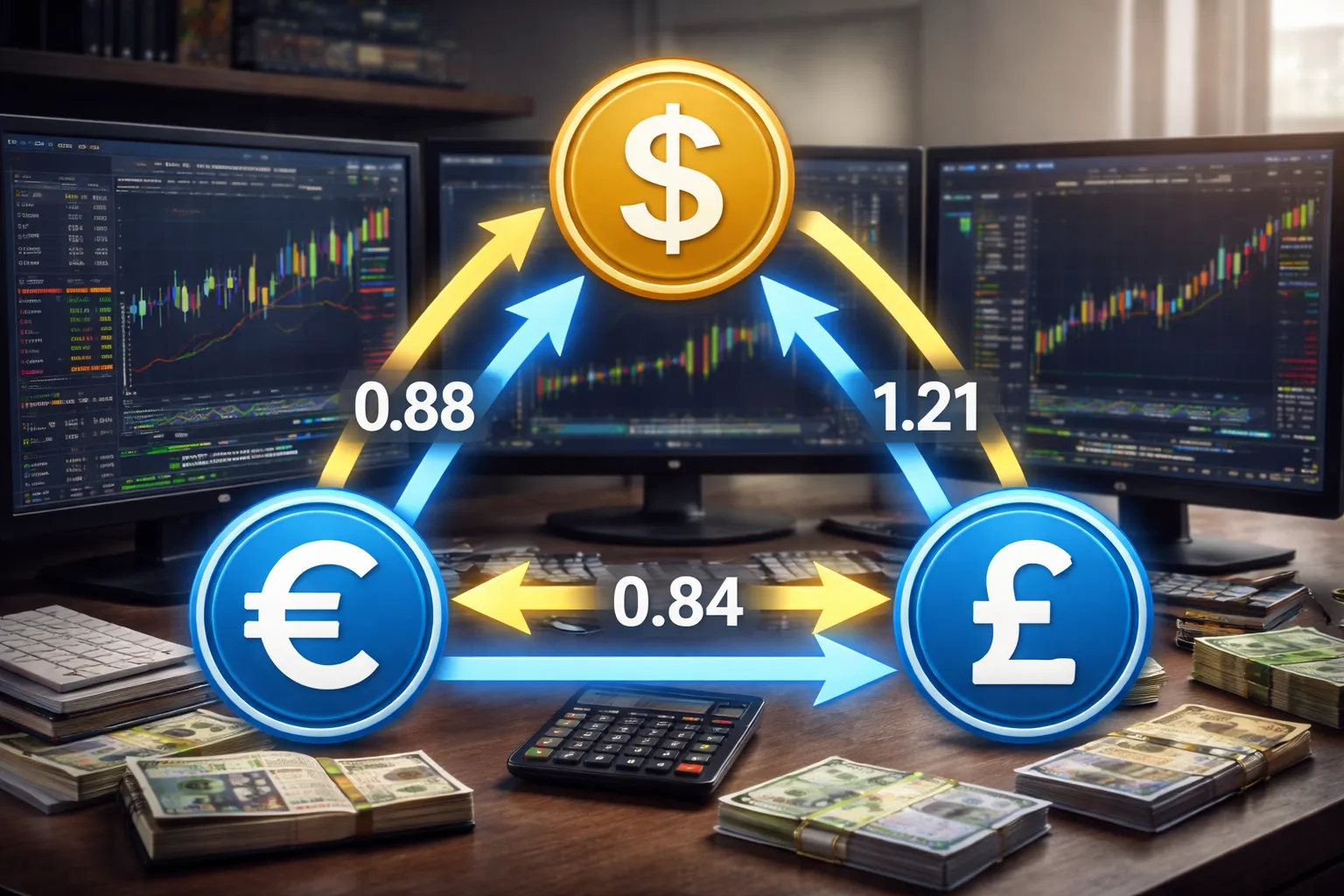
Not all arbitrage looks the same.
There are several ways these inefficiencies show up:
- Cross-exchange arbitrage → Same asset, different venues
- Triangular arbitrage → Currency relationships mispriced
- Cash-and-carry arbitrage → Spot vs futures misalignment
- Statistical arbitrage → Temporary divergence between correlated assets
Across all of them, the principle is identical:
Arbitrage exists when price temporarily disconnects from fair value.
The challenge isn’t finding the idea — it’s executing before the market corrects itself.
Profit from Arbitrage: What Traders Actually Capture
Arbitrage profits are typically small per trade but scalable.
Most opportunities look like:
- 0.1% – 0.5% spreads in liquid markets
- Larger spreads in low-liquidity or fragmented markets
Profit depends on:
- Trade size
- Execution speed
- Transaction costs
- Slippage
For example:
- A $10 price difference on Bitcoin across exchanges
- Or a small mispricing between ETF and underlying basket
These don’t look like much — but when executed repeatedly or at scale, they add up.
How to Spot Arbitrage Opportunities
Arbitrage opportunities don’t appear randomly. They tend to show up in specific conditions:
1. Liquidity Imbalances
- One exchange has heavy buying
- Another lags behind
2. Market Fragmentation
- Crypto exchanges
- Regional commodity markets
- Less efficient venues
3. Latency Differences
- Price updates are not synchronized
- Faster feeds reveal inefficiencies
4. Event-Driven Dislocations
- News releases
- Earnings
- Macro announcements
5. Derivatives vs Spot Mismatch
- Futures diverge from underlying
- Funding rates create imbalance
Key takeaway:
Most arbitrage is not about “finding a secret strategy” — it’s about monitoring multiple price sources simultaneously and reacting faster than others.
Trade Arbitrage: What Execution Actually Looks Like
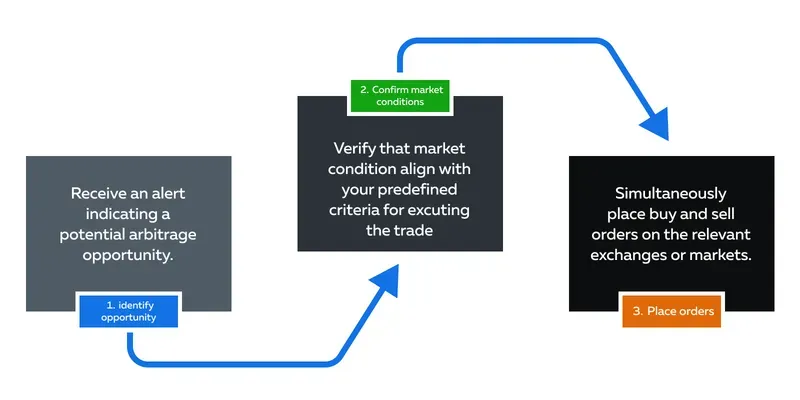
A typical arbitrage trade follows this structure:
- Identify price mismatch
- Confirm it exceeds costs (fees + spread + slippage)
- Execute both sides simultaneously
- Exit once prices converge
Execution risks are real:
- One leg fills, the other doesn’t
- Spread disappears mid-trade
- Fees erase profit
This is why most modern arbitrage:
- Uses automation
- Runs on predefined rules
- Focuses heavily on execution quality
Arbitrage Trading Strategies
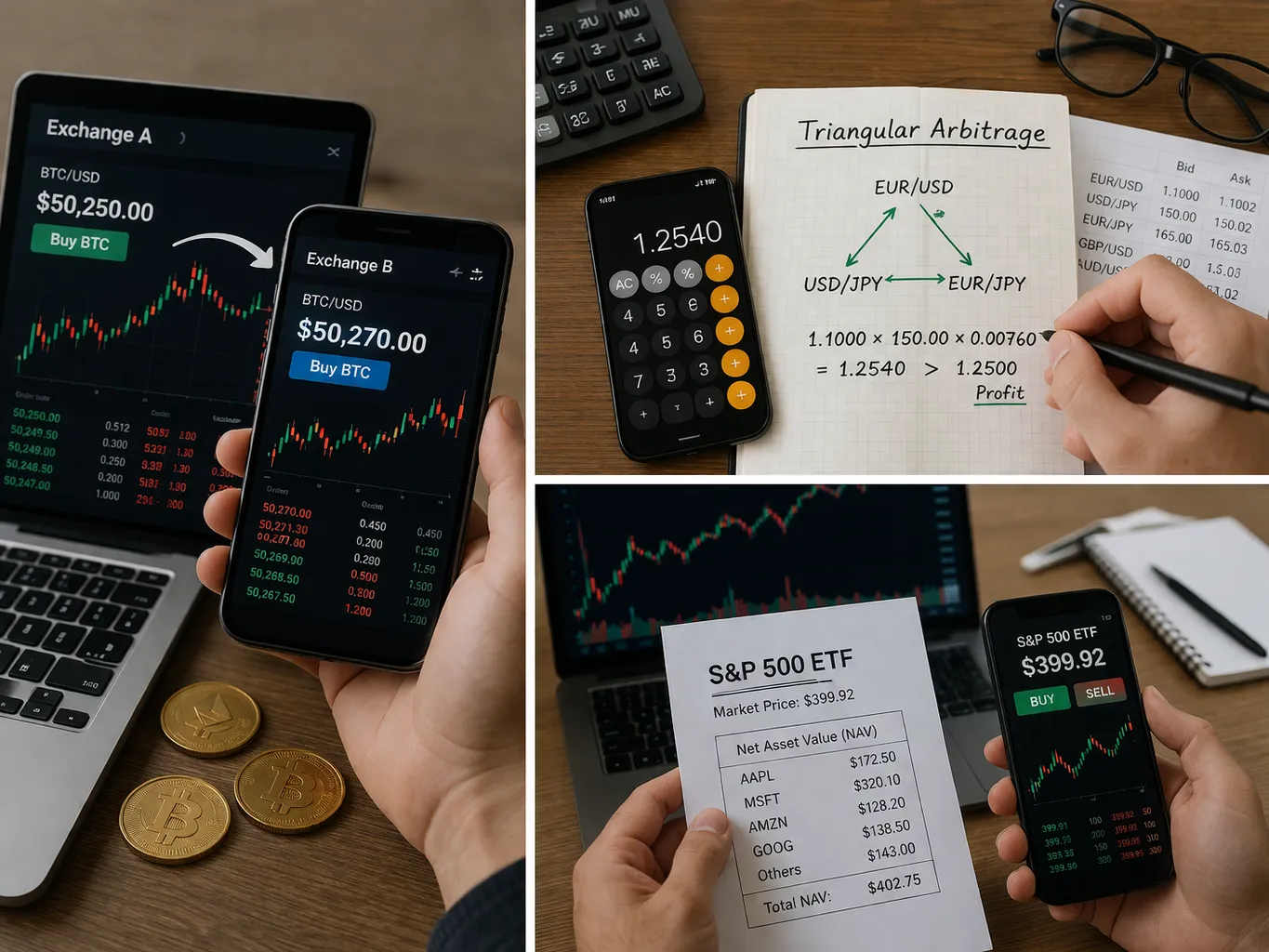
Cross-Exchange Arbitrage
Buy on one exchange, sell on another.
Most common in crypto due to fragmentation.
Triangular Arbitrage (Forex)
Uses three currency pairs to exploit pricing inconsistencies.
Example flow:
- USD → GBP
- GBP → EUR
- EUR → USD
Profit exists if the final USD amount is higher than the starting value.
Statistical Arbitrage
Relies on historical relationships:
- Pairs trading
- Basket strategies
Trades deviations expecting mean reversion.
Latency Arbitrage
Exploits differences in:
- Data feed speed
- Order routing
Typically requires advanced infrastructure.
Arbitrage in Stock Market
Arbitrage plays a major role in equities, especially through:
ETF vs Underlying Arbitrage
- ETF price deviates from its components
- Traders buy one and sell the other
Index Arbitrage
- Futures vs index components mispricing
Cash-and-Carry Arbitrage
- Buy asset in spot
- Sell futures contract
These strategies help keep markets efficient, not just profitable.
Arbitrage Across Markets (Real Examples)
Crypto Arbitrage
- Bitcoin trades at different prices across exchanges
- Driven by liquidity + regional demand
Forex Arbitrage
- Price discrepancies between currency pairs
- Triangular relationships create opportunities
Commodity Arbitrage
- Gold priced differently in London vs New York
- Requires factoring in transport + time
Futures Arbitrage
- Mispricing between spot and futures
- Often influenced by interest rates and demand
Earnings on Arbitrage: What’s Realistic Today
Arbitrage is often described as “low risk,” but that’s misleading.
In today’s markets:
- Opportunities are smaller
- Competition is higher
- Infrastructure matters more than strategy
Realistically:
- Retail traders find limited manual opportunities
- Most edge comes from:
- Automation
- Speed
- Cost efficiency
The Role of Technology in Arbitrage Trading
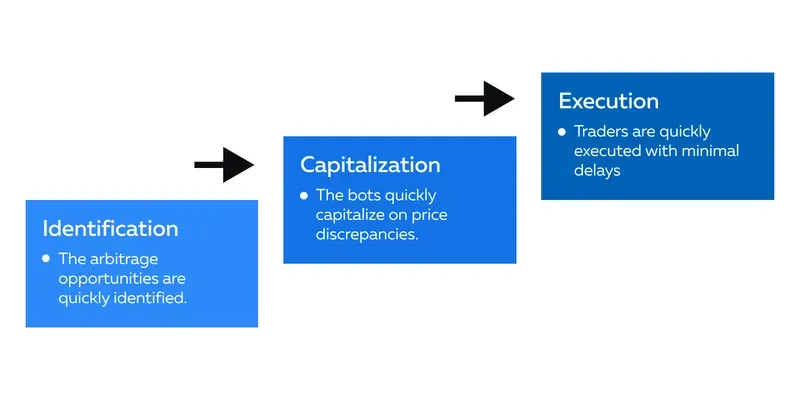
Arbitrage has shifted from manual to fully automated.
Today’s systems:
- Scan multiple markets in real time
- Execute within milliseconds
- Adjust dynamically to conditions
Common tools include:
- Algorithmic trading systems
- Cross-exchange bots
- Integrated trading platforms
Without automation, most opportunities simply disappear too fast.
Risk Management in Arbitrage
Despite being “market-neutral,” arbitrage carries real risks:
- Execution risk → incomplete trades
- Slippage → price changes mid-execution
- Fees → eliminate profit margins
- Counterparty risk → exchange or broker issues
- Liquidity risk → inability to exit
Successful traders focus less on finding trades and more on:
- controlling execution
- minimizing costs
- managing edge decay
Conclusion
Arbitrage trading is one of the clearest examples of how markets correct themselves.
Opportunities still exist — but they are:
- Faster
- Smaller
- More competitive
For most traders, arbitrage is less about “risk-free profit” and more about:
- understanding market structure
- recognizing inefficiencies
- improving execution
FAQ
What is arbitrage in trading?
Arbitrage is a strategy where traders profit from price differences of the same asset across different markets by buying low and selling high simultaneously.
Is arbitrage trading still profitable in 2026?
Yes, but margins are smaller and require fast execution, low fees, and often automation to remain profitable.
Which markets offer the most arbitrage opportunities?
Crypto, forex, stocks, and futures markets all offer opportunities, especially where liquidity is fragmented.
What are the main types of arbitrage trading?
Common types include cross-exchange arbitrage, triangular arbitrage, statistical arbitrage, and futures-based strategies.
What are the risks of arbitrage trading?
Key risks include execution delays, slippage, fees, and incomplete trades, which can turn a low-risk strategy into a losing one.
Sign Up Now
Latest Articles