
See prediction markets more clearly in real time.
Compare plans to access deeper market visibility for prediction markets.
Education
March 5, 2026
SHARE
What Prediction Markets Are and How Traders Can Approach Them
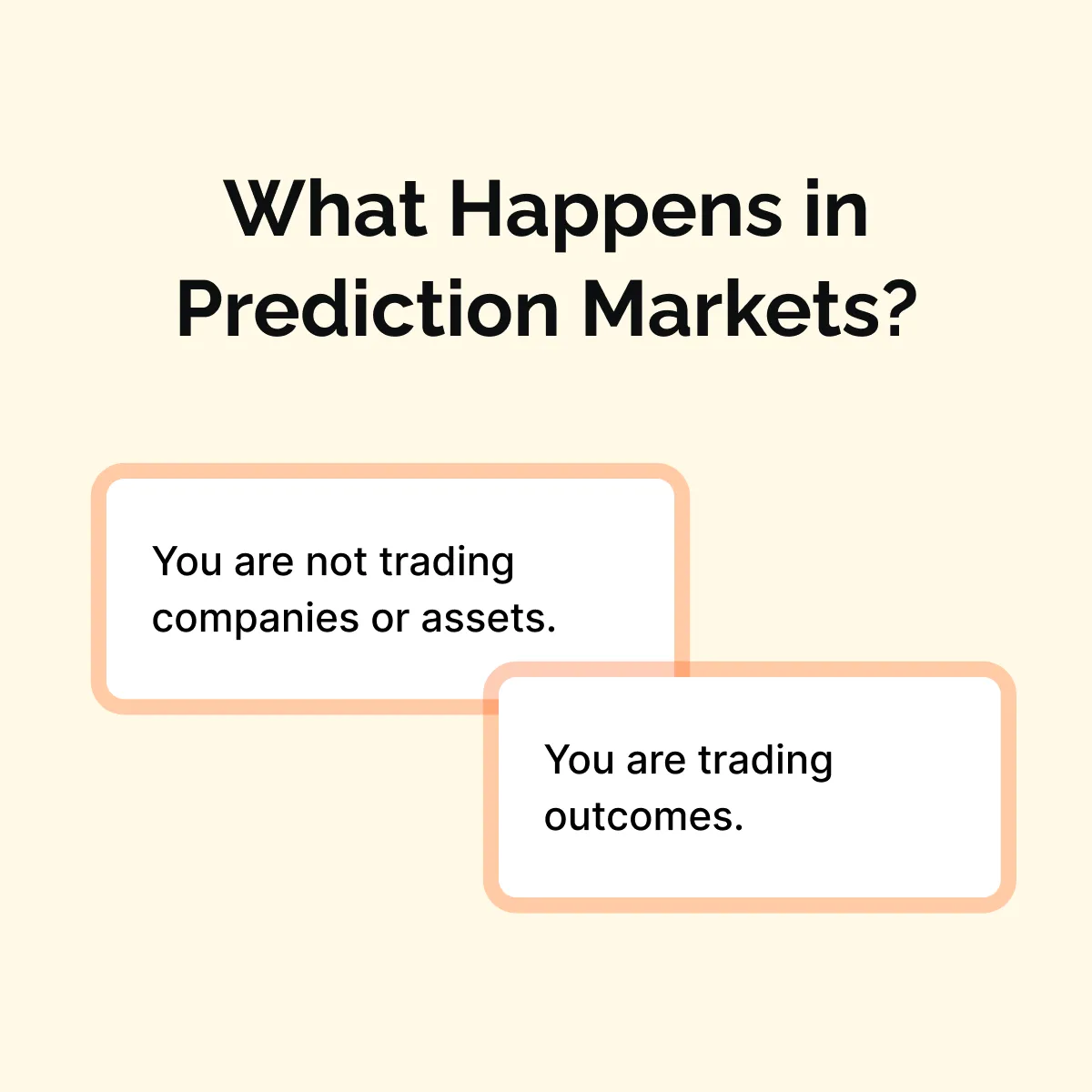
Prediction markets are the purest form of “participant expectations” where beliefs are expressed through prices. Instead of trading companies or assets, participants trade expectations about events. Every price tells a story about information, confidence, doubt, and participation.
This article will elaborate on what prediction markets actually are, how they work, and why it is best to treat prices as shared beliefs rather than truth.
What Prediction Markets Actually Are
Prediction markets are event-based markets. Here, people trade contracts based on what they think will happen in the future. The graphic below elaborates on the essence of prediction markets:
Each contract is linked to a specific future event, such as:
- An economic decision,
- A policy announcement, or
- Whether a certain level will be reached by a given date.
Once the participants decide on the event, the contract is set at a fixed value. Most prediction markets use “binary contracts”, which means the outcome has only two possibilities:
| Possibility I: YES (100) | Possibility II: NO (0) |
| If the event happens | If the event does not happen |
The above is the foundation of how prediction markets work. Understand how market participation shapes pricing → Compare Packages.
How Contracts Are Structured
A prediction market contract is written as a clear statement, for example:
- Will interest rates be cut this year?
- Will a new policy be approved?
- Will inflation cross a specific level by a certain date?
In prediction market trading, the contract price reflects what the market collectively believes. For example,
- Assume a contract is trading at 60.
- It means the market thinks there is a 60% chance that the event will occur.
It’s important to understand that this price shows “market consensus” (not certainty). Prediction markets only represent shared belief based on available information. This information must not be considered as the absolute truth.
How Pricing and Probability Are Formed
In prediction markets, prices are created through trading activity. There is no role of company performance or financial statements. In prediction markets, buying and selling contracts move prices. Participants trade in such markets in the following manner:
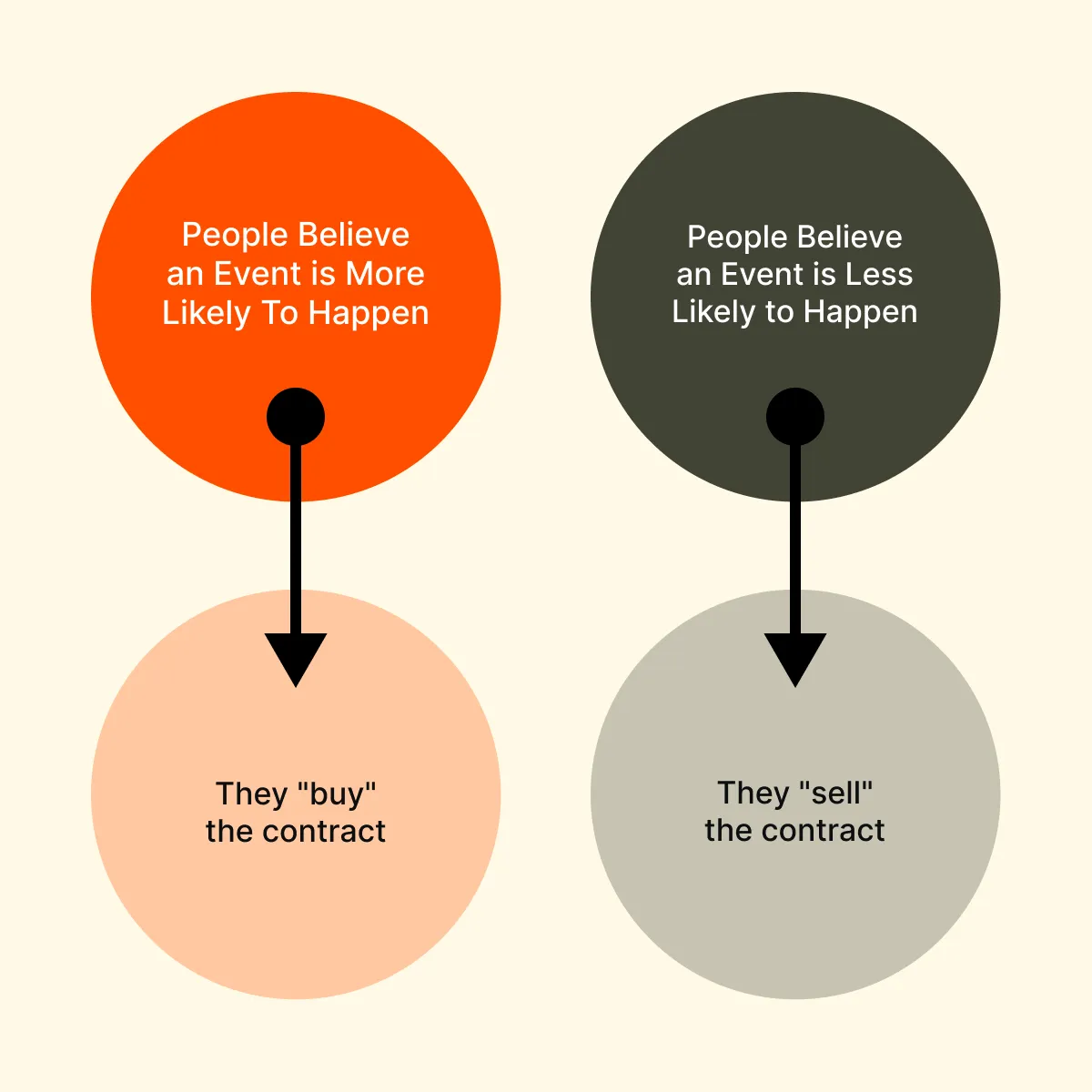
Note that prediction markets do not have cash flows, earnings, or valuation models, like stocks or bonds. There is no balance sheet or revenue to analyze. The price exists only to show how likely the market thinks an event will occur.
The “contract price” acts as a “probability signal”. For example,
- Assume the contract price is 70.
- The price suggests the market believes there is a 70% chance the event will happen.
In event-based markets, the pricing of contracts is influenced by:
- New information,
- News,
- Data, and
- Fluctuating opinions.
As information improves, traders adjust their positions. In response, the price updates to reflect the latest collective view, which is why it is better to view prediction markets as markets for probabilities rather than assets.
Example of Probability Repricing
In prediction markets, prices can change even in the absence of new information, a phenomenon known as “probability repricing”. Here’s an example:
- Assume that early in the day, a contract is trading at 35.
- This pricing indicates that the market believes there is a 35% chance that the event will occur.
- Later, new information is released, whether it be data, news, or expert commentary.
- After seeing this information, more buyers step in.
- They believe the event is more likely now.
- As a result, the price moves up to 65.
The major takeaway? The major takeaway here is that the event itself has not occurred. However, the market has updated its expectations solely on the basis of new information. This behavior is similar to how traditional markets reprice risk before:
- Earnings announcements,
- Economic reports, and
- Policy decisions.
Similarly, in event-based or prediction markets, prices constantly adjust to reflect the latest shared belief about the future.
Prediction Markets vs Traditional Financial Markets

Prediction markets are “structurally different” from traditional financial markets like stocks or bonds. However, at a “behavioral level,” they work in very similar ways. That’s mainly because the tools may change, but human behaviour stays the same. The following section elaborates on these differences and similarities.
Key Structural Differences
In prediction markets, contracts are tied to a specific event and have a completely clear endpoint. Once the event outcome is known, the contract expires and settles.
These markets are different from traditional assets because:
- The contracts have a fixed expiration and outcome.
- Prices are capped between 0 and 100, which represents probability.
- There is no ongoing valuation after the event occurs.
Which is why most traders use prediction markets only for outcomes, rather than for long-term ownership.
Key Behavioral Similarities
Even though the structure is different, the way prices move is familiar to most traders. In both prediction markets and traditional markets:
- Prices change because people buy and sell.
- Liquidity influences how stable or volatile prices are.
- “Information flow” determines probability repricing due to a change in expectations.
Anyone who understands futures or options trading already understands how prediction market trading works. Realize that such event-based markets follow the same logic! The only difference is that the asset is a future outcome instead of a financial instrument.
Liquidity and Market Quality
Liquidity is highly critical in prediction markets. It indicates how reliable the prices are. Liquidity means how many people are actively buying and selling contracts. The following elaborates on how traders interpret liquidity to check the reliability of prevailing prices:
| In Thin Markets | High-Liquidity Markets |
|
|
Why Liquidity Matters for Interpretation
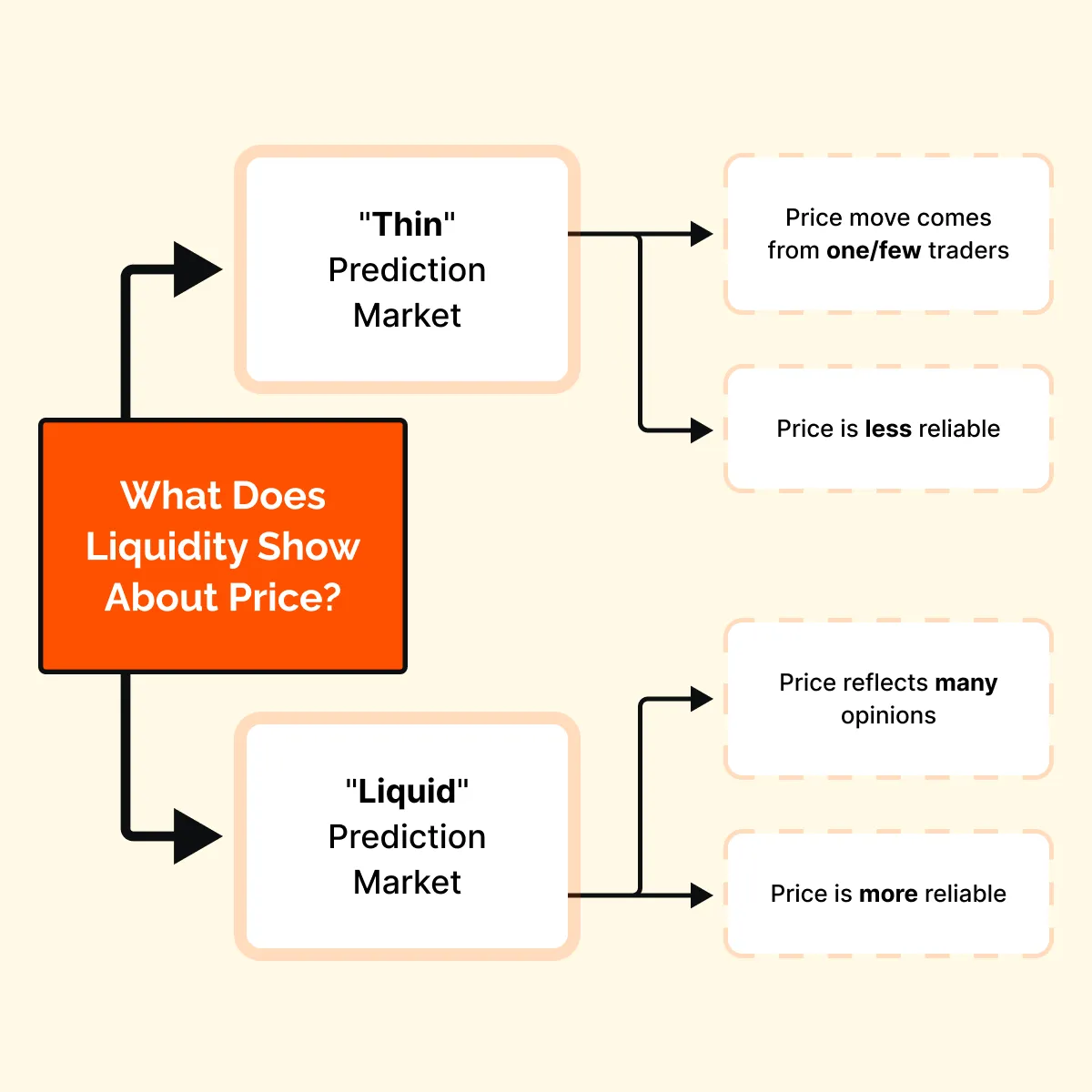
Liquidity tells participants how trustworthy a price is. In event-driven, low-liquidity markets, a price can move due to just one or two traders, which may not reflect the broader market view. On the other hand, in a high-liquidity market, many participants contribute. Thus, the price better represents collective belief.
Thus, traders should always check how much participation supports a probability before trusting it. In this way, liquidity in prediction market trading allows the assessment of “market quality”. The more active the market, the more confidence participants can place in what the price is revealing.
Who Trades Prediction Markets and Why
Prediction markets attract participants with diverse goals. Such diversity is what makes event-based markets active. However, this can also create confusion at times. The following table breaks down the mix of participants in such markets:
| Participant Type | Who They Are | Why They Trade |
| Individual Participants | Everyday traders or observers | To express what they believe is likely to happen |
| Analysts | Data-driven professionals | To react to new data, reports, or research |
| Institutions | Companies or funds | To reduce risk from specific economic or policy events |
| Probability Traders | Active market traders | To find and trade “mispriced probabilities.” |
This mix of participants is what gives prediction markets both insight and movement, but it can also introduce noise at times. Thus, prices can be informative, but they are not always perfect.
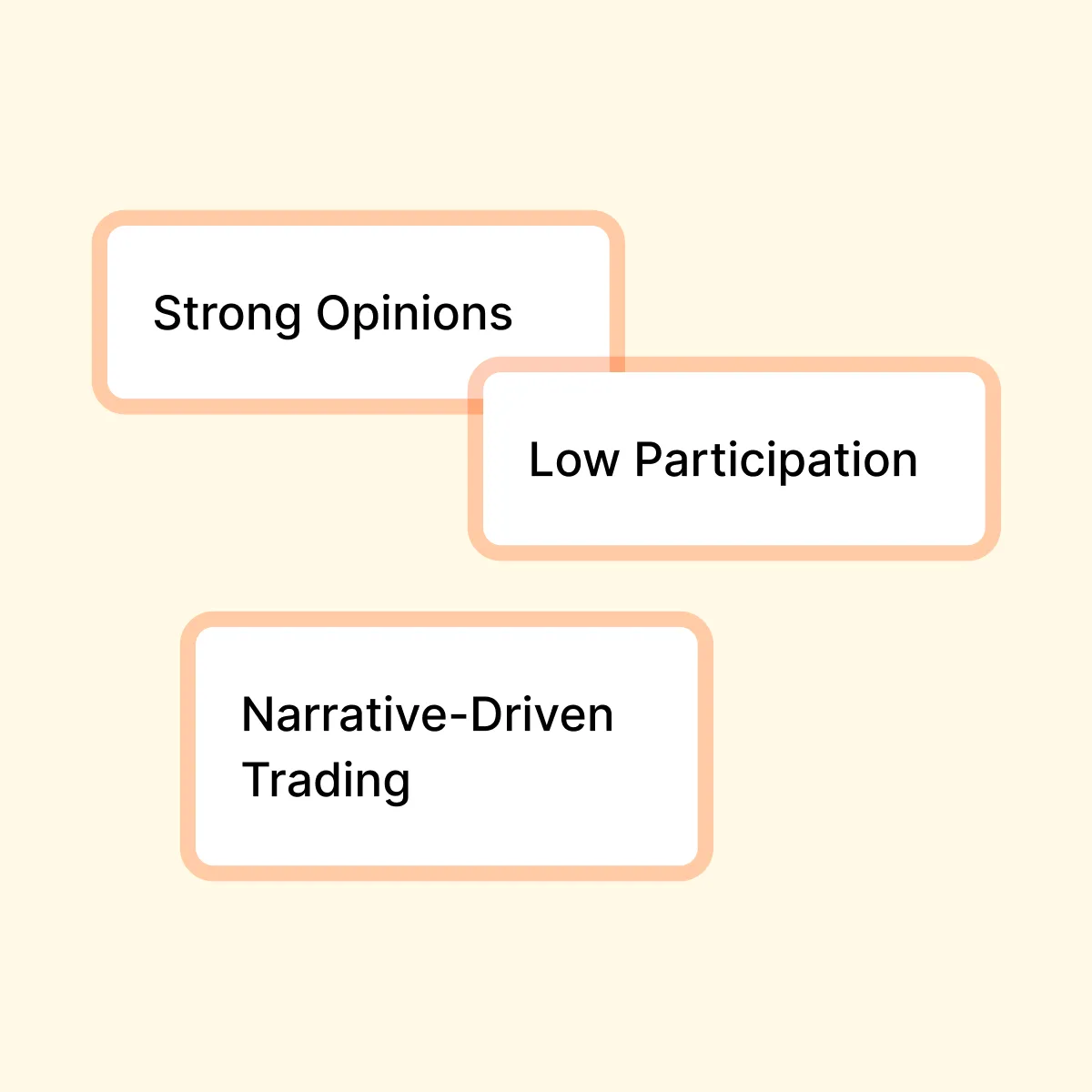
In markets driven heavily by stories, headlines, or public emotion, temporary distortions in probabilities may arise. Around highly publicized or emotional events, “narrative-based trading” may push prices away from realistic odds.
How Traders Should Approach Prediction Markets
Traders should not treat prediction markets as simple yes-or-no bets. That’s because in such markets, the goal is not to guess the outcome. Instead, it is to understand how the probability is being priced.
| The Wrong Question in Prediction Markets | The Right Question in Prediction Markets |
|
|
Learn how liquidity and transactions reflect expectations → Compare Plans
Thinking in Probabilities, Not Outcomes
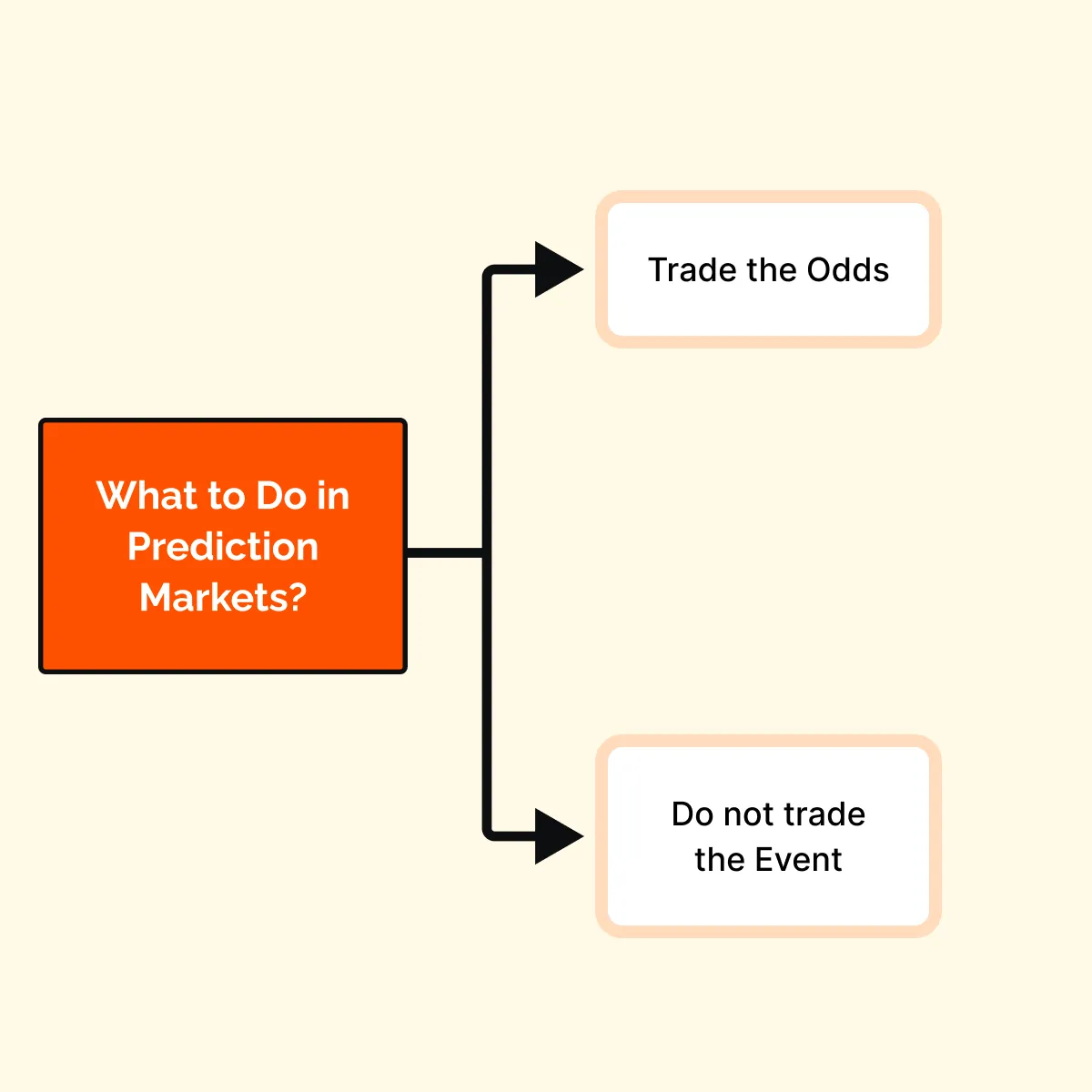
Usually, successful traders focus on differences in probability. For example,
-
- Assume a trader believes an event has an 80% chance of happening.
- But the market prices the contract at 55.
- The opportunity has arisen from that gap.
- Participants don’t have to be absolutely right about the outcome.
- The trading edge is in the “mispriced probability”.
This approach is common across all professional markets. Futures, options, and event-based markets all reward traders who manage risk by comparing their own probability estimates with the market’s.
Common Misconceptions About Prediction Markets
Most participants misunderstand the prediction markets. Usually, traders have several misconceptions that lead them to overestimate the quality of signals from such markets. Note that prices prevailing in prediction markets are helpful indicators, but they should always be interpreted with context and caution.
For a better understanding, here are some common misconceptions:
They Predict the Future
Prediction markets do not predict what will happen. Instead, they aggregate expectations from many participants. Prices only show what people collectively believe based on current information.
They Are Always Efficient
Prediction markets are not always perfectly efficient. Inefficiencies can and do exist, particularly in:
- Low-liquidity markets, and
- During highly emotional and widely publicized events,
In such cases, prices may temporarily move away from realistic probabilities.
Price Always Equals Truth
A contract price in a prediction market reflects who is participating and how active they are. It does not tell whether the price is correct. Always remember that price distortions can happen due to several reasons, such as:
What Prediction Markets Teach Traders About Markets in General
Prediction markets are valuable learning tools. That’s because they simplify how markets really work. They remove many layers of technical detail and focus only on the core drivers of price.
Traders may note that prediction markets revolve around three foundational essentials:
| Participation | Information | Probability |
|
|
|
By design, event-based markets do not rely on balance sheets, indicators, or complex valuation models. What remains is pure expectation. The prices prevailing in prediction markets only show how strongly the market believes in a particular outcome.
When traders have this clarity, they can better recognize how “sentiment and positioning” influence market prices. In this way, an analysis of prediction markets trains traders to:
- Think in probabilities,
- Read crowd behavior, and
- Interpret price as a reflection of belief, rather than certainty.
Conclusion
The article makes it clear that prediction markets cannot predict the future with certainty. Instead, they only help participants understand how expectations are formed, priced, and updated as new information becomes available.
The price in a prediction market reflects what participants collectively believe at a given moment. It is not what will definitely happen. Traders analyzing prediction markets should always watch how participation, liquidity, and information interact to influence probability.
Note that these same factors also influence price movement in stocks, futures, crypto, and every other market. Event-based markets make these factors easier to see by removing unnecessary complexity. See how order flow concepts apply beyond traditional markets → Compare Packages.
FAQs
1. Are prediction markets the same as gambling?
No, prediction markets are structured and event-based markets. In them, prices move in response to information and participation. It is different from gambling, where prices change as people react to data and news.
Most traders use prediction markets to understand expectations rather than pure chance.
2. Do traders need special skills to understand prediction markets?
No, to understand prediction markets, participants must be aware of the basic market behaviour, such as:
- Supply,
- Demand, and
- Price movement.
The basic rules are easy to understand. Usually, prices fluctuate based on the behaviour of market participants. Traders who understand how buying and selling influence prices in any market already understand the basics here as well.
3. Are prediction markets reliable indicators?
They can be useful, but they are not perfect. Prediction markets only reflect “collective belief,” rather than certainty. Usually, their reliability improves when:
- Liquidity is high, and
- Many participants are involved.
4. Why are traders paying attention to them now?
Traders prefer prediction markets because they “show probability”. The price acts like a percentage, showing what the market believes. When new information comes in, people usually change their views. As a result, trades happen and the price moves.
Prediction markets make it easier to watch how opinions form, change, and influence prices in real time.
Sign Up Now