


See market activity more clearly in real time.
Compare plans to access deeper market visibility for market activity.
Stocks
September 15, 2026
Updated
NQ vs ES: Why They Move Together, Until They Don’t
Let’s assume the stock market is a symphony, and ES and NQ futures are the lead instruments. Now, what will you observe? Usually, they play in harmony, but occasionally they hit different notes!
Yes, most of the time, the Nasdaq vs S&P 500 futures move together. They follow the same market rhythm, which is influenced by macro sentiment and Fed policy. But sometimes, one surges while the other stalls. And that’s when things get interesting!
These moments of divergence between NQ and ES are strong clues about market rotation, liquidity changes, and trader psychology. If you can interpret them, you can better anticipate price movements.
Want to stop chasing price blindly? Read this article to learn how index composition, liquidity structure, and order flow changes influence the ES and NQ relationship. You’ll also understand how to recognize, analyze, and even trade these divergences with the help of advanced market analysis tools like Bookmap.
Table of Contents
- NQ vs. ES: What’s the Difference?
- NQ Contract Specifications: Tick Size, Tick Value & Point Value
- ES Contract Specifications: Tick Size, Tick Value & Point Value
- Why NQ and ES Usually Trade in Sync
- What’s Inside the Index: ES vs. NQ Composition Differences
- Nasdaq-100 vs. S&P 500: Sector Exposure & Index Composition
- What Causes Divergence Between NQ and ES?
- NQ vs. ES Volatility & Average Daily Range
- Liquidity & Microstructure Differences Between ES and NQ
- NQ vs. ES Liquidity, Volume & Bid-Ask Spread
- NQ vs. ES Margin Requirements & Capital Needed
- Is NQ or ES Better for Beginners?
- NQ vs. ES for Scalping & Day Trading
- Why Does NQ Move More Than ES?
- How to Trade When ES and NQ Diverge
- NQ and ES Correlation, Divergence & Relative Strength
- MNQ vs. MES: Micro Futures Alternatives to NQ and ES
- Conclusion
- FAQ
NQ vs. ES: What’s the Difference?
NQ (E-mini Nasdaq-100) and ES (E-mini S&P 500) are both equity index futures contracts on CME Globex, tracking different underlying indices with different sector composition, different contract sizes, and — as covered throughout this guide — different volatility and liquidity profiles. The short version: ES tracks a broader, more diversified 500-company index and trades calmer; NQ tracks a narrower, tech-concentrated 100-company index and trades faster and more aggressively. Everything else in this guide is a more detailed version of that one distinction.
NQ Contract Specifications: Tick Size, Tick Value & Point Value
| E-mini Nasdaq-100 (NQ) | |
| Point value | $20 × index |
| Tick size | 0.25 index points |
| Tick value | $5.00 |
| Settlement | Cash |
| Expiration cycle | Quarterly (Mar/Jun/Sep/Dec) |
| Trading hours | Nearly 24 hrs, Sun–Fri (CME Globex) |
These figures are fixed by the exchange and don’t change with market conditions — unlike margin requirements, covered further down, which do.
ES Contract Specifications: Tick Size, Tick Value & Point Value
| E-mini S&P 500 (ES) | |
| Point value | $50 × index |
| Tick size | 0.25 index points |
| Tick value | $12.50 |
| Settlement | Cash |
| Expiration cycle | Quarterly (Mar/Jun/Sep/Dec) |
| Trading hours | Nearly 24 hrs, Sun–Fri (CME Globex) |
Why NQ and ES Usually Trade in Sync
E-mini-Nasdaq-100 (NQ) or E-mini-S&P 500 (ES) futures show correlated moves because they respond to the same economic and market conditions, such as:
- Inflation data,
- Interest rate changes, and
- Investor sentiment.
When investors feel optimistic about the economy (say, after strong jobs data or a dovish Fed meeting), money flows into equities. That’s known as a “risk-on” environment, and it pushes both NQ and ES futures higher. On the other hand, when fear or uncertainty hits (for example, owing to geopolitical tension or poor inflation data), both drop as traders shift to a “risk-off” stance.
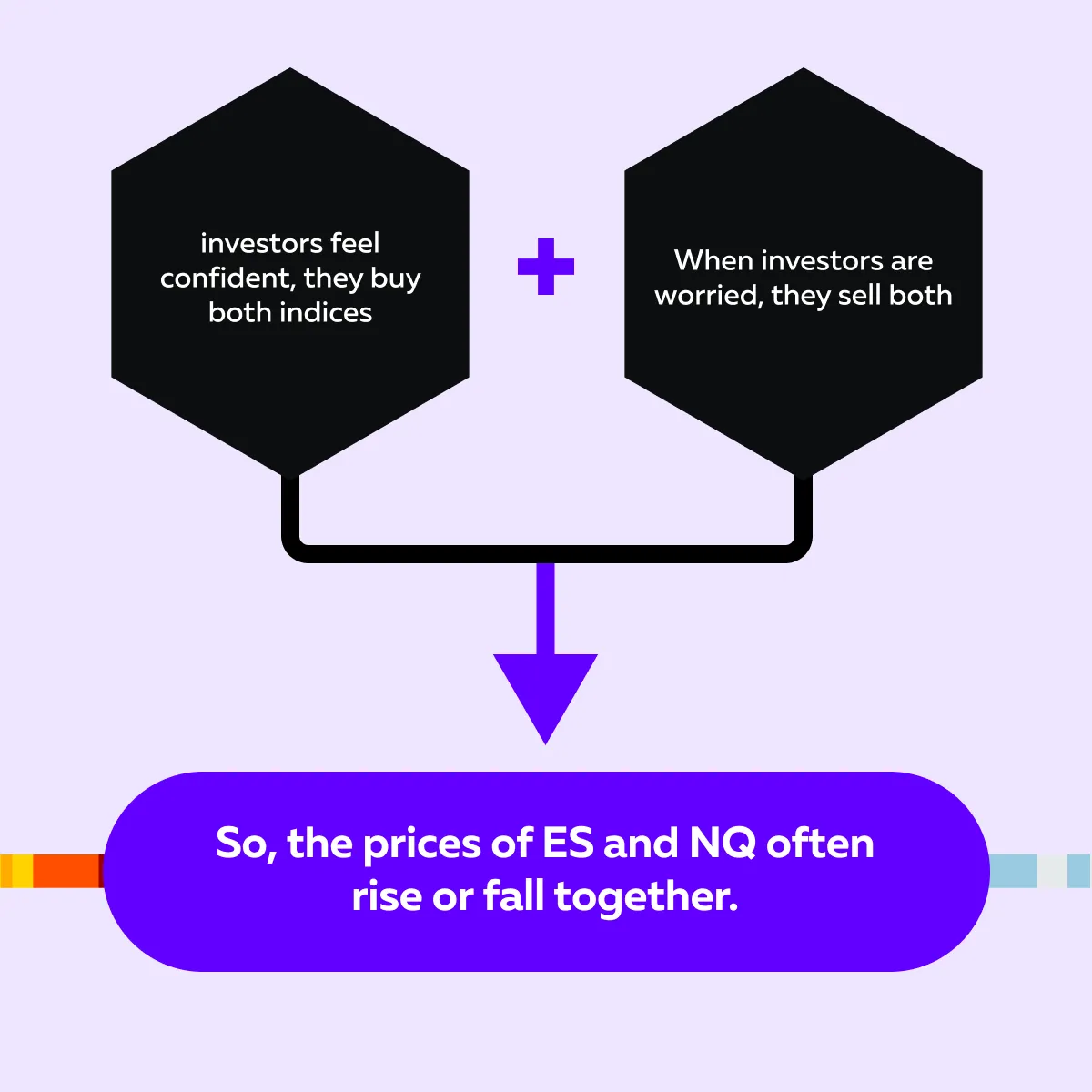
But That’s Not It! Check Out These Reasons for This Tight Relationship:
| Reason | Explanation | Effect on ES-NQ Relationship |
| Index and ETF Arbitrage |
|
|
| Passive Investment Flows |
|
|
| Intraday Liquidity Providers and Algos |
|
|
Still, remember that correlation doesn’t mean equality! ES and NQ don’t always move with the same speed or intensity. For example,
- Let’s say tech stocks, which dominate the Nasdaq, rise or fall sharply.
- Now, NQ futures may react much faster or more strongly than ES futures, which are more diversified.
So, even if both points are in the same direction, the intensity of change can be different. Compare order flow between NQ and ES side-by-side →
What’s Inside the Index: ES vs NQ Composition Differences
The Nasdaq vs S&P 500 futures comparison isn’t just about size! It’s about sensitivity. To understand NQ and ES correlation, and when it might break, you first need to look at what each index is made of:
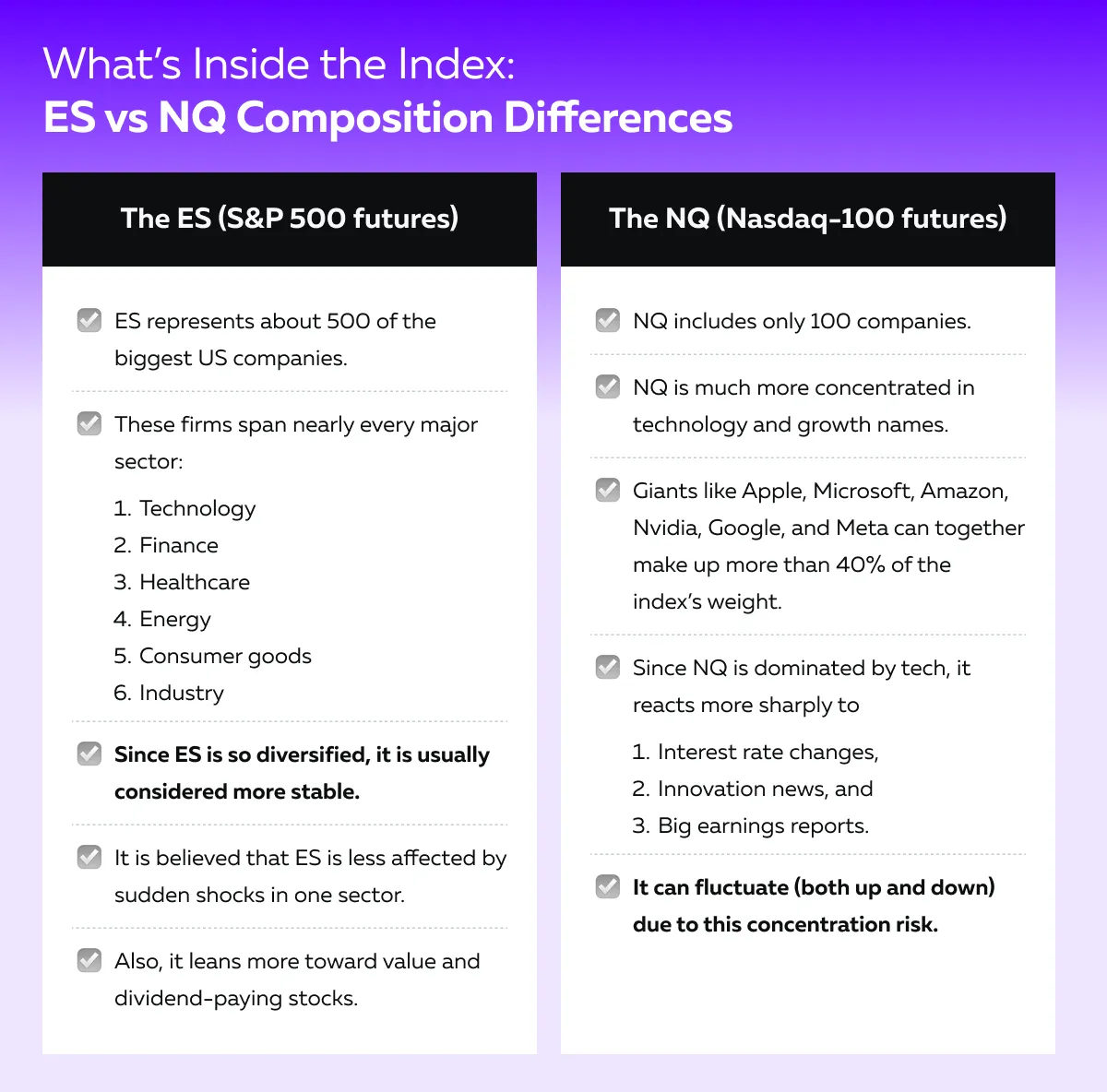
So, as a smart trader, you must realize that even if the market mood is stable, one major tech headline can send NQ futures surging or sliding while ES futures remain relatively calm.
Nasdaq-100 vs. S&P 500: Sector Exposure & Index Composition
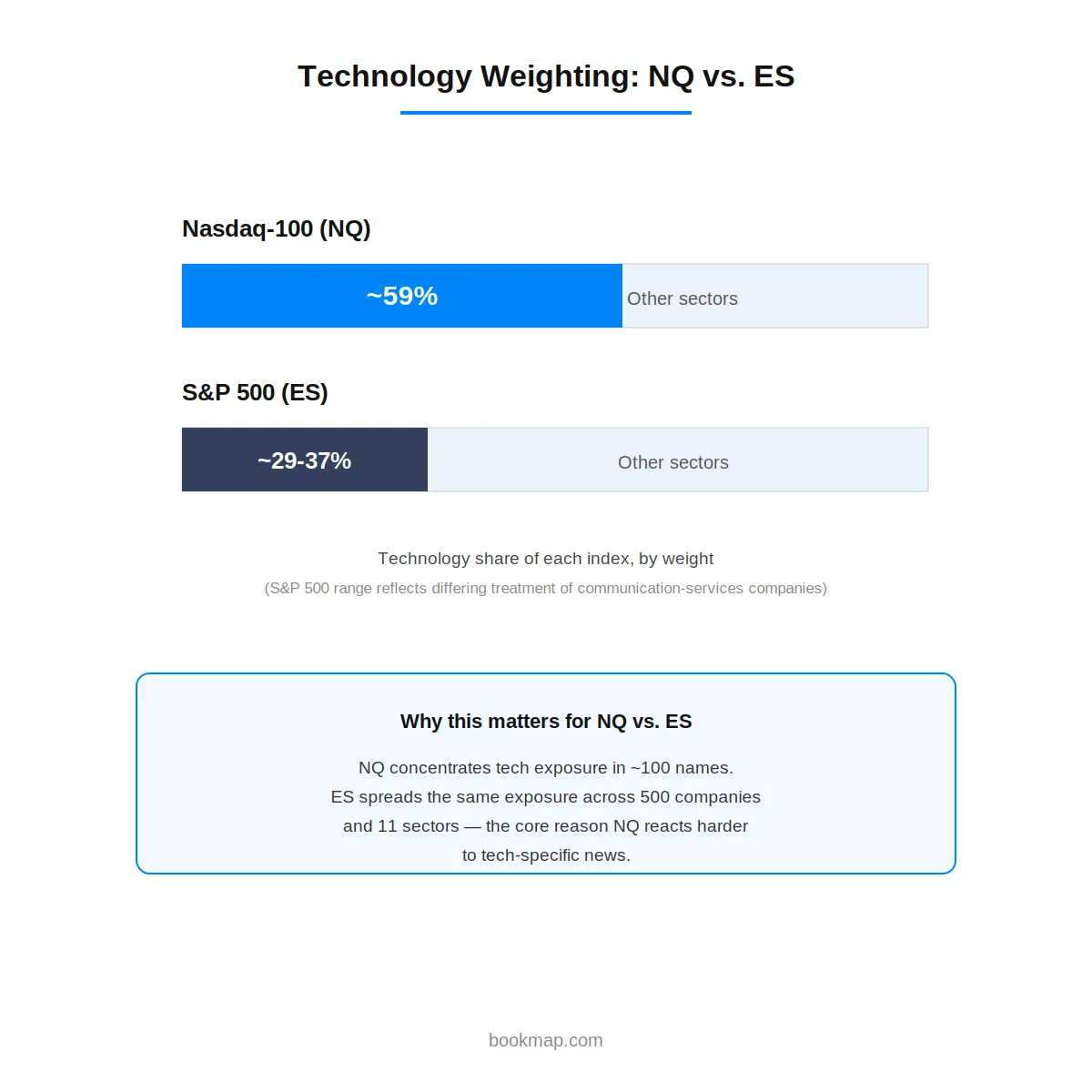
The Nasdaq-100 is heavily concentrated in technology — recent data puts the sector at roughly 59% of the index by weight, with the next-largest sectors (consumer discretionary, communication services) making up most of the rest. The S&P 500’s technology weighting is lower but has climbed significantly in recent years — commonly cited in the 29–37% range depending on how communication-services companies are classified, since several large platform companies sit in a sector boundary that’s been reclassified over time.
The practical takeaway isn’t the exact percentage, which shifts as prices move and companies get reclassified — it’s the gap between the two: NQ is a concentrated bet on a handful of mega-cap tech names, while ES spreads that same tech exposure across a broader set of sectors. This is the structural reason NQ reacts harder to tech-specific news, covered in more detail in the existing “What Causes Divergence” section above.
What Causes Divergence Between NQ and ES?

Divergence between NQ and ES futures doesn’t happen randomly! It’s usually triggered by some “recurring catalysts”. By learning about these catalysts, you can easily recognize:
- When the Nasdaq vs S&P 500 futures relationship might temporarily break down
and
- How to better trade that index futures divergence.
Now, let’s check out some popular recurring catalysts that cause divergence between NQ and ES:
1. Sector-Specific News or Earnings
As mentioned before, NQ is heavily influenced by major tech stocks. So, if a big player like Apple or Meta reports weak earnings, NQ may drop sharply. In contrast, ES could stay stable thanks to strength in financials or energy.
Conversely, positive news around AI or semiconductors can lift NQ faster than ES.
2. Interest Rate Expectations
When interest rates rise, future earnings of growth companies (like those in NQ) get discounted more heavily. That’s why NQ often falls more than ES when:
- Bond yields jump
or
- The Fed sounds hawkish.
3. Macro Rotations
In times of inflation or high commodity prices, investors may rotate out of tech. They could migrate and enter into value or cyclical sectors that are favoring ES over NQ. Additionally, institutional rebalancing between sectors can also tilt flows in one direction.
4. Risk Appetite and Volatility
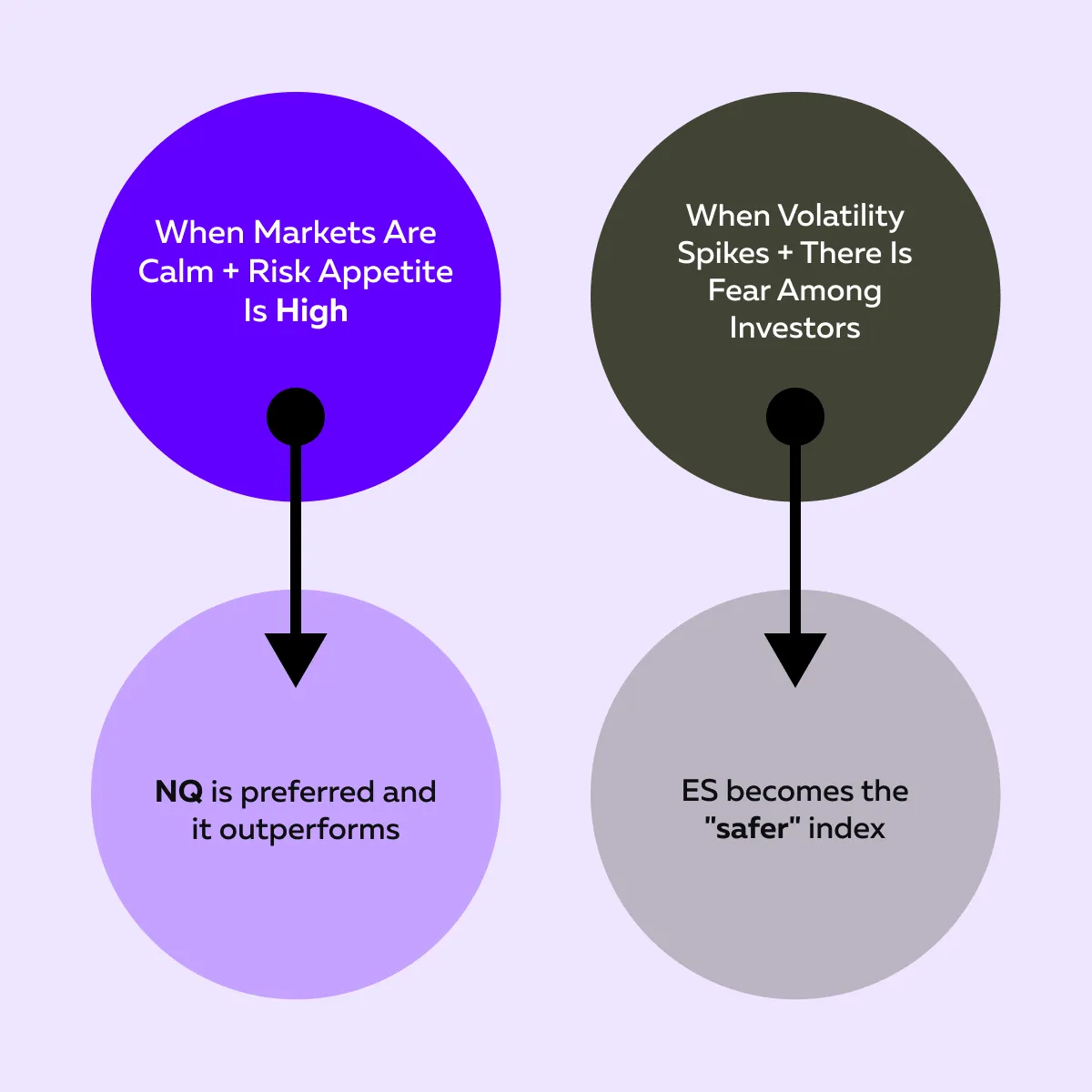
When the market feels stable and optimistic, investors are more willing to take risks! So, they buy tech-heavy NQ futures, which usually rise faster.
In comparison, when the market becomes uncertain or volatile, traders prefer safer and more balanced investments like ES futures. During those fearful periods, NQ may fall more sharply. This causes the two indices to diverge or move differently.
5. Options Market Influence
Options market activity can also affect how NQ and ES futures move during the day. Dealers who sell options on QQQ (Nasdaq) or SPY (S&P 500) often hedge their risk by buying or selling futures.
When gamma positioning (their exposure to price movements) changes, they might need to adjust those hedges. This buying or selling can add extra pressure to one index and make it move more sharply, while the other lags!
Need a Pro Tip!
Keep an eye on implied correlation indicators and sector ETF flows, particularly XLF (financials) vs XLK (technology). Such an observation lets you spot early signs of expected ES and NQ divergence before it plays out.
NQ vs. ES Volatility & Average Daily Range
NQ consistently trades a wider average daily range than ES in both raw points and percentage terms, a direct consequence of its concentrated tech exposure and thinner order book (covered next). Because average daily range shifts with the broader volatility regime — wider during high-volatility periods, narrower during calm ones — citing a fixed point figure here would be misleading within months. The more durable comparison is relative: NQ’s daily range is typically 1.5–2x that of ES on a percentage basis, a ratio that’s held reasonably consistent across different volatility regimes even as the absolute numbers change.
Checking each contract’s current ATR (Average True Range) directly on a chart is more reliable than relying on a fixed figure from any article, including this one.
Liquidity and Microstructure Differences Between ES and NQ
Do you think the ES and NQ futures differ only in terms of the companies they represent? Nope! They also behave differently at the micro level. Their liquidity and trading structure influence price movements and reversals. Let’s understand in detail:
| ES (S&P 500 futures) | NQ (Nasdaq-100 futures) |
|
|
Okay, but how to spot these differences? You can start using advanced real-time order flow analysis tools, like Bookmap. On them, you’ll often see NQ displaying:
- Sharper stop runs,
- Flash reversals, and
- Iceberg order spikes.
In contrast, ES will appear calmer and more stable. See how passive liquidity behavior differs between ES and NQ →
NQ vs. ES Liquidity, Volume & Bid-Ask Spread
ES consistently trades significantly higher daily volume and open interest than NQ, reflecting its role as the most heavily traded equity index futures contract globally. In practical terms, this shows up as a typically one-tick-wide bid-ask spread on ES during regular hours, versus a spread on NQ that holds at one tick during calm periods but widens more readily during fast moves, consistent with the thinner book described in the existing section above.
This liquidity gap is part of why stop clusters tend to have a more exaggerated effect on NQ than on ES — see Bookmap’s guide to spotting stop order clusters for how that shows up in practice.
NQ vs. ES Margin Requirements & Capital Needed
NQ’s margin requirement is consistently higher than ES’s in dollar terms — a direct reflection of its larger point value and higher volatility, both of which increase the exchange’s assessment of potential loss on the contract. Both carry the same day-trading-versus-overnight margin structure covered elsewhere on this site: a reduced figure for positions opened and closed within the session, and a higher figure for positions held overnight.
Exact dollar figures change with volatility and vary by broker, so check a broker’s current published margin schedule directly for both contracts rather than relying on a fixed number from any article.
How to Trade When ES and NQ Diverge
When ES and NQ futures start moving apart, it’s a signal. When you try to understand why the NQ and ES correlation is breaking, you can react intelligently instead of emotionally. Let’s see how professional traders approach index futures divergence with discipline and context:
1. They Identify the Lead!
Firstly, pro traders figure out which index is setting the tone. If NQ moves first, it’s often a tech-driven shift. But if ES moves higher while NQ lags, that could signal an inflation or interest rate theme favoring value and financials.
In this way, by knowing the leader, you can easily interpret what’s really driving price!
2. They Confirm with Order Flow
Most pro traders use volume + delta data to see if one index’s move has real conviction. They check the “liquidity heatmap” to check whether the lagging index stalls or shows absorption.
3. They Remain Cautious with Mirroring Trades
Professional traders never assume that if ES breaks out, NQ will follow. That’s because divergence can persist if liquidity or volume doesn’t support alignment. Thus, you also must always confirm if both instruments are moving with genuine participation.
4. They Look for Mean Reversion or Convergence
Many divergences eventually fade, but usually after stop runs or fake breakouts. Wait for signs of exhaustion in the leading index before trading a reversion setup.
5. They Use Bookmap to Replay Divergence Scenarios
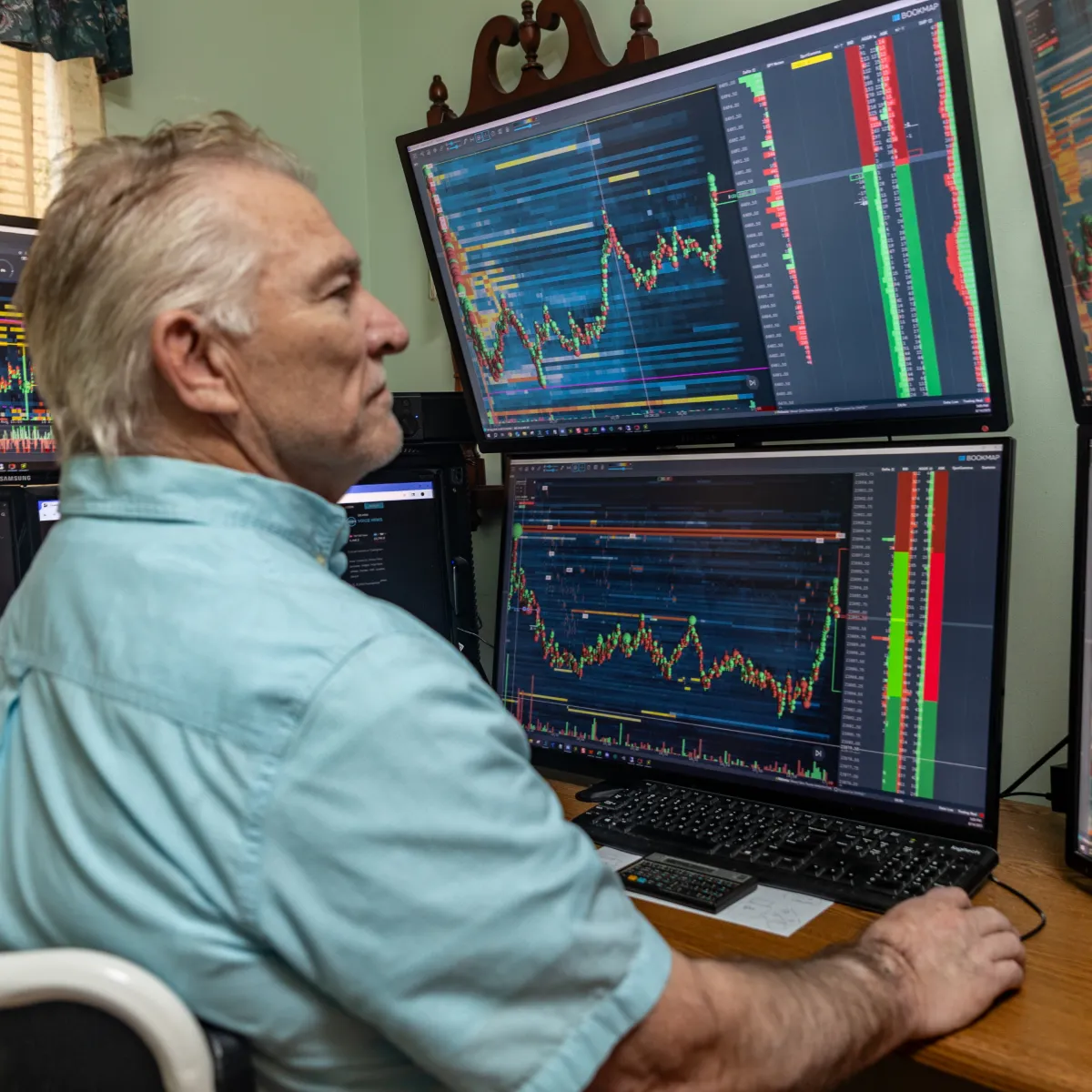
Veteran and successful traders often use order flow tools like Bookmap. Using it, they can replay how ES vs NQ futures behaved during key events, such as:
- Fed meetings,
- CPI releases, and
- Mega-cap earnings.
By studying past patterns using Bookmap, you can sharpen your sense of timing + spot divergence setups in real time. Replay divergence days in Bookmap to spot repeatable setups →
Is NQ or ES Better for Beginners?
ES is generally the more forgiving contract for a beginner: deeper liquidity, a calmer average range, and less punishing behavior around fast moves and stop clusters, as covered throughout this guide. NQ’s faster, more volatile behavior appeals to traders specifically looking for that speed, but it also means mistakes compound faster — the same stop-cluster dynamics that create opportunity also create risk for anyone not yet comfortable managing position size and stop placement under fast conditions.
Neither is objectively “better” — the more useful framing is that ES rewards patience and structure, while NQ rewards speed and tighter risk control, and a beginner is generally better served starting with whichever of those two they’re more naturally equipped to do well.
NQ vs. ES for Scalping & Day Trading
NQ’s wider range and thinner liquidity make it a common choice for scalpers specifically seeking fast, large moves to capture — the same characteristics that make it riskier for beginners make it appealing for a scalper who can manage that speed. ES’s calmer, deeper-liquidity profile suits day trading strategies built around more structured setups and slower confirmation, where getting a fast, clean fill matters less than reading a level with confidence.
Neither style is exclusive to one contract, but the mismatch between trading style and contract characteristics — scalping ES’s calmer range, or day trading NQ’s sharp reversals — is a common source of frustration worth avoiding. Bookmap’s guide to the psychology of pullbacks covers a related timing mistake that shows up more often on NQ specifically, given how quickly its pullbacks can resolve.
MNQ vs. MES: Micro Futures Alternatives to NQ and ES
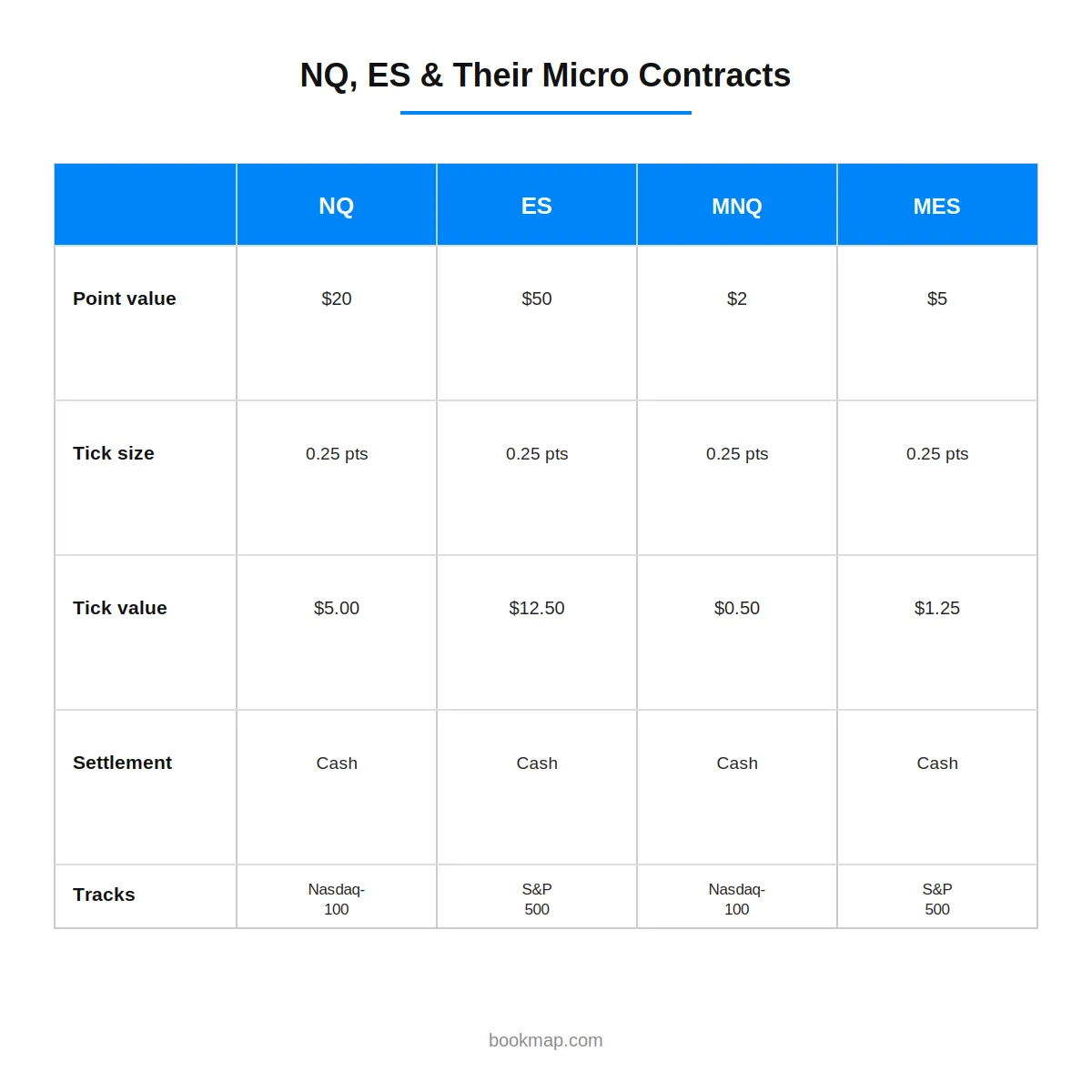
Micro E-mini Nasdaq-100 (MNQ) and Micro E-mini S&P 500 (MES) track the same indices as NQ and ES at 1/10th the size — a $2 multiplier for MNQ versus NQ’s $20, and a $5 multiplier for MES versus ES’s $50. Tick values scale down proportionally: $0.50 per tick on MNQ, $1.25 per tick on MES.
For a trader working through the beginner-versus-scalping considerations covered above, the micro versions offer a practical way to trade NQ’s speed or ES’s stability at a fraction of the capital and dollar risk — useful for testing a strategy on the “real” volatility profile of either contract before committing to full-size trading.
Conclusion
So now you know that ES and NQ futures usually move together. However, there are cases when divergence also appears because of:
- Tech earnings shocks,
- Changing rate expectations, and
- Liquidity differences between the two markets.
That’s why most professional traders know that the ES and NQ relationship is dynamic, not fixed.
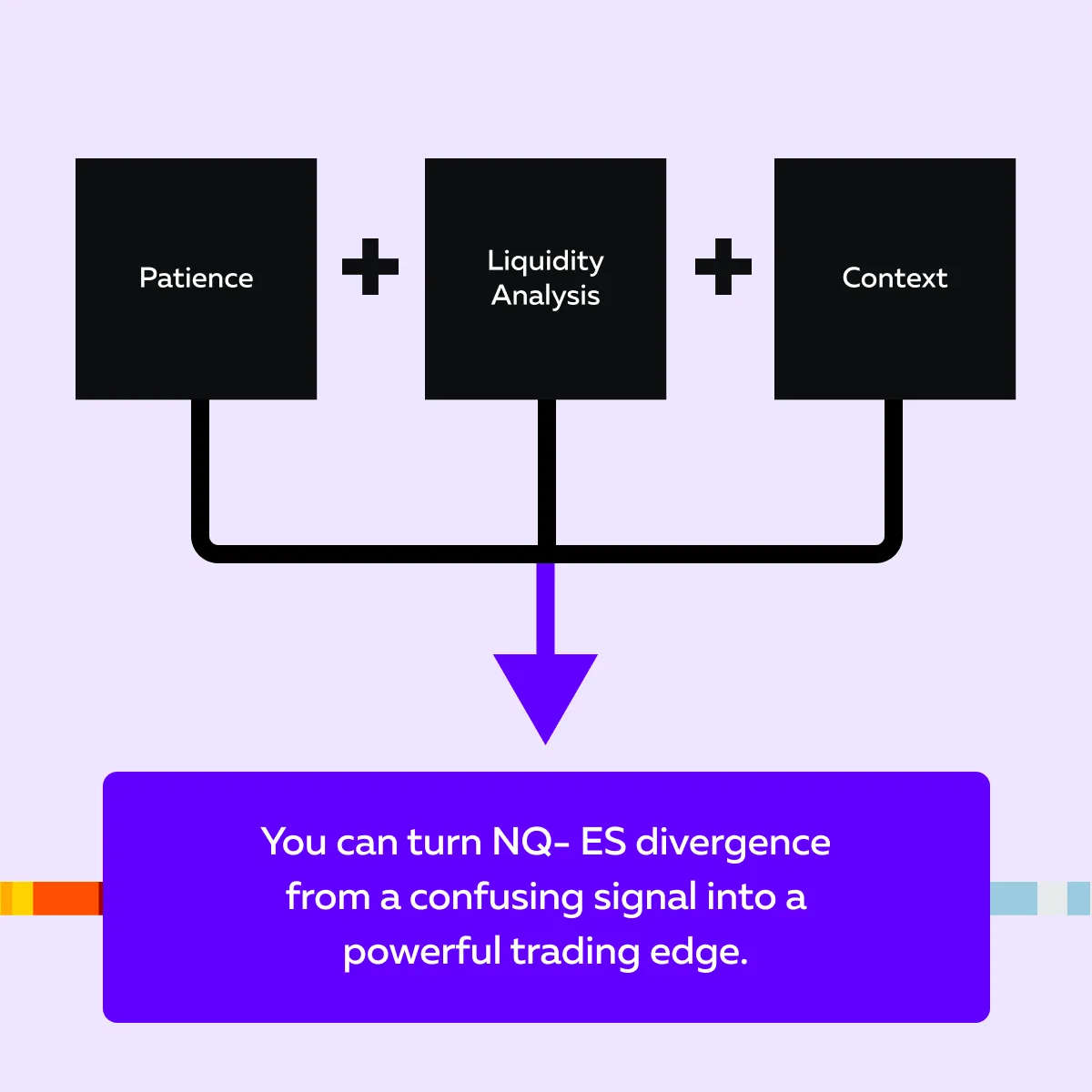
As a trader, if you also want to trade this relationship more effectively, you must monitor real-time volume, order flow, and sector momentum (instead of assuming both indices will always align). When divergence appears, treat it as useful information! It is a clue about market sentiment, rather than noise or confusion.
Furthermore, you can even use leading market analysis tools like Bookmap to study how Nasdaq vs S&P 500 futures behave during major events. The more you understand their rhythm and reaction, the better your trades will be. Use Bookmap’s full-depth liquidity view to track rotations in real time →
FAQs
1. Why do ES and NQ usually move together?
Both ES and NQ futures represent the complete US stock market mood. When hit by major economic news like Fed announcements or global events, most investors buy or sell equities broadly.
That’s why both indices usually rise or fall in the same direction. They even show similar macro sentiment and risk appetite.
2. Why does NQ move faster or more aggressively?
The NQ (Nasdaq-100) is dominated by large tech stocks. It has thinner liquidity compared to ES. This makes it more sensitive to headlines about:
- Technology
- Interest rates
- Innovation trends
Thus, due to fewer large resting orders in the NQ order book, price moves can stretch quickly and reverse just as fast!
3. Should I trade both NQ and ES the same way?
No! NQ futures are more volatile. They demand tighter stops and need you to make quick decisions. In contrast, ES futures are more stable with fewer fluctuations. They suit more structured setups.
Thus, it is recommended that, based on each instrument’s speed and liquidity profile, you must adjust your:
- Position size,
- Stop-loss distance, and
- Trading strategy.
4. What tools help identify divergence between ES and NQ?
You can utilize real-time order flow tools, such as Bookmap, which will help you:
- Spot where liquidity builds or disappears,
- Learn how aggressive buyers or sellers act, and
- Track which index leads.
Additionally, you can even compare this data between ES and NQ futures to spot genuine divergence early and avoid false signals.
5. Can divergence between ES and NQ be traded directly?
Yes, but trade carefully! Some traders use spread strategies, where they buy the weaker index and sell the stronger one. They do so expecting prices to converge.
However, this approach requires experience and a solid understanding of the “index futures divergence strategy”. Also, you should have a comprehensive understanding of the market structure.
6. What are the contract specs for NQ vs. ES?
NQ (E-mini Nasdaq-100) has a $20 point value and a $5.00 tick value. ES (E-mini S&P 500) has a $50 point value and a $12.50 tick value. Both trade in 0.25-point ticks, settle in cash, and expire quarterly on the same March/June/September/December cycle.
7. What’s the difference between MNQ/MES and NQ/ES?
MNQ and MES are the Micro E-mini versions of NQ and ES, at 1/10th the size — a $2 multiplier for MNQ and a $5 multiplier for MES, versus $20 and $50 for the standard contracts. They track the identical underlying indices; only the dollar value per point changes.
8. Which has higher margin, NQ or ES?
NQ’s margin requirement is consistently higher than ES’s in dollar terms, reflecting its larger point value and higher volatility. Exact figures change with market conditions and vary by broker — check a current margin schedule directly rather than relying on a fixed number.
9. Is NQ or ES better for scalping?
NQ’s wider range and thinner liquidity make it a common choice for scalpers seeking fast, larger moves. ES’s calmer, deeper-liquidity profile suits more structured setups where a clean, predictable fill matters more than speed.
10. How much of the Nasdaq-100 is technology stocks?
Recent data puts technology at roughly 59% of the Nasdaq-100 by weight — significantly more concentrated than the S&P 500’s technology weighting, commonly cited in the 29–37% range depending on sector classification. This concentration is the main structural reason NQ reacts more sharply to tech-specific news than ES does.
Sign Up Now
Latest Articles