


See zero day options more clearly in real time.
Compare plans to access deeper market visibility for zero day options.
Education
October 14, 2026
Updated
The Rise of Zero-Day Options: Opportunities and Risks for Traders

Zero-day options now make up about two-thirds of S&P 500 index options volume. Have you ever heard of zero-day options trading? Also known as 0DTE options trading, it offers small upfront costs and fast outcomes. It also carries some of the highest risk in the options market: these options lose value quickly, move fast and can be expensive to trade, and research on retail traders in 0DTE options has found average losses. Want to balance risk and reward?
This article will explore the core concepts of zero-day options, from their definition and popularity to the risks and strategies that can help you manage them. Also, you’ll learn about strict risk management, pre-planned entries, exits, and how advanced tools like our Bookmap can help you deal with volatility. Read till the end to sharpen your trading skills and gain confidence!
Options involve risk and are not suitable for every investor. Read the Options Clearing Corporation’s booklet Characteristics and Risks of Standardized Options, available from your broker, before trading. This article is educational and is not trading advice.
Table of Contents
- What Are Zero-Day Options and Why Are They Popular?
- Key Opportunities With Zero-Day Options
- Major Risks Associated With 0DTE Trading
- 0DTE Options Trading Risks: What the Evidence Shows
- Options Trading Risk Factors in a Zero-DTE Context
- How Does Gamma Risk Affect 0DTE Options?
- Derivatives Market Volatility Risks
- Same-Day Expiration Options Risk Analysis
- Best Practices for Trading Zero-Day Options
- Best Risk Management Strategies for 0DTE Traders
- Intraday Financial Risk Management
- Conclusion
- FAQs
What Are Zero-Day Options and Why Are They Popular?
Zero-day options are also known as 0DTE options. They are options contracts on their expiration day, with zero days left until they expire. You can buy one that morning or hold it from an earlier day, but it always expires by the close. Daily expirations are listed on the S&P 500 index (SPX) and on the largest ETFs, such as SPY and QQQ. Options on individual stocks have traditionally expired on Fridays, and since January 2026 some mega-cap stocks also list Monday and Wednesday expirations.
Unlike weekly options that can expire after a few days, zero-day options offer a much shorter timeframe, making them ideal for traders looking to capitalize on intraday price movements.
Why Are Zero-Day Options So Popular?
The popularity of zero-day options has surged in recent years due to several reasons:
| High Potential for Quick Profits | Low Capital Requirement | Speculative Appeal |
|
|
or
|
Example of 0DTE Options
- Let’s assume that during a recent FOMC announcement, market volatility spiked.
- This spike happened because investors reacted to changes in interest rate policies.
- In such a scenario, many traders used zero-day options trading strategies.
- They tried to profit from the rapid price fluctuations that followed.
- For example:
- They buy call options if they expect the market to rise.
- They buy put options if they anticipate a decline.
Key Opportunities With Zero-Day Options
Zero-day options, or 0DTE options, offer you several unique advantages, such as:
- Minimal capital outlay,
- Ability to earn quick profits,
and
- Short-term hedging.
Let’s understand these benefits in detail:
Capital Efficiency and Leverage
You can control larger positions with minimal investment using zero-day options because the premiums for 0DTE options are much lower than those of standard options. That leverage cuts both ways: a small premium can produce a large percentage gain, and it can also go to zero within hours.
The graphic below makes the concept clearer:
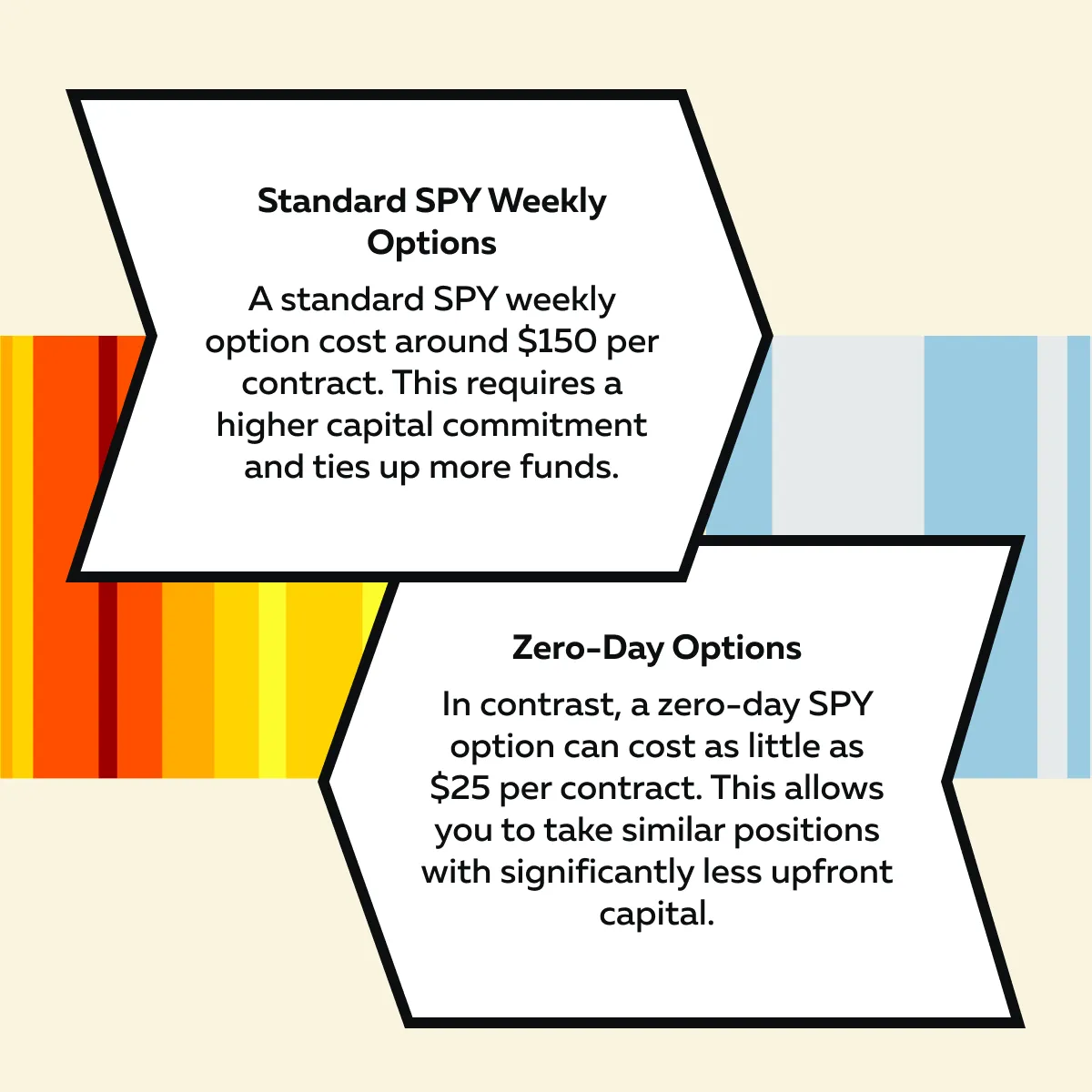
Such cost-efficiency makes 0DTE trading strategies a preferred choice for active and speculative traders.
Quick Profit Potential
Through zero-day options trading, you can make quick profits by taking advantage of intraday volatility. Since 0DTE options expire on the same day, you can capitalize on fast market movements after key events or announcements.
Let’s understand better through an example:
-
- Let’s assume inflation data is released, and the numbers are higher than expected.
- This unexpected news leads to a sharp drop in the stock market.
- Most investors start worrying about likely interest rate hikes.
- Here, a trader anticipates this market reaction.
- They buy zero-day put options just before the data is released.
- The trader purchased the options at a low premium.
- Now, due to the report, the market falls.
- The value of these put options skyrockets within minutes.
- The trader sells options contracts at a much higher price.
Any cautions? Yes! While the potential for profit is high, these options contracts carry a very short timeframe. Thus, if the market moves against you, it will lead to possible losses. See actionable market sentiment unfold live. Try Bookmap for futures, stocks, and crypto.
There is a second cost that the example above leaves out: implied volatility. Option prices before a scheduled event include the market’s expectation of a big move, and that premium collapses once the number is released. A trader can be right about direction and still lose if the move is smaller than the market priced in.
Flexible Short-Term Hedging
Zero-day options (0DTE options) are not just for speculation! They can also be used for short-term hedging. Institutional investors and experienced traders often use these options to protect their portfolios from sudden market volatility, particularly when key economic events or earnings reports are due.
How 0DTE Options Help with Hedging?
Using zero-day options, you can hedge against intraday market swings. Let’s learn how through an example:
- A hedge fund holds large long positions in tech stocks.
- Assume that it is a volatile earnings week.
- To protect against sudden price drops, the fund buys zero-day put options when the market opens.
- Later, the earnings reports were disappointing, and the market declined.
- The value of these put options increases.
- This hedging strategy offsets the losses from the long positions.
Thus, you can manage risk using 0DTE trading strategies and protect your portfolio from short-term price fluctuations without tying up significant capital.
Major Risks Associated With 0DTE Trading
Zero-day options have an extremely short lifespan, which requires traders to be always prepared for:
- Rapid price changes,
and
- Expected losses.
Let’s understand the various associated risks you must be aware of:
Extreme Volatility and Time Decay (Theta Risk)
A major risk in 0DTE trading strategies is time decay (also known as theta risk). As the expiration time approaches, the value of zero-day options drops quickly, even if the underlying asset’s price doesn’t move significantly.
Why does Time Decay happen?
One must understand that zero-day options have very little time left before expiration. Thus, their value is mainly driven by how close the underlying stock or index is to the strike price.
As time passes, the option’s value declines rapidly (if the price doesn’t move favorably) within just a few hours. Let’s gain more clarity through the graphic below:

For example,
- Suppose a trader buys zero-day call options on a stock trading at $100 at market open.
- They are expecting the price to rise.
- By midday, the stock remains at $100.
- However, the call options lose 70% of their value because of time decay.
- The premium collapses since the option is nearing expiration, and the price hasn’t moved.
- This collapse leaves the trader with an unrealized loss.
Stay one step ahead in volatile markets using Bookmap’s real-time order flow insights.
Emotional Decision-Making and Overtrading
Zero-day options trading (0DTE trading) happens quickly! This fast pace often leads to emotional decision-making. Most traders usually experience greed, fear, and impulsivity, which can cloud judgment and increase risk. Check out the graphic below to learn how emotions affect 0DTE trading:

For example,
- A trader starts the day with a few profitable 0DTE trades.
- They decide to quadruple their position size for the next trade.
- They do so, hoping for even bigger profits.
- Unfortunately, the market suddenly reverses.
- The large position results in devastating losses.
- In this way, emotional decision-making leads to increased risk.
- It even wiped out earlier gains.
Thus, you need to stay disciplined to succeed in zero-day options trading. Also, avoid letting emotions drive your decisions.
Liquidity and Execution Challenges
Be aware that liquidity can become a major issue in 0DTE trading strategies (particularly near the end of the trading session). Let’s see how:

Why Liquidity Becomes a Problem?
The two primary reasons are:
| Wider Bid-Ask Spreads | Execution Difficulty |
|
or
|
Let’s study an example:
- A trader tries to close a profitable zero-day options position in the final hour of trading.
- Due to low liquidity, their order fills at a less favorable price.
- These occurrences reduce profits or turn a winning trade into a loss.
As a Practical Solution, Start Using Our Bookmap for Liquidity Management
To manage these risks, traders can use our avant-garde market analysis tool, Bookmap. It offers a real-time liquidity heatmap. Using it, you can easily visualize liquidity pockets on the order book, which allows you to:
- Identify areas of strong liquidity for better order execution,
and
- Avoid getting stuck in positions during periods of thin liquidity.
0DTE Options Trading Risks: What the Evidence Shows
Zero-day options are now a major part of the options market, but the evidence on how traders fare is sobering. Cboe reports that 0DTE contracts reached a record 66.2% of SPX options volume in July 2026. Estimates of the retail share of that activity range from roughly 30% to 60%, depending on the method used.
The best-known study of retail results, by Beckmeyer, Branger and Gayda at the University of Münster, looked at retail trades in 0DTE S&P 500 options. It found that retail traders lost money in aggregate: about $184,000 a day on average from February 2021 to February 2023, and about $358,000 a day after daily expirations began in May 2022. The study covers an earlier period, and the products and participants have changed since, so treat the dollar figures as a warning about the structure and not as a forecast.
Not every finding points the same way. Cboe’s research found that only about 4% of SPX 0DTE trading was in naked short options, and Cboe says its data shows no evidence that 0DTE trading increases market turbulence. The market is large and liquid enough that most participants can trade in and out easily. The problem for an individual buyer is the odds: a long option starts the day with a clock running against it, and spreads and fees take a share of every round trip.
Dangers of Zero Days to Expiration Options
Four features make 0DTE options dangerous in ways longer-dated options are not:
- The clock is part of the price. A long option loses value every minute. By the afternoon, the move you need just to break even can be larger than the day’s likely range.
- Outcomes are close to binary. An at-the-money option can finish worth several dollars or worth nothing, with little time to recover from a wrong entry.
- Exposure changes faster than you can manage it. Near expiry, small moves in the underlying produce large changes in the option’s value and delta. The gamma section below explains why.
- Costs are a larger share of the trade. Wide spreads, per-contract fees and slippage take a bigger share of a small premium, and traders who open and close several positions a day pay them repeatedly.
None of this means 0DTE options cannot be used well. It means the position should be sized for the possibility of total loss, which for a buyer is the entire premium.
Options Trading Risk Factors in a Zero-DTE Context
Every options trade carries the same basic risk factors. Zero-day options compress them into a few hours:
| Risk factor | What it means | How it shows up in 0DTE |
| Time decay (theta) | Option value falls as expiration approaches | Decay is fastest in the final hours, so a flat market still costs the buyer |
| Gamma | How fast delta changes as price moves | Highest for at-the-money options near expiry, so small moves have large effects |
| Implied volatility (vega) | Sensitivity to changes in expected volatility | Premiums swell before scheduled events and collapse after them |
| Liquidity and spreads | The cost and difficulty of entering and exiting | Spreads can widen sharply in the final hour and in fast markets |
| Assignment and exercise | The obligation to deliver on a short option | Not an issue on cash-settled index options, a real risk on stock and ETF options |
| Margin and leverage | The capital committed behind a position | Brokers can close short positions if margin falls short |
| Event risk | Scheduled and unscheduled news | FOMC and CPI releases drive both the opportunities and the largest losses |
| Costs | Fees, slippage and order handling | Per-contract fees and spreads weigh on small premiums |
How Does Gamma Risk Affect 0DTE Options?
Delta measures how much an option’s price moves for each point the underlying moves. Gamma measures how quickly delta itself changes. Gamma is highest for at-the-money options and rises sharply as expiration approaches. On expiration day, an option near the money can go from almost no sensitivity to the underlying to behaving almost like the underlying itself within a small price range.
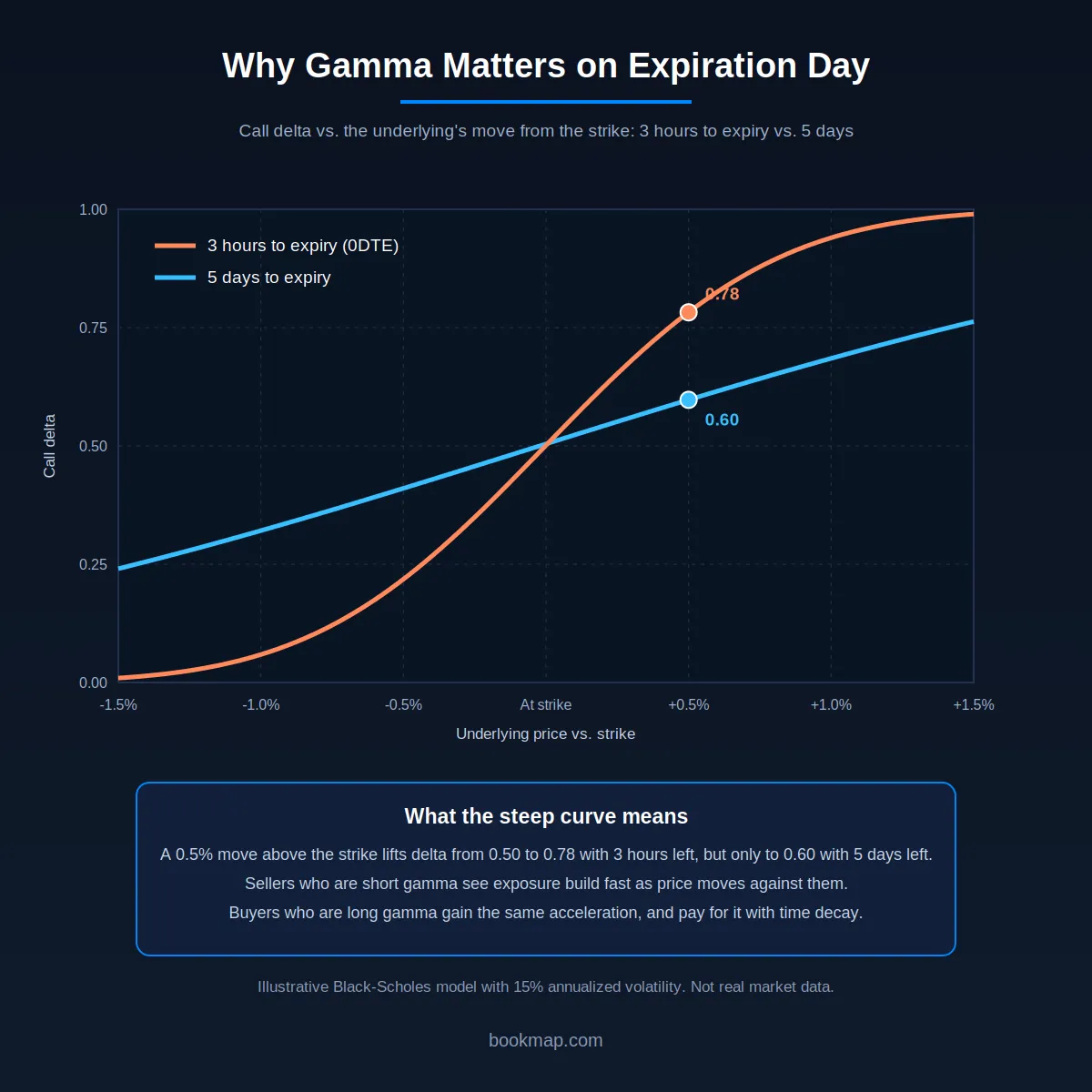
The chart shows the effect in an illustrative model. With three hours left, a 0.5% move above the strike lifts a call’s delta from 0.50 to about 0.78. With five days left, the same move lifts it to about 0.60.
What that means for each side of the trade:
- Buyers are long gamma. Their gains accelerate if the market moves their way, and their losses are capped at the premium. They pay for that with time decay.
- Sellers are short gamma. Their losses accelerate if the market moves against them, and the faster the move, the faster the exposure builds. A short option that looked safe at noon can be deep in the money by the close.
- Market makers hedge their own gamma. When they are short gamma, their hedging can add to price moves, and when they are long gamma, it can dampen them. Some analysts argue this affects intraday index behavior. Cboe says its data shows no evidence that 0DTE trading increases market turbulence, so treat the effect as debated and not settled.
On a heatmap, gamma risk shows up as speed: price moves through levels quickly, liquidity gets pulled and the book thins as participants adjust. Bookmap’s guide to order book depth in day trading explains how to read that.
Derivatives Market Volatility Risks
Options prices are built on expected volatility, so volatility is both the main source of 0DTE opportunity and the main source of risk.
- Implied volatility moves prices before the move happens. Premiums rise into scheduled events such as FOMC decisions and CPI releases, because the market expects a large move. If the move is smaller than expected, buyers can lose even when they are right on direction, because implied volatility falls sharply after the event.
- Volatility regimes change quickly. A quiet morning can turn fast. Cboe publishes a one-day volatility index, VIX1D, that reflects the volatility priced into the shortest-dated S&P 500 options, which makes it a useful gauge of what the market expects for the day.
- Spreads and liquidity move with volatility. Fast markets widen spreads and thin the book on the underlying, which feeds back into option prices and fills.
- Futures and options feed each other. Index options are hedged with futures and stocks, so shocks pass quickly between them. Bookmap’s guide to how futures markets influence stock prices covers the link.
- Margin can change. Brokers can raise margin requirements for short options in volatile markets, which can force positions to close at poor prices.
For how these dynamics look in the order book, see Bookmap’s guide to trading in volatile times.
Same-Day Expiration Options Risk Analysis
Risk depends heavily on what you hold. The same move in the underlying produces very different outcomes for a buyer, a seller of naked options, a spread and an iron condor. This section breaks the risk down by product and by position.
Zero Days to Expiration Contract Risk Profile
The product you trade decides how the option settles, whether it can be exercised early and how long it trades on expiration day:
| Product | Style and settlement | Same-day expirations | What to know |
| SPX (SPXW) | European, cash-settled to the closing value | Monday to Friday | No early assignment. Expiring options stop trading at 4:00 p.m. ET and cash moves the next business day |
| XSP (Mini-SPX) | European, cash-settled | Monday to Friday | One-tenth the size of SPX |
| SPY, QQQ, IWM | American, settled in shares | Monday to Friday | Early assignment is possible, and exercise delivers shares |
| Single stocks | American, settled in shares | Fridays, plus Monday and Wednesday on some mega-caps since January 2026 | Assignment creates a stock position after the close |
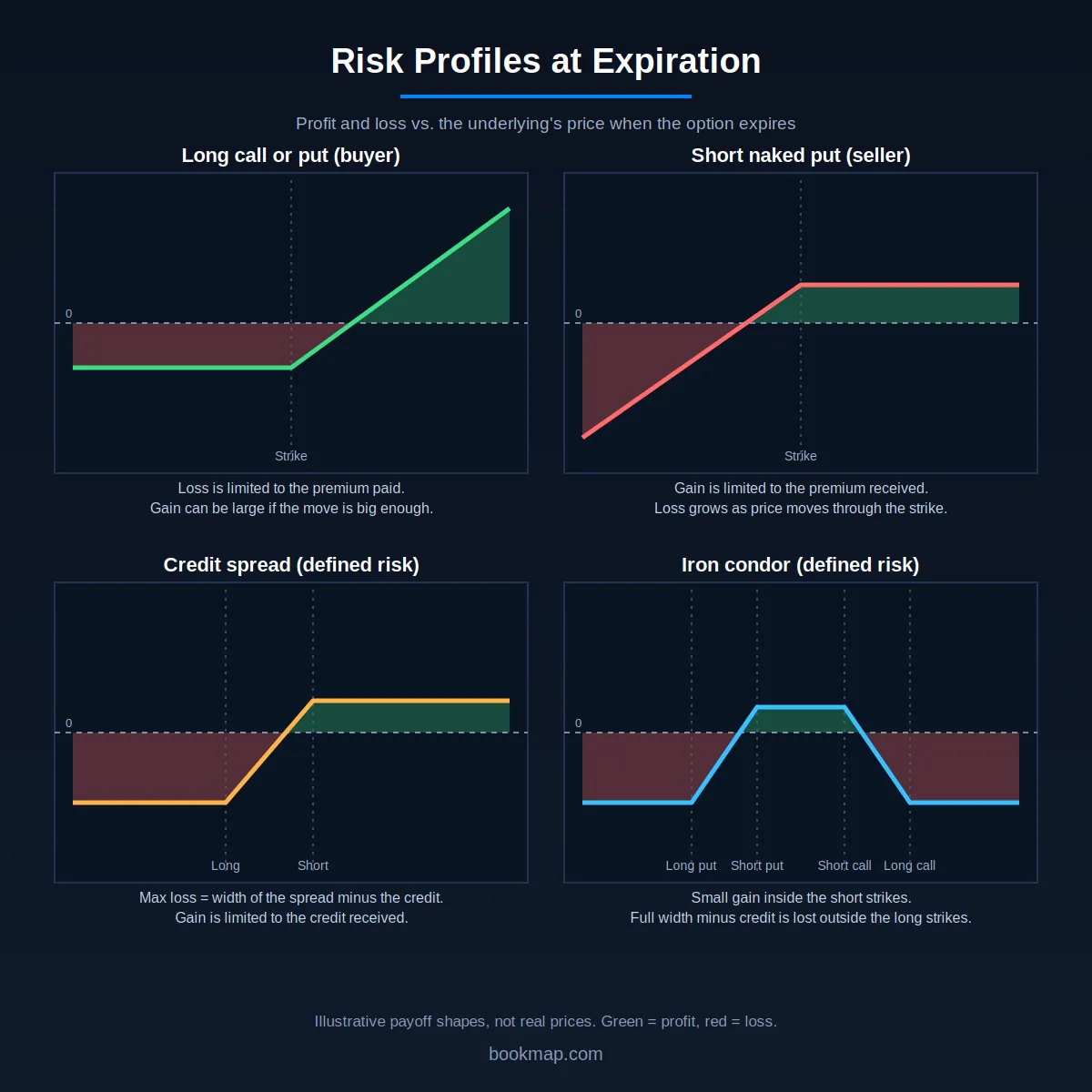
The shapes below show how the risk differs by position. A buyer’s loss is capped at the premium. A seller of a naked option takes the opposite side of that payoff, with a small capped gain and a large loss. Spreads and iron condors cap the loss, but the cap can be many times the premium collected.
Are You Buying or Selling Zero DTE Options?
Buying and selling are different risk businesses.
Buying gives a known, limited risk: the premium. The odds work against the buyer, though. The underlying has to move far enough and fast enough to overcome time decay, spreads and fees, so buyers typically lose small amounts often and depend on a few larger winners.
Selling collects premium and wins most of the time, but the losses when it goes wrong are much larger than the gains. A trader who sells naked options takes on the risk that one fast move wipes out many days of premium. Selling defined-risk spreads limits that loss but does not remove it.
Choose the side based on the loss you can accept, not on the win rate.
Can You Lose More Than Your Investment on Zero DTE Options?
It depends on what you hold:
- Long options: No. The most you can lose is the premium you paid.
- Defined-risk spreads and iron condors: You cannot lose more than the maximum loss of the structure, which is the width of the spread minus the credit received. That maximum can be several times the premium you collected.
- Naked short options: Yes. A short call has theoretically unlimited loss, and a short put can lose nearly the full value of the underlying. A fast move can create a loss larger than the cash in your account, leaving a balance you owe your broker.
If you sell options, know the maximum loss before you enter, and check whether your account’s margin can cover a bad day.
SPX 0DTE Iron Condor Tail Risk
An iron condor sells an out-of-the-money put spread and an out-of-the-money call spread at the same time. It collects a credit and profits if the index stays between the short strikes. It is popular in 0DTE because both sides decay quickly and the maximum loss is defined.
An illustrative example with SPX at 7,500 (hypothetical numbers):
- Sell the 7,450 put and buy the 7,440 put.
- Sell the 7,550 call and buy the 7,560 call.
- Collect a net credit of 2.00 points, or $200 per condor (SPX options are $100 per point).
- Maximum profit: $200, if SPX closes between 7,450 and 7,550.
- Maximum loss: $800 per condor (the 10-point width minus the 2.00 credit, times $100), if SPX closes beyond 7,440 or 7,560.
- Breakevens: 7,448 and 7,552.
The tail risk is in that ratio. The trade risks about $800 to make $200, so it has to win roughly four times out of five just to break even, before commissions on four legs. Many small wins can be erased by a single day when the index moves quickly through a short strike, which is more likely around scheduled events and in fast markets. Because SPX options are cash-settled and European-style there is no early assignment, but the loss is still realized at expiration or when you close, and spreads can be wide when you need to exit.
Ways traders try to limit the damage include staying out of event days, sizing so that the maximum loss is a small share of the account, closing or adjusting when price reaches a short strike instead of waiting, and avoiding new condors late in the day when gamma is highest.
SPX Index Options vs. Single Stock Options
Whether you trade SPX or a single stock changes the risk:
- Settlement and assignment. SPX options settle in cash and cannot be exercised early, so there is no stock position to manage. Stock and ETF options settle in shares. A short option that finishes even one cent in the money is automatically exercised and assigned, and you end up with a stock position you did not plan to hold, with overnight gap risk.
- Event risk. A single stock can gap on its own news. Nasdaq’s proposal for Monday and Wednesday expirations avoids listing dates that coincide with a company’s earnings release, but Friday expirations and unscheduled news still carry company-specific risk.
- Availability. Daily expirations exist for SPX and the largest ETFs. Single stocks trade Friday expirations, and some mega-caps have added Monday and Wednesday expirations since January 2026.
- Taxes. Broad-based index options such as SPX generally receive different US tax treatment than stock and ETF options. Check with a tax professional.
0DTE Pin Risk on Out-of-the-Money Contracts
Pin risk is the uncertainty that arises when the underlying closes at or very near the strike of an option you are short. An option that is out of the money for most of the day can finish a cent in the money in the final minutes, and that decides whether you are assigned.
For stock and ETF options, any option that finishes at least $0.01 in the money is automatically exercised by the Options Clearing Corporation unless the holder instructs otherwise. A short out-of-the-money option that you expected to expire worthless can therefore leave you with a stock position after the close, and a gap risk at the next open. For cash-settled index options there is no assignment, but proximity to the strike still decides whether the settlement is zero or a loss.
Practical rules:
- Close short options that are near the strike before the final minutes instead of hoping they expire worthless.
- For stock and ETF options, check your broker’s cutoff times.
- Remember that the closing price is set at 4:00 p.m. ET, after which you cannot trade your way out.
Same Day Option Settlement Risk
How and when an expiring option settles depends on the product:
- SPX and other cash-settled index options. The value is set from the index’s closing value on expiration day, and cash moves the next business day. The option stops trading at 4:00 p.m. ET, so any move in the minutes before the close is already in the settlement.
- Stock and ETF options. In-the-money options are exercised and shares settle on the standard US cycle, currently one business day after the trade (T+1). Assigned sellers must deliver or receive shares they may not have the cash or margin to hold.
- After-hours moves. Prices can move after the close. For stock and ETF options, the closing price decides exercise, so an after-hours move can leave you with a stock position that is already at a loss when it opens. Brokers accept do-not-exercise instructions up to a cutoff, and the cutoff varies by broker.
Settlement risk is highest for traders who hold short positions into the close, or who forget that an in-the-money long option will be exercised automatically and that they need the cash or margin to carry the shares.
Broker Liquidation Rules for Zero DTE Options
Brokers manage expiration risk themselves, and their rules can close your position when you did not plan to. Common practices:
- Cutoffs for opening new positions. Many brokers stop accepting new expiring positions, or multi-leg orders, in the last hour of trading.
- Limits on closing orders. Some brokers stop accepting closing orders near the end of the day and take over the management of expiration risk themselves.
- Auto-liquidation. If your account lacks the buying power or margin to handle exercise or assignment, the broker can close your option positions before expiration, often in the final hour, at whatever the market is offering. Standard margin agreements allow this.
- Margin changes. Margin for short options can rise in volatile markets, and a margin call can lead to forced closing.
- Do-not-exercise deadlines. Long options that finish in the money are exercised automatically unless you submit a request by your broker’s deadline.
Day trading margin rules also changed in 2026. FINRA’s amended Rule 4210 removed the pattern day trader designation and its $25,000 minimum equity requirement, effective June 4, 2026, and replaced them with an intraday margin standard. A phase-in period runs to October 20, 2027, so practices differ by broker.
Read your broker’s expiration-day policy before your first 0DTE trade, and keep enough buying power to cover assignment on any short option.
Best Practices for Trading Zero-Day Options

Be aware that zero-day options are highly volatile and time-sensitive. Thus, to succeed in zero-day options trading (0DTE trading), you must follow disciplined strategies that balance risk with reward. Let’s check them out:
Strict Risk Management
Risk management is essential in 0DTE trading strategies. It prevents heavy losses from rapid market moves. As a trader, you should:
| Aspects | Set Stop-Loss Orders | Keep Position Sizes Small | Set Maximum Loss Limits |
| How to? | Define clear exit points where you will square off. | Limit each trade to a small portion of your portfolio. | Predetermine how much loss you are willing to accept per trade. |
| How does it help? | You can cut losses if the trade goes against you. | This measure allows you to reduce overall exposure. | This approach lets you avoid emotional decisions. |
A note on stop-loss orders: stops on options do not work like stops on stocks. When spreads are wide, a stop can trigger and fill far from your stop price, and some brokers handle stops on options differently or do not offer them. Check how your broker treats them, and consider setting the exit on the price of the underlying or using a defined-risk spread so the worst case is fixed in advance.
A Smart Approach
- Allocate no more than 1-2% of your trading capital to each 0DTE trade.
- This strategy ensures that in the event of a losing trade, your overall portfolio won’t be affected significantly.
Pre-Planning Entries and Exits
To execute profitable zero-day options trades, you must carefully plan entry and exit points (before placing a trade). That’s because without a plan, it’s easy to:
- Get caught up in intraday emotions,
and
- Make impulsive decisions.
Why Pre-Planning Matters?
| Avoid Emotional Trading | Improve Trade Consistency |
| Pre-determined entry and exit points reduce the likelihood of reacting emotionally to sudden price changes. | By following a well-defined plan, you can maintain discipline and improve long-term success. |
For example,
- A disciplined trader identifies key technical levels before entering a trade.
- They do so by analyzing support and resistance zones.
- Then, they use our real-time market analysis tool, Bookmap.
- They analyze real-time order flow on Bookmap.
- Our tool, Bookmap, helps them visualize where liquidity is concentrated.
- This data allows them to set precise entry and exit points.
Such preparation helps to avoid impulsive adjustments during volatile market conditions.
Monitoring Real-Time Order Flow
By monitoring real-time order flow, you can gain valuable market insights. Check out the graphic below:
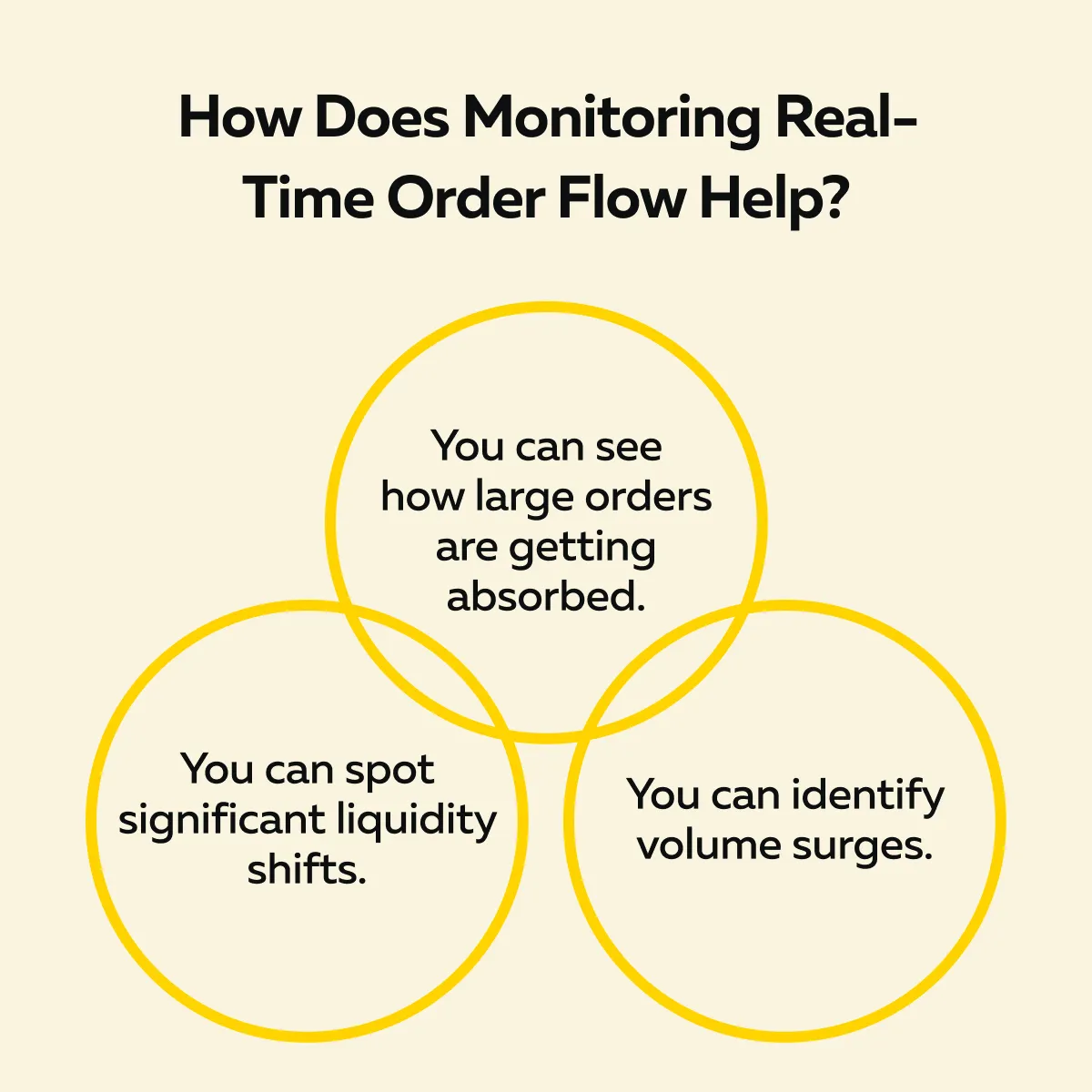
Be aware that these signals can indicate imminent price movements. Using them, you can smartly adjust your positions accordingly.
Why Order Flow Is Important?
- Identify Key Liquidity Zones: You can see where large buyers or sellers are positioned.
- React to Market Changes: You can detect sudden shifts in order flow to exit or adjust positions quickly.
For example,
- Let’s assume a trader is using our platform, Bookmap’s heatmap.
- They notice heavy selling liquidity forming at a resistance level.
- This large order absorption prevents the price from rising further.
- Recognizing this, the trader exits their long position.
- By doing so, they preserve their profits before a likely market reversal.
Using Bookmap to Navigate Zero-Day Options Volatility

Be aware that in zero-day options trading (0DTE trading), market conditions can change within seconds. By using our tool, Bookmap, you gain a unique advantage! You get several real-time visual insights into market dynamics. These cues allow you to make better decisions during periods of high volatility. Let’s see how:
How Bookmap Helps in 0DTE Trading?
Bookmap’s advanced visualization tools allow traders to:
| Track Liquidity Shifts | Monitor Buyer and Seller Activity | Identify Significant Volume Changes |
|
|
|
Now, let’s gain more clarity by checking out two practical cases:
| Case I: Identifying Short-Term Reversal Zones | Case II: Confirming Breakout Scenarios |
|
|
Why Bookmap is a MUST for 0DTE Trading?
By using our Bookmap, you can better understand market intent. Using Bookmap’s heatmap, you can:
- Prevent impulsive decisions,
and
- Optimize trade timing.
Also, you can strategically enter and exit trades by identifying liquidity zones, which reduces the risk of poor entries/exits.
Best Risk Management Strategies for 0DTE Traders
The best-practice list above covers the basics. These strategies apply to the trade itself:
- Size by maximum loss, not by premium. Define the most you can lose in dollars, which for a spread is the width minus the credit, and keep it to a small share of the account. The 1% to 2% guideline above is a common starting point.
- Prefer defined risk if you sell. Spreads and iron condors have a known worst case. Naked options do not.
- Set a time-based exit. Decide in advance the latest time you will hold, for example closing short positions well before the final hour, when gamma, spreads and pin risk are highest.
- Treat event days differently. Scheduled events such as FOMC and CPI move prices, widen spreads and inflate premiums. Use smaller size, or sit out, unless the plan is specifically built for them.
- Use limit orders and check the spread. If the bid-ask spread is a large share of the premium, the trade starts at a disadvantage. Avoid market orders in thin or fast markets.
- Write the exit rules for both outcomes. Define where you cut a loser (a premium loss or a price level in the underlying) and where you take profit, so neither decision is made in the heat of the moment.
- Know your broker’s expiration rules. Cutoffs, margin and auto-liquidation policies differ, and they matter most on the day you are wrong.
- Keep a trade journal. Record the reason for entry, maximum loss, exit and fees on every trade. Patterns show up in the journal that do not show up in memory.
For sizing, see Bookmap’s guide to position sizing for success.
Intraday Financial Risk Management
Trade-level rules decide each position. Session-level rules decide how much the whole day can cost.
- Set a daily loss limit before the open. When it is hit, you are done for the day. This is the rule that protects the account from the day that goes wrong in sequence.
- Cap the number of trades. More trades mean more spreads and fees and more chances to chase. Many traders also stop after a set number of consecutive losses.
- Do not double up after a loss. Increasing size to win back a loss is the pattern behind the account-wiping example earlier in this article.
- Run a pre-session checklist. Check the event calendar, mark your key levels, confirm your maximum loss per trade, check your buying power and note your broker’s expiration cutoffs.
- Trade only risk capital. Use money you can afford to lose entirely, because with 0DTE options a total loss of the premium is a normal outcome.
- Review before you resume. After a large loss, step away. Replaying sessions is a low-cost way to rehearse without risk, and Bookmap’s guide to Replay Mode shows how.
Conclusion
Zero-day options trading (0DTE) offers an opportunity to earn smart profits in the market. Through it, you can capitalize on rapid price movements. Also, the capital requirements are low. However, the rapid time decay and volatility can quickly erode gains!
Therefore, you must set clear stop-loss orders, avoid emotional decision-making, and manage position sizes to succeed. Additionally, you can start using our real-time market analysis tool, Bookmap. It offers real-time insights into market liquidity and order flow. You can also identify key price levels, spot potential reversals, and refine entry and exit points on our platform.
Navigate rapid market movements with clarity—visualize liquidity instantly with Bookmap.
FAQs
What are the main risks of 0DTE options?
The main risks are fast time decay, gamma (small moves causing large changes in option value), wide spreads and poor fills late in the day, implied volatility collapsing after events, and, for sellers, losses that can be many times the premium collected. In the best-known study of retail results, retail traders lost money on average.
Can you lose more than your investment on zero DTE options?
Not if you only buy options: the most you can lose is the premium. If you sell naked options you can lose far more than the premium, and a fast move can leave you owing your broker. Spreads and iron condors cap the loss at a defined maximum.
How does gamma risk affect 0DTE options?
Gamma makes an option’s delta change quickly as price moves, and it is highest for at-the-money options close to expiration. Sellers who are short gamma see losses accelerate when the market moves against them. Buyers who are long gamma see gains accelerate, but they pay for it through time decay.
Is buying or selling 0DTE options riskier?
They carry different risks. A buyer’s loss is limited to the premium but the odds work against them. A seller wins more often but can lose far more than the premium collected, especially with naked options.
What is the difference between SPX 0DTE options and single stock options?
SPX options are cash-settled, cannot be exercised early and have daily expirations. Stock and ETF options settle in shares and can be assigned early, and single stocks mostly expire on Fridays, with Monday and Wednesday expirations on some mega-caps since January 2026.
What happens to a 0DTE option at expiration?
An SPX option settles in cash based on the index’s closing value, and cash moves the next business day. A stock or ETF option that finishes at least $0.01 in the money is automatically exercised, and shares settle one business day later.
Will my broker close my 0DTE options before expiration?
It can. If your account lacks the buying power or margin to handle exercise or assignment, many brokers close option positions before expiration, often in the final hour. Brokers also set cutoffs for opening new positions and deadlines for do-not-exercise requests, so read your broker’s expiration-day policy.
What is pin risk?
Pin risk is the uncertainty about assignment when the underlying closes at or very near the strike of an option you are short. An option that is out of the money for most of the day can finish a cent in the money and be exercised.
What are the best risk management strategies for 0DTE traders?
Size by maximum loss, prefer defined-risk structures if you sell, set a time-based exit, treat event days differently, use limit orders, write exit rules in advance, and set a daily loss limit.
What share of SPX options volume is 0DTE?
Cboe reported a record 66.2% in July 2026, up from about 20% in 2020.
Sign Up Now
Latest Articles