


See market activity more clearly in real time.
Compare plans to access deeper market visibility for market activity.
Trading Basics
November 28, 2025
SHARE
How Pro Traders Review Their Year and Plan for the Next Quarter

Every December, professional traders slow down their execution and shift into evaluation mode. They treat the end of the year as a performance audit. The goal is simple. Understand what worked, what failed, and what needs to change. A clean review sets the foundation for the next quarter, which is why pros approach this process with structure instead of emotion.
Below is a clear, repeatable framework used by experienced traders to review their year and build an actionable plan for the months ahead.
Start With a Clean, Data Driven Summary of Your Year
The first step is to gather the data. Pro traders never begin a review based on memory. They collect all the numbers that show how they actually traded.
Important metrics include:
- Total number of trades
- Win rate compared to risk to reward
- Average hold time
- Average heat taken on winning trades
- Biggest winner compared to biggest loser
- Days with the worst slippage
- Days where rules were broken
- Days with unusually strong performance
This creates clarity. When the full year is summarized in data, patterns appear that were invisible in daily execution.
Classify Each Day by Market Type
Pros do not review their year as one continuous environment. They break it down by market structure.
- Trend days
- Balance or range days
- News driven days
- Low volume drift days
- High volatility days
This shows where the trader’s edge held up and where it struggled. Many traders perform well on trend days but lose consistently during balance. Others excel during high volatility but underperform when conditions compress. Knowing this distinction is essential for next quarter planning.
Remove Outliers to See Your True Baseline
A single large win or loss can distort the entire year. Pro traders temporarily remove these outliers to see their “core performance.” This tells them whether the year was built on consistency or a few events that will not repeat.
Study Your Best and Worst Trades in Detail

Once the data is organized, pros zoom into the trades that mattered most.
Choose Your Top Five and Bottom Five Trades
The goal is not to review every trade. The goal is to review the trades that reveal your behavior.
For each of these ten trades, record:
- Market context
- Reason for the idea
- Order flow confirmation or lack of it
- Entry and exit logic
- What you did well
- What you would change now
This section often exposes a simple truth. Most traders know why their best trades worked. They rarely understand why their worst trades happened. The worst trades usually reveal the real problems.
Look for Clusters Across the Year
Pro traders check whether certain patterns repeat themselves.
Examples:
- Worst trades cluster around FOMC days.
- Best trades occur near prior day extremes.
- Losses grow during low volume environments.
- Rule breaks increase during afternoon sessions.
Clusters tell you where discipline weakens or where the strategy is mismatched with conditions.
Evaluate the Strategy Itself, Not Just the Execution

A yearly review is not only about discipline. It is also about whether your strategy fits the current market environment.
Check if Your Core Setups Still Work
Volatility rises and falls. Liquidity conditions shift. Some setups become less frequent or require different timing. Pros evaluate each setup individually.
For each setup, record:
- How many times it appeared this year
- Win rate
- Average drawdown
- Average reward
- Quality of structure
- Liquidity behavior
This tells you which setups deserve priority next quarter.
Identify Strategy Variants Worth Keeping
Over the year, you may have discovered small variations of your setups. Professionals document these variants and decide which belong in the playbook and which should be removed.
Audit Your Rules and Discipline
No review is complete without analyzing personal behavior. Execution errors usually cost more than strategy flaws.
Identify Where You Broke Your Own Rules

Common issues include:
- Taking impulse trades
- Fighting trend days
- Moving stops
- Hesitating on clean signals
- Forcing trades in low volume conditions
Pro traders quantify how much these errors cost them. This is often uncomfortable but essential.
Create a Short List of Non-Negotiable Rules

This list becomes the foundation for next quarter. It is brief and practical. Examples:
- No entries until the first liquidity shift appears.
- One trade per zone unless structure changes.
- Reduce size when volatility drops below a defined threshold.
- No afternoon trading unless the morning was profitable.
Rules only matter if they are simple enough to follow every day.
Build a Structured Plan for the Next Quarter
The review ends with action. Pros build a plan that focuses on improvement, not perfection.
Choose Two or Three Focus Areas
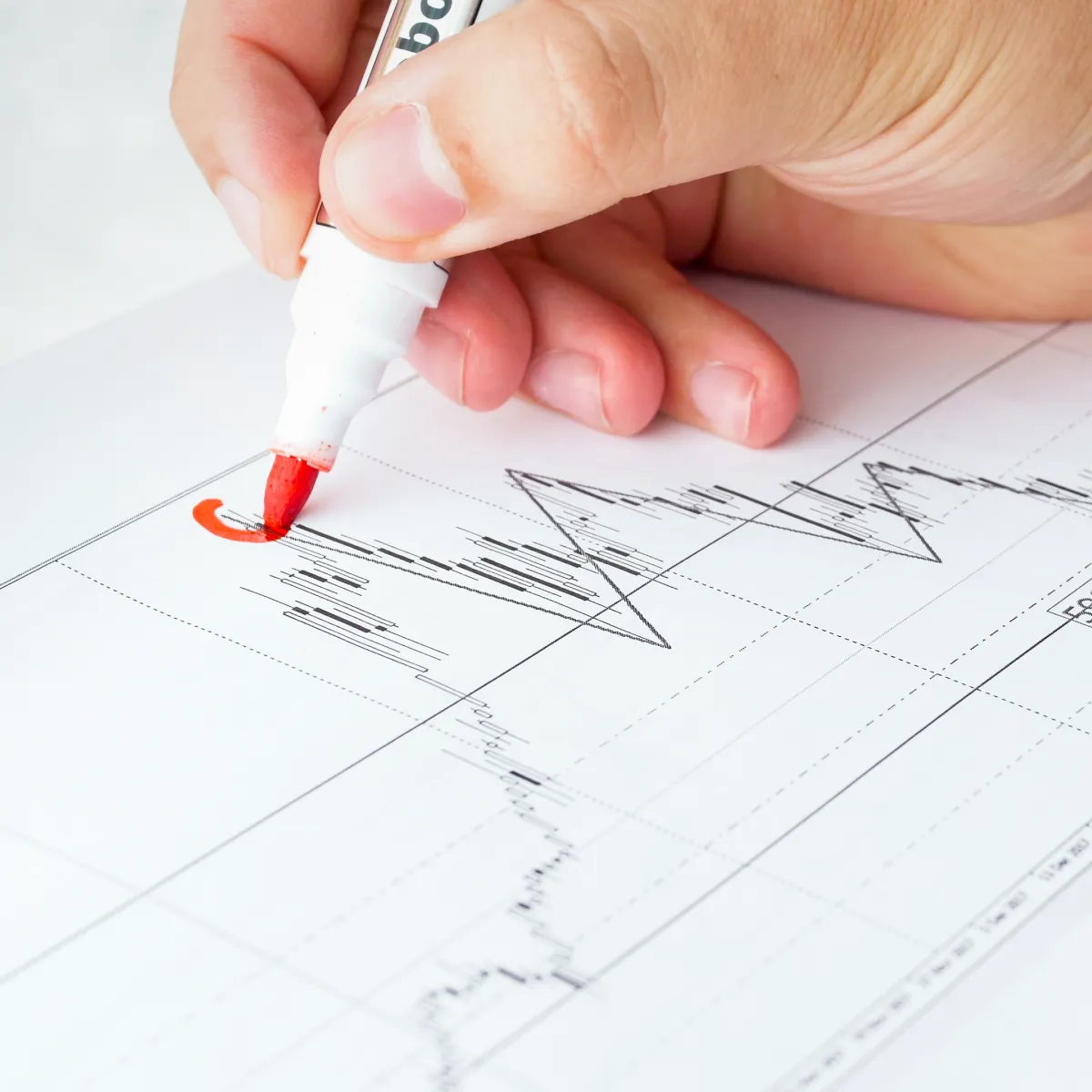
These are the themes that will guide your next quarter. Examples:
- Better timing around liquidity
- Cleaner stop placement
- Patience during chop
- More observation time before the open
A plan with too many goals always fails. A plan with a small number of priorities leads to measurable progress.
Set Milestones You Can Track Weekly
Examples:
- Record and review the first 30 minutes of every session for three weeks.
- Limit trades in the first five minutes of the open.
- Practice waiting for confirmation instead of anticipating the break.
Weekly milestones keep the quarterly plan alive.
Refresh Your Tools and Workspace
Pro traders finish by preparing their tools.
- Clean your charts and remove unnecessary indicators
- Review your layouts and alert logic
- Confirm your data feeds are stable
- Make sure you have deeper context when volatility changes
- Ensure your execution tools match your time horizon
A clean workspace reduces friction and sharpens your focus for the new quarter.
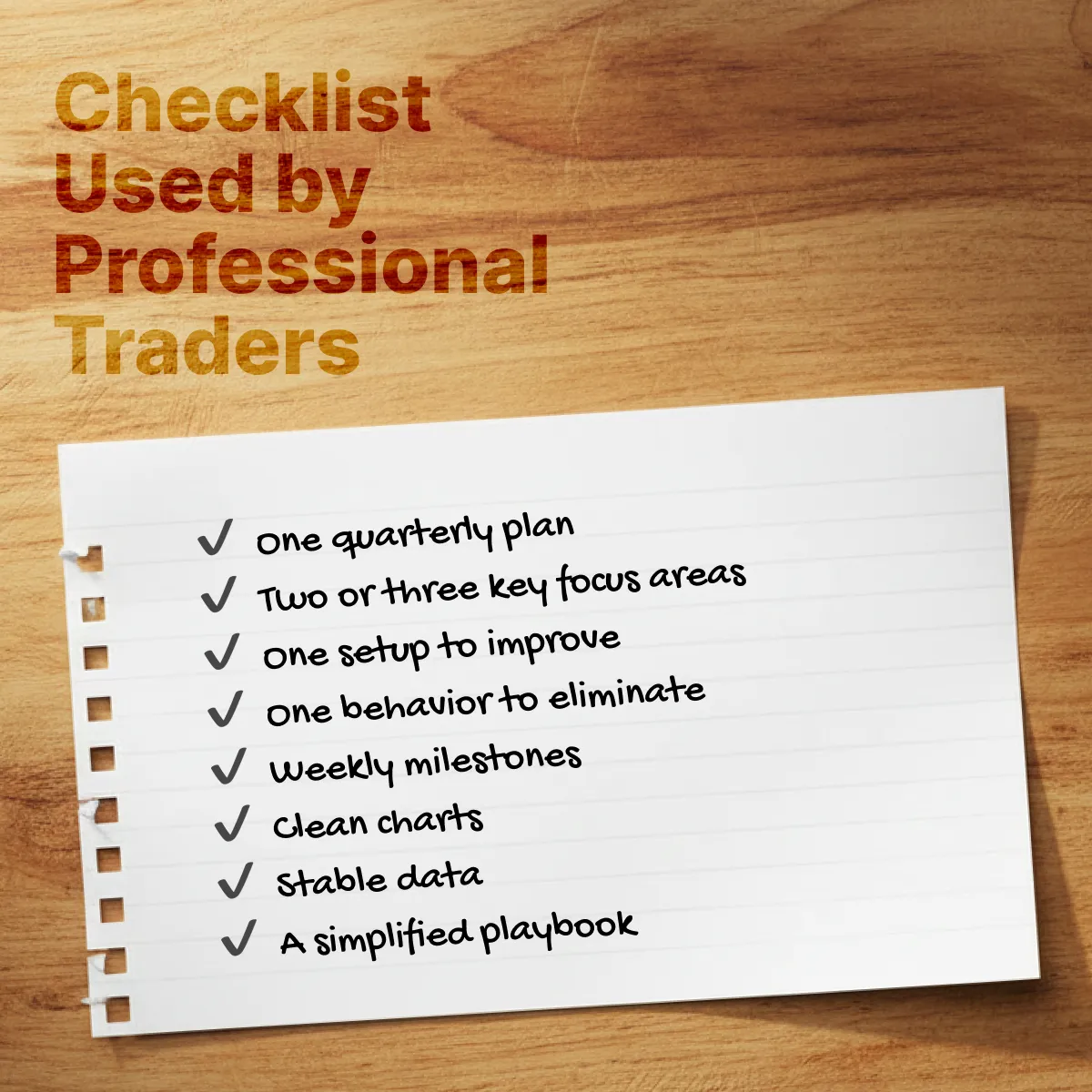
Trading becomes clearer when the process is planned instead of improvised.
Conclusion
A yearly review is not about judging your performance. It is about understanding it. Professional traders use this process to reduce uncertainty, tighten their strategy, and enter the next quarter with clarity.
If you complete these steps, you will begin the year with structure instead of hesitation.
Sign Up Now