


See how institutional traders respond to modern markets.
Compare plans to follow liquidity, execution, and positioning in real time.
Market Analysis
May 12, 2026
How Does a Goldman Sachs Trader Trade Today? What Modern Institutional Trading Really Looks Like
Markets don’t reward wild predictions. Modern institutional traders make thorough decisions based on data analysis, market liquidity, order flow, macroeconomic signals, and predefined trading rules. Usually, the result is “disciplined execution” that leads to profitable trades.
Additionally, within large institutions, trading is not handled by a single expert but by multiple specialised desks working together.
This article talks about how a Goldman Sachs trader actually operates today, from pre-market preparation to real-time execution and risk control. It also explains the role of technology, collaboration, and structured decision-making. By the end, readers will understand how institutional traders think, act, and manage uncertainty in today’s markets.
First, “Goldman Sachs Trader” Could Mean Several Different Jobs
The phrase Goldman Sachs trader creates the impression of a single expert managing all market activity. However, within an institutional trading desk, responsibilities are divided across multiple specialised roles. As a result, how bank traders trade depends on the function assigned to each desk. For example,
| Trader A: Operating as a “Market Maker” | Trader B: Handling Foreign Exchange Exposure | Trader C: Managing Trade Execution |
|
|
|
This distinction continues across other desks.
- For example, a macro or rates trader tracks government bond markets such as U.S. Treasuries, where decisions are influenced by:
- Yield movements
- Auction outcomes, and
- Central bank signals.
- Meanwhile, a systematic or quantitative desk may rely on models and algorithms rather than discretionary judgment.
Therefore, the Goldman Sachs trader strategy is not a single unified method. Instead, it is a collection of different specialised approaches. Furthermore, such a variety also creates differences observed in a professional trader workflow, where each desk follows its own process based on:
- Market structure
- Risk exposure, and
- Client requirements.
Additionally, in comparison of hedge fund vs bank traders, the hedge funds may deploy capital with a single strategy or theme, whereas banks operate multiple desks simultaneously, each with a defined mandate.
As a result, there is no single way to define how investment bank traders trade, as institutional activity represents a “coordinated system” of multiple trading functions (rather than following any uniform approach).
The Modern Institutional Edge Is Usually Process, Not Prediction
Retail narratives assume that institutions win because they can predict price direction with high certainty. However, observations from an institutional trading desk suggest that the advantage usually comes from “process” rather than prediction. And this process is built on several coordinated elements:
- Sequential organisation of market information across desks
- Advanced trading systems and infrastructure
- Defined risk limits and strict position sizing rules
- Continuous access to client order flow
- Collaboration between traders, analysts, and risk teams
- Disciplined execution methods
- Ongoing evaluation of risk versus reward
As a result, the professional trader workflow reflects consistency. Let’s better understand through an example of an institutional desk trading gold. Its approach might not be to predict whether prices will rise during the day, but to identify some major conditions influencing the trade, such as:
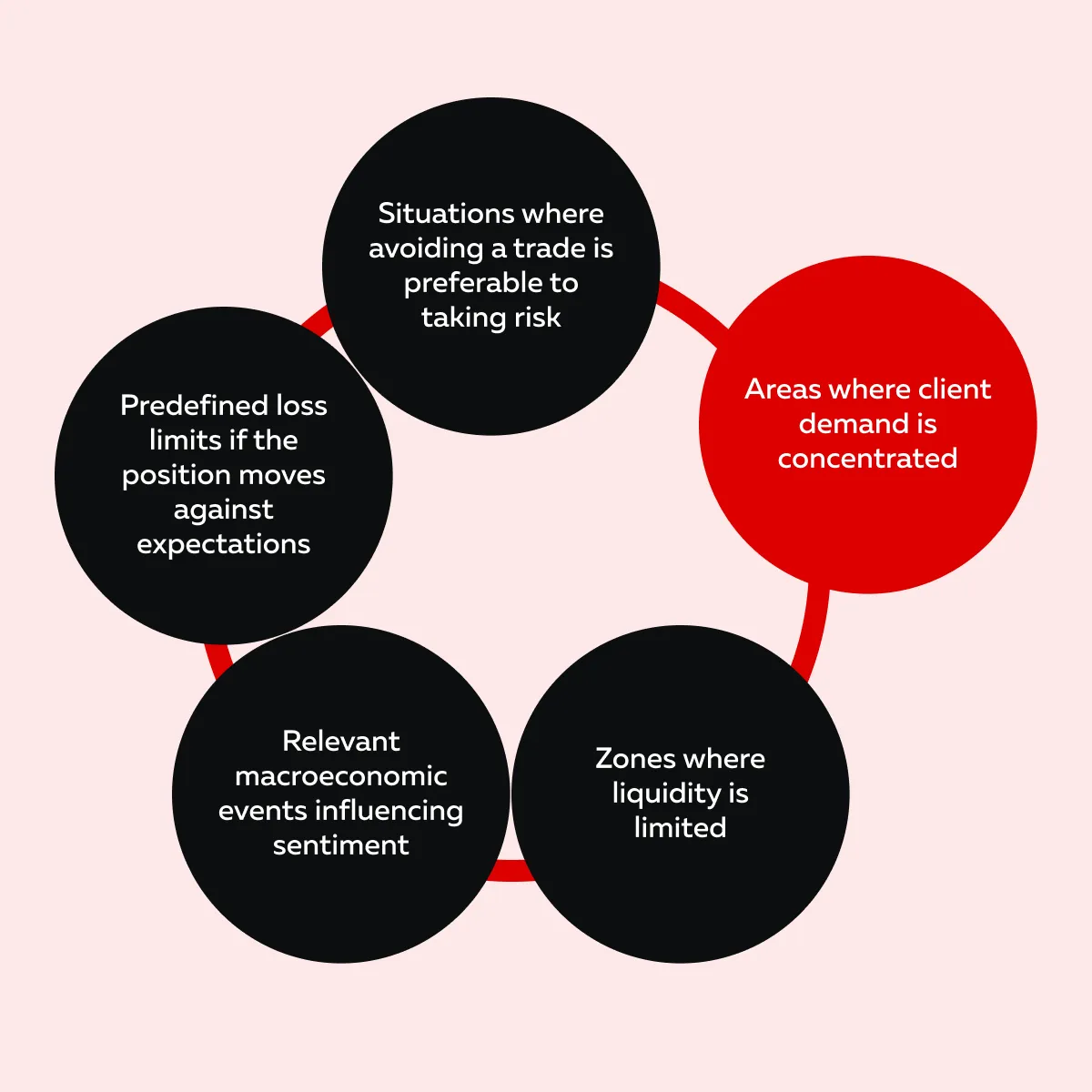
Retail approaches usually seek confirmation about direction before entering a trade. In contrast, observations of how bank traders trade show a preference for managing probabilities within controlled risk frameworks.
Consequently, what may appear as a Goldman Sachs trader strategy is rarely a prediction-driven model. Instead, it reflects a structured process where outcomes remain uncertain, but risk is measured and contained. See how professionals analyze liquidity and execution → Compare Packages
How a Professional Trader’s Day May Actually Start
A day on an institutional trading desk begins before markets open. This early preparation influences how investment bank traders trade during the session. As a result, activity at the open is rarely reactive. In the preparation phase, usually a review of the following market inputs is performed:
- Overnight price movements across global markets
- Major macroeconomic headlines and developments
- Scheduled economic data releases
- Central bank commentary and policy signals
- Options positioning and implied expectations
- Prior session liquidity zones and key price levels
- Cross-asset relationships such as equities, bonds, and currencies
- Existing desk positions and risk exposure
Based on this review, traders form these scenario-based questions that guide the day:
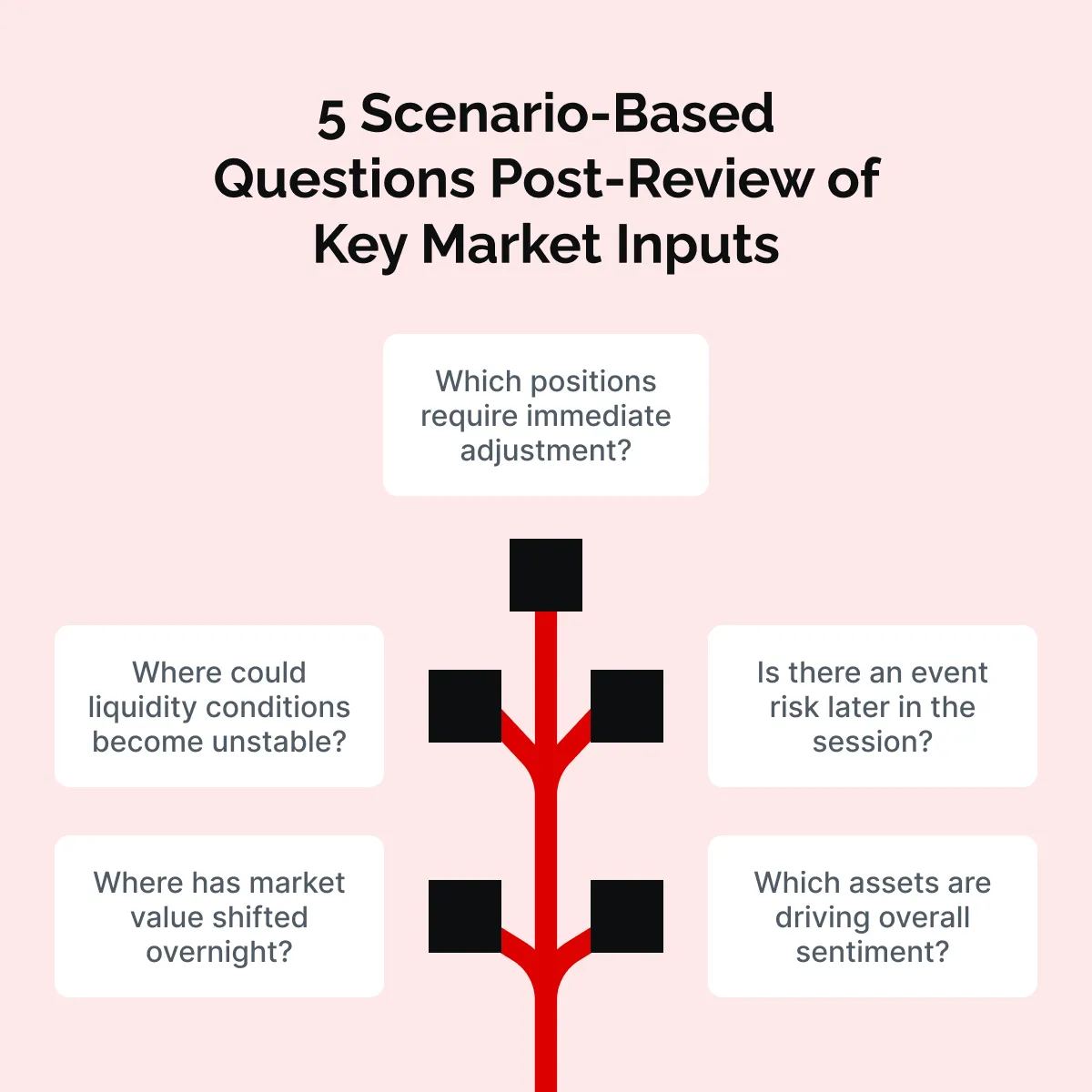
In this way, the professional trader’s workflow reflects preparation before participation. Usually, markets are approached with predefined scenarios, rather than decisions formed after the opening bell.
Execution Matters More Than Most Retail Traders Realize
Once the market opens, execution becomes highly important. This is because institutional order size can influence price movement. Entering a large position without planning may shift the market against the trade itself. To avoid such negative situations, institutions may use these “execution methods” to manage impact:
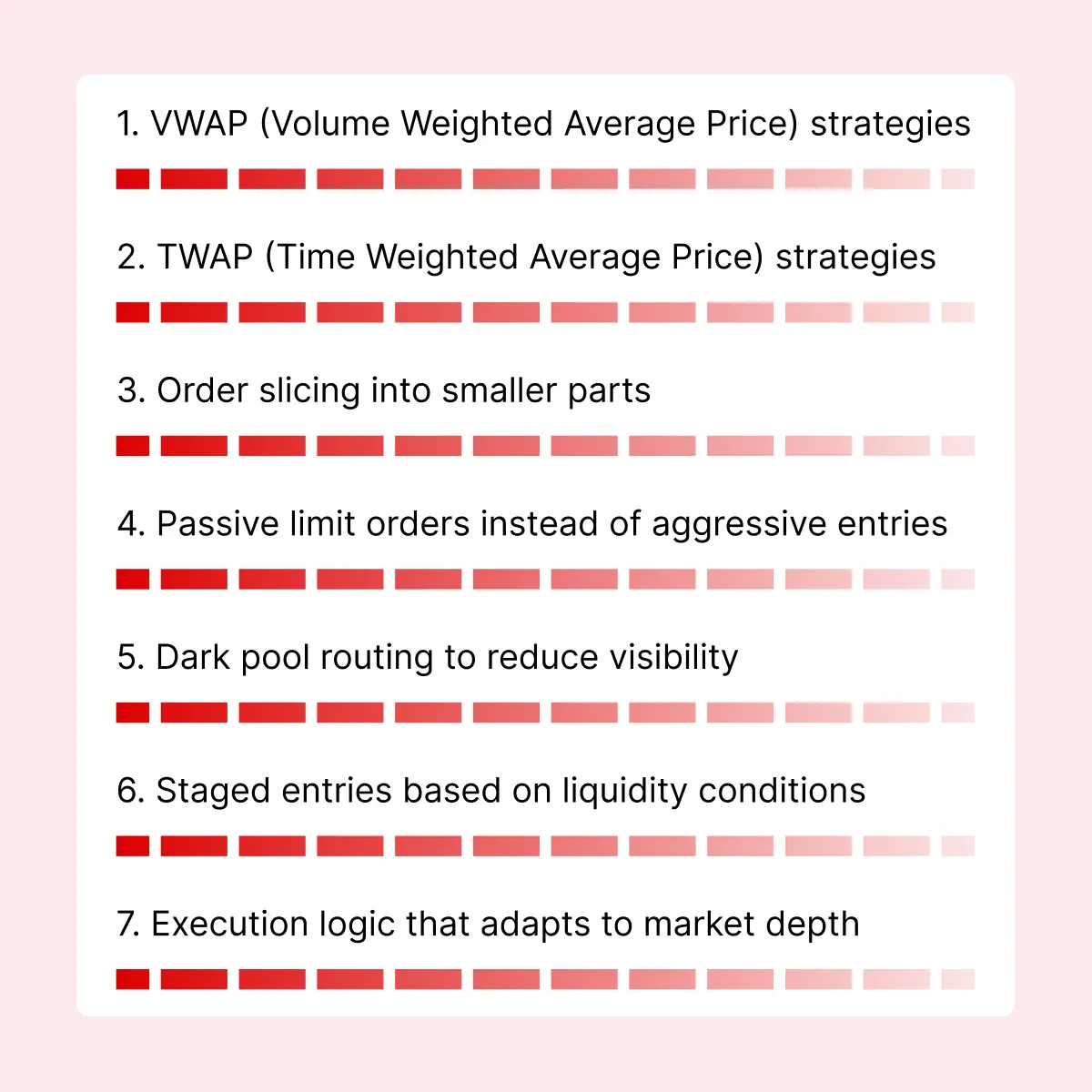
These methods show that execution is not a single action but a process. Post-execution, such institutional traders also evaluate outcomes using these metrics:
- Average fill price relative to market benchmarks
- Degree of market impact caused by the order
- Timing of entries across different liquidity windows
- Availability of buyers and sellers at different price levels
In contrast, retail perspectives usually emphasise “directional accuracy” alone. However, observations from institutional environments indicate that trade entry and exit quality carry equal importance.
This difference also appears in the broader hedge fund vs bank trader comparison. While both consider direction, institutional desks place strong emphasis on execution. See how professionals analyze liquidity and execution → Compare Packages
Risk Limits Often Control the Trader More Than Opinions Do
One of the less visible aspects of an institutional trading desk is “risk governance”. While market opinions exist, actual trade size and exposure are usually determined by predefined limits. As a result, how bank traders trade is influenced more by constraints than by conviction alone. Let’s have a look at some institutional constraints:
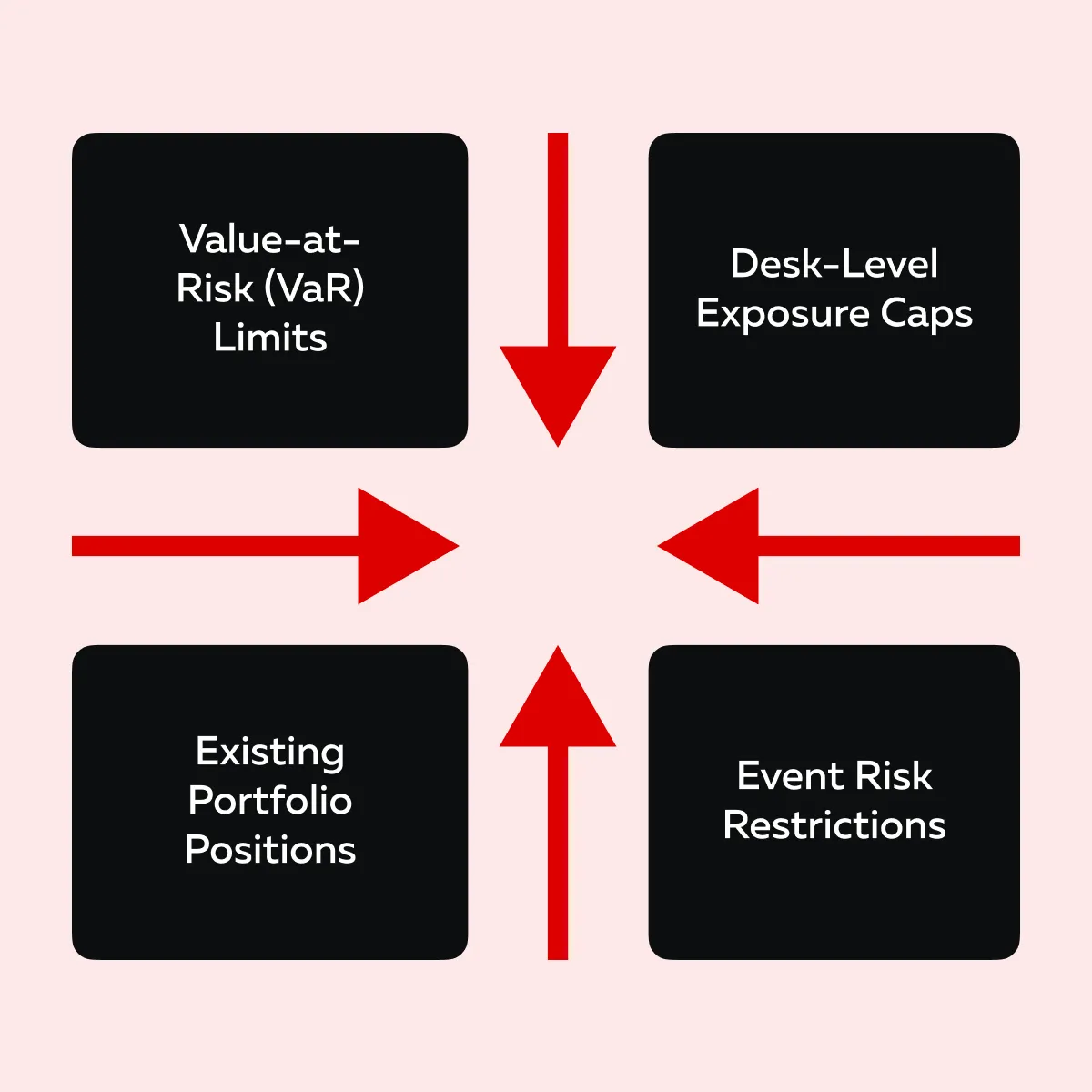
Therefore, even a strong market view may not translate into a large trade if it conflicts with these controls. Now, this leads to the development of a different execution strategy as compared to retail participation. Most institutional traders operate within a framework that balances multiple variables at the same time:
- Strength of market conviction
- Available liquidity in the market
- Correlation with other positions on the desk
- Acceptable drawdown levels
- Firm-wide risk limits and mandates
Consequently, “aggressive positioning” is absent from the professional trader workflow. Note that their objective is not to maximize a single opportunity, but to maintain consistency and stay within defined boundaries.
What They Watch Intraday
Once the trading session is active, most traders shift their attention to real-time market signals. These signals are usually interpreted within context rather than in isolation. Let’s see what inputs a professional desk may monitor simultaneously:
- Price behaviour around key levels identified earlier
- Quality and direction of order flow
- Activity around major options strike levels
- Reactions across related markets such as equities, bonds, and currencies
- Breaking news and macro developments
- Bid-ask spreads and transaction costs
- Changes in volatility
- Shifts in liquidity conditions
These observations are then combined to form a broader market view. Let’s understand better through an example,
| Suppose Equity Index Futures Rise | Suppose Price Breaks Higher |
|
|
Therefore, institutional behaviour reflects “context-based” interpretation. Price alone is rarely sufficient, and instead, multiple signals are assessed together.
Technology and Automation Are Now Part of the Job
Modern trading at an institutional trading desk no longer depends on individual instinct alone. Instead, it operates within a system where technology supports decision-making. Nowadays, investment bank traders use a combination of human judgment and automated tools.
Let’s have a look at some tools commonly used:
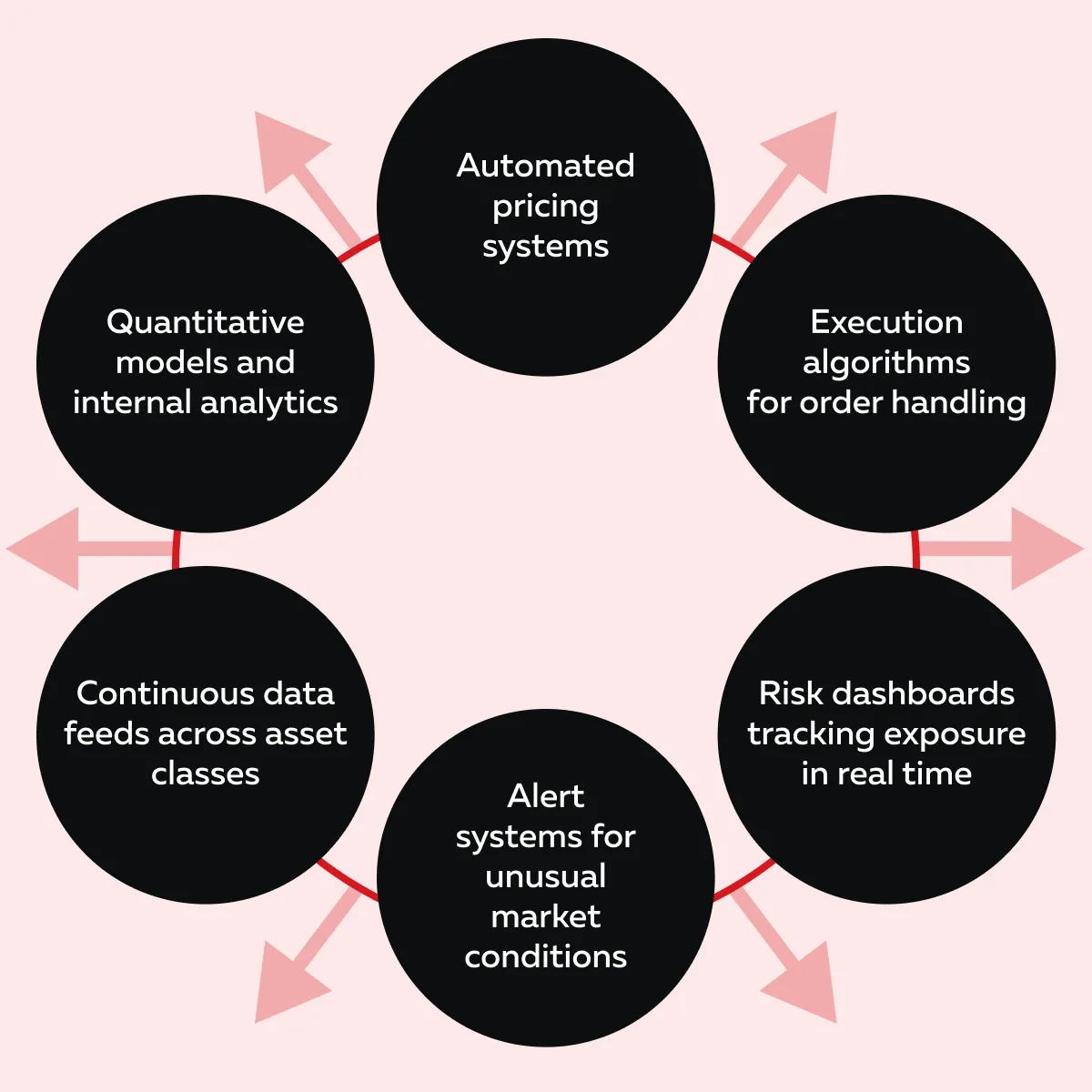
In such a trading setup, technology handles repetitive and data-heavy tasks, while the trader evaluates outcomes and makes strategic decisions. For example,
- An execution algorithm may manage a large parent order across time.
- At the same time, a risk dashboard may indicate rising exposure, or an alert may signal abnormal volatility.
- The trader then decides whether to reduce, increase, or hedge positions.
In this way, the modern professional trader workflow is based on collaboration between systems and human input. What may appear as a Goldman Sachs trader strategy is usually supported by “layered tools” that enhance visibility and control (rather than replacing the trader’s role).
What Retail Traders Can Actually Learn From This
Usually, retail participants do not have access to institutional infrastructure. However, they may follow several observable habits of bank traders, such as:
- Preparation before the session instead of reacting after the open
- Attention to execution quality alongside trade direction
- Reduced position size during uncertain conditions
- Objective tracking of trading performance
- Decision-making based on probabilities (rather than certainty)
- Use of automation and technologically advanced tools that show liquidity and market participation
By following these habits, retail readers may almost replicate a professional trader’s workflow. At the same time, there also emerges a major difference in favour of retail participants. Usually, institutions remain “active” due to client obligations and market-making roles. In contrast, retail participants retain flexibility, including the option to stay out of the market when conditions are unclear. Understand the market mechanics institutions watch → Compare Plans
Conclusion
Modern institutional trading is not about predicting the market. Instead, it is about following a pre-defined process. Usually, a Goldman Sachs trader works within a specialised role (rather than using a single trading strategy) and prepares trading setups using market data.
Before the market opens, they analyse global trends, risks, and key events. During the session, execution and risk control matter as much as trade direction. Besides, nowadays, they are supported by technology and automation tools, which support decision-making.
Overall, success comes from discipline and managing probabilities rather than chasing certainty. While retail traders may not have the same resources, they can still improve by focusing on preparation, better execution, and controlled risk-taking instead of trying to predict every market move. Learn how modern traders read participation in real time → Compare Packages
FAQs
1. Do Goldman Sachs traders know where the market is going?
No, in financial markets, no participant is aware of the exact direction. At most, they can estimate possible outcomes by studying data, news, and market behaviour. Also, they mostly focus on managing risk and probabilities, as usually their goal is to stay prepared for different scenarios (rather than being right every time).
2. Do institutional traders use technical analysis?
Yes, but not in isolation. They may use charts and price levels along with:
- Macro data
- News
- Order flow, and
- Market positioning
This gives a more complete view. Note that technical analysis is just one part of a bigger decision-making process.
3. Do banks use algorithms instead of human traders?
Usually, banks use both and don’t replace traders with algorithms. In combined usage, algorithms handle fast and repetitive tasks like:
- Placing orders
- Adjusting prices, and
- Managing large trades
On the other hand, human traders focus on bigger decisions, like interpreting news, managing risk, and deciding strategy. So, technology improves speed and accuracy, while humans provide judgment and control.
4. Can retail traders compete with institutional traders?
Retail traders may not match size or advanced tools, but they have flexibility. They can trade less, wait for better setups, and avoid unnecessary risk. By staying patient and disciplined, they can still perform well in specific market situations.
Sign Up Now
Latest Articles