


See order flow more clearly in real time.
Compare plans to access deeper market visibility for order flow.
Education
March 5, 2026
The Best Way to Learn Order Flow in 2026
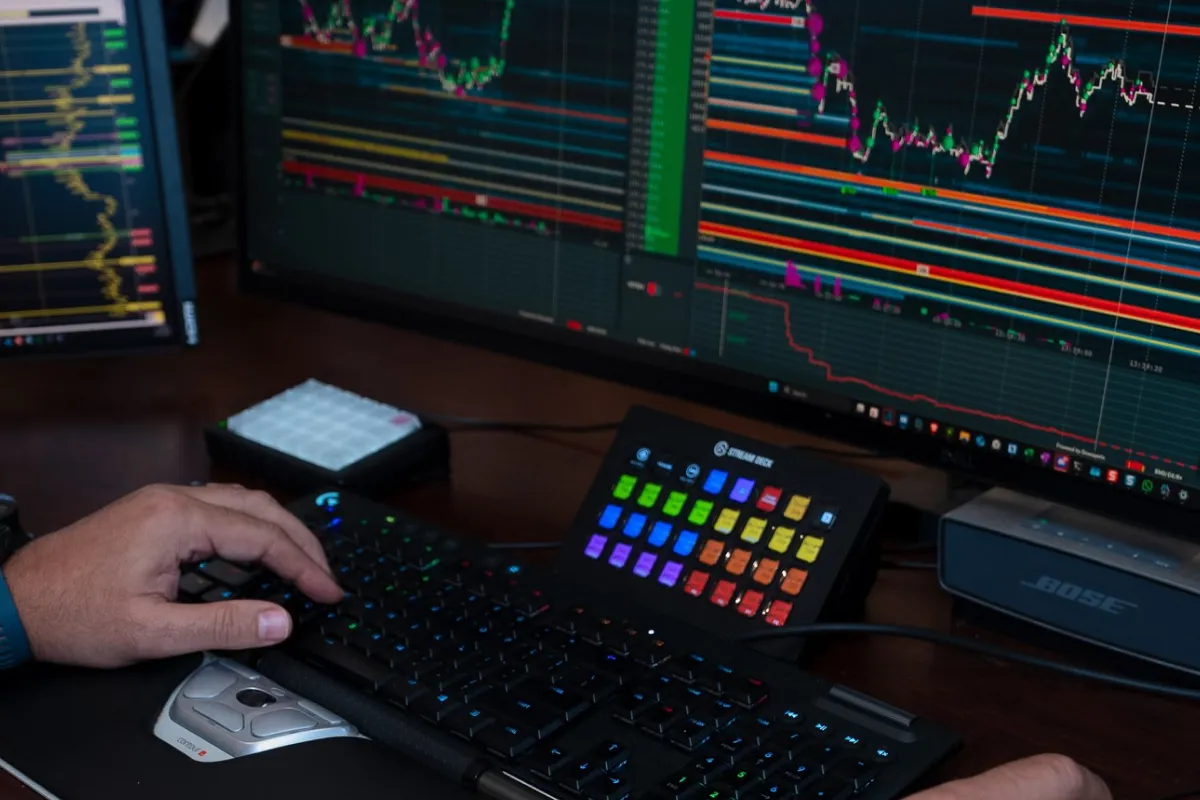
Most traders start learning order flow by chasing signals, such as delta spikes, fast tape, and sudden volume, which is the wrong approach as it treats order flow like an “indicator”. Traders expect an automatic price reaction and enter trades without understanding where the activity is occurring.
Later, when the price does not move, they assume order flow failed, when in reality the interpretation was incomplete. The right approach is to make an order flow analysis to study market behaviour (not signals).
Order flow should first be used to understand context, participation, and liquidity. Instead of asking, “Is this a buy or sell signal?”, the better question is, “What is the market doing here?” This educational article will delve deep into the concept of order flow.
Why Learning Order Flow Feels Harder Than It Should
For many new traders, learning about order flow can feel confusing because the education around it is scattered. Most are introduced to concepts, such as:
- Delta,
- Absorption,
- Liquidity, and
- Exhaustion.
But the trainers and bootcamp mentors fail to show how they all tie together. Hence, instead of understanding the market’s story, they end up memorising signals. Take exhaustion as an example. Usually, beginners are taught to treat exhaustion as an “automatic reversal signal”. Thus, they try to see:
- Aggressive buying slows down,
and
- Expect the price to turn.
But markets don’t move just because aggression fades. A move only ends when participation is complete or when strong liquidity steps in. Without that context, the signal is misunderstood, which is a common mistake in order flow trading for beginners.
Another Issue is Expectation
Many traders try to learn order flow trading only to find entries. When results don’t materialize, they assume order flow doesn’t work and quit. That’s the wrong approach! The best way to learn order flow is first to understand why prices move (not just where to enter).
Always remember that in 2026, markets are fast and highly automated. Today, shallow concepts fail. Thus, a trader must learn to read:
- Participation,
- Transactions, and
- Acceptance.
Here is an example that elucidates how they benefit:
- Assume that a trader sees aggressive buying on the tape.
- In response, they decide to go long, but the price doesn’t move.
- This event happened because liquidity absorbed the buying.
This is where the correct interpretation of order flow is critical. Always remember that order flow only shows intent, but interpretation makes all the difference.
What Order Flow Actually Is
At its simplest, order flow is a record of actual transactions. It shows the following:
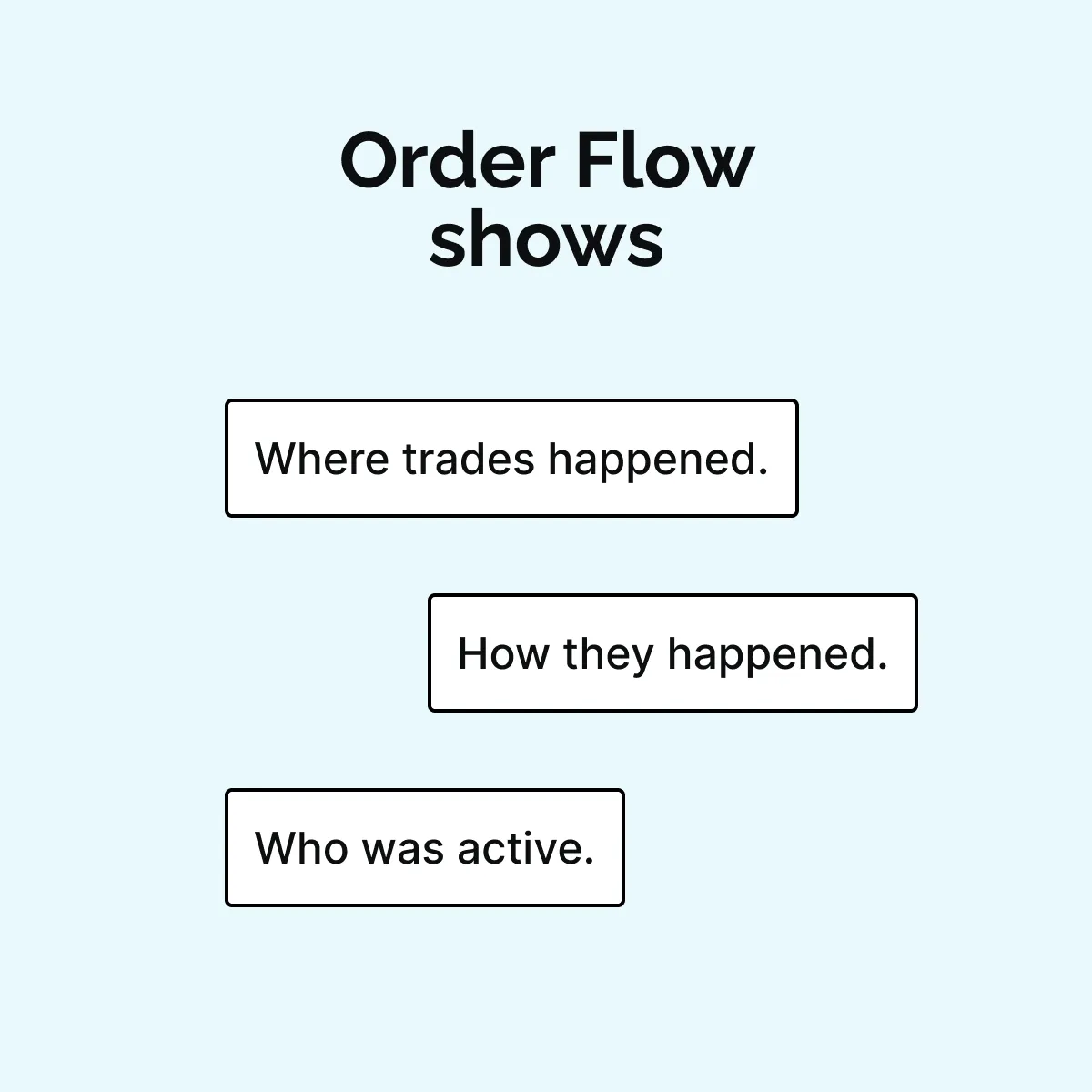
By analyzing order flow, traders can see whether:
- Buyers or sellers were aggressive,
and
- Price accepted the activity or rejected it.
Realize that this is the foundation of order flow trading for beginners. As traders progress in their learning journey, they understand that the primary objective of order flow analysis is not to predict direction. Order flow does not say, “price will go up” or “price will go down.”
Instead, it explains:
- Why did the price move?
or
- Why did it not move (despite heavy activity)?
Usually, this concept is described as “effort versus result”. A lot of effort with little price movement indicates strong liquidity.
An Important Takeaway
When learning order flow trading, traders are only trying to get answers to these three questions:
- Where is trading actually happening?
- Who is being aggressive?
- Who is absorbing trades or stepping aside?
This is why order flow is not a strategy by itself. It is education. It teaches traders how markets function at the “transaction level”. Once they understand how participation and liquidity interact, they can build strategies that match real market behavior.
Step One: Learn to Observe Without Trading

The first and most crucial step to learning order flow is: do not trade. Just observe! Before placing trades, it is critical to understand how prices behave around actual buying and selling. Traders must spend the entire trading session watching how the price interacts with liquidity and transactions.
The advantage of this process is that it builds visual memory. Gradually, traders’ eyes start to recognize patterns without forcing them. Remember, this is a core habit for beginners in order flow trading. While observing, learners should specifically focus on these three things:
- Where does the price slow down?
- Where transactions increase, but the price stops moving?
- Where does the price move quickly with little resistance?
By making these observations, traders can better understand trading behaviour. For more clarity, here is an example:
- Assume that the price is moving toward a previous high.
- A trader sees a surge in transactions.
- However, the price fails to move higher.
- Many beginners think this is a show of strength.
- But in reality, it signals “absorption”.
- It shows that large sellers are absorbing aggressive buying.
Note that at this learning stage, there are no entries and no exits. A trader’s aim should not be to make money. Instead, they should focus on understanding why the price reacts the way it does, which is the best way to learn order flow.
Additionally, traders should also try to understand the difference between order flow vs. indicators. Lack of knowledge in this area usually pushes traders to act before they truly understand what is happening.
Step Two: Understand Context Before Signals
Order flow data by itself is not enough. To learn order flow properly, a trader must always read it “within context”. The reason is that without context, the same signal can mean completely different things. Be aware that context includes the following factors:
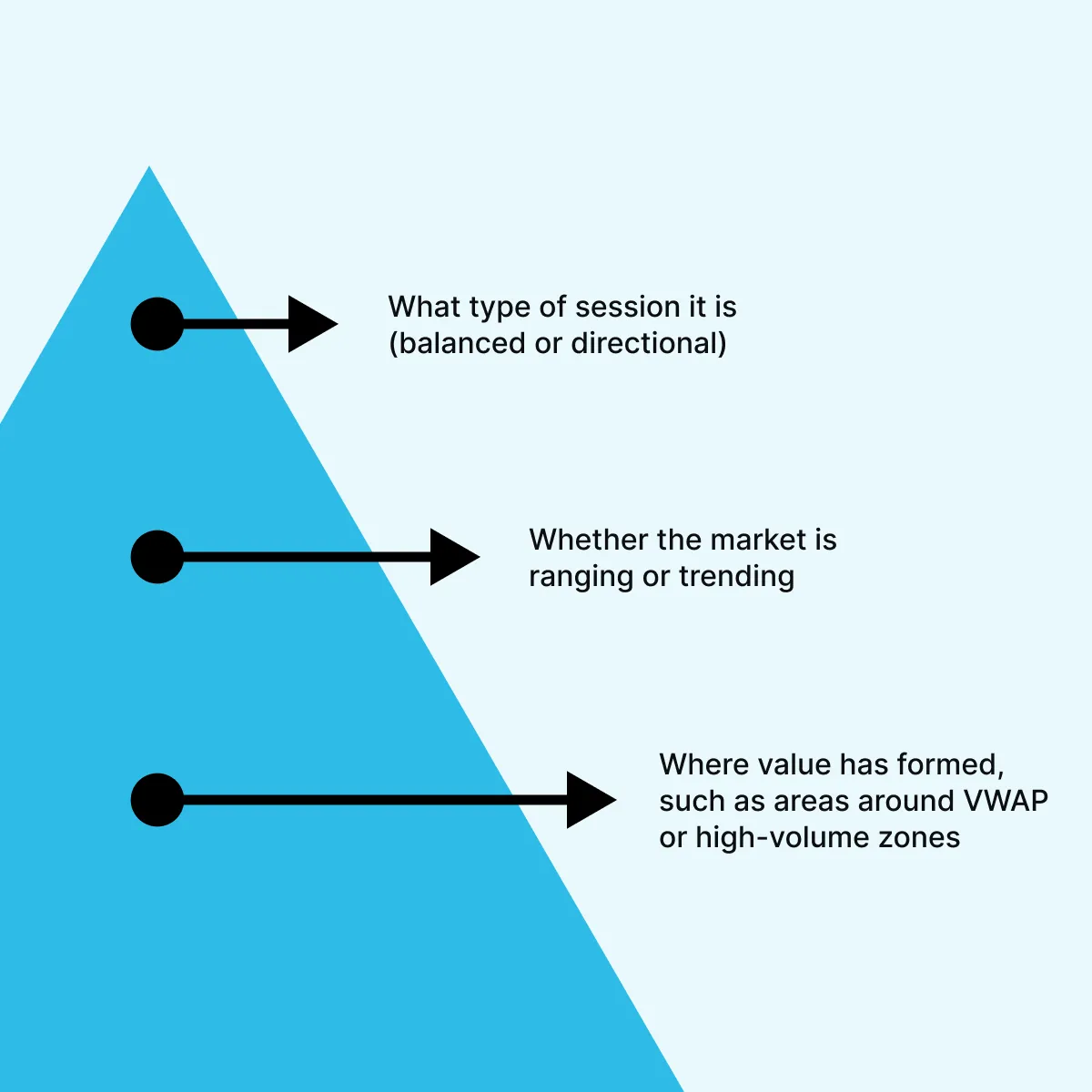
This area is where many traders struggle when they learn order flow trading. They see aggressive buying or selling and react immediately. But aggression only matters if the market cares about that area.
For example,
-
- Assume there is aggressive buying at VWAP during a balanced session.
- This buying indicates a two-sided trade and possible rotation.
- The same aggressive buying, far from value in a strong trend, may signal continuation (not rotation).
- The takeaway here is that the activity looks similar, but the meaning is radically different.
This is why, in the beginning, traders should try to understand the environment, as signals without context are just noise.
Step Three: Learn One Concept at a Time
One of the common reasons why traders struggle while learning order flow is because of the information “overload”. They try to understand everything at once, such as delta, absorption, exhaustion, liquidity, and VWAP. But nothing sticks, and order flow becomes confusing.
The better approach is to focus on one behavior at a time, which is particularly important in order flow trading for beginners, as “traders are training their eyes and not collecting signals”. Below is the ideal learning sequence a beginner may follow:
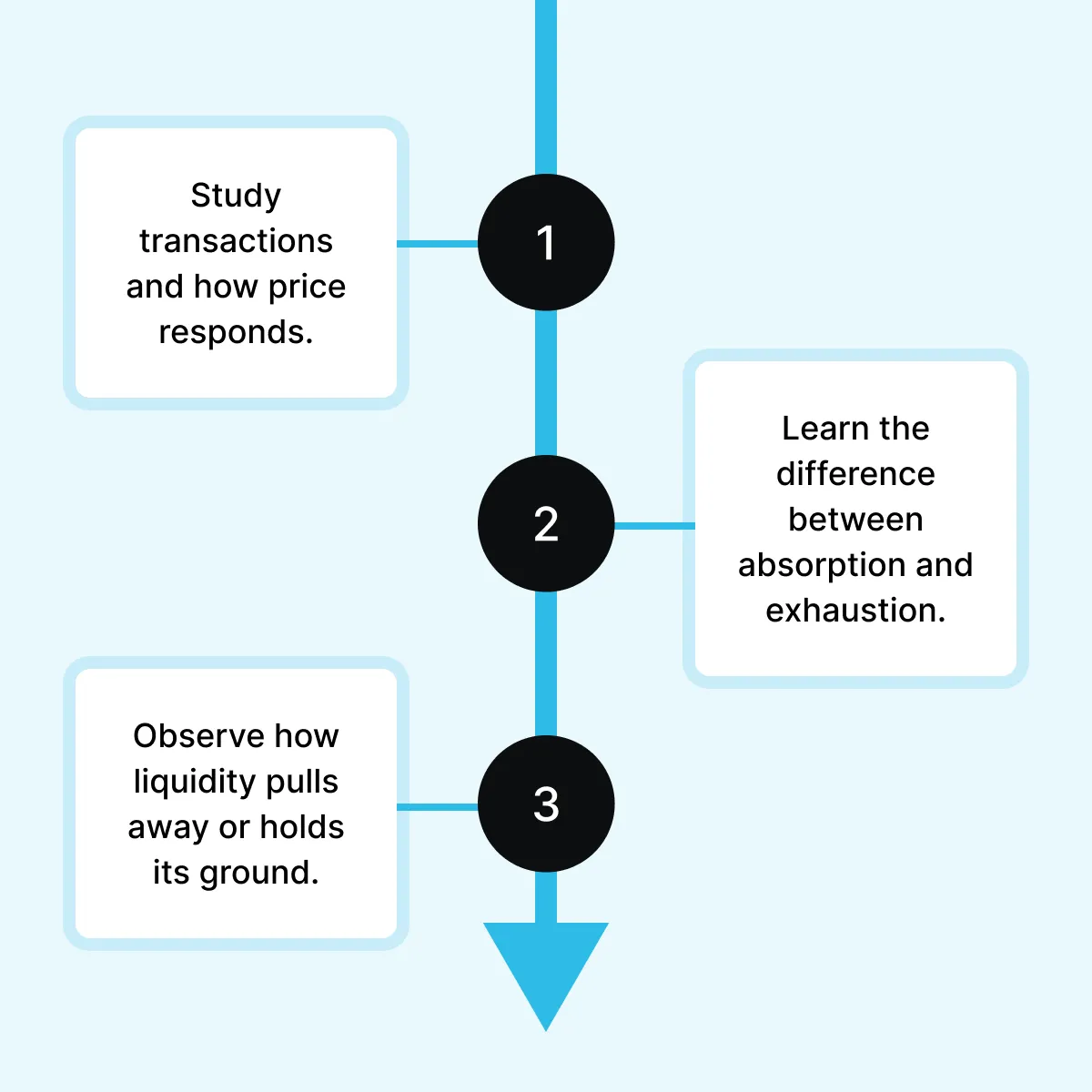
For a better understanding, here is an example:
- A trader spent an entire week only watching how the price behaves when it reaches visible liquidity.
- They ignore entries, indicators, and other concepts.
- Such a focused study is often the best way to learn order flow.
- It builds real understanding instead of surface-level knowledge.
Learn order flow through live market behavior → Compare Plans
Step Four: Separate Learning From Execution
Another key rule when learning order flow trading is to separate learning from trading. Trying to study order flow while placing trades creates bias. The mind of a trader looks for confirmation instead of truth.
Instead, a beginner trader must divide their time into two clear parts:
| Part I: Learning Sessions | Part II: Trading Sessions |
|
|
For example,
- Assume a trader uses “replay” (using Bookmap’s replay mode) to study a failed breakout.
- They watch where:
- Participation increased,
- Liquidity appeared, and
- Price acceptance stopped.
Since there is no pressure to be right, learning becomes faster. Additionally, this separation removes emotion and lets traders see the real difference between order flow and indicators.
For more examples and beginner-friendly heatmap studies, you can check out the Bookmap order flow education course. Study it today to support your learning process.
Common Mistakes Traders Make When Learning Order Flow
When traders start learning order flow, most mistakes stem from “misunderstanding” what the data shows (not from the data itself). Below are the three most common mistakes that traders make:
| Mistake One: Using Order Flow Without Context | Mistake Two: Treating Delta As Direction | Mistake Three: Overtrading While “Learning” |
|
|
|
How Visualization Helps in 2026
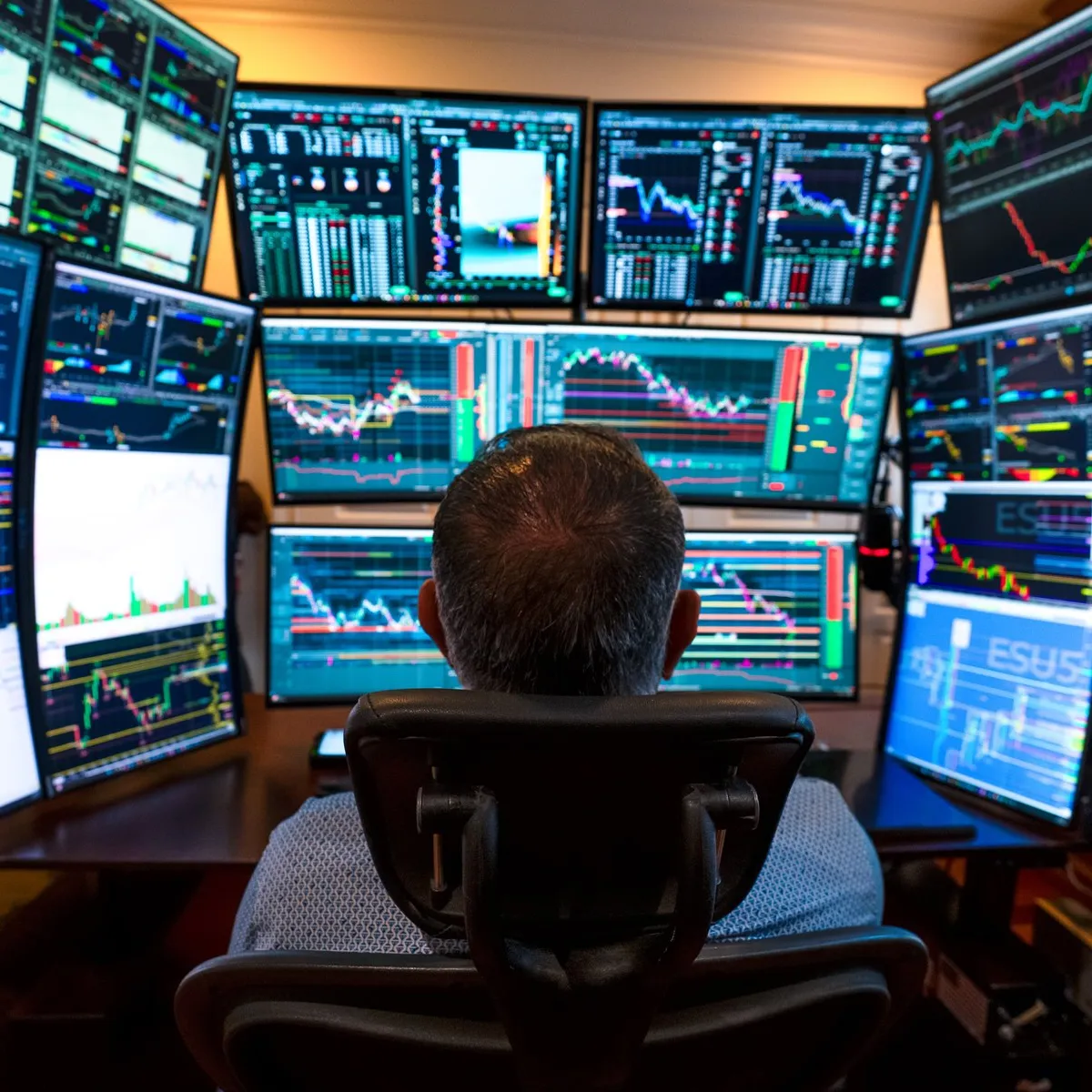
In 2026, orders are placed and filled in milliseconds, which makes raw data hard to process in real time. But traders have found a solution to this problem through “visualization”. Nowadays, several good visual tools slow down perception.
When using them, there is no need to stare at numbers. Instead, traders can see where activity is happening. On such visual tools, transactions cluster on the chart. By analyzing them, traders can see the following:
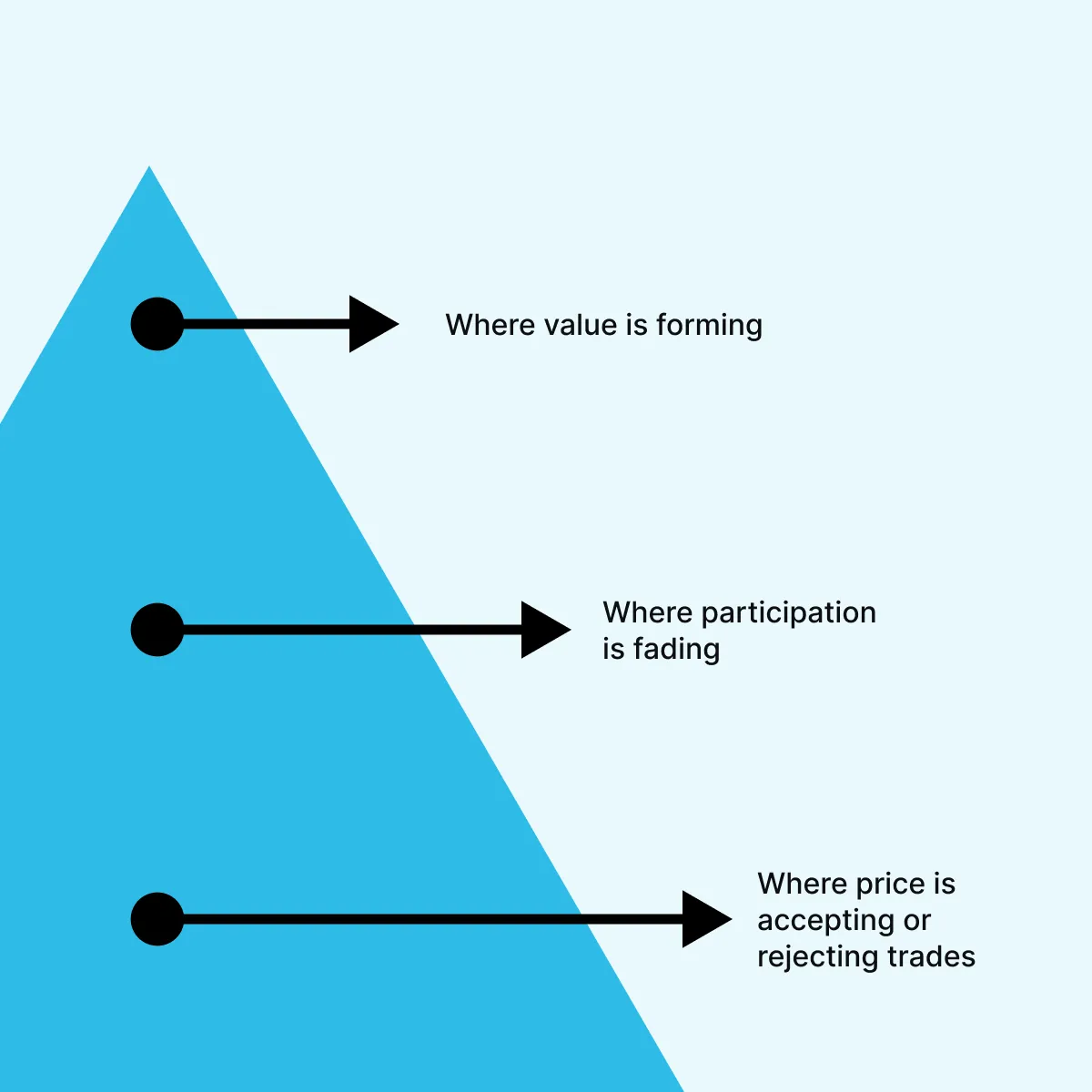
For anyone starting in order flow trading, visualization makes complex data intuitive. See real order flow instead of indicators → Compare Packages.
What Real Progress Looks Like
The number of trades does not measure real progress. Instead, it is gauged through better trading decisions (not higher activity). If a trader is learning order flow, below are some signs of improvement that can represent progress:
- Fewer impulsive entries,
- More patience during choppy markets, and
- A better understanding of why moves fail.
For example, assume a trader stops chasing breakouts. Instead, they recognize when participation is weak and step aside. That awareness shows actual learning progress.
Conclusion
The readers now know the best way to learn order flow in 2026. It is not by chasing signals, but by following a structured process. Participants should start with observation, understand the context, and progress step by step. This approach allows them to see how the price reacts to real participation.
Realize that when learning order flow trading, one is learning why markets move, pause, or fail to move at all. That understanding builds patience. Also, it reduces emotional decisions and gradually improves consistency.
Furthermore, order flow explains behavior as it forms. It is different from indicators that react after price moves. Traders must develop this skill in 2026 to gain insights that last across various strategies, instruments, and market conditions. Understand how liquidity and transactions shape price → Compare Packages.
FAQs
1. How long does it take to learn order flow?
Learning order flow takes time because learners are training their eyes and thinking. It is not about memorizing some written rules. Most traders need several months of regular observation to understand patterns in participation and liquidity.
Always remember that progress comes from repetition and review.
2. Can beginners learn order flow?
Yes, order flow trading for beginners often works well because they are more open to learning how markets actually behave. They are not overly dependent on indicators and have fewer habits to correct.
3. Should I trade while learning order flow?
Limited trading is fine, but it should not be a learner’s primary focus. The best way to learn order flow is through separate learning sessions where:
- Traders first observe or replay markets without pressure
and
- Then, they participate in trading sessions where they only execute what they already understand.
4. Does order flow replace indicators?
Order flow does not have to replace indicators. For many traders, order flow is the primary tool. They use it to know what is happening in real time:
- Who is active?
- Where is the liquidity?
- Why does the price react?
Others still use indicators, but with better context.
Sign Up Now
Latest Articles