


See value migration more clearly in real time.
Compare plans to access deeper market visibility for value migration.
Education
February 12, 2026
Value Migration Explained: How Markets Shift from One Area of Acceptance to Another
Do you know how most traders spot price changes? They look for strong candles. But that’s the wrong approach! That’s because markets move due to “agreement shifts” and “value migrations.” Always remember that price does not lead the market- participation does.
In the market, buyers and sellers constantly reassess where they are willing to do business. And that shared agreement is called “value”. Want to learn how this value actually forms? Read this article to understand why value never stays fixed, and how migration begins at the edges of balance.
By the end, you will stop chasing movement and start reading behavior.
What “Value” Actually Means in Market Structure
For most traders, “value” means one exact price. But that’s not true! Instead, it refers to a “price area” where buyers and sellers repeatedly agree that trading makes sense. In this area, both sides do not reject the price and are comfortable doing business there.
Okay, how to recognize value? You can look for how the market behaves in that zone via these three ways:
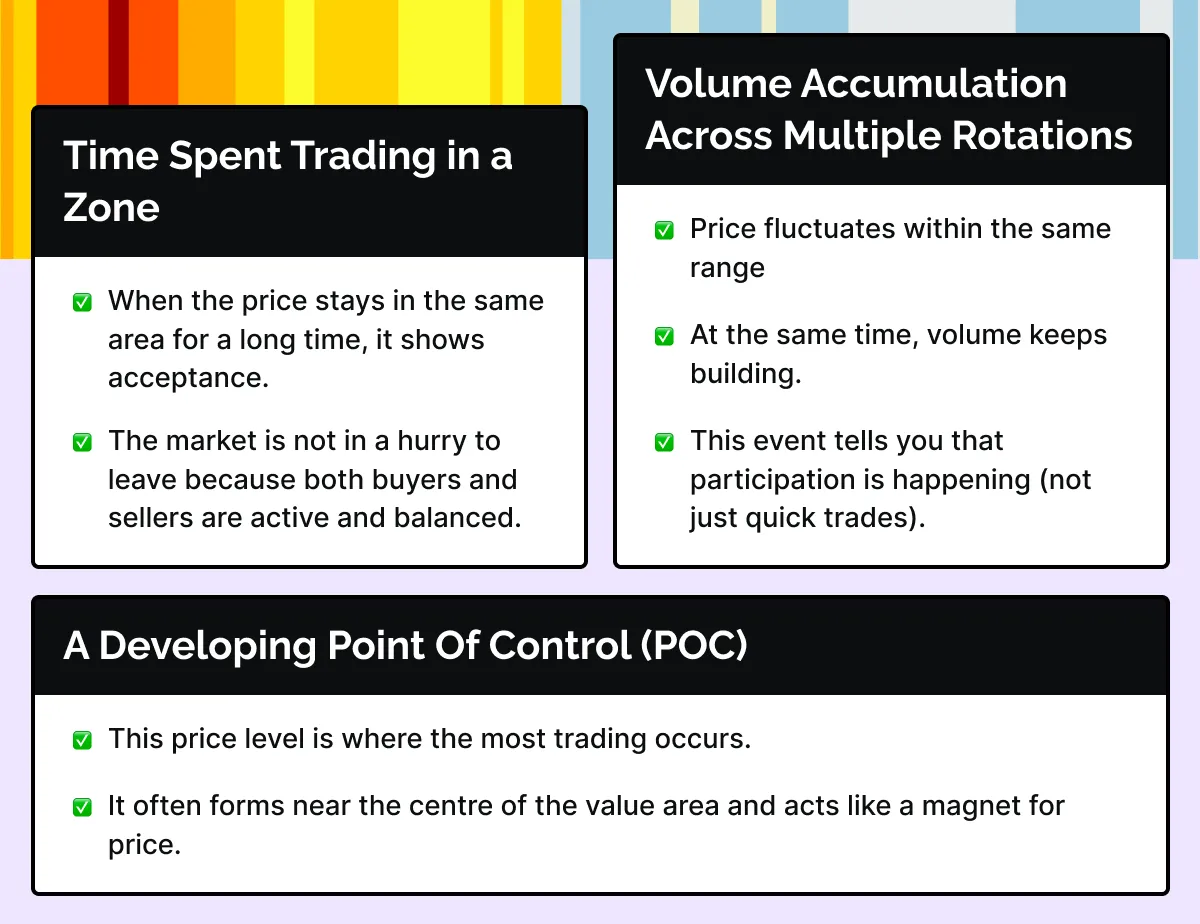
Okay, how does value impact price? When value exists, price slows down. Usually, movement becomes choppy and rotational as the market negotiates fair prices. In contrast, when value is absent, price moves quickly. There is little agreement, so the market travels fast to search for the next area of acceptance.
Why Value Does Not Stay Fixed
Market value is not permanent because market participation is always changing. Traders, institutions, and algorithms constantly reassess where they are comfortable buying or selling. But why do they reassess? That’s because of new information that enters the market.
For more clarity, let’s check out several factors that commonly cause value to change:
| Factor I: Changes In Inventory Positioning | Factor II: Changes In Liquidity Availability | Factor III: News, Order Flow, Or Higher-Timeframe Context |
|
|
|
So, what happens when the value changes? Let’s understand:
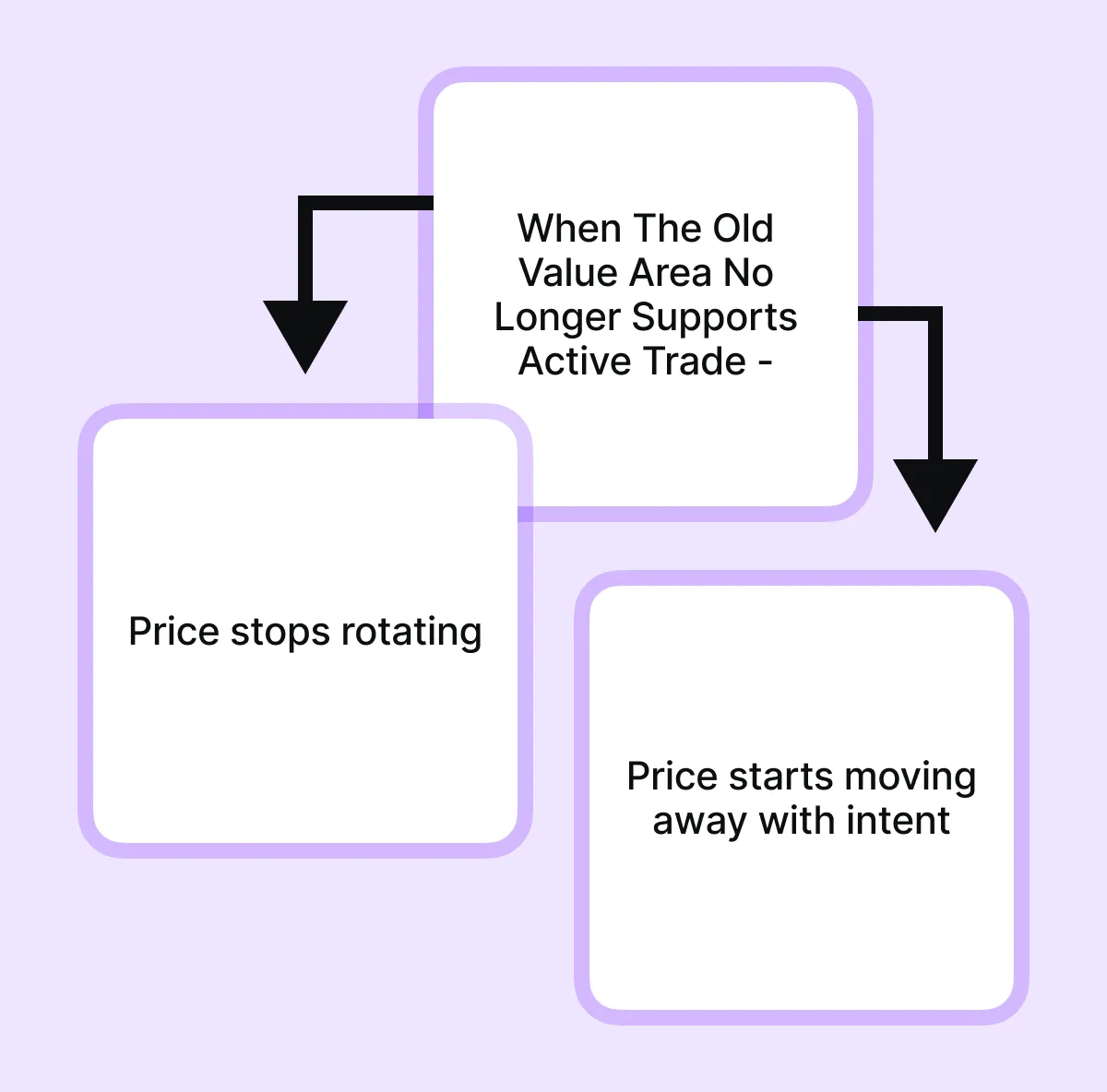
What does this show? The market is no longer negotiating. Instead, it is searching and will continue to do so until a new area attracts enough participation to restore acceptance. This process is a core concept in value migration trading.
The Difference Between Price Movement and Value Migration
How do most traders spot value migration? They look for price fluctuations. But that does not mean the value has changed. The market can move for many short-term reasons without actually agreeing on new prices. Let’s see some reasons why prices move:
| Liquidity Pulls | Aggressive Buying Or Selling | Stop Orders Triggering |
| Orders disappear at certain prices. As a result, the price jumps to the “next available level”. | Strong orders hit thin order books, pushing prices up quickly. | When stops are hit, the price can surge or drop in a chain reaction. |
In these situations, the market does not pause to trade. There is little time spent on prices. Thus, there is limited rotation and low acceptance. Usually, price explores an area, then often moves on.
Move beyond static profiles to dynamic market context → Compare Packages.
How Value Migration Begins
Value migration usually starts near the edges of an existing “balance area.” What is it? The balance area is where:
- Value has already been established, and
- The market has accepted the value.
Inside this value area, prices are well understood. Also, rotations between highs, lows, and the center happen smoothly. But gradually, this efficiency weakens. You may notice that the price is starting to test the value area highs or lows more often. And when it rotates back toward the center, those moves become smaller and less effective.
Below are some clear changes that usually appear in liquidity behavior:
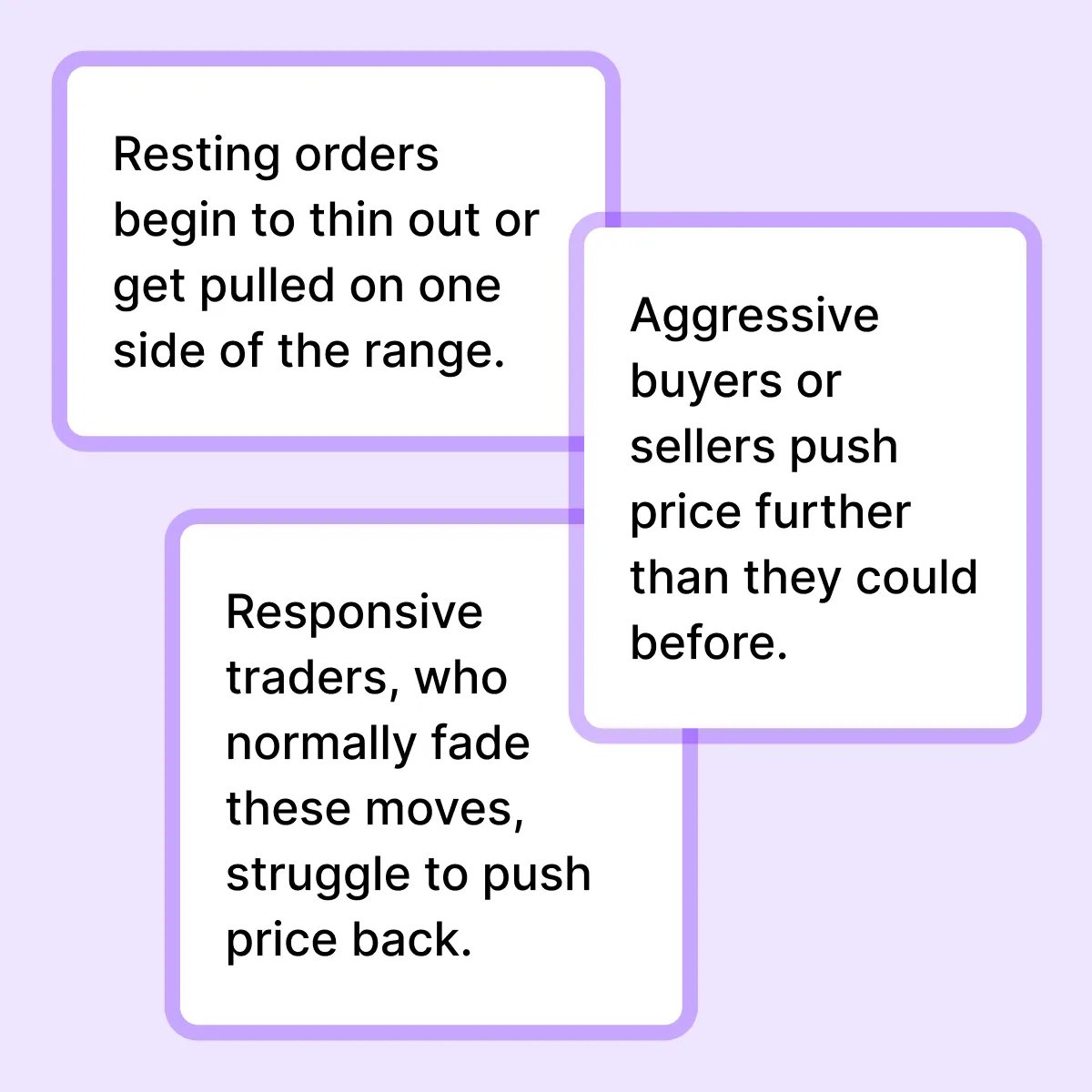
At this point, the market is probing! It is asking an important question:
- Can trade happen outside this value area?
As a trader, you must realize that the current price is exploring beyond the accepted value. However, it has not yet slowed down or built acceptance. In value migration trading, this is a critical early phase.
Acceptance as the Turning Point
“Acceptance” is what separates a failed move from true value migration. Without acceptance, price movement is only a “test”. Let’s see how:
| Case I: Price Reaches a New Area But Quickly Reverses. | Case II: Price Pauses for A Short Moment and Then Continues In The Same Direction. However, Volume Does Not Build |
|
|
Okay, so how does acceptance show up? Let’s check out its behavior:
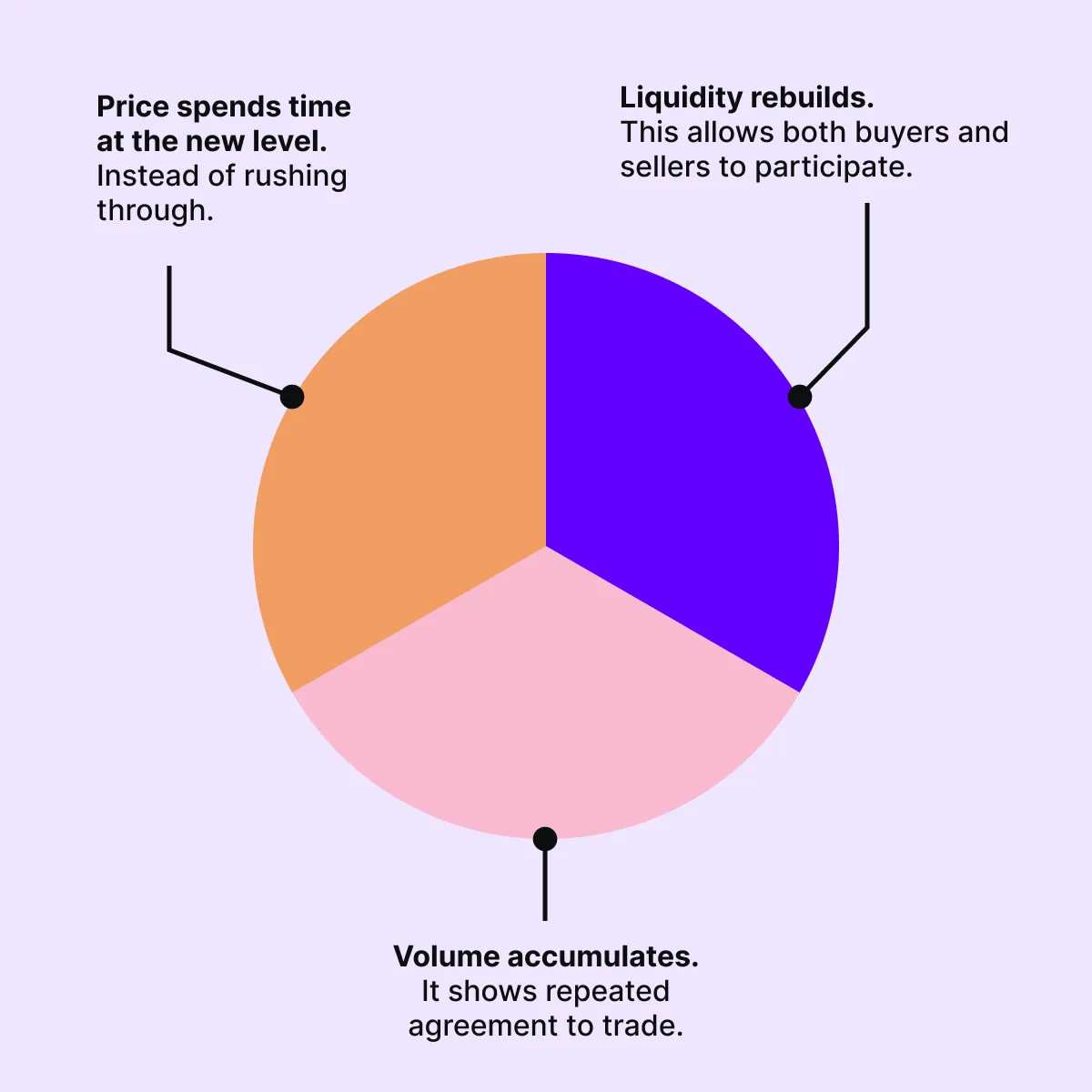
When acceptance happens, the market shifts from a “one-directional” movement to “rotational trading”. It signals that the market is starting to agree on prices in a new area. In value migration trading, acceptance is usually seen as the turning point.
See acceptance form in real time through liquidity behavior → Compare Plans.
VPOC and Value Area Behavior During Migration
During value migration, market changes usually occur gradually (not all at once). Okay, how to spot these changes? These changes are visible through the behavior of the:
- VPOC (Volume Point of Control),
and
- Value area.
Instead of jumping from one price level to another, the VPOC often stretches or drifts toward the new zone. At the same time, “competing volume nodes” can arise when different participants disagree on where value lies. As a result, trading activity spreads across multiple nearby prices.
Now, because of this disagreement, overlapping value areas are common during transitions. Let’s see how the market gets divided:
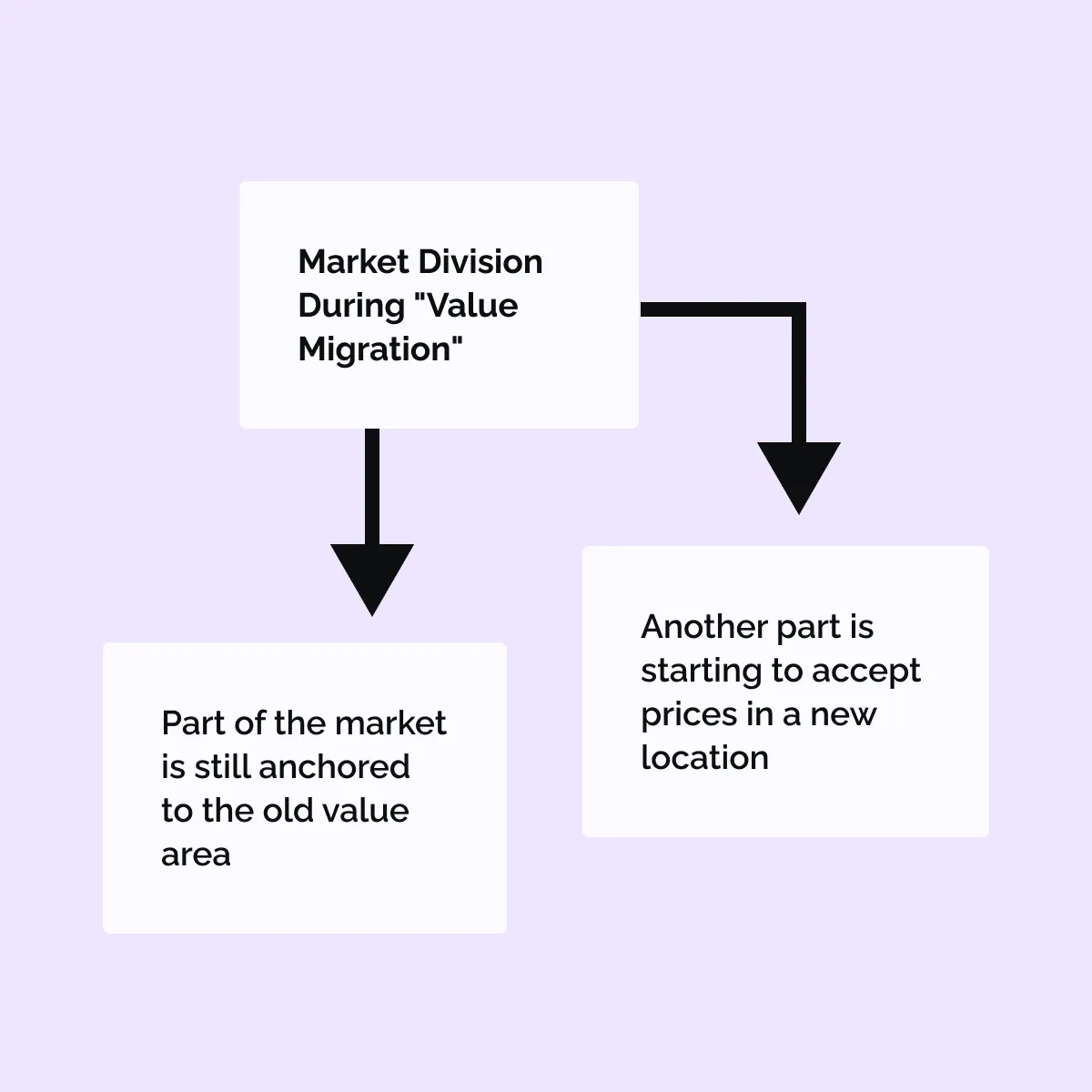
Are these phases signs of confusion or indecision? Nope! They represent active negotiation. The market is testing, trading, and reassessing until enough participants concentrate in one area to achieve acceptance.
Why Value Migration Often Looks Messy
During the transition, the price usually:
- Rotates sharply,
- Overlaps the prior value area, and
- Appears directionless.
This behavior reflects disagreement among participants. How?
- Some traders still see the old value area as fair, whereas
- Others are beginning to trade at new prices.
So, is this messiness noise? Not at all. Instead, it is information. It shows that the auction is active and still unresolved. Traders who expect one-directional moves during this phase often misread what is happening. In value migration trading, understanding this negotiation phase is highly critical.
Failed Value Migration and Its Consequences
Not every attempt at value migration succeeds! Yes, a “failed migration” usually begins with price movement into a new area. A quick rejection then follows this event. Usually, the price does not stay long enough for trade to occur. Additionally:
- Volume remains low,
- Liquidity does not rebuild, and
- Acceptance never forms.
Okay, but what happens to the price when this happens? In most cases, price returns to the prior value area, where trading was previously accepted. In this way, the market is choosing “familiarity over uncertainty”.
Realize that these failures are critical as well. That’s because they create weak highs or weak lows. The market tried to migrate value but was unable to complete the process.
Reading Value Migration Through Order Flow
Order flow allows you to see in real time whether:
- Value is actually migrating,
or
- Price is only moving temporarily.
It shows how participants behave as the price moves into new territory. During successful value migration, order flow usually shows the following signs:
These signs indicate that the market is slowing and beginning to operate at a new level. On the other hand, if order flow stays one-sided and liquidity does not rebuild, the move lacks acceptance. Price may keep moving, but it is still searching (not settling down). In this case, the value has not migrated yet.
Want to make these observations easier? You may start using Bookmap. It is an advanced real-time market analysis tool. Using it, you can visualize:
- Liquidity,
- Volume, and
- Aggressive activity.
On Bookmap, you can easily observe how participation evolves as the market tries to migrate value. This knowledge is beneficial for value migration trading.
For More Clarity, Let’s Study an Example:
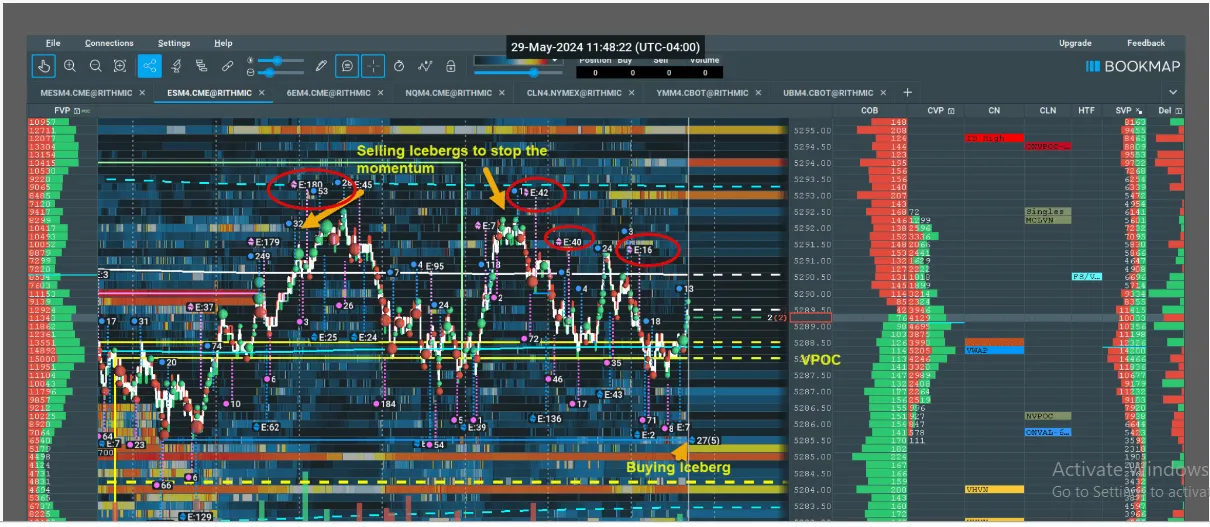
In the above image, value migration can be seen clearly through VPOC behavior. Instead of jumping instantly, the point of control shifts gradually as:
- Volume accumulates at higher prices, and
- Liquidity rebuilds in that area.
Also, the price does not immediately return to its prior value. Instead, it spends time trading in the new zone. This behavior shows repeated interaction between buyers and sellers. Let’s see how you can interpret it:
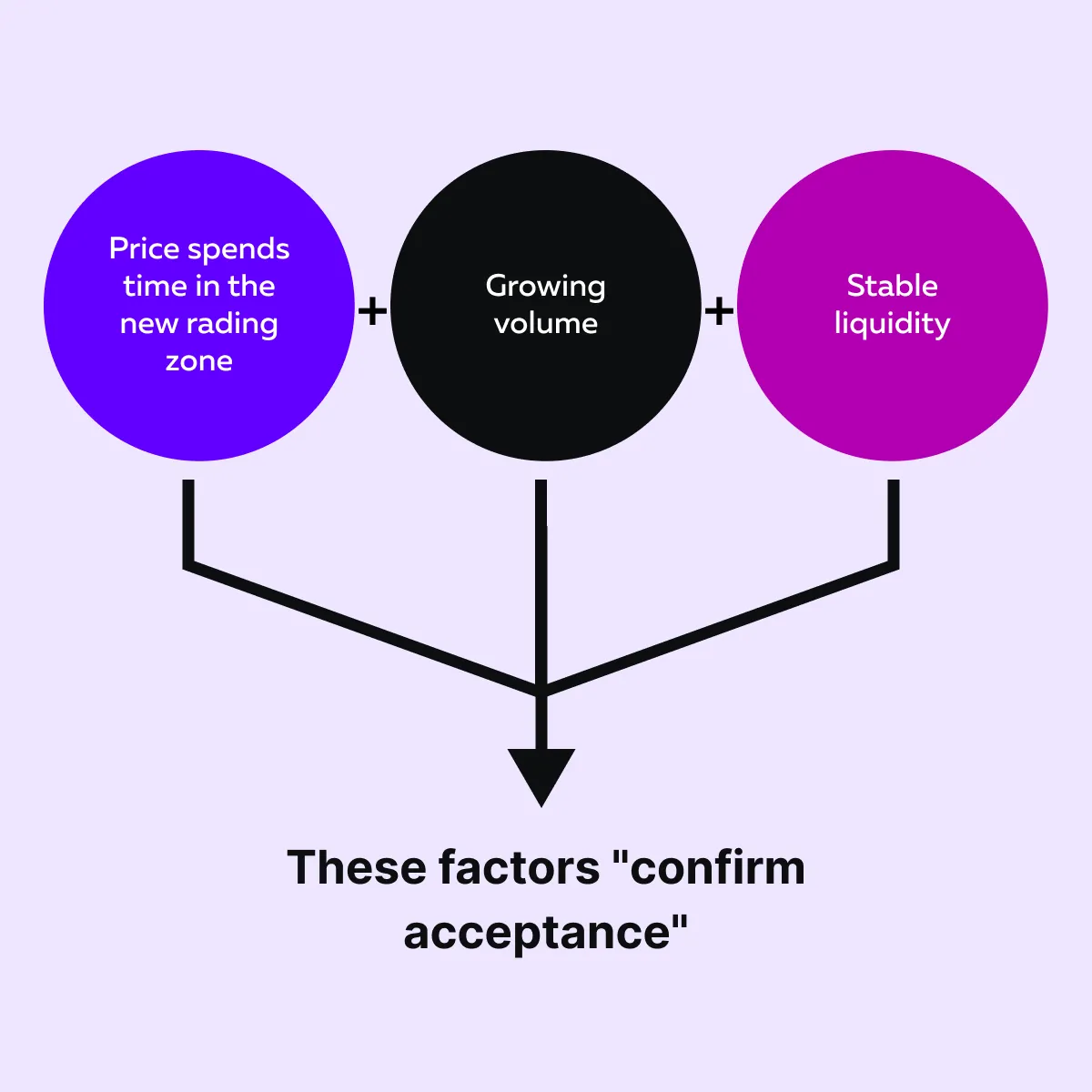
What does this show? The market is no longer just moving the price. Instead, it is establishing value. In value migration trading, this is how traders identify when a new accepted zone has formed.
Explore more real order flow examples → https://bookmap.com/insights
Conclusion
So now you must have understood that value migration explains “how and why” markets change. It reflects changes in:
- Participation,
- Liquidity, and
- Where buyers and sellers agree to trade.
By analyzing value migration, you can learn that price usually moves because value is changing. Also, as a trader, you should focus on “price acceptance”. This way, you can understand whether the market is actually building agreement or just passing through levels.
While doing value migration trading, your aim is never to chase moves. Instead, you must wait for confirmation through behavior. Understand how value actually shifts using real order flow → Compare Packages.
FAQs
1. What is value migration in trading?
Value migration is how the market “shifts agreement” from one price area to another. Instead of just moving quickly:
- The market slows down,
- Trades repeatedly, and
- Builds volume at new prices.
This behavior shows that buyers and sellers are accepting a new area as fair.
2. How is value migration different from a breakout?
A breakout only describes price moving “outside a range”. In contrast, value migration explains what happens after that move. Usually, value is considered migrated:
- Price slows down,
- Volume builds, and
- Trading continues at the new level.
Without acceptance, a breakout is just a temporary move.
3. Does value always migrate smoothly?
No! Value migration is often uneven. Why? In such market phases,
- Price may rotate,
- Price can overlap the old value, and
- Price moves back and forth.
Additionally, migration also fails sometimes if the market cannot build volume or liquidity at new prices. This failure causes the price to return to the prior value area.
4. How does Bookmap help identify value migration?
Bookmap shows liquidity, volume, and aggressive activity in real time, which allows traders to see whether:
- Liquidity is rebuilding, and
- Volume is accumulating at new prices.
These are essential signs of acceptance in value migration trading.
Sign Up Now
Latest Articles