


See arbitrage more clearly in real time.
Compare plans to access deeper market visibility for arbitrage.
Futures
January 23, 2026
What Is Arbitrage Trading? (2026 Guide)
Profitable trading is typically about buying and selling at a better price — whether that means buying low and selling high, or buying high and selling higher (or the reverse for shorts).
Arbitrage trading, however, works a bit differently.
Instead of predicting direction, arbitrage focuses on price differences between related instruments or markets. Trades are usually fast, margins are small, and success depends on execution rather than prediction.
If done consistently and efficiently, arbitrage can be one of the most reliable strategies in trading.
What Is Arbitrage Trading?
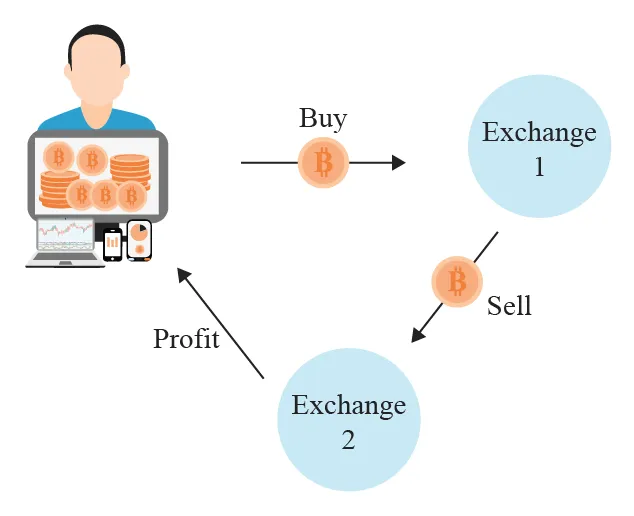
Arbitrage trading is a strategy that seeks to profit from price discrepancies between the same or closely related assets across different markets, exchanges, or instruments.
The basic idea:
- Buy where the asset is cheaper
- Sell where it’s more expensive
- Capture the difference before prices converge
In theory, arbitrage is considered “risk-free.”
In reality, there is always risk — especially related to execution, latency, and costs. The collapse of Long-Term Capital Management (famously covered in When Genius Failed by Roger Lowenstein) is a reminder that even sophisticated arbitrage strategies can fail under pressure.
How Arbitrage Trading Works
Arbitrage exists because markets are not perfectly efficient.
Prices are constantly influenced by:
- Supply and demand imbalances
- Delays in information
- Differences in liquidity across venues
- Market participant behavior
These factors can temporarily push prices away from their “fair value.”
Arbitrage traders step in to exploit these inefficiencies — and in doing so, they actually help bring prices back into alignment.
Types of Arbitrage Trading
Arbitrage can be categorized into four main types:
1. Pure Arbitrage
This is the most straightforward form.
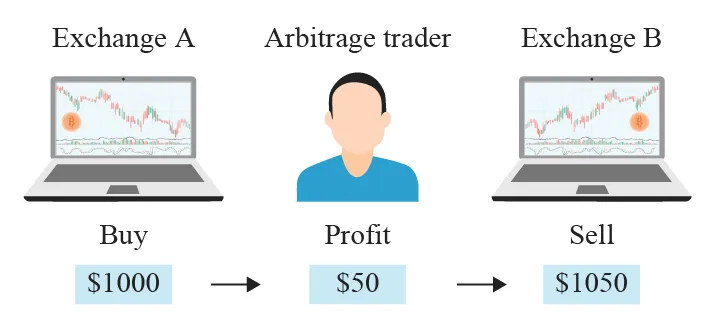
A trader buys and sells the same asset across two different markets to capture a price difference.
Example:
- Buy Bitcoin on Exchange A
- Sell it on Exchange B
This is what most people think of when they hear “arbitrage.”
2. Merger Arbitrage
Merger arbitrage focuses on companies involved in acquisitions.
When a merger is announced:
- The target company typically trades below the acquisition price
- Traders buy shares expecting the deal to close
As the deal progresses, the price usually moves closer to the offer price.
However, this strategy carries risk:
- Deals can fall through
- Regulatory issues can arise
3. Convertible Arbitrage
This strategy involves:
- A convertible bond
- The underlying stock
A trader typically:
- Goes long the bond
- Shorts the stock
The goal is to profit from pricing inefficiencies between the bond and equity, while maintaining a hedged position.
4. Statistical Arbitrage
Statistical arbitrage (stat arb) is a quantitative, market-neutral strategy.
It involves:
- Identifying relationships between assets
- Trading deviations from those relationships
These strategies often:
- Use large datasets
- Operate across many assets
- Execute at high frequency
Arbitrage Examples
Futures Spread Arbitrage
A futures spread involves trading two contracts with different expiration dates.
Common approaches include:
- Calendar spreads (same asset, different expiries)
- Inter-commodity spreads (related assets)
The goal is to profit from pricing differences between the contracts.
Public Company Merger Arbitrage
A trader buys shares in a company being acquired below the deal price and profits if the deal closes successfully.
This strategy is widely used by hedge funds but requires:
- Strong risk management
- Deep understanding of deal structure
How Do HFT Firms Use Arbitrage?

High-frequency trading (HFT) firms rely heavily on arbitrage strategies.
They use:
- Ultra-fast algorithms
- Direct exchange connections
- Low-latency infrastructure
Common HFT arbitrage approaches include:
- Benchmark arbitrage
- Statistical arbitrage
- Latency arbitrage
- Volatility arbitrage
Speed is the main edge — opportunities often last milliseconds.
Is Arbitrage Trading Still Profitable?
Yes — but not in the way most people expect.
Modern arbitrage:
- Has smaller margins
- Is highly competitive
- Often requires automation
For retail traders:
- Manual arbitrage opportunities are limited
- Costs and execution speed matter more than strategy
Most consistent arbitrage today is done by:
- Quant firms
- Market makers
- Algorithmic traders
Arbitrage and Market Efficiency
Arbitrage plays an important role in financial markets.
By exploiting price differences, arbitrage traders:
- Help align prices across markets
- Improve price discovery
- Reduce inefficiencies
In contrast to some strategies that may push prices away from fair value, arbitrage tends to pull prices back toward equilibrium.
Risks of Arbitrage Trading
Despite being considered “low risk,” arbitrage has real challenges:
- Execution risk → one leg fills, the other doesn’t
- Slippage → price changes before execution completes
- Transaction costs → can eliminate profit
- Latency → delay reduces edge
- Counterparty risk → exchange or broker issues
The biggest misconception is that arbitrage is risk-free — in practice, it’s execution-dependent.
Conclusion
Arbitrage trading involves buying and selling the same or related instruments to capture small price differences across markets.
It’s one of the oldest trading strategies — and still widely used today.
However:
- Opportunities are smaller
- Competition is higher
- Execution matters more than ever
Even if you don’t trade arbitrage directly, understanding it helps you better understand how markets behave — and why prices stay aligned.
Where This Connects to Real Trading
While most traders won’t run full arbitrage systems, the core idea still matters:
Markets constantly move between inefficiency and balance.
Being able to spot when price is out of sync — whether across exchanges, instruments, or liquidity — is what separates reactive trading from informed decision-making.
Sign Up Now
Latest Articles