


Order Flow Strategies
Tools, Examples & Setups for Every Market
If you want to build better trade setups by understanding real-time buyer/seller activity, this page brings together the tools and examples that show how order flow reveals conviction, reversals, and short-term opportunity.
This page focuses on practical order flow execution plans rooted in market microstructure and liquidity behavior. Instead of relying on lagging indicators, these strategies emphasize tape reading methodology, market depth analysis, and real-time interaction between aggressive and passive participants. The goal is to help traders build repeatable execution plans that adapt across futures, stocks, and cryptocurrency markets.
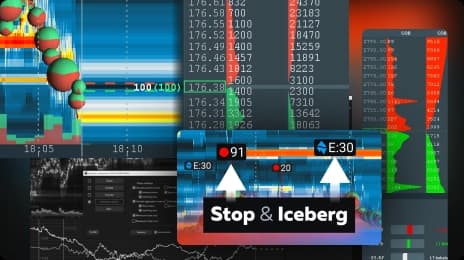
See order flow clearly as trades develop.
Compare plans to track buyer/seller activity and real-time liquidity.
Core Concepts for Order Flow Traders
Understanding how to read the tape, interpret liquidity behavior, and spot genuine conviction in the order book is essential to executing better trades across any market. The videos below walk through foundational order flow concepts, from reversals to cumulative volume delta and real vs. fake liquidity.
Many of these concepts can be expanded into full market microstructure strategies. For example, reversals often rely on absorption at key levels, cumulative delta helps validate or reject price moves, and liquidity behavior reveals whether participation is genuine or deceptive. These building blocks form the foundation for more advanced order flow execution plans.
These concepts also help traders identify market imbalances, institutional participation, and areas where aggressive buyers or sellers may be trapped. Many professional futures trading methodologies use these same principles to build higher-probability execution frameworks.
Understanding Tape Reading and Market Depth
Modern order flow trading is built around understanding how orders interact in real time. Traders monitor bid-ask spread dynamics, liquidity shifts, aggressive execution, and order book pressure to better interpret price discovery and short-term market direction.
Rather than relying only on candles or lagging indicators, order flow traders analyze how participants behave at key levels and whether liquidity is supporting or rejecting price movement.
Explore more setups and concepts in the Learning Center
Bookmap Tools for Order Flow Tactics
When you’re trading based on order flow, precision matters. These tools give you deeper insight into how liquidity is behaving, which orders are aggressive or passive, and whether the market is absorbing or rejecting price at key levels.
Order flow traders often combine these tools to validate signals through multiple dimensions. For example, integrating delta divergence with price action can help confirm exhaustion, while volume-based tools allow traders to define value areas before execution. This layered approach is essential for backtesting order flow signals and refining consistency over time.
This approach helps traders move beyond static technical analysis by combining real-time liquidity and transaction mapping with market microstructure analysis. Traders can monitor execution flow, absorption, and order book behavior directly from the chart.
Prerequisites:
These tools require a Global or Global+ Bookmap package and a compatible market data feed (BookmapData CME, Rithmic, etc.).
Compare Packages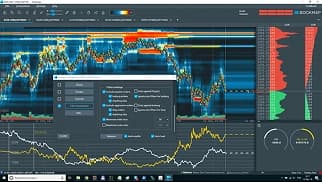
MBO Bundle (25% Discount!)
See every buy and sell order—including its size and price—on an individual level. Helps confirm whether volume is real or misleading, and lets you track stops, icebergs, and more with unmatched clarity.
Get It Now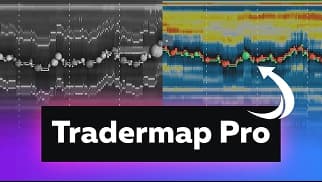
Tradermap Pro
Build custom heatmap views by applying MBO filters (like iceberg or aggressive orders) to instrument copies. Perfect for comparing different order book layers or highlighting specific behavior.
Get It Now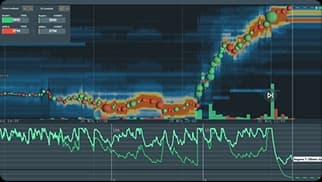
Market Pulse (Futures & Stocks Bundle)
Get real-time visual and audio alerts powered by 10+ algorithms that detect shifts in volume, order book pressure, spreads, and sweeps. Ideal for monitoring aggressive activity and sudden changes across multiple stocks or futures instruments.
Get It NowReal Trade Examples
Order flow isn’t just theory—it’s how real trades come together. Below are two examples that show how traders used Bookmap tools to spot opportunity, confirm momentum, and manage exits with greater confidence.
Example 1: Algo Behavior Ahead of FOMC
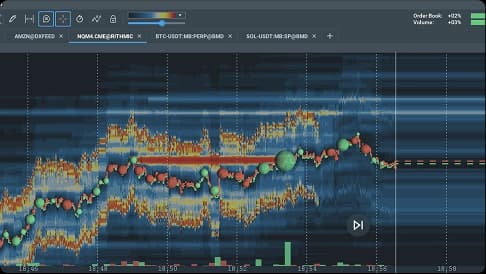
Market: NQ
Tools Used: Heatmap, Liquidity View
Just five minutes before the FOMC release, algo trading bots that typically follow price action shut off—creating a noticeable shift in the heatmap. This “halo” disappearance signaled the market’s transition into high-volatility mode.
See the Trade ReviewExample 2: ES Mean Reversion to VWAP with Volume Confirmation
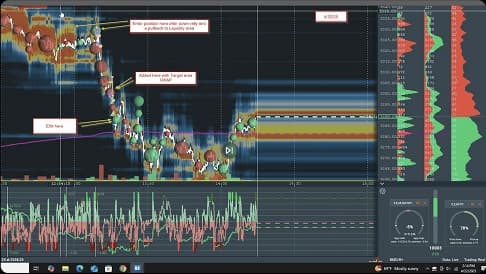
Market: ES
Tools Used: Cumulative Volume Delta (CVD), Market Pulse
A pullback into liquidity created a potential long setup. After seeing relative sell volume increase (and Market Pulse alert extremes), the trader scaled in, expecting downside continuation—before exiting early on signs of exhaustion.
See the Trade ReviewThese examples highlight how specific order flow phenomena translate into actionable setups. Whether it’s absorption at key support levels, stacked imbalance reversals, or volume-at-price reactions, the common thread is execution based on observable behavior rather than prediction.
Want more trade examples?
Explore a full archive of strategy breakdowns and Bookmap trade reviews across stocks, futures, and crypto.
Order Flow Trading Across Different Markets
Order flow strategies can be adapted across multiple asset classes, but liquidity behavior differs depending on the market.
- Futures traders often focus on centralized liquidity, footprint charts, and DOM behavior in products like ES and NQ.
- Stock traders monitor hidden liquidity, execution speed, and order book shifts around key levels.
- Crypto traders pay closer attention to volatility, liquidity gaps, and cross-exchange order flow behavior.
While the mechanics vary, the underlying principles of price discovery, liquidity interaction, and aggressive versus passive participation remain consistent.
Read More: Blog Articles on Order Flow
Explore strategies and techniques for interpreting order flow across markets—whether you’re looking to spot early reversals, trade macro events, or time breakout entries with precision.
These articles expand on both discretionary and systematic approaches, helping traders bridge active trading systems with quantitative market analysis through real-time order flow data.
How to Spot Trend Reversals Early Using Order Flow Analysis
Learn how to identify momentum shifts and confirm with liquidity and volume signals before the crowd catches on.
Read the article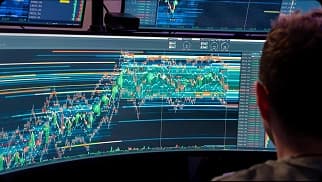
Technical Analysis vs. Order Flow: Techniques and Tools for Traders
See how order flow gives traders a real-time edge over traditional technical analysis, revealing true market intent, liquidity shifts, and execution behavior behind every move.
Read the article
Key Order Flow Strategies: Breakouts, Trends, Trapped Traders, and Stop Runs
A detailed breakdown of high-probability setups built around order flow patterns and behavioral signals.
Read the articleReady to go deeper?
Explore our free trading resources to sharpen your edge
Take the Trading Strategy Quiz
Take the Risk Tolerance Quiz
Try the Profit Calculator
Frequently Asked Questions (FAQ)
Do order flow strategies work better for futures or spot markets?
Order flow strategies are commonly applied to futures due to centralized liquidity, but the same principles can be used in spot markets where depth and execution data are available.
Are these setups designed for high-frequency or swing trading?
Order flow strategies can support both. Some traders focus on short-term scalping and high-frequency execution, while others apply the same concepts to intraday or swing setups.
Which depth of market data is used for these strategies?
Order flow strategies rely on full depth-of-market data that shows resting liquidity, executed trades, and order behavior in real time. Bookmap visualizes this directly through its heatmap and volume tools.
Are you looking for beginner definitions or professional software setups?
Some traders are just learning how order flow works, while others want advanced execution tools and data feeds. This page is designed to support both foundational concepts and practical trading workflows.
Do you want to focus on futures, stocks, or cryptocurrency order flow?
Order flow principles apply across markets, but execution behavior and liquidity structure can differ significantly between futures, equities, and crypto instruments.
Are you interested in manual tape reading or automated order flow bots?
Some traders prefer discretionary tape reading and visual analysis, while others use automated alerts or algorithmic systems to monitor liquidity and execution patterns.
Would you like to see a comparison of paid vs. free order flow tools?
Free tools can help traders understand basic order flow concepts, while professional platforms typically provide deeper liquidity visibility, historical order book analysis, and advanced execution tracking.
Do you need to know which data feeds (Rithmic, CQG) are best for this?
Data quality matters for order flow trading. Traders commonly use feeds such as Rithmic, CQG, or BookmapData depending on the market and level of depth required.
Get Started with Bookmap
Bookmap gives you the tools to trade with real-time context—so you’re not just reacting to price, but anticipating what comes next.
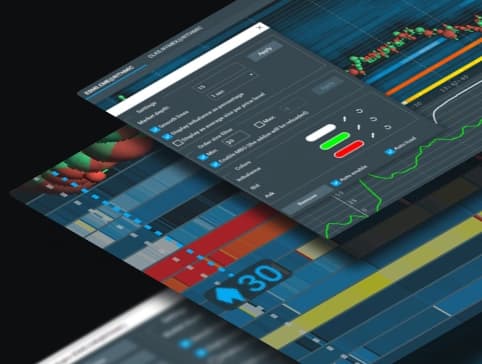
Access indicators like the MBO Bundle, Tradermap Pro, and Liquidity Tracker Pro with the Global+ plan and start building your strategy around what the market is actually doing.
Sign Up Now