



Quick Summary: Pre-Market Intelligence Briefing
Before the opening bell, five categories of information consistently shape how the regular session starts: index futures direction, scheduled earnings and economic data, overnight performance in Europe and Asia, volatility and yield signals, and where the actual order flow is concentrated. None of these predicts the day with certainty — they narrow the range of likely outcomes and flag where volatility is most likely to show up first. This guide walks through each one, what it tells you, and where its limits are.
The 5 Core Pillars to Analyze Before the Opening Bell
Every premarket routine, however detailed, comes back to five underlying questions:
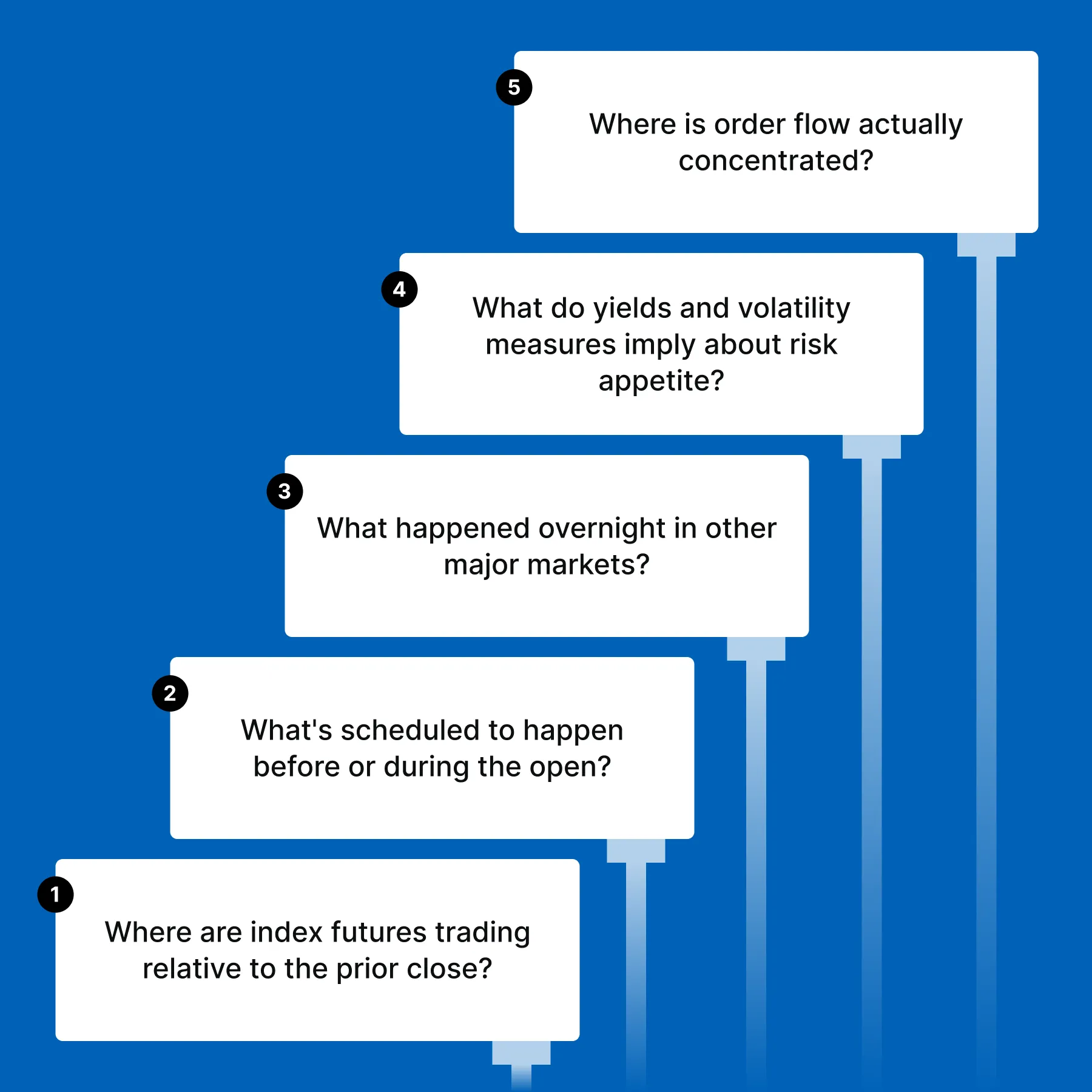
- Where are index futures trading relative to the prior close? This sets the baseline directional bias for the session.
- What’s scheduled to happen before or during the open? Earnings and economic data releases are the primary sources of scheduled volatility.
- What happened overnight in other major markets? European and Asian sessions often set the tone before US futures fully reflect it.
- What do yields and volatility measures imply about risk appetite? These context indicators shape how much any given futures move should be trusted.
- Where is order flow actually concentrated? Headline futures levels and volume tell you less than watching where real liquidity and aggression are building in the book.
S&P 500 & Nasdaq Futures: Premarket Movement in Real Time
S&P 500 (ES/MES) and Nasdaq-100 (NQ/MNQ) futures trade nearly 24 hours a day on CME Globex, which means they’re already pricing in overnight developments well before the cash market opens. The direction and size of the overnight move is the most commonly cited premarket signal, but two things matter more than the raw number:
- Agreement across contracts. When S&P 500, Nasdaq-100, and Dow futures are all moving the same direction with real volume behind them, that’s a stronger signal than a move confined to a single index.
- Volume behind the move. A futures move on light overnight volume is more prone to fading once the deeper liquidity of the regular session arrives; a move backed by heavy participation carries more weight.
Futures direction sets a baseline expectation for the open, but it’s a starting point, not a forecast — the size of an implied gap frequently shrinks or reverses in the first minutes of regular trading once cash-market liquidity takes over.
Major Corporate Earnings Reports Before Market Open Today

Companies scheduled to report earnings before the open are one of the most reliable sources of premarket volatility, particularly for large-cap names with significant index weight. A single earnings surprise from a heavily weighted stock can move broad index futures noticeably, independent of any macro catalyst.
Checking the day’s earnings calendar — which companies are reporting, their approximate index weight, and consensus expectations — is a standard part of any premarket routine, since a stock-specific move can otherwise be mistaken for a broader market signal.
US Economic Data Calendar Releases: 8:30 AM ET, CPI, Jobs
Most major US economic releases — CPI, PPI, nonfarm payrolls, retail sales, GDP — are scheduled for 8:30 a.m. ET, exactly one hour before the cash market opens. Futures typically react sharply and immediately to these releases, often overshooting in the first seconds after the number hits before settling into a more considered move.
Knowing what’s scheduled for a given morning — and treating the immediate post-release spike with some skepticism until it settles — is a meaningfully different approach than reacting to a headline number in isolation.
European & Asian Stock Markets: Overnight Performance (Nikkei, DAX, FTSE)
Because US index futures trade continuously, they absorb information from markets that are in their own regular sessions while US markets are closed. Japan’s Nikkei, Germany’s DAX, and the UK’s FTSE 100 are the most commonly referenced international benchmarks for this purpose — a sharp move in any of them, particularly one tied to a shared macro theme (central bank policy, a regional data surprise, broad risk sentiment), can influence US futures before any US-specific news arrives.
This influence is correlational rather than mechanical. A DAX selloff driven by an issue specific to European markets may say very little about US equities, so overnight international performance is a factor to weigh alongside others, not a standalone signal.
10-Year Treasury Yield & WTI Crude Oil Premarket Shifts
Treasury yields and crude oil are watched premarket as broader risk and inflation gauges rather than direct equity signals. A sharp overnight move in the 10-year yield often reflects shifting expectations about interest rates or inflation, both of which have downstream effects on equity valuations — particularly for growth and technology stocks, which tend to be more sensitive to changes in the discount rate applied to future earnings.
Crude oil moves overnight for its own supply-and-demand reasons (OPEC decisions, geopolitical developments, inventory data), but sharp moves can ripple into energy-sector futures and, at extremes, into broader market sentiment around inflation expectations.
Premarket Top Stock Gainers, Losers & Unusual Volume Movers
Beyond the broad index futures, individual stocks trading actively in premarket — typically on earnings, news, or analyst actions — are worth a separate check. Unusual volume in a single name premarket often precedes outsized moves once regular-session liquidity arrives, and can also signal where the day’s most active order flow is likely to concentrate.
This is also where premarket data has real limits: volume is thin compared to the regular session, so a stock showing a large percentage move on light premarket volume can behave very differently once full liquidity returns at the open.
Federal Reserve Official Speeches, FOMC & Interest Rate Outlook
Scheduled remarks from Federal Reserve officials — and FOMC meeting days in particular — are a distinct category of risk from routine economic data, because they carry direct signal about the path of interest rate policy rather than just a single data point feeding into that policy. Markets often react more sharply to a perceived shift in tone from a Fed official than to the specific words used, which is why premarket routines typically include checking the day’s Fed speaker calendar alongside the economic data calendar.
FOMC decision days carry their own dynamic: markets frequently move on the initial statement, then move again — sometimes in the opposite direction — during the press conference, as the more detailed commentary reshapes the market’s read on the decision.
VIX Volatility Index: Premarket Futures & Implied Market Risk

VIX futures track expected S&P 500 volatility over the near term, and they typically move inversely to equity futures — rising when equity futures sell off sharply, easing when equity futures are calm. Checking VIX futures alongside equity index futures helps distinguish between an overnight move that reflects genuine risk-off positioning and one that’s comparatively orderly.
A large equity futures move with little corresponding VIX reaction suggests the market isn’t pricing much additional risk around it; a sharp VIX spike alongside a smaller equity move can indicate hedging or positioning activity rather than fresh directional conviction.
S&P 500 Fair Value & Price Gap Opening Bell Trading Strategy
Fair value is the theoretical relationship between index futures and the underlying cash index, based on the cost of carrying that position (interest rates) minus expected dividends. The gap between where futures are actually trading and this calculated fair value — not the futures price in isolation — is what determines the “implied open” quoted by financial media.
Traders generally take one of two approaches to a meaningful implied gap at the open: fading it (betting the move overshoots and reverts once regular-session liquidity arrives) or trading the continuation (betting the gap reflects a genuine catalyst and will extend). Which approach fits depends heavily on whether the move is backed by strong overnight volume and a clear catalyst, or thin liquidity without much behind it.
Retail Sentiment: Trending Stocks & Premarket Discussion
Retail trading activity and discussion — trending tickers on social platforms and financial forums, unusually high options activity in specific names — has become its own premarket signal over the past several years, distinct from institutional order flow. A stock trending heavily in retail discussion can see premarket volume and volatility disconnected from any fundamental catalyst, driven instead by coordinated retail attention.
This is worth monitoring as a distinct category, but it comes with a real caveat: retail-driven premarket moves are often less durable than moves backed by institutional order flow, and can reverse sharply once the broader market’s liquidity returns at the open.
Why Choose Bookmap for Pre-Market Order Flow Analysis
Every category above — futures levels, earnings, economic data, international markets, yields, VIX, fair value, retail sentiment — describes context. None of it shows you what’s actually happening in the order book: how much real liquidity sits behind a premarket move, whether a level is being defended or run through, or whether the volume behind a move is genuine participation or a handful of thin trades.
That’s the gap between watching headline numbers and watching order flow directly. See Bookmap’s guide to technical analysis vs. order flow for how this approach differs from traditional premarket analysis, and the order flow strategies resources for the specific tools — heatmaps, volume-based signals, depth-of-market visualization — that apply directly to reading premarket liquidity and aggression before the bell.
Platform Accessibility & Broker Data Connections
Reading premarket order flow requires a data feed that shows actual market depth, not just last-traded price. Bookmap connects to a range of brokers, exchanges, and market data providers across futures, stocks, and crypto — worth confirming compatibility with a specific broker or data feed before relying on it for premarket analysis, since depth-of-market access varies by provider.
Bookmap Pricing & Software Subscription Tiers
Bookmap offers tiered subscription packages depending on the depth of order flow data required — from a free entry tier up to Global and Global+ plans that unlock full market-by-order data and advanced liquidity tools. Compare current plans and pricing directly, since packages and features are updated periodically.
5 Strategic Steps for Trading the Opening Bell
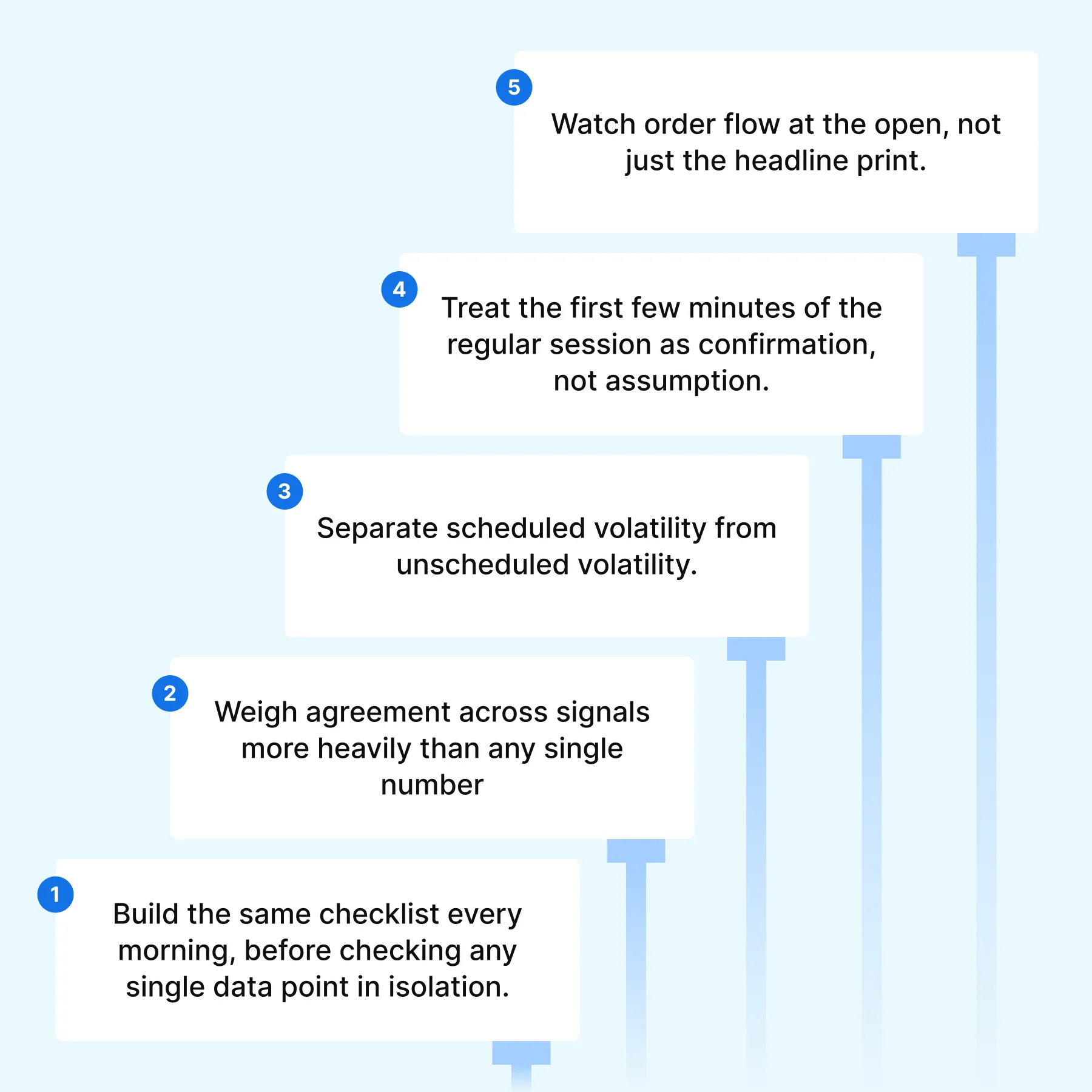
- Build the same checklist every morning, before checking any single data point in isolation. Futures, earnings, econ data, international markets, and volatility measures each mean less on their own than they do together.
- Weigh agreement across signals more heavily than any single number. Index futures, VIX, and overnight international performance pointing the same direction carries more weight than one metric moving alone.
- Separate scheduled volatility from unscheduled volatility. Knowing what’s on the calendar (earnings, econ data, Fed speakers) lets you distinguish an expected reaction from a genuine surprise.
- Treat the first few minutes of the regular session as confirmation, not assumption. Implied gaps from premarket futures frequently shrink or reverse once real liquidity returns at 9:30 a.m. ET — a plan should account for that rather than assume the premarket read holds.
- Watch order flow at the open, not just the headline print. Where liquidity is actually resting and how aggressively it’s being taken tells you more about whether a move will hold than the opening price alone.
Ready to see the order flow behind the opening bell rather than just the headline numbers? Try Bookmap for free today.
FAQ
What should I check before the stock market opens?
A useful premarket routine covers five areas: index futures direction (and whether it’s backed by real volume), scheduled earnings and economic data, overnight performance in European and Asian markets, yield and volatility signals (10-year Treasury, VIX), and where order flow is actually concentrated once premarket trading begins.
How accurate are premarket futures at predicting the market open?
Premarket futures reliably indicate overnight sentiment direction but are less reliable on magnitude — the size of an implied gap often shrinks or reverses in the first minutes of regular trading, once the deeper liquidity of the cash session takes over from the comparatively thin overnight session.
Why do economic data releases happen at 8:30 AM ET?
Most major US economic reports (CPI, jobs data, GDP, retail sales) are scheduled for 8:30 a.m. ET, one hour before the market opens, giving futures markets time to react to the data before the cash session begins.
What is S&P 500 fair value and why does it matter premarket?
Fair value is the theoretical price relationship between index futures and the underlying cash index, based on the cost of carrying that position. The gap between where futures are trading and this calculated fair value — not the futures price alone — is what determines the implied direction of the market open.
How does the VIX relate to premarket futures?
VIX futures typically move inversely to equity index futures — rising when equity futures sell off and easing when they’re calm. Checking VIX alongside equity futures helps distinguish genuine risk-off sentiment from a comparatively orderly overnight move.
Does retail sentiment affect premarket trading?
Yes, increasingly. Stocks trending heavily in retail discussion or options activity can see premarket volume and volatility disconnected from fundamentals. These moves are often less durable than institutionally driven moves and can reverse once the broader market’s liquidity returns at the open.
Why do European and Asian markets matter for US premarket trading?
Because US index futures trade nearly continuously, they absorb overnight developments from markets like Japan’s Nikkei, Germany’s DAX, and the UK’s FTSE while US markets are closed. A shared macro theme moving those markets sharply can influence US futures before any US-specific news breaks — though the relationship is correlational, not mechanical.
What’s the difference between fading a gap and trading the continuation?
Fading a premarket gap means betting the initial move overshoots and reverts once regular-session liquidity arrives — this tends to work better when the gap isn’t backed by strong volume. Trading the continuation means betting the gap reflects a genuine catalyst that will extend, which tends to work better when heavy overnight volume and a clear catalyst support the move.