


See how futures contracts and margin work in real markets.
Compare plans to explore futures with real-time market depth and order flow.
Futures
August 19, 2026
Futures Contract Mechanics & Margin Requirements: A Beginner’s Guide
Table of Contents
- Futures Contract Mechanics & Margin Requirements (Initial vs. Maintenance)
- Micro E-mini Futures & Beginner Capital Requirements
- Pattern Day Trader (PDT) Rule Exemption for Futures
- Key Differences: Futures vs. Options vs. Stock Trading
- Section 1256 Contracts & Tax Treatment (60/40 Rule)
- Expiration & Rollover Schedule Mechanics
- Risk Management, Stop-Loss & Bracket Order Execution
- Order Flow, Volume Profile & Depth of Market (DOM) Strategy
- Common Beginner Mistakes & Over-Leverage Risks
- Why Choose Bookmap
- FAQ
Futures Contract Mechanics & Margin Requirements (Initial vs. Maintenance)
A futures contract is an agreement to buy or sell the value of an underlying asset at a future date — for financial futures like equity index contracts, this settles in cash rather than physical delivery. Trading one doesn’t require paying the contract’s full notional value upfront; instead, traders post margin, a performance bond the exchange requires to cover potential losses, not a down payment on the contract itself.
Margin comes in two forms:
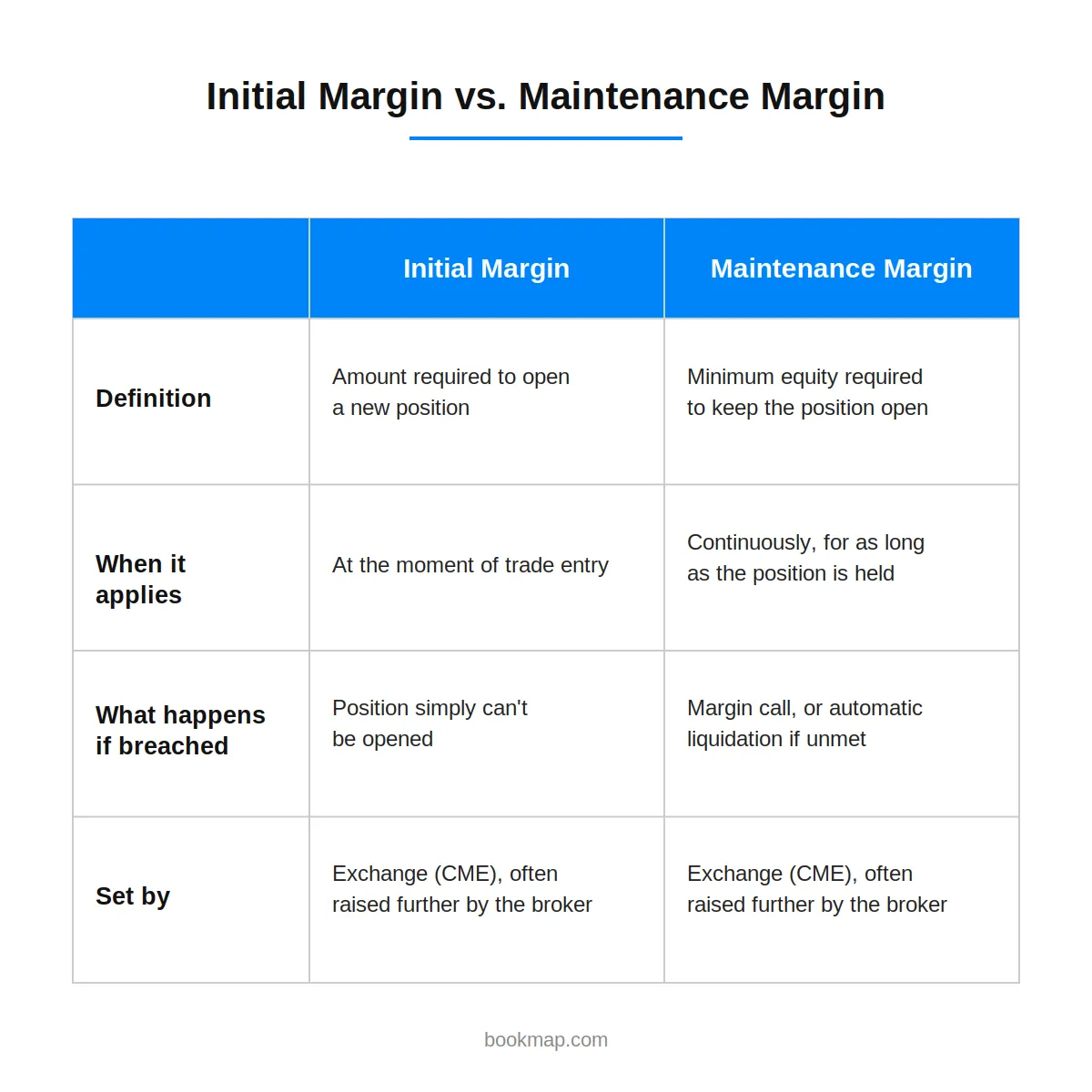
Both figures are set by the exchange and adjusted for volatility — sometimes significantly during periods of market stress — so any specific dollar figure quickly goes stale. Check a broker’s current published margin schedule directly rather than relying on a fixed number from an article, including this one.
Brokers also typically split margin into two further tiers: day-trading (intraday) margin, a reduced figure that applies only while a position is opened and closed within the same session, and overnight margin, closer to the exchange’s full initial margin requirement, which applies to any position held past the session’s close. The gap between the two can be substantial — a position sized comfortably under day-trading margin may not be sizeable under the overnight figure.
Micro E-mini Futures & Beginner Capital Requirements
Micro E-mini contracts (MES, MNQ, MYM, M2K) are 1/10th the size of their standard E-mini counterparts, with proportionally smaller multipliers, tick values, and — most relevant for beginners — margin requirements. This is the main reason micros exist: they let a trader with a smaller account control a properly sized position instead of being forced into a single standard contract that risks far more than the account can absorb.
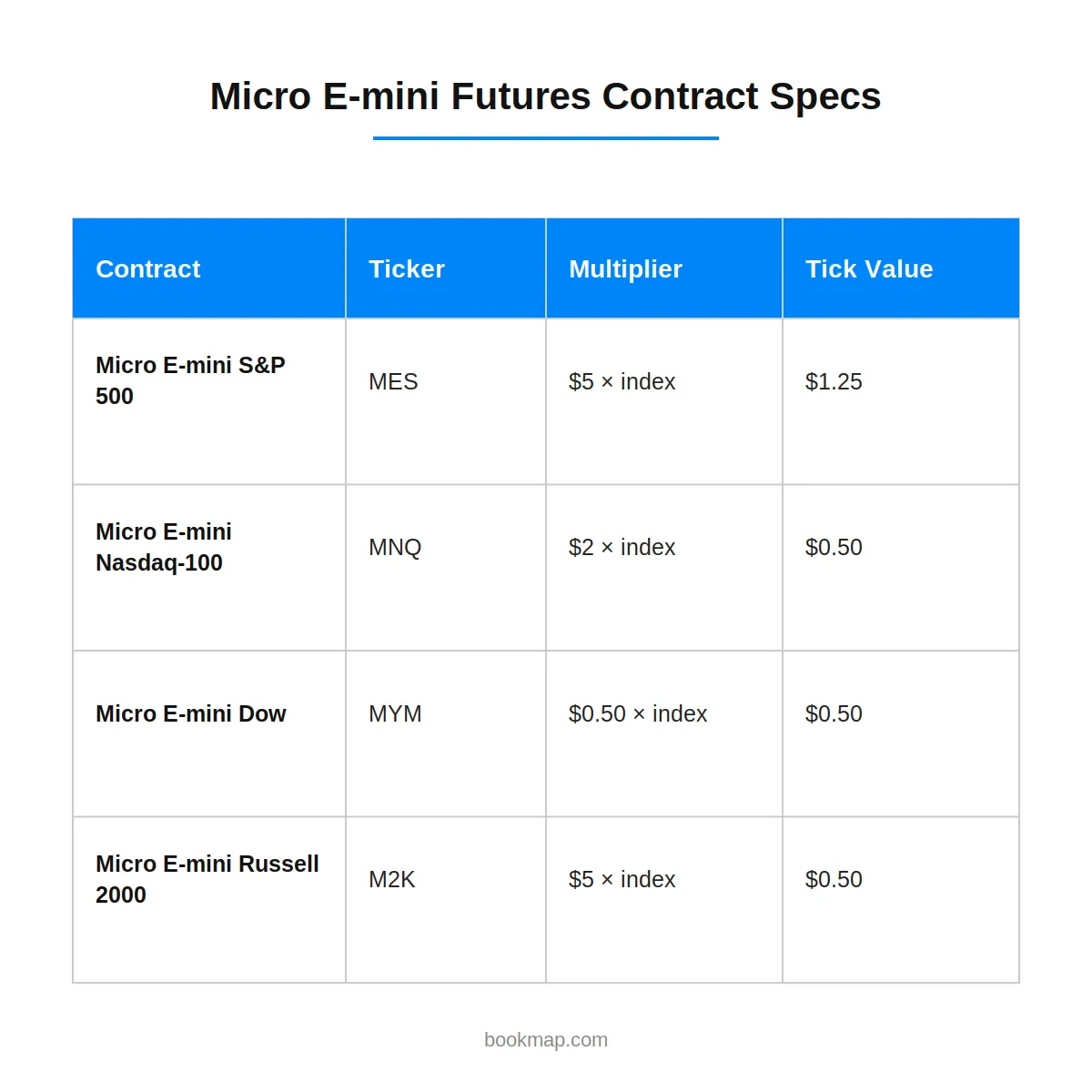
For a beginner specifically, the practical capital question isn’t just “what’s the minimum margin” — it’s whether the account can absorb a realistic string of losing trades at that position size without breaching maintenance margin. A common (though not universal) starting-point guideline is keeping any single position’s day-trading margin requirement well under 10% of total account equity, leaving room to absorb drawdown without an immediate margin call.
Pattern Day Trader (PDT) Rule Exemption for Futures
The Pattern Day Trader rule (FINRA Rule 4210) requires margin accounts executing four or more day trades within five business days to maintain a minimum of $25,000 in account equity — but this rule applies specifically to equities and equity options trading, regulated by FINRA and the SEC. Futures markets are regulated separately, by the CFTC and the NFA, and the PDT rule simply doesn’t apply to them.
This is one of the more practically significant differences between futures and stock/options day trading for smaller accounts: a trader can day trade futures contracts as frequently as they want, regardless of account size, without triggering a PDT restriction — subject, of course, to the broker’s own margin requirements and risk controls, which still apply regardless of the PDT rule’s absence.
Key Differences: Futures vs. Options vs. Stock Trading
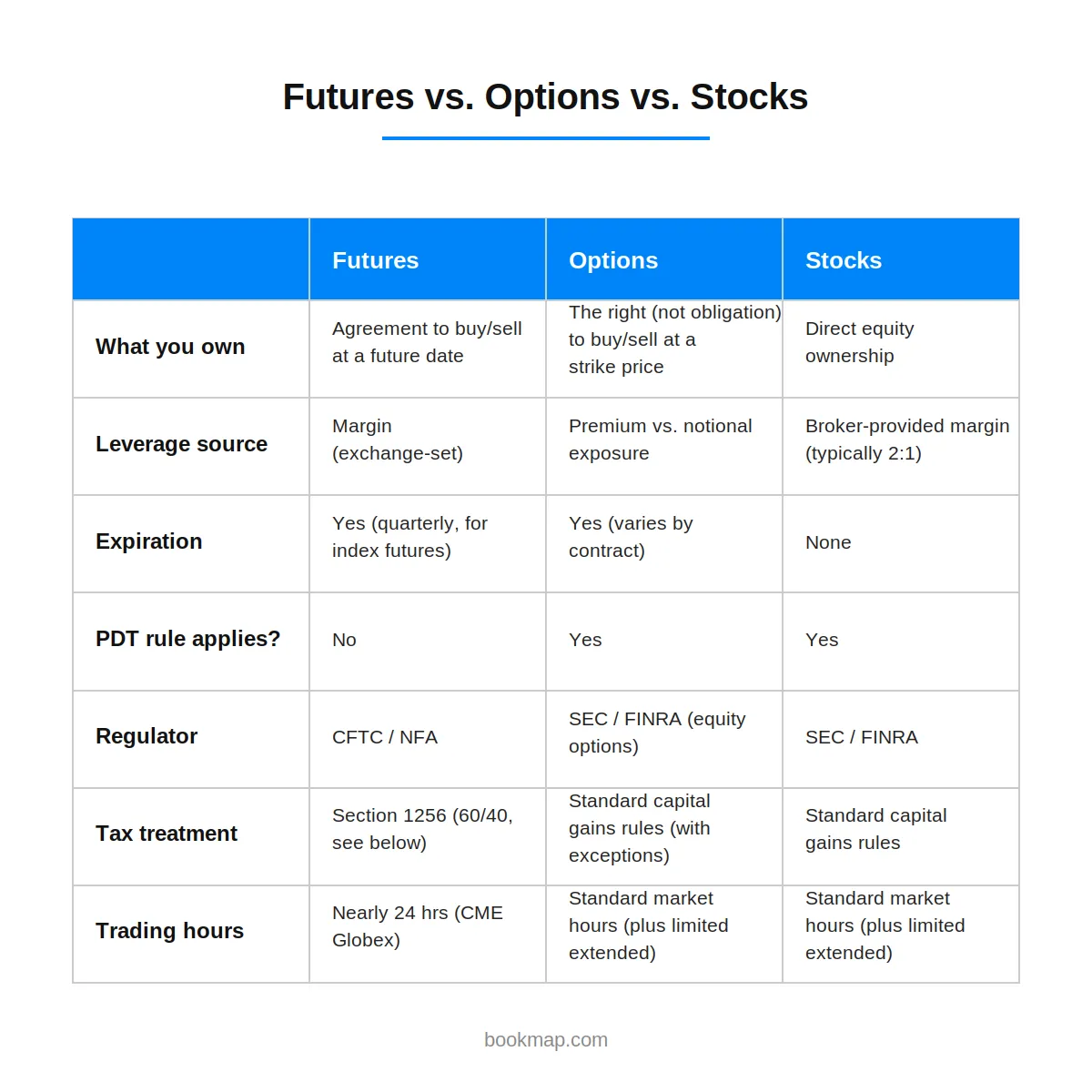
The regulatory and tax differences above are genuinely structural, not just technicalities — they meaningfully change practical considerations like account size requirements (no PDT minimum for futures) and after-tax returns (the Section 1256 rule below) independent of trading strategy or skill.
Section 1256 Contracts & Tax Treatment (60/40 Rule)
CME futures contracts, including all Micro E-mini and standard E-mini products, are classified as Section 1256 contracts under the U.S. tax code. Under this rule, 60% of any gain or loss is treated as long-term capital gain or loss and 40% as short-term, regardless of how long the position was actually held — even a trade opened and closed within the same day qualifies for this treatment. This differs meaningfully from equity trading, where actual holding period determines tax treatment directly, and short-term equity trading is taxed at ordinary income rates.
This is general information, not tax advice — every trader’s situation is different, and this section shouldn’t substitute for consulting a qualified tax professional about individual circumstances.
Expiration & Rollover Schedule Mechanics
Equity index futures expire quarterly, on the standard March, June, September, and December cycle, with the third Friday of the expiration month typically marking final settlement. Since these contracts are cash-settled, a trader holding a position into expiration doesn’t need to take any action to avoid physical delivery — the position simply settles in cash automatically.
Most active traders instead “roll” their position before expiration: closing the expiring contract and opening an equivalent position in the next quarterly contract, to maintain continuous exposure without ever reaching settlement. Rolling early enough to avoid the reduced liquidity that typically shows up in an expiring contract’s final days is a common practical consideration — volume and open interest shift to the next contract well before the actual expiration date.
Risk Management, Stop-Loss & Bracket Order Execution
A stop-loss order closes a position automatically once price reaches a specified level, capping downside risk on a trade without requiring the trader to watch the position continuously. A bracket order combines an entry with both a stop-loss and a take-profit order simultaneously — once the entry fills, both exit orders are live, and whichever is hit first automatically cancels the other.
For futures specifically, position sizing and stop distance need to be calculated together using the contract’s actual tick value, not just a percentage move — an 8-tick stop on ES ($100 per contract, at $12.50 per tick) risks a very different dollar amount than the same 8-tick stop on MES ($10 per contract, at $1.25 per tick), even though both represent the identical underlying price move. Defining risk in dollar terms first, then working backward to the appropriate stop distance and contract size, is generally more reliable than picking a stop distance first and calculating the resulting risk afterward.
Order Flow, Volume Profile & Depth of Market (DOM) Strategy
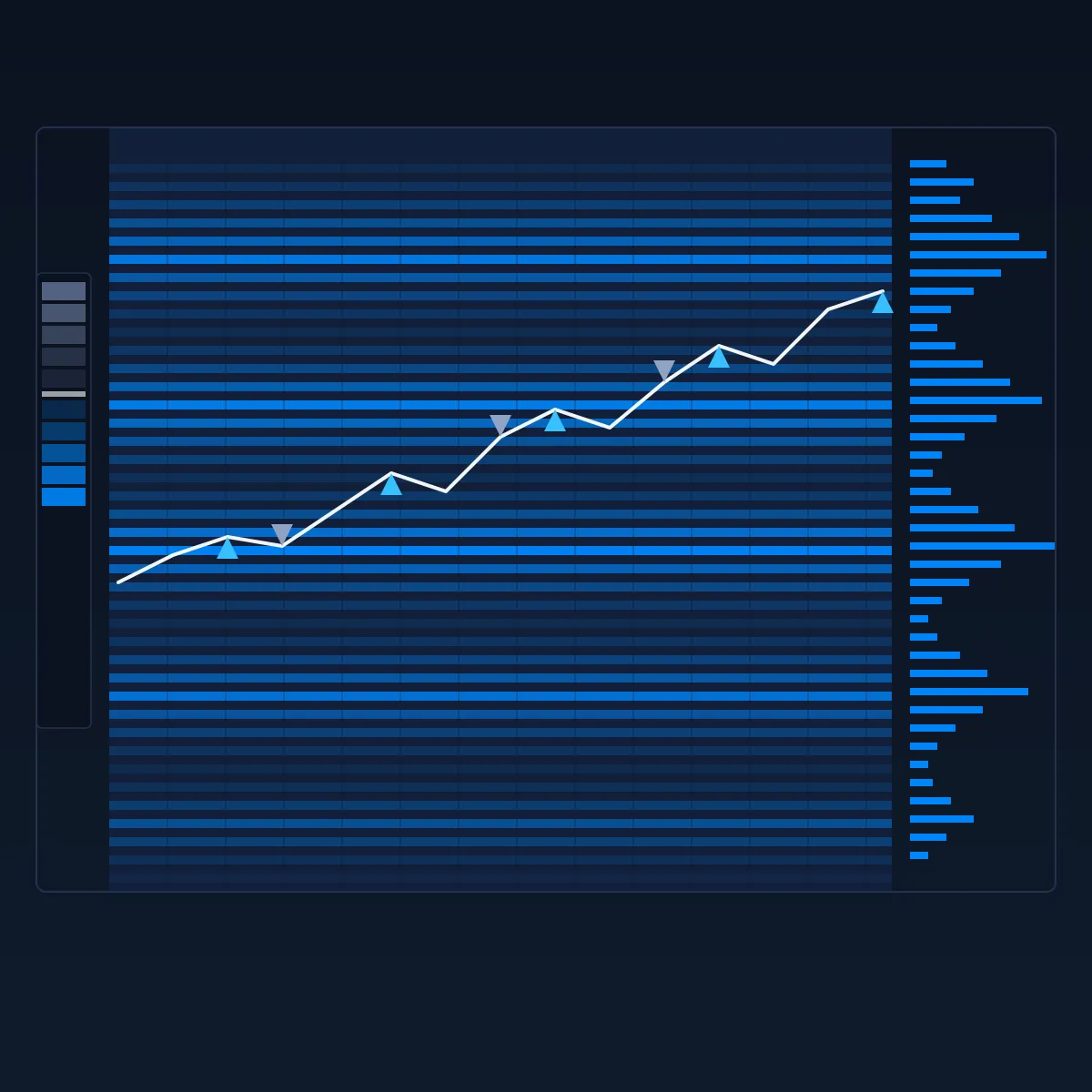
Margin rules, tax treatment, and order types describe the mechanics of holding a futures position — they don’t describe what’s actually happening in the market while a trade is live. Depth of Market (DOM) shows the resting buy and sell orders at each price level, volume profile shows where the most trading activity has concentrated over a given period, and order flow analysis combines both to show real-time buying and selling pressure as it develops, rather than only the last traded price.
This is a meaningfully different approach from reading price and indicators alone. See Bookmap’s guide to technical analysis vs. order flow for how the two approaches differ, and Bookmap’s guide to market structure in trading for how liquidity and price action interact at the level individual participants operate on.
Common Beginner Mistakes & Over-Leverage Risks
Futures’ inherent leverage is both the appeal and the most common source of beginner losses. A few recurring mistakes:
- Sizing positions off margin requirement rather than account risk tolerance. A low margin requirement makes a position affordable to open — it says nothing about whether the account can absorb a realistic losing streak at that size.
- Treating day-trading margin as the “real” cost of a position. Overnight margin is often meaningfully higher; a position comfortable intraday may not be if held past the close.
- Ignoring the PDT rule’s absence as a license for excessive trading frequency. No PDT restriction on futures doesn’t mean unlimited trading is risk-free — overtrading remains a common path to losses regardless of regulatory permission to do it.
- Not calculating stop-loss distance in actual dollar terms. A “20-tick stop” means something very different in risk terms depending on which contract (standard vs. micro) it’s placed on.
- Overlooking rollover timing. Holding into an expiring contract’s final, thinner-liquidity days — rather than rolling to the next contract earlier — can mean worse execution than necessary.
Why Choose Bookmap
Everything above — margin, tax treatment, order types, contract mechanics — is the structural foundation for trading futures. None of it shows what’s actually happening in the order book while a position is live: where liquidity is concentrated, whether a level is being defended or run through, or whether a move is backed by genuine participation.
Bookmap’s order flow strategies resources cover the heatmap, volume-based signals, and depth-of-market tools built specifically for that — on standard and micro E-mini contracts alike. Try it for free today.
FAQ
What’s the difference between initial margin and maintenance margin?
Initial margin is the amount required to open a new futures position. Maintenance margin is the minimum account equity required to keep that position open — if equity falls below it, the broker issues a margin call or closes the position. Both are set by the exchange and adjusted for volatility over time.
Does the Pattern Day Trader (PDT) rule apply to futures trading?
No. The PDT rule (FINRA Rule 4210), which requires $25,000 minimum equity for accounts making four or more day trades in five business days, applies specifically to equities and equity options. Futures are regulated separately by the CFTC and NFA and aren’t subject to this rule.
How are futures taxed differently from stocks?
CME futures contracts are classified as Section 1256 contracts, meaning 60% of any gain or loss is treated as long-term and 40% as short-term for tax purposes, regardless of actual holding period — even a same-day trade qualifies. Stock trading tax treatment depends directly on how long the position was held. This is general information, not tax advice.
What happens when a futures contract expires?
Equity index futures are cash-settled at expiration — no physical delivery occurs. Most active traders roll their position to the next quarterly contract before expiration rather than holding to settlement, partly to avoid the reduced liquidity typical of an expiring contract’s final trading days.
How much capital do I need to start trading Micro E-mini futures?
Micro E-mini contracts (MES, MNQ, MYM, M2K) require significantly less margin than standard E-mini contracts, making them a common starting point for smaller accounts. Beyond the minimum margin figure, it’s worth sizing positions so a realistic string of losing trades wouldn’t threaten the account’s maintenance margin — not just checking whether a single position is affordable to open.
What’s the difference between day-trading margin and overnight margin?
Day-trading (intraday) margin is a reduced figure that applies only to positions opened and closed within the same session. Overnight margin, closer to the exchange’s full initial margin requirement, applies to any position held past the session’s close — and is often substantially higher.
Sign Up Now
Latest Articles