


See scalp setups more clearly without the noise.
Compare plans to read short-term structure and avoid whipsaws.
Education
March 18, 2026
How to Trade Scalp Setups Without Getting Whipsawed
A breakout without participation is like a door opening into a wall. It may allow movement, but it leads nowhere. Most whipsaws also exhibit this behavior. Price moves beyond a level and entries trigger. At this point, most traders expect price continuation. Yet within moments, the move stalls and rotates back.
The failure is not caused by bad timing! It occurs because the market never accepted the new price.
Realize that markets constantly shift between “balance” and “expansion”. In a balanced market, price rotates because buyers and sellers agree on value. In an imbalanced market, price trends are affected by disagreement between them.
Scalping operates directly within this balance-and-expansion cycle. Usually, scalping mistakes occur when trades are taken on the inside of the balance instead of during expansion. This article explains how to scalp without getting whipsawed. It also delves into how scalp trading setups form, why whipsaws develop, and how to avoid whipsaw trading.
Why Whipsaws Happen in the First Place
Whipsaws are not random price movements. Instead, they reflect a failure of structure. They occur when the price leaves an area but fails to gain acceptance at the new level.
Notably, there is no single definition of a scalp. That’s because:
- Some scalp trading setups operate within narrow micro ranges,
- Others trade rotations inside broader balance areas, whereas
- Some setups are based on breakouts from compression.
Thus, the holding time does not determine outcome quality. It is “structural acceptance,” which determines whether continuation is possible.
When Does a Whipsaw Form?
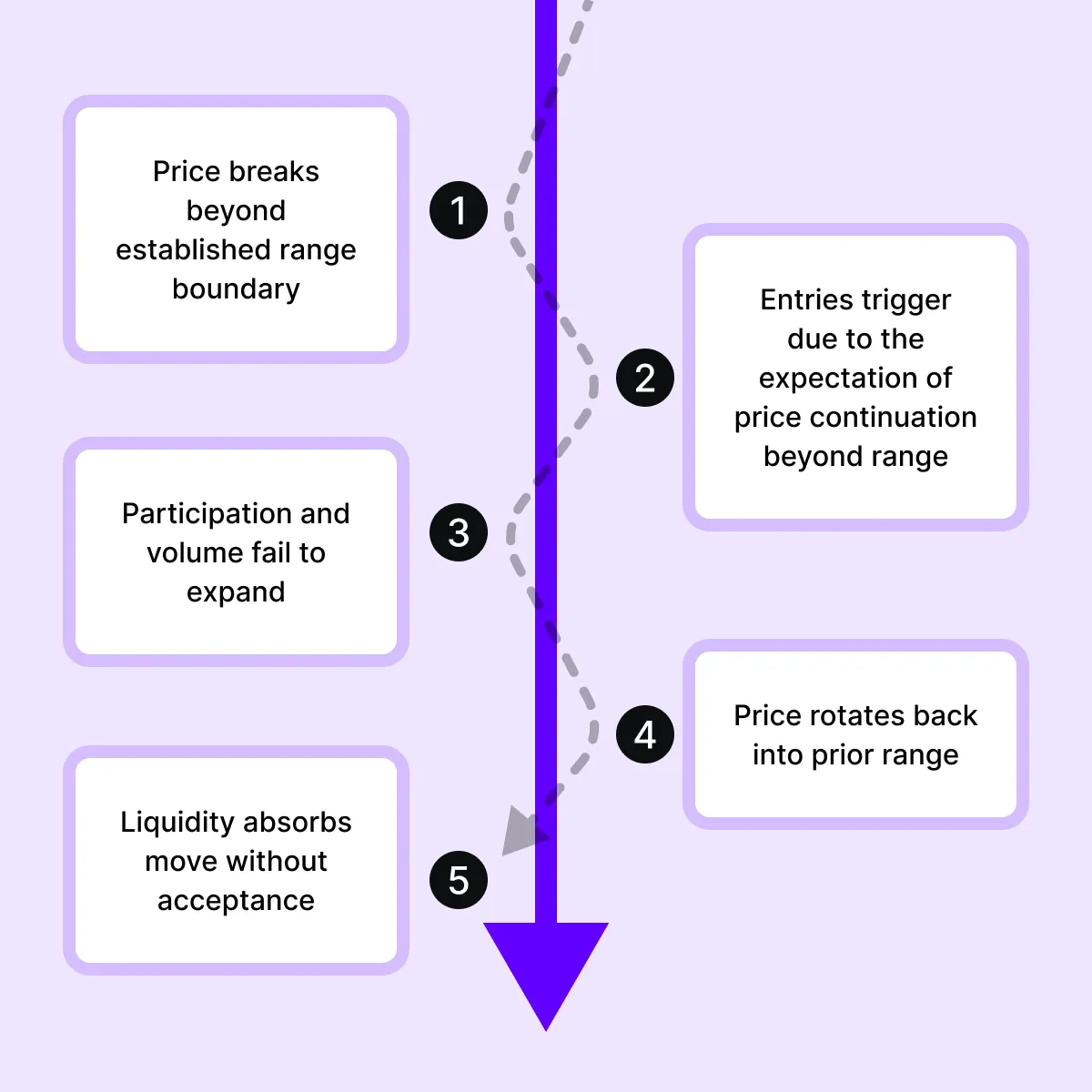
A whipsaw develops when:
- Price moves enough to trigger entries, but lacks the participation needed to sustain the move.
This situation is common inside balanced markets, where buyers and sellers are active on both sides. In such phases, liquidity exists above and below the range, but neither side has clear control.
Furthermore, the price is negotiated within the balance. Small moves outside the range represent price exploration, not commitment. Since there is no expansion in volume or participation, price returns to its prior level. This behavior is the core reason scalping mistakes occur and explains why scalping fails in many conditions.
Example of How a Whipsaw Forms
- I) The Market Condition
-
- Consider a market trading between 4500 and 4510 for an extended period.
- Price rotates repeatedly between these levels.
- It is showing a balance.
- Both buyers and sellers are active, but neither side establishes dominance.
- II) Price Increases
- Later, the price moves above the prior high and reaches 4513.
- This move appears to be a breakout.
- Many scalp trading setups treat such moves as the start of continuation.
- However, continuation depends on structural acceptance.
III) Absorption
- Buying interest is absorbed above 4510.
- Transaction volume does not increase.
- Hence, the price cannot hold above the prior range.
- This behavior shows that the market is not accepting higher prices.
- Consequently, without acceptance, the breakout remains incomplete.
- IV) Rotation
- Price rotates back inside the range and trades at 4504.
- The breakout occurs, but it does not lead to a structural change.
- The breakout attempt fails because of insufficient participation.
Thus, Insufficient participation prevents continuation and explains why scalping fails in balanced conditions. See how order flow helps filter scalp entries.
Step 1: Diagnose the Environment Before Looking for a Setup
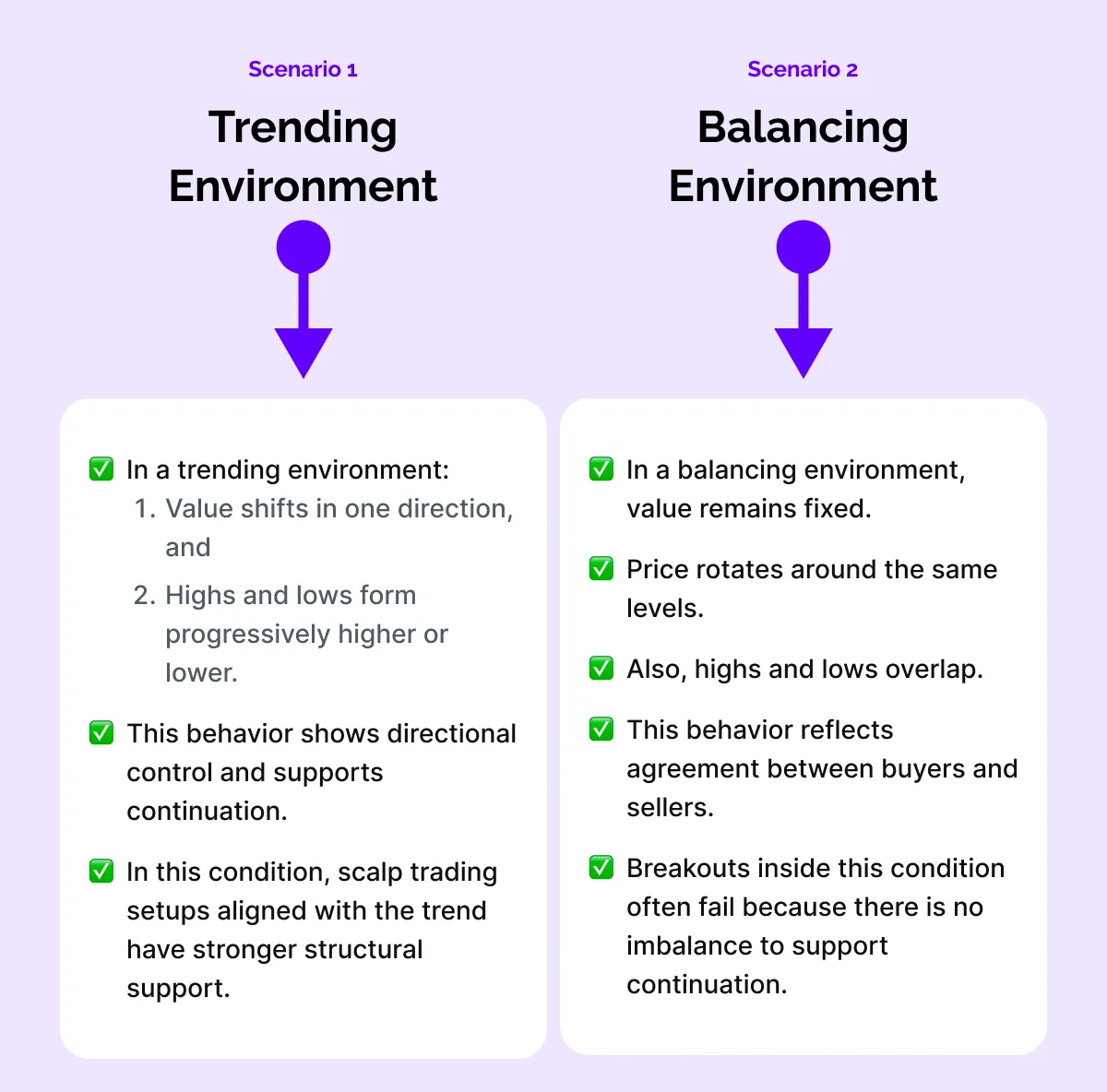
Scalping depends on the market environment, as price behavior changes based on whether the market is trending or balancing. This structural context determines whether continuation or rotation is more likely.
Key Characteristics of Trending vs Balancing Environments
The Role of Volatility in Providing Important Information
In such market environments, expanding volatility indicates increasing participation and supports directional movement. On the contrary, compressing volatility reflects agreement and negotiation. Breakouts during compression often lack follow-through.
Furthermore, when highs and lows overlap, the market is in balance. In this condition, price movements in the middle of the range lack structural support, which is where many scalping mistakes occur. Moves from the center of value often reverse because neither side has control.
With such structural awareness, traders can scalp without getting caught.
Step 2: Require Participation Expansion, Not Just Price Break
A price break alone does not confirm continuation. Continuation depends on participation. Without increased activity, the breakout lacks structural strength. For continuation to develop:
-
- Transaction volume must increase as the price moves beyond a certain level.
- This increase shows that more participants agree with the new price.
- Sustained trading at the new level indicates acceptance.
- And acceptance reflects structural change, i.e., it is not just a temporary movement.
Additionally, expansion is visible when the price moves beyond a level and continues to trade there with steady volume. This shows that buyers or sellers are willing to operate at the new price.
False Breaks Show Different Characteristics
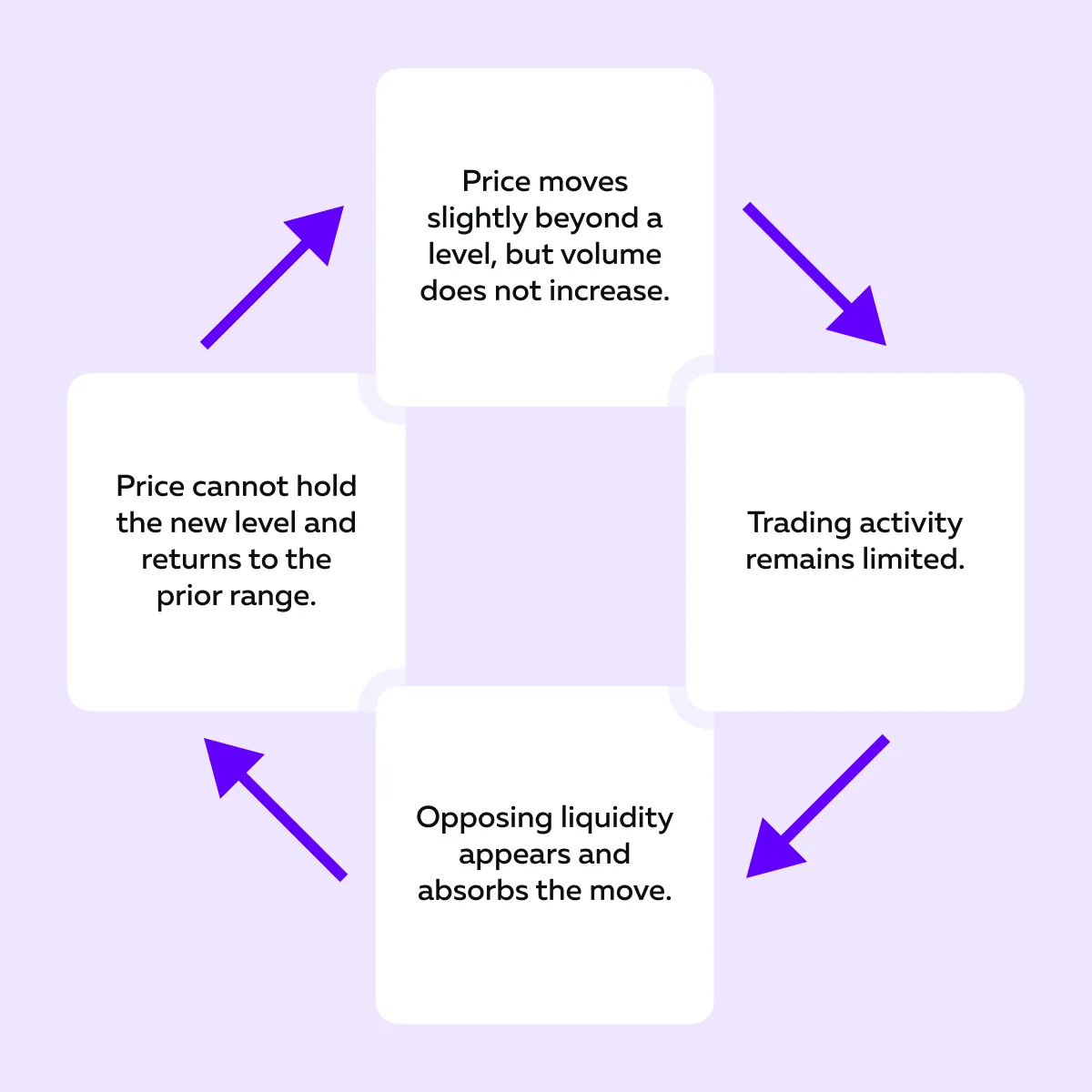
These fragile moves often lead to many scalping mistakes. Usually, a breakout without participation lacks structural support and leads to a reversal. This behavior is one of the most common reasons why scalping fails during balanced or low-participation conditions. Understand participation before committing to short-term trades.
Step 3: Analyze Liquidity Behavior at the Break
Price movement alone does not confirm continuation. Liquidity behavior must also confirm whether continuation is structurally supported. Liquidity behavior reveals whether a breakout can sustain continuation or fail. The reaction of liquidity at the new level determines structural strength or weakness.
When liquidity refreshes against the move, it signals resistance. Here’s an example:
- Suppose price breaks higher.
- Aggressive buying enters the market.
- However, large resting sell orders remain in place and continue to replenish.
- These orders absorb incoming buying pressure.
- As a result, the price stops advancing.
- This pause occurs because opposing interests match or exceed incoming orders.
This condition reflects absorption rather than price continuation and increases the likelihood of whipsaws.
When Does Continuation Become More Likely?
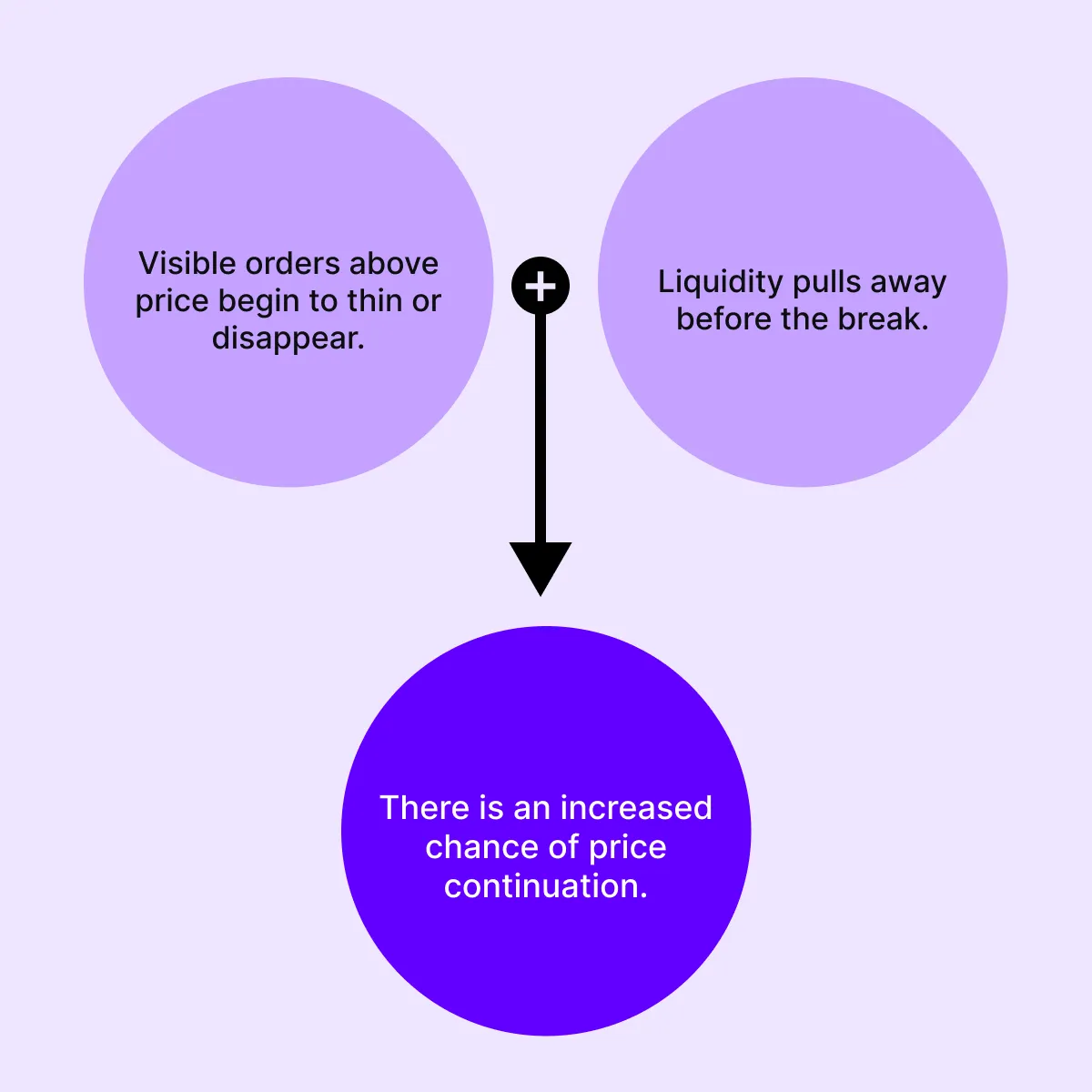
Both these events show reduced resistance. When the price moves into this area, there is less opposing liquidity. This allows price to transact more freely at higher levels. This creates stronger scalp trading setups because the price can move into new territory without immediate rejection.
The interaction between aggressive orders and resting liquidity determines the quality of the outcome. Understanding liquidity behavior helps traders identify where structural asymmetry exists.
Step 4: Trade Where Structure Offers Asymmetry
Price operates within ranges across multiple timeframes. This creates nested areas of agreement and negotiation. An extensive session range may contain smaller intraday ranges, which may further contain even more minor rotations. For example,
- A 40-point session balance forms the broader range.
- Inside it, a 15-point intraday range reflects shorter-term agreement.
- Within that, a 4-point rotation represents very short-term negotiation.
- At this level, price oscillates without structural imbalance or directional control.
Scalping inside a range is not inherently flawed. The outcome depends on structural location. The middle of a range represents balance. In this area:
- Buyers and sellers are both active, and neither side has control.
- Liquidity exists above and below.
- Participation remains evenly distributed.
Such an environment offers limited directional clarity. As a result, continuation attempts from the middle usually fail.
Structural Edges Offer Different Conditions
Edges represent the boundaries of agreement. Beyond these levels:
- Stops cluster, and
- Liquidity becomes thinner.
These conditions create structural asymmetry. In such areas, price may rotate back into the range or establish acceptance outside the range. Both outcomes show structural reference. However, in this area, a scalp setup becomes vulnerable when it forms inside the negotiated value without a structural context.
Additionally, stronger scalp trading setups form at structural transitions. These include:
- Moves from range extremes back into value,
or
- Confirmed expansion beyond range boundaries.
These locations provide clearer imbalance and participation signals.
Step 5: Recognize Exhaustion Before Entering
Exhaustion occurs when a price move loses its momentum despite continued trading activity. It reflects weakening directional control and is a common condition that precedes whipsaws.
Signs of Exhaustion
Usually, exhaustion appears when aggressive buying or selling increases, but the price stops advancing. In such a market phase, transactions continue, yet the price remains roughly the same, which shows that opposing liquidity is absorbing the move. Participation exists, but it no longer supports further price progression.
Another sign of exhaustion is “range compression” after a strong move. In it:
-
- Price may rally several points with expanding activity.
- However, on the next attempt, the price fails to move higher.
- This shows that the market is no longer willing to accept higher prices.
- The imbalance that drove the move is no longer present.
Scalp trading setups entered during exhaustion have limited structural support. In such market conditions, continuation becomes unlikely because the move has already consumed available liquidity.
Step 6: Align Stop Placement With Structure, Not Emotion
Stop placement determines whether a trade is based on structural logic or emotional reaction. “Tight stops” placed near minor highs or lows mostly sit within normal market noise. These locations:
- Attract liquidity,
and
- Frequently get triggered without any structural change.
On the other hand, “structural stop placement” shows the original trade premise. If a scalp is based on expansion, the stop should be placed where expansion becomes structurally invalidated. Such a structural invalidation occurs when:
- Price returns to the prior balance area,
or
- Fails to maintain acceptance beyond the breakout level.
This distinction is highly important because normal price fluctuations occur within ranges. Stops placed inside these fluctuations increase vulnerability to whipsaws.
What a High-Quality Scalp Setup Actually Looks Like
High-quality scalp trading setups follow a structural sequence elaborated on below.
| Sequence Stage | Explanation |
| Balance to Expansion Transition |
|
| Participation Increases at Breakout |
|
| Liquidity Thins Ahead of Price |
|
| Pullback Forms |
|
| Expansion Resumes with Participation |
|
In contrast, weak setups show different characteristics, as illustrated below:
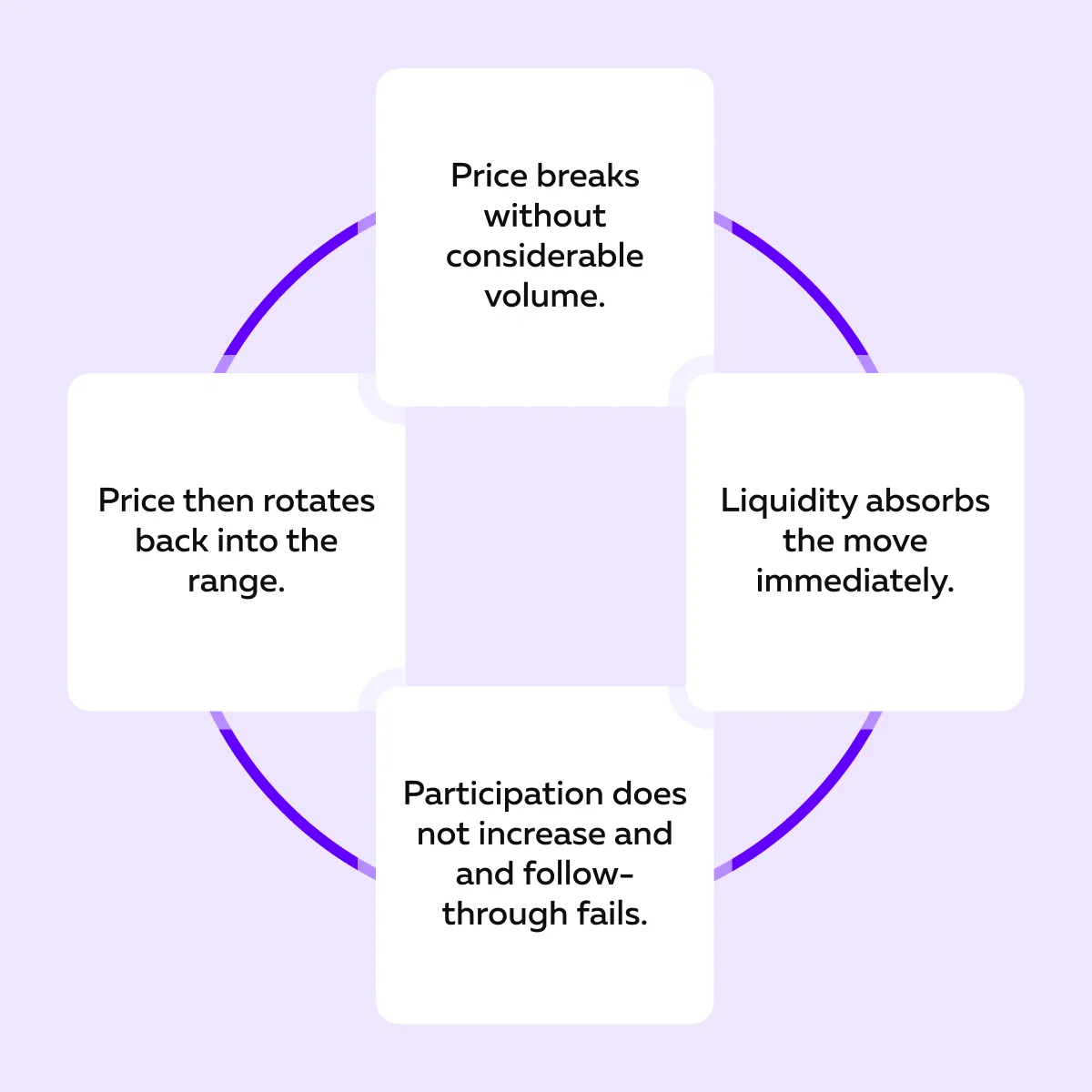
These fragile conditions increase the likelihood of whipsaws.
Conclusion
Scalping without getting whipsawed depends on “structural clarity” rather than reaction speed. Whipsaws occur when prices move without participation, acceptance, or liquidity support. These conditions only create temporary movement and should not be interpreted as sustained continuation.
Notably, high-quality scalp trading setups emerge when the:
- Market shifts from balance to expansion,
- Participation increases, and
- Liquidity allows continuation.
Such a market structure provides the reference for entry, risk, and continuation expectations. Without these elements, the price remains in negotiation and is vulnerable to reversal.
By understanding these structural conditions, traders can avoid whipsaw trading and reduce common scalping mistakes. Explore tools built for precision intraday execution.
FAQs
1. Why do breakout scalps fail so often?
Breakout scalps fail when the price moves beyond a level but lacks strong buying or selling interest. Without increased participation, the market does not accept the new price. Due to this price rejection:
- Liquidity absorbs the move,
and
- Price returns to the range.
This is one of the most common reasons why scalping fails and creates whipsaws.
2. Should scalpers trade inside the balance?
Scalping inside balance works best near the edges, not in the middle. That’s because the middle reflects agreement between buyers and sellers. Thus, price lacks direction. In contrast, at the edges, price is more likely to rotate back or break out.
Such a structural location allows traders to avoid whipsaws and improve scalp trading setups.
3. Is faster execution the key to avoiding whipsaws?
Speed does not prevent whipsaws. Instead, structural conditions are more critical. If participation and liquidity do not support continuation, the trade remains weak regardless of execution timing.
Understanding market structure helps traders avoid whipsaws and unstable entries.
4. How can traders reduce whipsaws immediately?
Whipsaws reduce when trades occur with strong participation and in line with the structural context. Usually, “continuation probability” is improved via:
- Volume expansion,
- Liquidity support, and
- Structural location.
Avoiding mid-range entries and focusing on structural transitions helps reduce scalping mistakes.
Sign Up Now
Latest Articles