


Spot breakout pressure before expansion begins.
Compare plans to see volatility compression and breakout levels clearly.
Trading Basics
March 18, 2026
Narrow Range Breakouts: Why Volatility Compression Leads to Expansion

Before markets expand, they go through a phase of compression. Before strong market moves, the price enters a period of compression. During this phase, the market trades within a narrow band and volatility declines. Consequently, buyers and sellers temporarily agree on a price, keeping it within a narrow range.
However, this quiet behavior does not mean the market is inactive. Instead, positioning continues to develop, gradually creating structural pressure within the range. Once the price finally breaks beyond this narrow range, market behavior begins to change. At that point, participation increases and the market shifts from balance to expansion.
Read this article to learn how narrow range breakout strategy setups form, why volatility compressions lead to range expansion trading, and how traders check for trading consolidation in real market conditions.
What a Narrow Range Actually Represents
A narrow range appears when:
- Market volatility contracts, and
- Price moves within a small band.
This period signals a “temporary balance” between buyers and sellers. Both sides agree on the value for a short time. Hence, the price oscillates within a tight range rather than trending strongly. Due to such tight price rotations:
- Trading activity concentrates within defined highs and lows.
- Liquidity gradually builds near the edges of the range because many orders accumulate there.
The Phases of Volatility Compression
Compared with previous sessions, price movements are smaller, reflecting “volatility compression”. However, compression does not represent inactive markets. Instead, it shows the positions initiated by different market participants.
During these phases, traders also build inventory within the range. Different participants build up this inventory in the following manner:
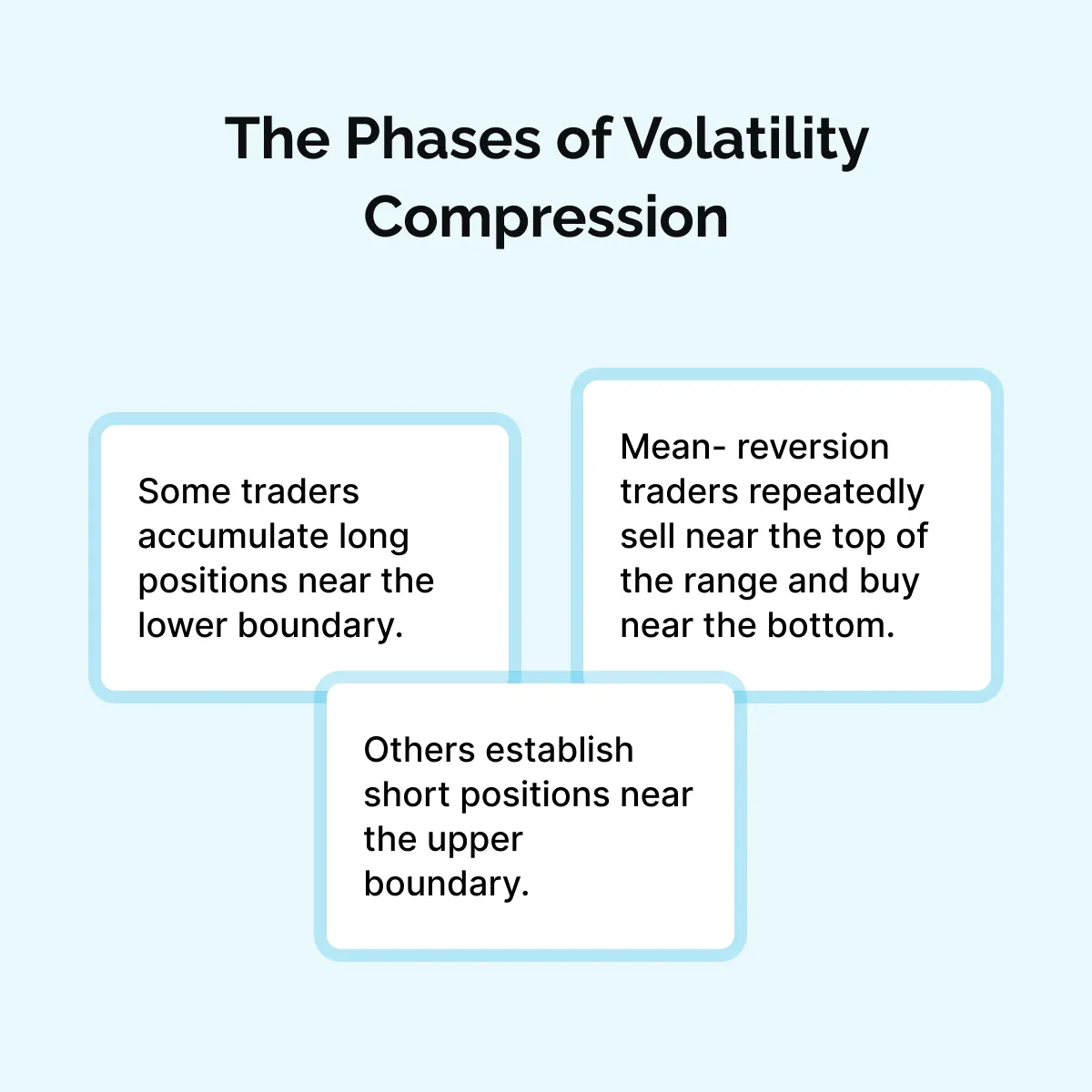
Meanwhile, essential order clusters begin to form. Stop-loss orders start to gather:
- Above the range high, and
- Below the range low.
In addition, breakout traders also place entry orders just outside the boundaries, and liquidity providers tighten spreads. Such a tightening of spreads is done to manage risk.
Consequently, the market structure gradually develops tension. The longer the price remains confined within a tight range, the more positions accumulate on both sides. Later, when the price finally moves beyond the boundaries, these clustered orders trigger strong momentum.
The Phase of Accumulation and Trapped Order Flow
It is worth mentioning that inside a “narrow range”, market activity appears calm, yet positioning continues to build beneath the surface in the following manner:
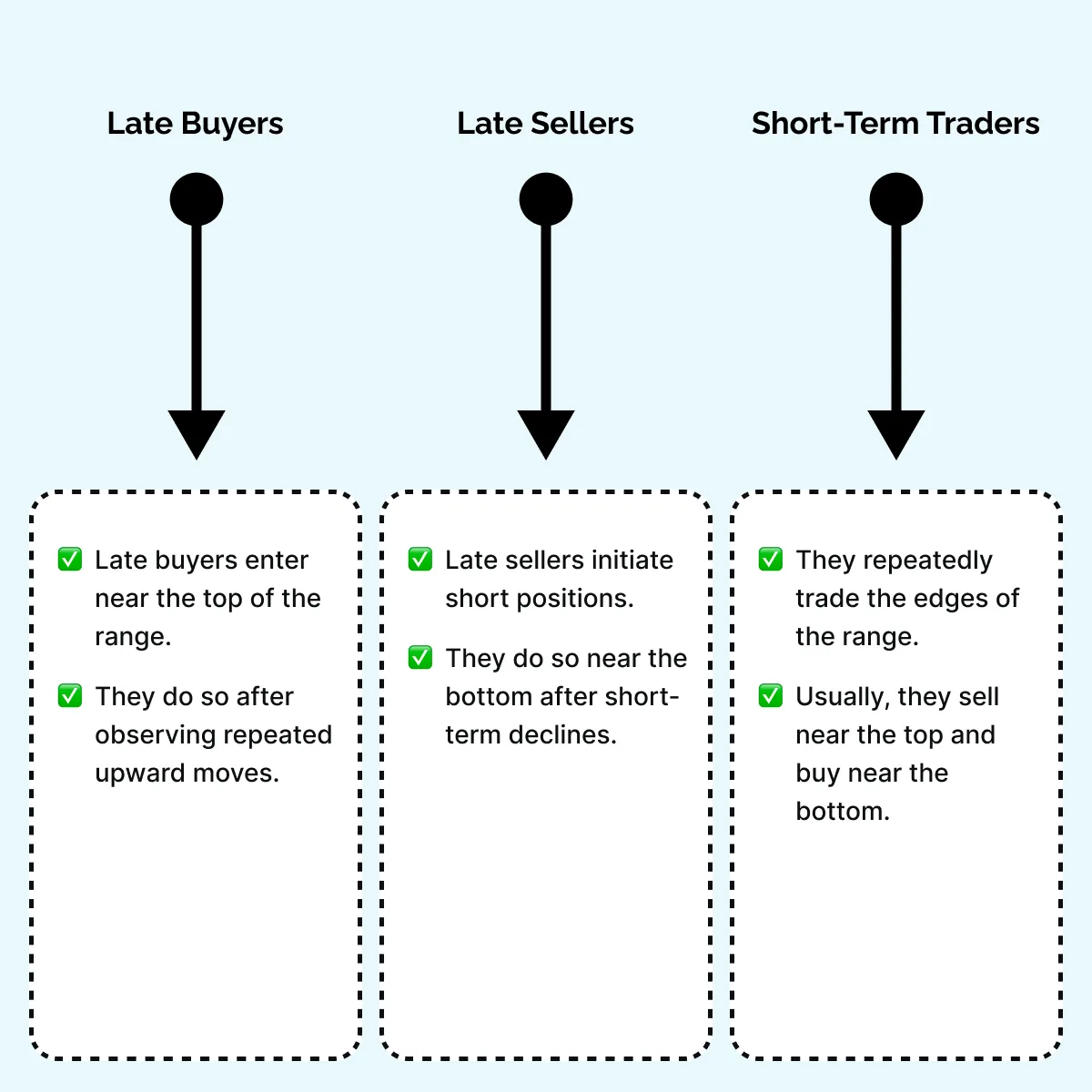
However, these actions do not last indefinitely. When the price finally moves beyond the range boundary, many of these positions become incorrect. As a result, traders caught on the wrong side become trapped. Their stop-loss orders begin to trigger, which forces them to exit their positions.
This reaction creates strong order flow. Most such trapped traders are forced to reposition by closing their losing trades and rebalancing inventory. For example:
-
- Assume that price breaks above the range to the upside.
- Short positions built near the top of the range become trapped.
- Their stop-loss orders convert into buy orders.
- This conversion adds additional buying pressure.
- At the same time, breakout traders enter new long positions.
- Consequently, the move begins to reinforce itself.
Note that a similar process can also occur on the downside. If the price breaks below the range, long positions established near the bottom become trapped. Their stops trigger selling, adding to the downward pressure.
The Major Takeaway

The market behaves like a “coiled structure” during volatility contraction. The compression does not occur only because price movement slows. Instead, positioning also compresses as inventory accumulates inside the range.
Gradually, this inventory builds tension within the market structure. And once the range boundary breaks, that stored inventory must exit the market.
Why Breakouts From Compression Often Accelerate
A breakout from a narrow range signals a transition from market balance to imbalance. During the range, buyers and sellers agree on value. But once the price moves outside this range, that agreement begins to break down. Consequently, market participation changes. When the price breaks above the range high, several forces enter the market simultaneously.
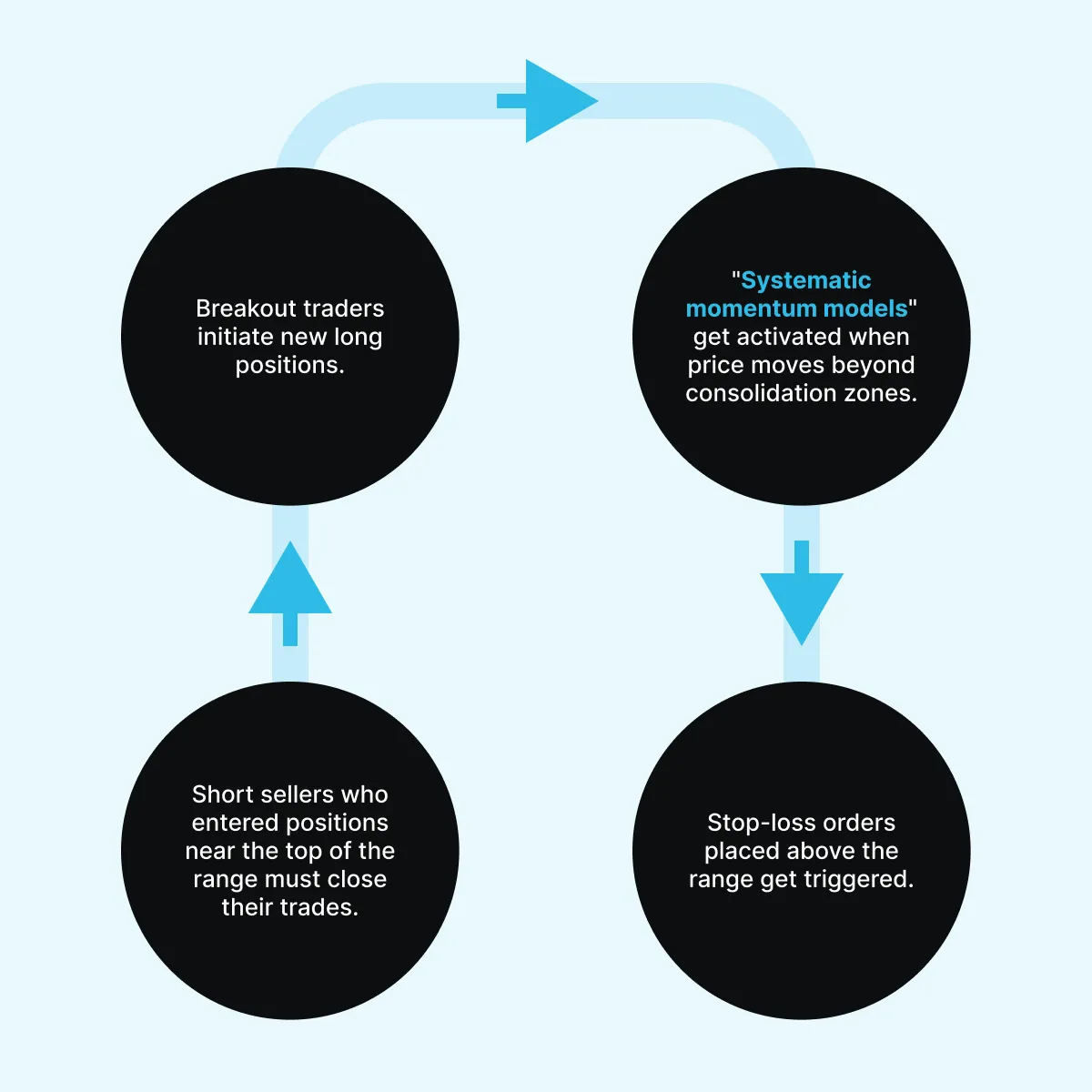
Together, these actions add more buying pressure and push the price further upward. Consequently, the market shifts into range expansion trading, where the price begins to move with greater directional strength.
A Similar Sequence Occurs During a Downside Move
Assume that the price breaks below the low end of the range. Consequently, long positions built near the bottom of the range become trapped. Their stop-loss orders trigger selling activity. Additionally,
- Breakout traders enter new short positions, and
- Selling pressure builds.
Therefore, the move develops into a volatility-compression breakout to the downside. Participation also expands as new traders enter and trapped positions exit. Furthermore, new price extremes naturally attract attention in the following manner:
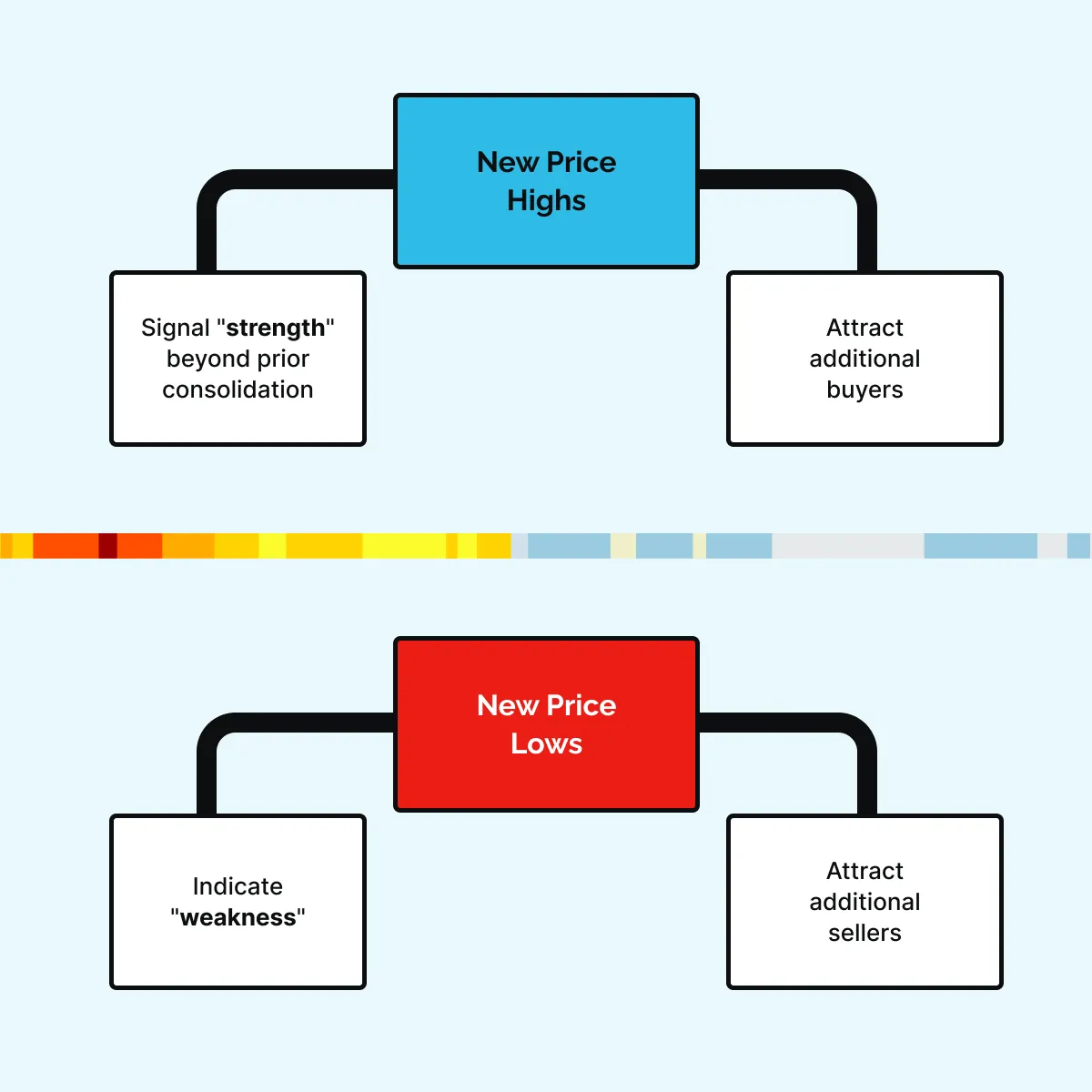
For this reason, trading consolidation breakouts frequently evolve into sustained moves once the market transitions from compression to expansion. Understand how volatility expansion unfolds in real time.
The Role of Participation in Sustaining Expansion
Price moving outside a narrow range does not automatically mean a strong trend will continue. Real expansion occurs only when market participation increases after the breakout. In other words, more traders must become active once the market leaves the compression zone. For example,
- Assume a healthy breakout occurs from a tight price range.
- There is a visible increase in transaction volume.
- At the same time, the price continues to trade outside the earlier consolidation.
- This behavior indicates that new participants are supporting the move.
Another essential sign of real expansion appears during pullbacks. In a strong upside breakout, the price may briefly decline. However, there is a high chance it could remain above the previous high. After this pause,
- Trading activity increases again, and
- The upward move resumes.
Such behavior reflects stable participation and leads to range expansion trading. However, not every breakout develops this way. Some moves fail because participation does not expand. In these situations, price may break the range by only a small margin, sometimes just one or two ticks.
Meanwhile, transaction volume remains unchanged, and available liquidity absorbs the move. As a result, the price reverts to its previous range. These situations represent failed trading consolidation breakouts.
Therefore, the strength of a breakout depends less on the price level itself and more on the level of participation that follows the move.
Riding Breakouts Without Predicting the Destination
After a volatility compression breakout, the market usually enters a “phase of exploration”. During this stage, the final destination of the move remains uncertain because price discovery is still developing.
For this reason, the market shows continuation as long as participation remains strong. Instead of moving toward a predetermined level:
- Price expands step by step, and
- Traders continue to enter the market.
Within a narrow range breakout, continuation appears through these structural patterns:
At the same time, participation remains an important signal. Rising activity suggests that the expansion still has support. On the other hand, strong liquidity absorption may indicate that the move is losing momentum.
Consequently, expansion phases continue while participation remains active. The price move usually slows when:
- Participation declines, or
- Surplus liquidity begins to absorb incoming orders
At that point, the range expansion trading phase gradually ends, and the market may return to a consolidatory phase. See how participation builds during breakouts.

Why Higher Highs Invite More Participation
Once price leaves a narrow range and begins printing new highs, market participation increases. This breakout signals that the earlier balance between buyers and sellers has shifted. And this shifted balance is now attracting new trading activity.
Initially, some traders who missed the first move begin entering the market. At the same time, short positions established near the range high experience pressure. This pressure developed because the market is moving against them. As these traders close their positions, their buy orders add additional upward momentum.
Introduction of Algorithmic Systems
While the market participation is increasing due to higher highs:
- Algorithmic systems become activated, and
- Continuously detect the developing move.
These systems respond to expansion beyond consolidation zones, which adds further buying activity. Consequently, each new high attracts additional participation.
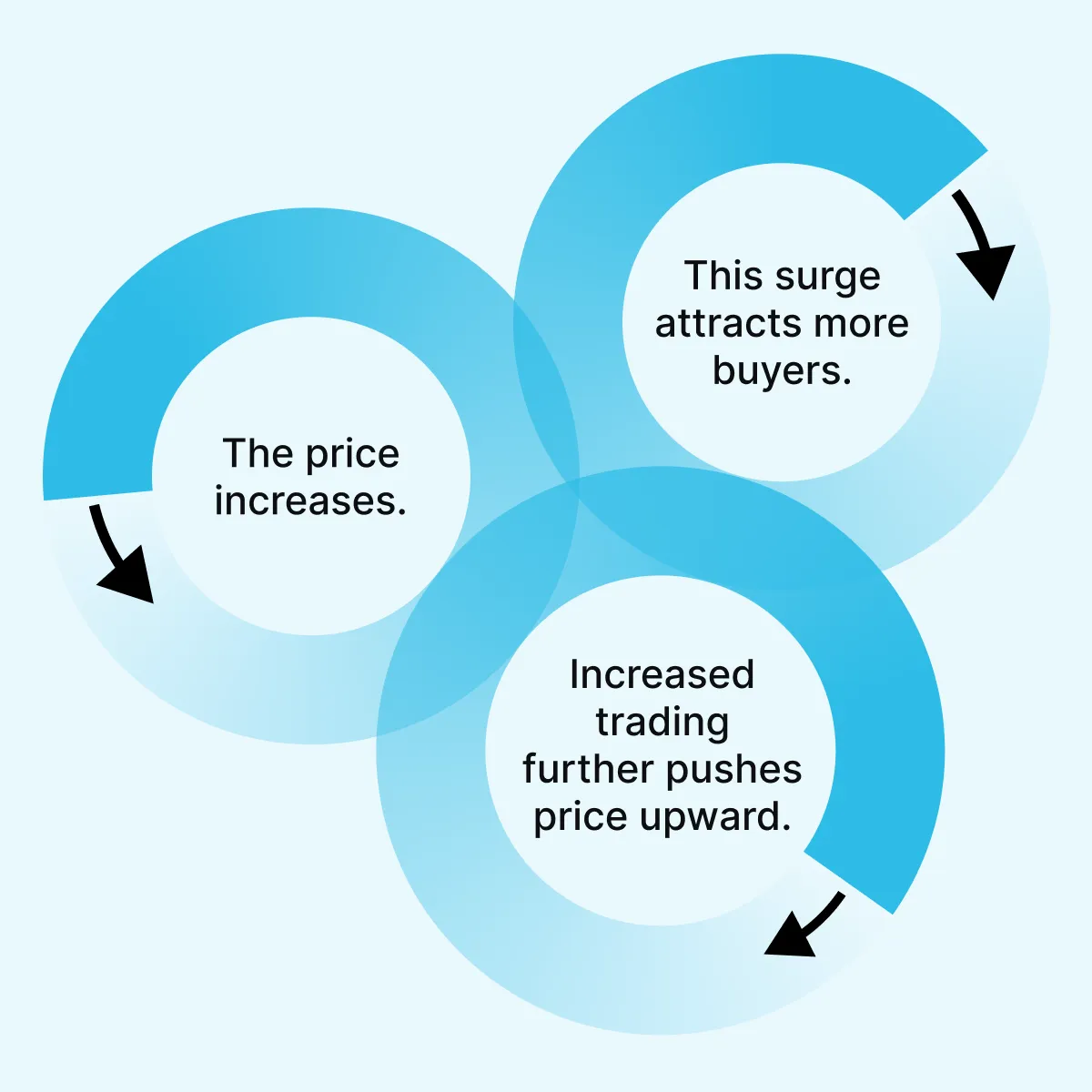
Over time, this behavior forms a “feedback loop”. For this reason, moves that begin from volatility compression travel farther than expected.
How to Structure a Narrow Range Breakout Trade
A narrow range breakout strategy follows a structured sequence. This sequence represents how markets transition from compression to expansion. Traders may follow these steps to give structure to their narrow breakout trade:
| Steps to Perform | Explanation |
| Step 1: Identify Volatility Contraction |
|
| Step 2: Mark Structural High and Low |
|
| Step 3: Wait for Break With Participation |
|
| Step 4: Enter at the Time of Acceptance or Pullback |
|
Conclusion
A narrow range reflects a period of “market compression”. In this phase, prices move within a narrow band, and volatility remains low. Also, positions gradually build inside the range while liquidity gathers near the boundaries.
As a result, the market stores potential energy. Once the price moves beyond the range and participation rises, that stored pressure releases through expansion. This transition marks the shift from balance to imbalance.
Consequently, short positions may get covered, breakout traders may enter, and momentum systems could be activated. In this environment, the opportunity does not lie in predicting the final destination of the move. Instead, it lies in identifying when the market leaves consolidation and exploration begins. Explore tools designed to track liquidity during expansion.
FAQs
1. What is a narrow range breakout?
A narrow-range breakout strategy refers to a situation in which the price moves outside a small consolidation zone. Usually, such price movements are seen after a period of volatility contraction.
During the range, buyers and sellers trade within boundaries. Once price breaks above or below that band, along with participation, the market usually shifts into range expansion trading.
2. Why do breakouts from tight ranges move so quickly?
Breakouts from tight ranges accelerate because many orders are clustered near the edges. When the price breaks the boundary:
- Stop-loss orders trigger, and
- Breakout traders enter at the same time.
This combined order flow produces a strong volatility-compression breakout, pushing the price away from the range.
3. Do all narrow range breaks trend?
No, some trading consolidation breakouts fail because participation does not increase. If volume stays low or liquidity absorbs the move, price can return inside the range. Thus, sustained trends occur only when:
- Trading activity expands, and
- The market accepts prices outside the earlier consolidation.
4. How do traders manage risk on breakouts?
Risk management in a tight-range breakout strategy depends on market structure rather than fixed targets. To manage risk, positions can be initiated after confirmation or minor pullbacks. Additionally, during expansion, the trade could be managed by tracking:
- Higher lows in upward moves, or
- Lower highs in downward moves
At the same time, traders should pay due attention to monitoring participation.
Sign Up Now
Latest Articles