


See order flow more clearly in real time.
Compare plans to access deeper market visibility for order flow.
Trading Basics
March 5, 2026
Order Flow Data Quality: What It Is and Why It Changes Execution
Many traders rely heavily on order flow analysis in their decision-making. Remember that it only tells the truth when the data behind it is complete and updated promptly. Seasoned participants believe order flow “stops working” during fast markets or volatile sessions. However, the real issue is usually the quality of order flow data (not the method itself).
This article will delve into the importance of accessing high-quality order-flow data to prevent confusion during trading and will also elaborate on how transaction accuracy and depth-of-market updates influence what traders see. Besides, the article will also discuss how low-quality data exaggerates aggression, masks absorption, and makes liquidity appear unstable.
What Order Flow Data Quality Actually Means
Order flow data quality is about how “complete and timely” the trading information is. In other words, it shows how accurately a data feed captures what is actually happening in the market (moment by moment). Some common characteristics of high-quality order flow data:
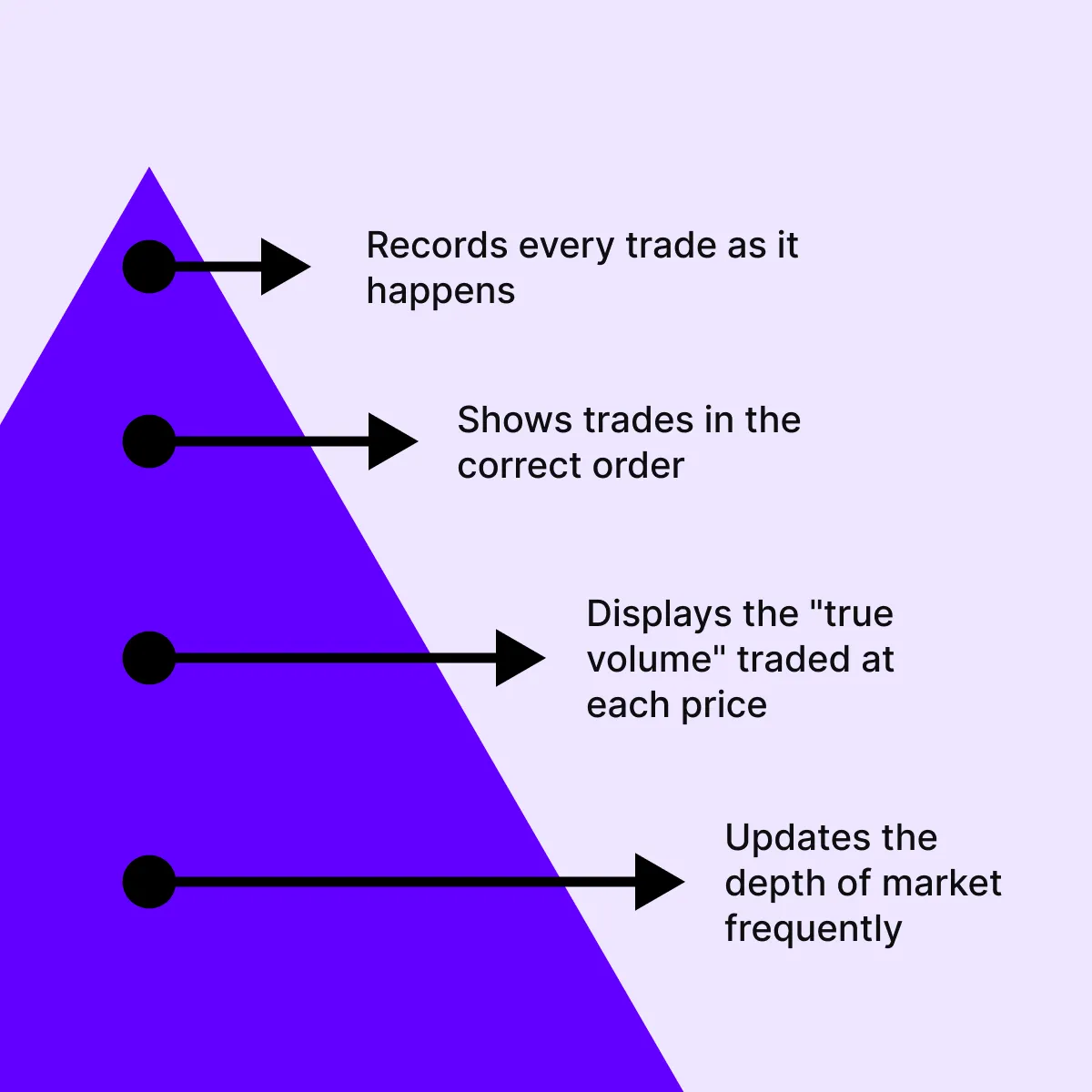
When the aforementioned level of order flow accuracy is present, an accurate picture of buying and selling activity can be drawn up. Low-quality data, on the other hand, may:
- Delay updates,
- Combine multiple trades into one,
- Filter out essential details.
The downside of low-quality data feeds is that they degrade market data quality during trading sessions and potentially make order flow appear different across platforms.
The most crucial point to understand here is that order flow is “transactional.” It is built entirely from real trades and orders. If those transactions are distorted or incomplete, the market story being derived by participants is distorted as well.
Why Data Quality Has a Direct Impact on Execution
Realize that trade execution usually happens in seconds or even fractions of a second. In such a short time, traders depend heavily on order flow to make decisions. This is where the quality of order flow data becomes crucial.
Traders use order flow to answer these basic but relevant questions:
- Is buying or selling activity increasing or slowing down?
- Is liquidity staying in the market, or are orders being pulled away?
- Is price being absorbed at a level, or is the market accepting higher or lower prices?
Strong market data quality in trading helps answer the aforementioned questions. When data quality is poor, these signals become misleading, which is also one reason why order flow looks different across platforms.
Execution Example
-
- Assume a participant sees aggressive buying hitting the offer and goes long.
- They are expecting the price to continue higher.
- Instead, the price stalls and quickly reverses.
If they had access to accurate, high-quality order flow data, they would have noticed that large resting orders were absorbing that buying pressure. But since they used lower-quality data, this absorption was not visible.
Observe that in this case, the “execution error” came from “missing information” (not from bad decision-making). Explore tools designed for higher-fidelity order flow analysis.
How Low-Quality Data Actively Misleads Traders

Low-quality data can actually change market perception and push participants toward the wrong conclusion, which is one of the primary risks when order flow data quality is poor. The cons of using low-quality data are:
Aggression Appears Stronger Than It Really Is
Assume that transaction data is delayed or lumped together into a group. Many small trades are aggregated into a single large trade, making regular market activity appear as strong buying or selling pressure.
For example,
- Assume several small buys may hit the offer within seconds.
- Aggregated data shows this as a single buying spree.
- The trader reads this as strong initiative.
- However, the real participation is light and easily absorbed.
When traders make decisions based on such a distorted market view, they enter trades too early and exit too late. They executed trades based on “overstated momentum” and suffered losses.
Absorption Becomes Invisible or Misread
Absorption can only be understood by seeing both:
- Aggressive trades, and
- The market’s response
If depth-of-market updates are slow or incomplete, passive orders cannot be seen absorbing volume. For example,
- Assume the price trades heavily at one level for several minutes without moving.
- Low-quality data shows volume.
- However, it hides the resting liquidity that keeps refreshing behind the scenes.
- The trader assumes continuation is building.
- But in reality, the price is actually capped.
The negative impact of the aforementioned distortions is that traders hold positions longer than the market structure supports. Compare how different data quality changes what you see.
Liquidity Zones Look Unstable or Random
When depth-of-market data updates slowly or at low resolution, market liquidity cannot be trusted, as large orders may appear and disappear suddenly. But that’s not the reality! Actually, those orders are being refreshed repeatedly, but poor order-flow data quality doesn’t clearly show this.
For example,
- Assume a strong liquidity level continues to absorb trades.
- With low-quality data, it looks like liquidity vanishes after each interaction.
- Traders think liquidity is pulling and expect a breakout.
- But in reality, the market is actually stable.
Such misunderstandings only breed more false breakout trades and poorly placed stops.
Delta and Volume Signals Lose Context
The prerequisites for delta and volume to work well are that trades are correctly classified and sequenced. With weak order flow accuracy, these tools lose their meaning.
This loss of accuracy is because:
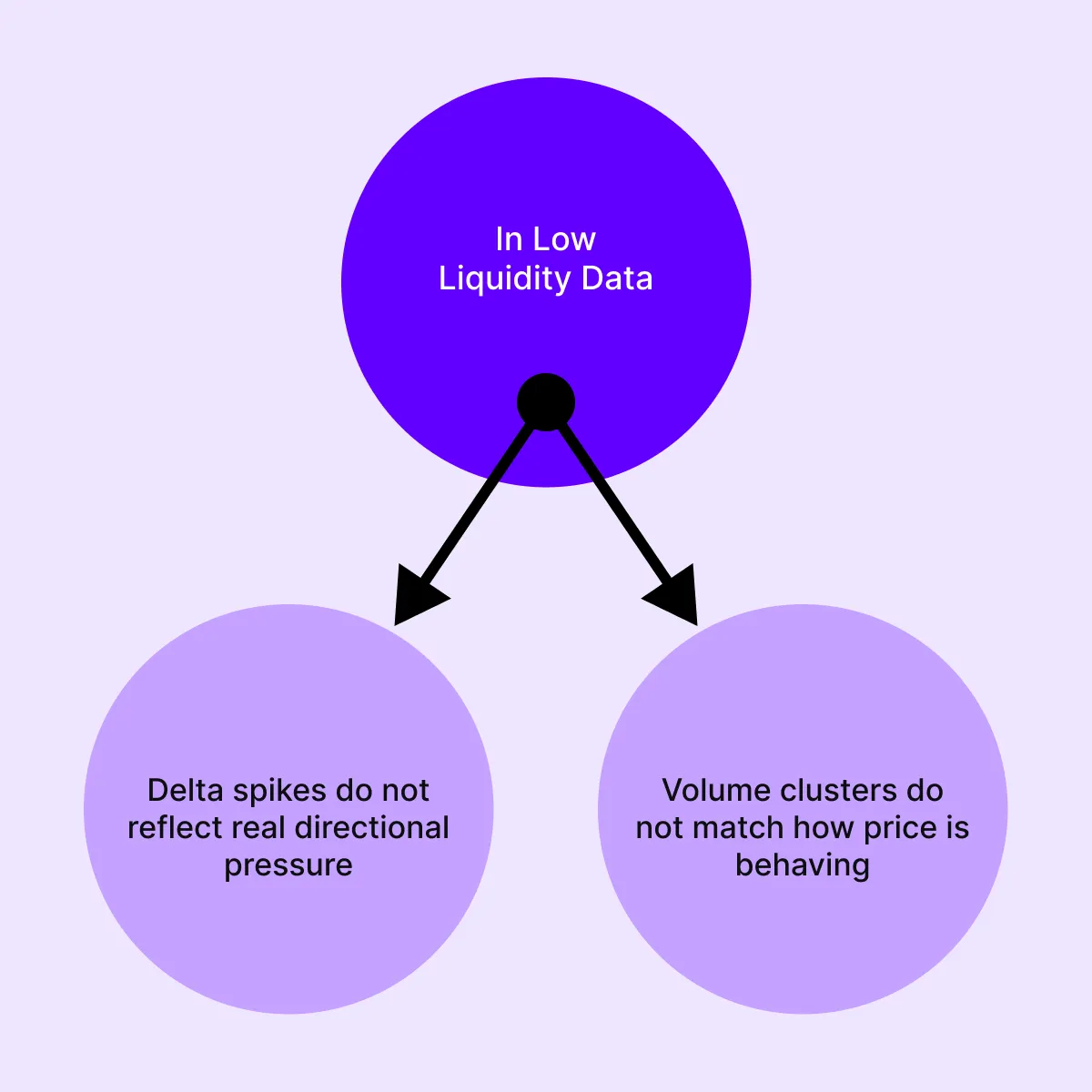
For more clarity, here is an example:
- Assume that the negative delta rises in the market.
- But the price holds steady.
- The trader assumes buyers are trapped.
- In reality, sellers are being absorbed.
- The “incomplete depth data” hides that response.
This opaqueness creates confusion and leads participants to fade strength when continuation is actually forming. Besides, this is another reason why order flow looks different across platforms.
Traders Adapt Their Behavior to False Information
The most harmful impacts of poor market data quality in trading are behavioral. Most traders adjust entry timing, stop placement, and position size based on what they believe the market is doing.
When the information is misleading, traders unknowingly build bad habits. Gradually, they lose confidence in good setups and blame psychology. However, the real problem is “unreliable order flow data”.
Why Data Quality Matters More in Fast Markets
Fast markets usually occur in highly liquid instruments, where many participants trade simultaneously. In such markets:
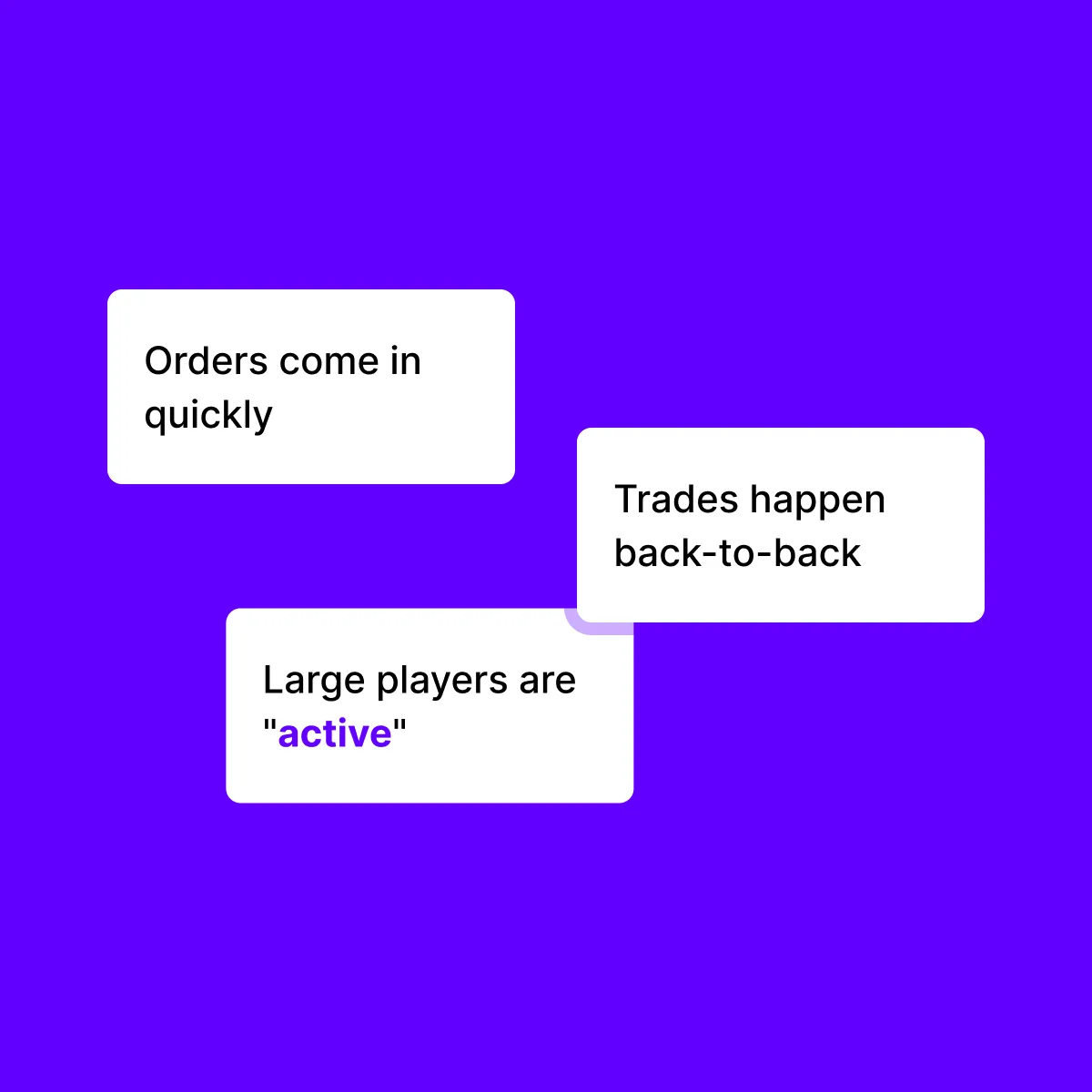
In these conditions, order flow data quality becomes far more critical, as missed or delayed depth-of-market updates can distort the market structure. Aggressive buying or selling may appear stronger than it truly is, just because the data feed cannot keep up.
This inferior data feed is why some feel that:
- Order flow looks “clean” during slow sessions
but
- It becomes confusing or unreliable during fast ones.
Realize that the problem is not volatility itself. The real issue is “data resolution”, which shows how frequently and accurately transactions and liquidity updates are captured and delivered.
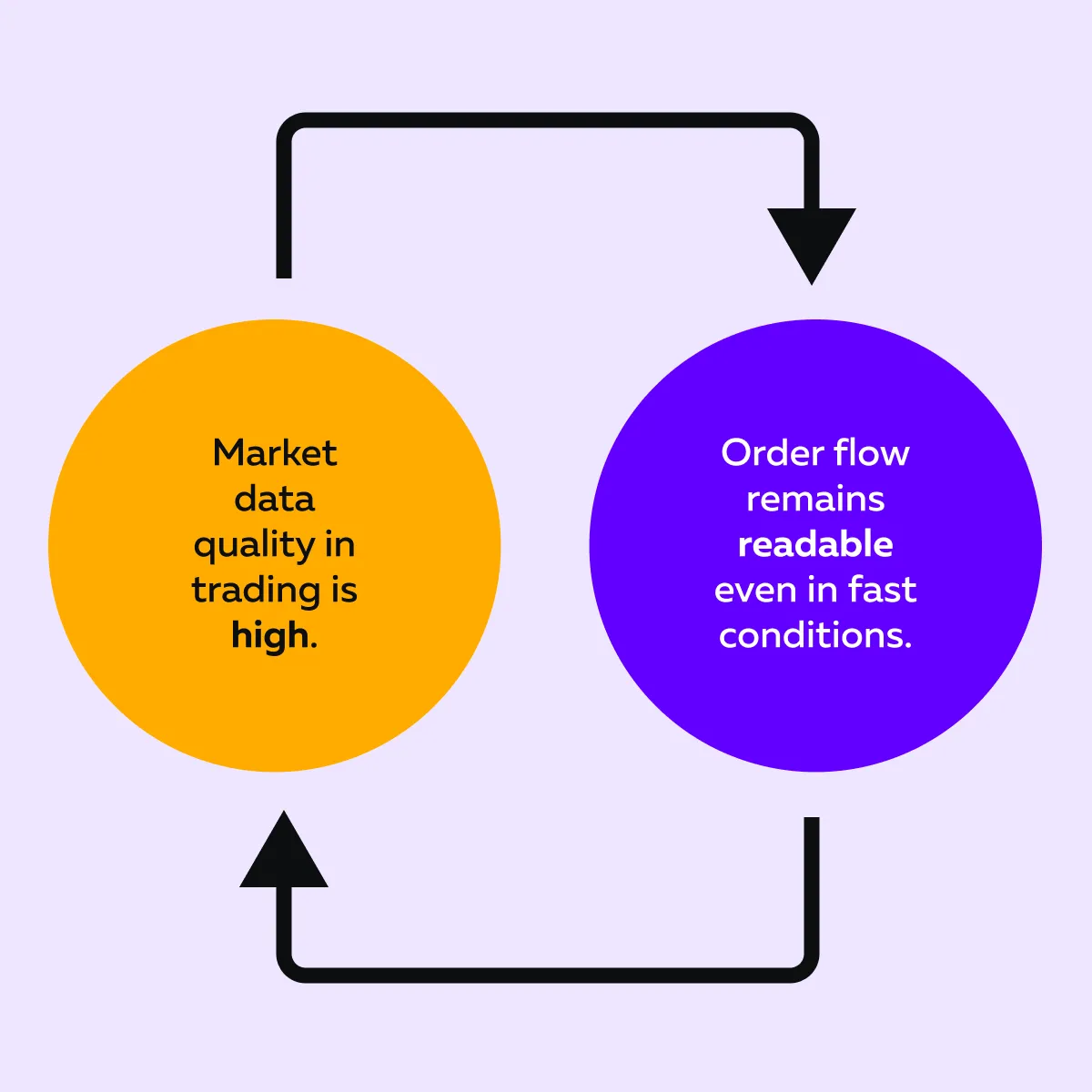
In contrast, when the quality of market data is “low”, the market story becomes distorted.
Institutional-Grade Data and Why It Exists
Professional traders and institutions make decisions at very high speed and with large position sizes. For them, even minor information errors can increase risk or damage execution, which is why institutional-grade order flow data quality exists.
Note that such participants need:
- Highly accurate transaction data,
and
- Frequent depth-of-market updates.
By using both, they try to understand liquidity, participation, and actual buying or selling pressure. When highly accurate order flow data is available, they can manage entries and exits with far less distortion.
To meet these needs, “higher-fidelity data solutions” have been developed. For example, BookmapData is one such solution that provides 100% complete transaction and depth information. By using it, traders can interpret order flow with greater clarity and consistency. You can review it here for reference: https://bookmap.com/en/bmdata.
Real Example: How Data Quality Changes Interpretation
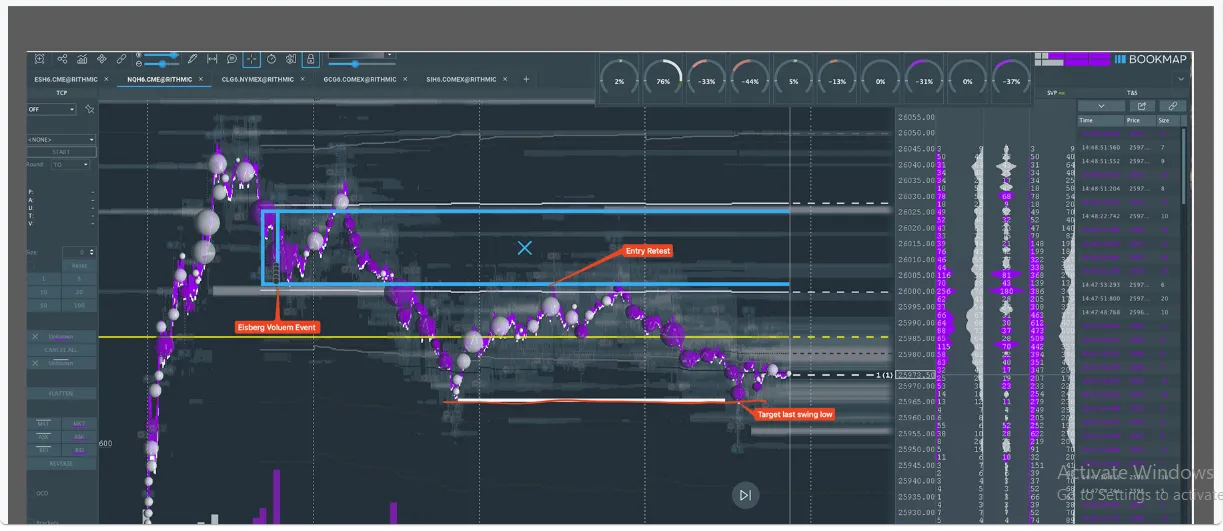
In the Bookmap chart above, the liquidity is represented by the “shaded zones”. These zones show where large resting orders were waiting (particularly near key price levels). As the price moved into these areas, participation changed. The aggressive trades increased. However, the price still did not move easily.
Participants may interpret this behavior as liquidity absorbing the pressure rather than allowing it to persist. Furthermore, near the marked levels, execution timing matters, which is why skilled traders try to observe both the:
- Aggressive activity,
and
- Steady liquidity behind it.
Traders use the aforementioned analysis to understand when the price was likely to stall, retest, or rotate. In contrast, with lower-quality data, much of this behavior would be hidden. When observing such a distorted view, the trader would feel:
and
- Participation is looking stronger than it really is.
As a result, the trader could hesitate or enter too late. This is why order flow looks different across platforms and why order flow accuracy matters so much. Explore more real order flow examples → https://bookmap.com/insights
How Traders Can Evaluate Their Own Data Quality
Before changing strategies, traders should first question their inputs because poor market data quality in trading can make even good strategies feel unreliable.
Traders may potentially check the quality of their data feeds by comparing transaction activity to price response and try to answer the following question:
- When volume increases, does price behave logically?
Next, they may observe liquidity behavior across different sessions and ask themselves:
- Does liquidity appear consistent and believable?
Finally, they may note how their order flow signals contradict actual outcomes. They should also keep in mind that if order flow regularly feels confusing or misleading, the issue may not be skill or psychology. Very often, the first thing that needs review is the quality of the order flow data itself.
Conclusion
A thorough reading of this article should have made it clear that order flow does not fail without a reason. When traders struggle to read the market, the problem is the data behind it. Poor-quality order-flow data leads to “distorted signals,” indicating unclear liquidity.
Success in modern markets hinges on traders being able to see participation and liquidity as they truly are, in real time. And this happens via “order flow analysis”. When order flow accuracy improves, many common issues begin to disappear, such as:
- Entries feel clearer,
- Exits make more sense,
- Execution becomes more consistent.
Thus, in 2026, traders must analyze order flow data to make better trade executions. See how order flow data quality impacts execution.
FAQs
1. What is order flow data quality?
Order flow data quality shows how accurately a data feed shows real trades and liquidity as they happen. By using high-quality data, traders can see:
- Correct trade order,
- True volume,
- Frequent depth updates.
Having access to high-quality data means that traders can trust what they see on the screen to match real market activity.
2. Can poor data cause false trading signals?
Yes, poor order-flow accuracy can make buying or selling pressure appear stronger than it is. It may:
- Hide absorption,
- Delay liquidity updates, and
- Distort volume.
These gaps, delays, and distortions mislead traders into acting on incomplete or misleading signals.
3. Why does order flow look different across platforms?
That’s because different platforms use different:
- Data sources,
- Aggregation rules, or
- Update speeds.
These differences significantly impact market data quality in trading. Also, all these factors change how trades, volume, and liquidity appear to the trader.
4. Does better data guarantee better trades?
No, better data only improves trade clarity and decision-making. It cannot replace skill. High-order flow data quality allows traders to read the market more accurately, but execution still depends on timing, context, and discipline.
5. How can traders tell if data quality is the issue?
If order flow signals often conflict with price movement or outcomes, data quality should be reviewed first. This mismatch is a common reason order flow can look different and feel unreliable, even with a solid strategy.
Sign Up Now
Latest Articles