


Track futures volatility and oil-driven reactions in real time.
Compare plans to follow macro moves, liquidity shifts, and fast market responses.
News & Announcements
May 28, 2026
Stock Futures Are Falling, and Oil Jumps Higher: What Traders Should Understand Right Now
 Most premarket headlines read the same: “Stock Futures Are Falling, and Oil Prices Jump Higher.” Consequently, traders believe the adage that oil goes up and stocks go down. However, market behavior is rarely that simple.
At times, an increase in oil prices creates pressure on equities through inflation concerns and higher costs. In other cases, futures may dip briefly before recovering. Besides that, there are situations in which oil prices rise while stocks remain stable because earnings strength, interest rate expectations, or positioning take priority.
Even the current backdrop reflects this mix of signals. Presently, in May 2026, oil is rising due to supply-related geopolitical concerns, while equity futures are softer. Read this article to learn why equity futures are down today, why oil prices are rising, and how the oil and stock market relationship plays out in real market conditions.
Why Oil Rising Often Pressures Stock Futures
In the market, oil is not viewed just as a commodity. Instead, it is believed to influence the broader economy. Because of this, when oil prices move, the following market variables adjust at the same time:
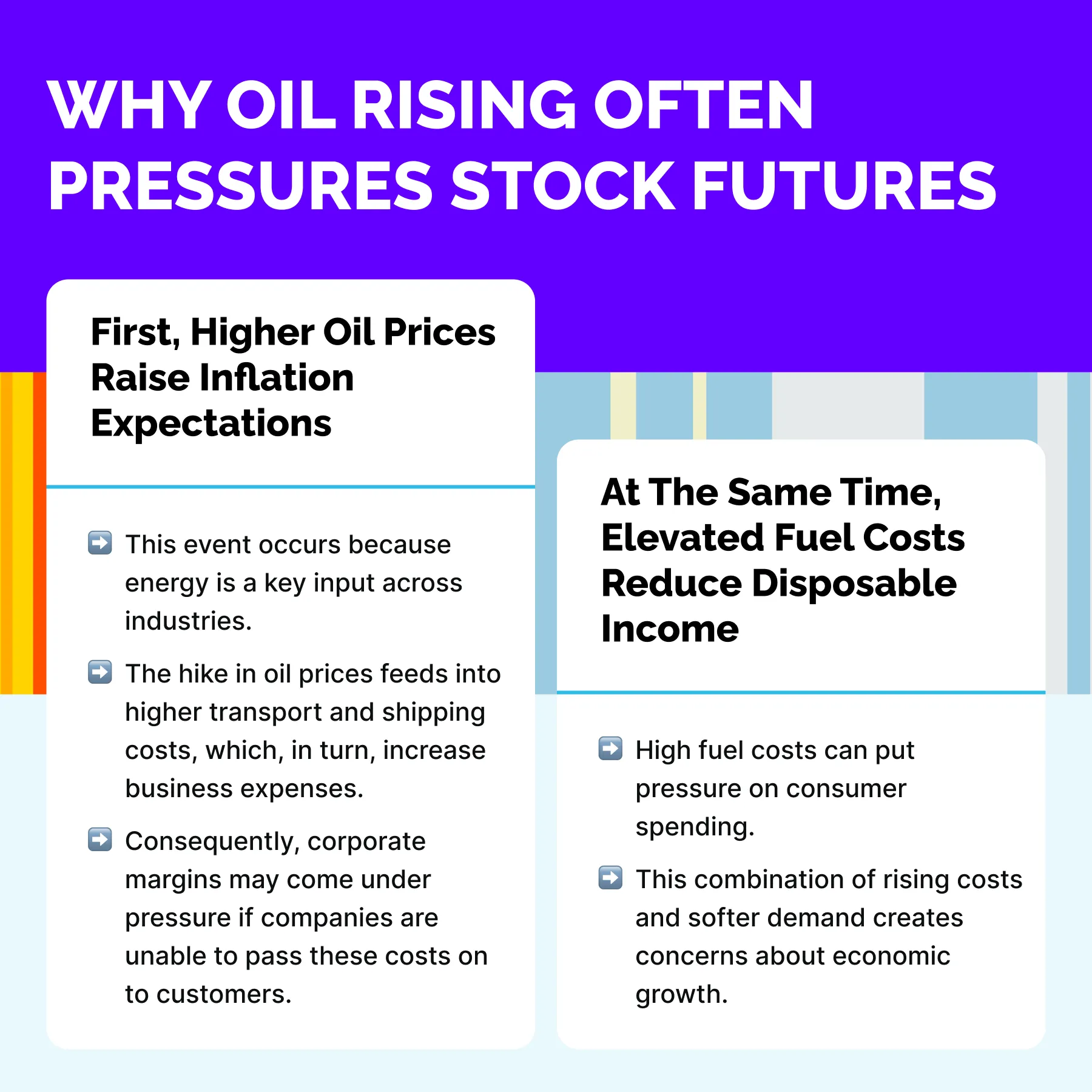
Therefore, markets begin to reassess rate expectations, as persistent inflation may require central banks to maintain tighter policy for longer. In parallel, rising oil also reflects geopolitical risk sentiment.
As these factors converge, traders interpret oil strength as a signal of potential economic stress. This interpretation could be the likely reason why stock futures are down today in many such scenarios. Note that this reaction is more pronounced in “premarket hours”, when liquidity is thinner and macro-driven moves dominate.
For example,
- Suppose Brent crude rises sharply due to supply disruption risk.
- In response, equity index futures such as S&P 500 futures may decline before the cash market opens.
- This event reflects a repricing of inflation and growth expectations rather than a direct reaction to oil alone.
In this context, the market adage “futures lower oil higher” becomes more evident. The equity markets are responding to what higher oil prices imply for inflation, policy, and growth.
Why Oil Is Jumping Right Now
Recent market movements point to a “catalyst” behind oil prices’ rise. As of May 2026, oil has moved higher because:
- Peace talks between the United States and Iran have stalled, and
- Export disruptions in the Middle East are currently unresolved
Reports also indicate that Brent crude is trading near multi-week highs, amid building inflation concerns and “supply uncertainty”. This uncertainty stems from major shipping routes, such as the Strait of Hormuz, which handles a significant share of oil flows, remaining closed to trade.
The Expected Market Response
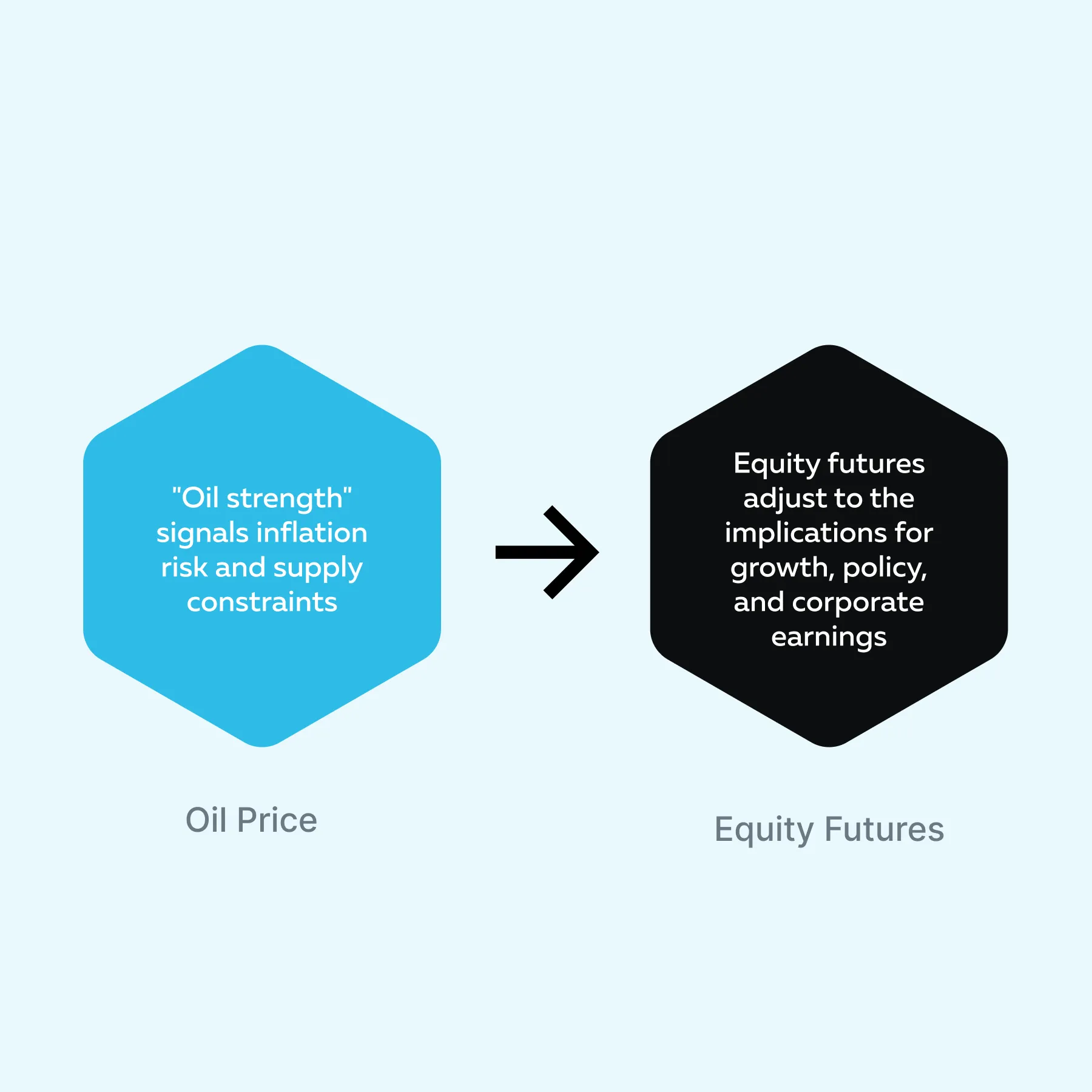
When negotiations weaken or disruptions persist, the market begins to price in potential supply tightness and transport risk. As a result, the price increase is not driven by vague geopolitical fears. Instead, it reflects a tangible risk to supply and distribution. Therefore, the current setup, with stock futures falling and oil jumping higher, is rooted in “macro repricing”.
Why Stock Futures Are Only Falling Slightly (Not Crashing)
A key observation in the current market setup is that equity futures are not declining sharply. Instead, movements remain “modest”, with:
- Dow futures are slightly lower,
- The S&P 500 is near flat to mildly negative, and
- Nasdaq futures are showing relative strength.
This pattern indicates that markets are not reacting to a single dominant factor. Rather, multiple forces are offsetting each other. On the one hand, rising oil prices are raising inflation concerns; on the other, stock futures are down, though the decline is limited.
However, this pressure is being balanced by several supportive factors, such as:
| Supportive Factor | Meaning | How It Supports Markets |
| AI-Driven Growth Optimism | Strong expectations around artificial intelligence and innovation-led expansion | Supports sentiment, especially in tech stocks, and offsets pressure from rising oil prices |
| Technology Earnings Strength | Positive earnings outlook from large-cap tech companies | Encourages buying interest, particularly in Nasdaq-linked stocks |
| Recent Record Highs In Indices | Major indices trading near peak levels | Reflects underlying strength and sustained investor confidence |
| Steady Interest Rate Expectations | The central bank is expected to hold rates unchanged. | Reduces pressure on valuations and supports a stable market outlook |
| Neutral Policy Uncertainty | Some caution around future decisions, but no aggressive
tightening expected |
Prevents sharp negative reactions and keeps risk appetite relatively intact |
Consequently, the overall market tone becomes “mixed”. In such a scenario, outright risk aversion may not be the right approach. Instead, partial adjustments can be made to inflation concerns. See how markets react to macro headlines in real time → Compare Packages.
Which Futures Markets Traders Are Watching Most Closely Today
When stock futures fall, and oil jumps higher, most market participants avoid relying on a single chart. Instead, multiple futures markets are observed together to interpret the nature of the move.
This approach helps determine whether the current setup reflects:
- A short-term reaction to overnight headlines,
- A broader inflation repricing,
- A shift toward risk-off positioning, or
- Temporary noise ahead of key events such as earnings or central bank decisions.
Therefore, the focus shifts from isolated price action to combined signals across markets. This is particularly relevant in explaining why stock futures are down today without a sharp sell-off. The following futures markets are being watched currently by traders:
ES Futures (E-mini S&P 500)
ES futures are widely treated as a primary indicator of market sentiment. As oil rises and inflation concerns build, ES behavior provides insight into how seriously markets are pricing this development.
Traders usually assess the quality of the decline rather than just the direction. To do so, they may make the following observations:
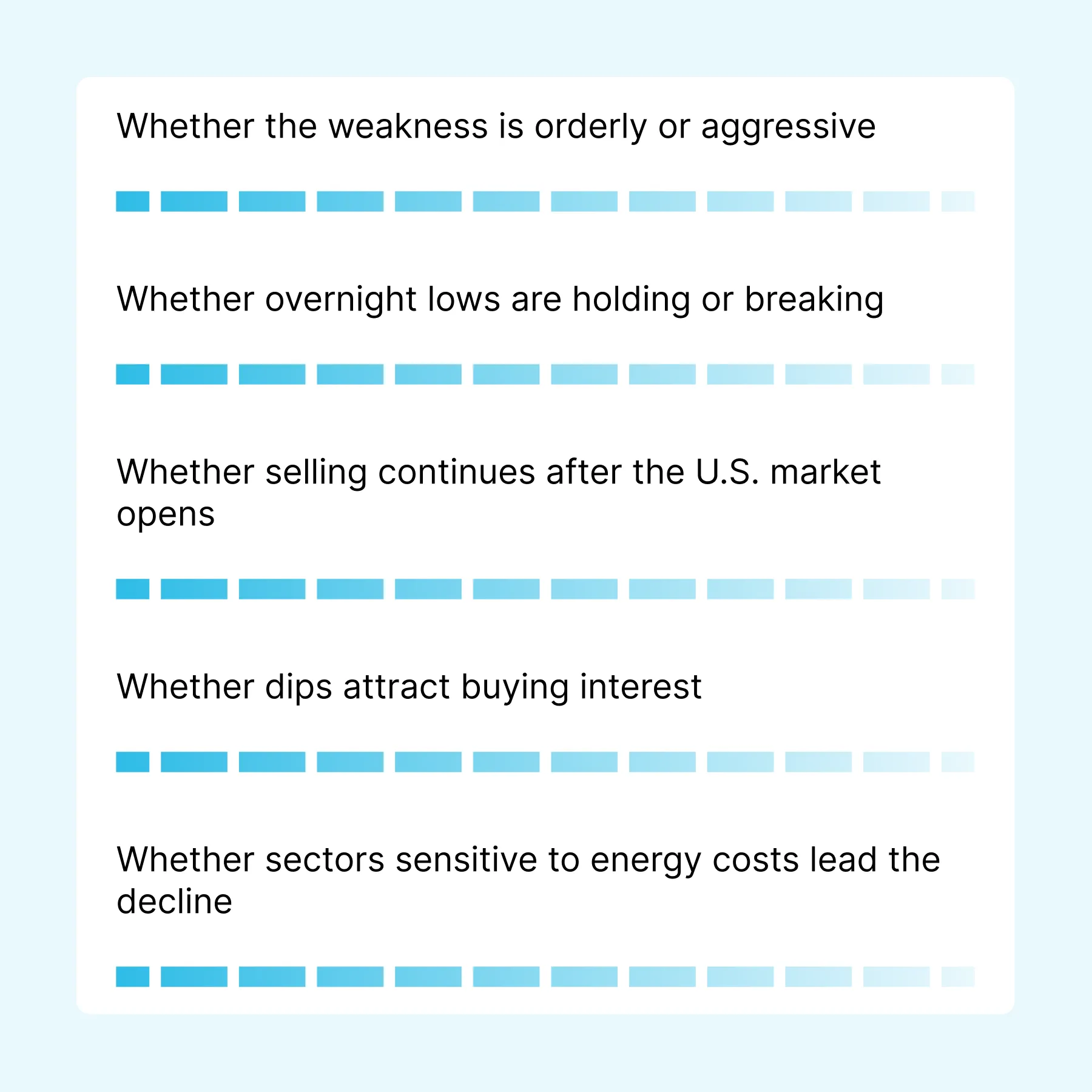
After making these observations, if ES opens “weak” but regains key levels, it suggests that higher oil prices are not significantly damaging risk appetite. However, if ES remains “under pressure” and fails to recover, it indicates that markets are placing greater weight on inflation risks and growth concerns. Additionally, some major signals tracked by most investors are:
- Acceptance below the overnight range,
- Attempts to reclaim premarket lows,
- Expansion in selling volume,
- Whether weakness extends beyond early trading volatility.
NQ Futures (Nasdaq)
NQ futures usually behave differently because they are concentrated in growth and technology stocks. As a result, the reaction to rising oil prices is more balanced. The following dynamics illustrate this:
- On one side, higher oil prices increase inflation concerns. This dynamic can influence interest rate expectations, potentially driving yields higher.
- On the other side, strong optimism around AI and large-cap technology earnings continues to support demand for these stocks.
- In addition, leadership sectors have shown consistent dip-buying interest.
Again, this creates a “mixed” response, where NQ may remain stable even as oil prices rise. While monitoring NQ, several traders make the following observations:
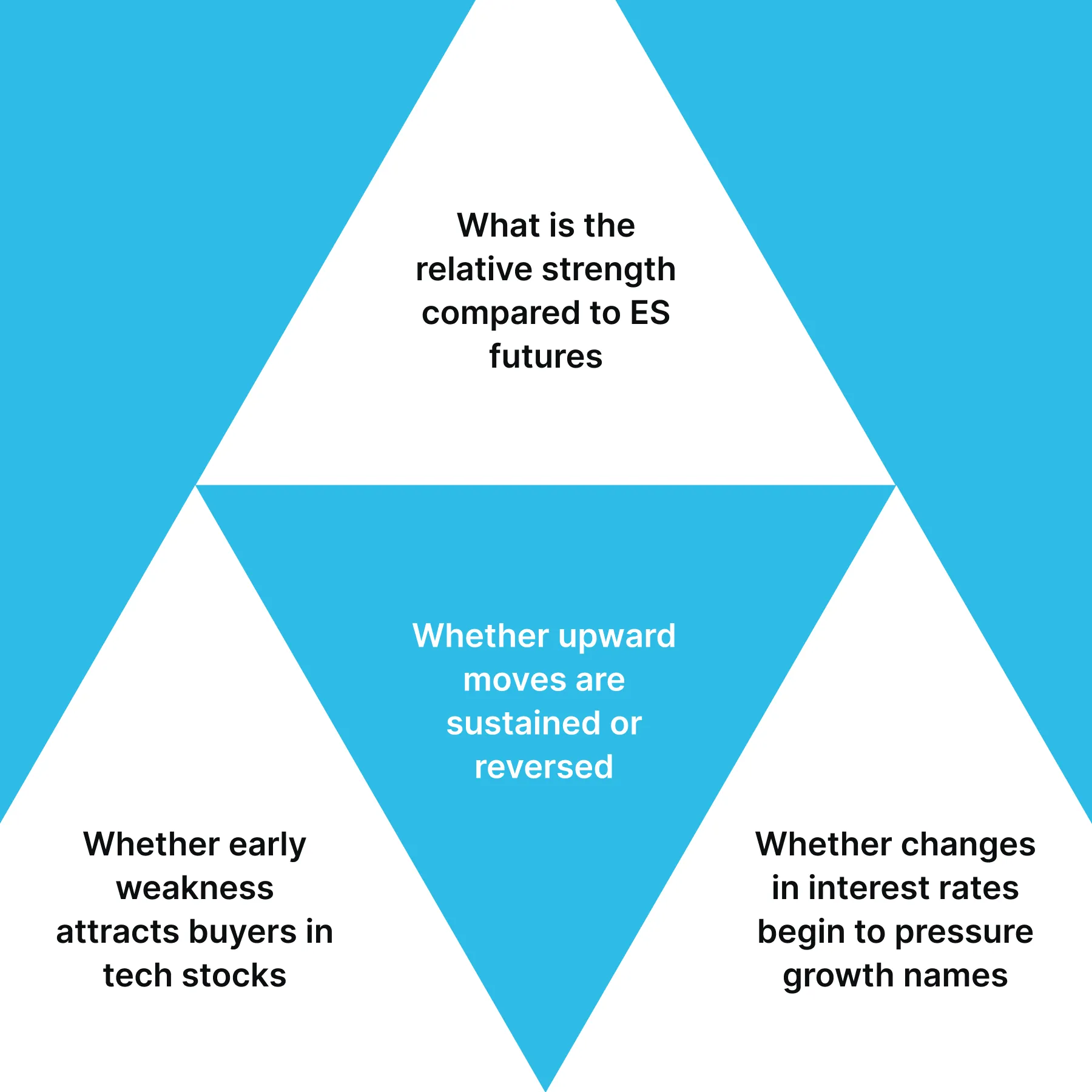
Note that if NQ holds steady while ES weakens, it suggests “selective risk appetite” rather than broad market stress.
CL Futures (Crude Oil)
Crude oil futures sit at the center of the current setup, particularly when stock futures are falling, and oil jumps higher. In this scenario, market participants track oil directly rather than only observing equity reactions. The primary question in this market environment is:
- Whether the price move represents a genuine shift in pricing,
or
- It is just a short-term reaction to overnight headlines.
To assess this, traders observe the following:
- Whether crude holds above overnight highs,
- Whether pullbacks attract sustained buying,
- Whether trading volume remains elevated after the initial move,
- Whether price action appears stable or erratic due to thin liquidity, and
- Whether prices decline once U.S. participation increases.
If crude continues to trade at higher levels amid steady demand, the move may be considered genuine. In that case, equity markets may respond more negatively. However, if crude fails to hold gains and declines during active trading hours, it suggests the move may have been “temporary”. Usually, this leads to recovery in equity futures.
Treasury Futures / Rates Markets
Attention then shifts to Treasury futures and interest rate markets, as they are also used to gauge the broader impact of rising oil prices. While oil strength signals potential inflation, it can also indicate risks to economic growth.
This creates two possible interpretations:
| Scenario I: Yields are Rising | Scenario II: Yields are Falling |
|
|
Some key observations made while analyzing treasury futures and interest rate markets are:
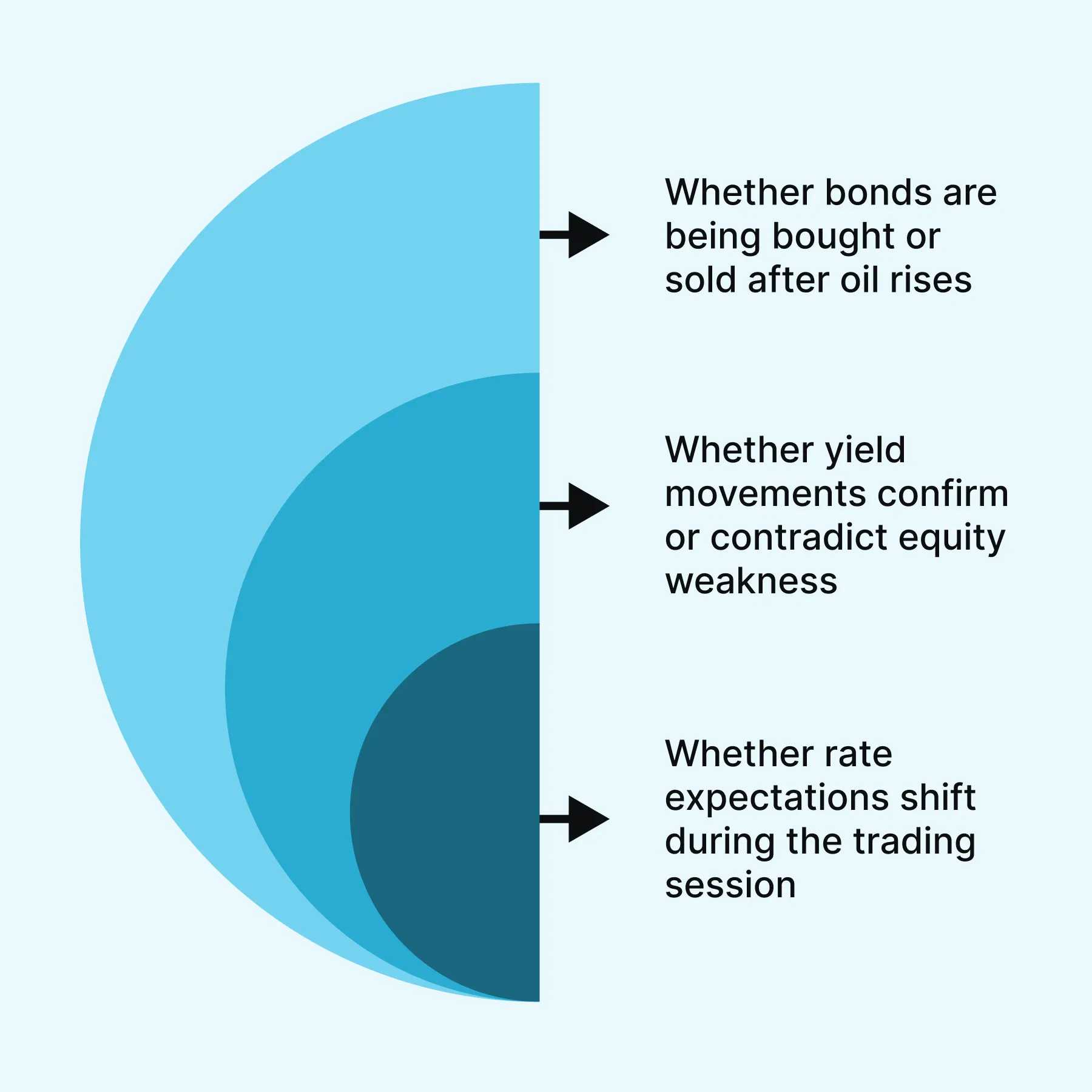
This “cross-market” analysis strengthens the reading of how oil affects stocks. Track stock index reactions beyond the headline → Compare Packages.
Gold Futures (GC)
Gold futures provide an additional layer of insight during periods of macro uncertainty. When oil rises due to geopolitical or supply-related developments, gold can help signal whether broader risk sentiment is changing.
If both oil and gold move higher together, markets may interpret the situation as a mix of inflation concern and defensive positioning.
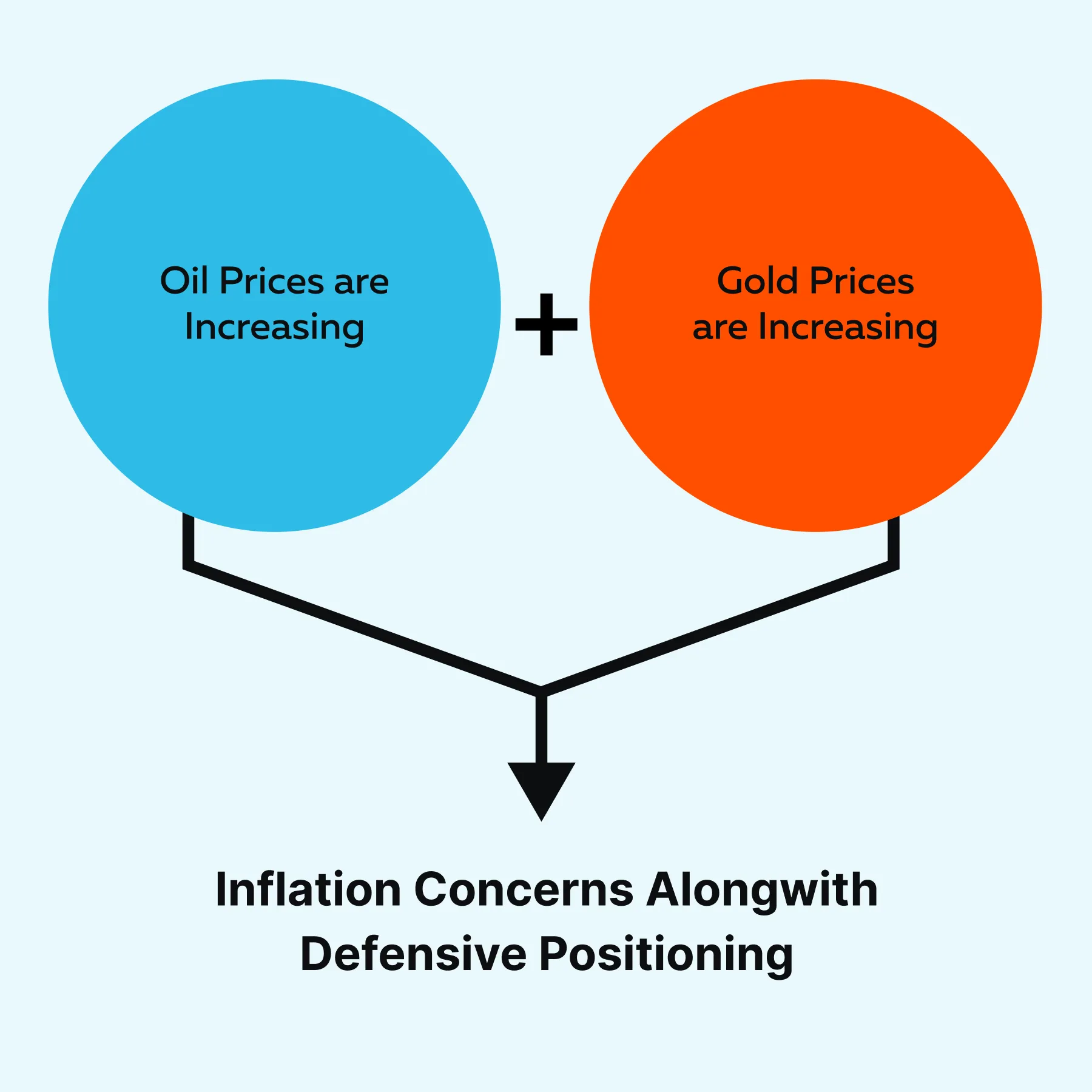
On the other hand, if gold remains stable despite rising oil, the move may be viewed as limited or temporary. To make better interpretations, traders usually observe the following:
- Whether oil and gold rise at the same time,
- Whether gold gains are sustained during U.S. trading hours, and
- Whether gold diverges from equity market behavior.
This comparison helps determine whether risk aversion is expanding across markets or remains isolated to energy. Consequently, it provides additional context for why oil prices are rising and how broadly that move is influencing financial markets.
How Traders Read the Market Open
Realize that “overnight headlines” may create early price moves. However, those moves do not always continue after the market opens. Therefore, the opening phase is treated as a confirmation point rather than a conclusion.
This strategy is particularly relevant when stock futures are falling, and oil jumps higher, since both signals need validation through real trading activity. To make better interpretations, most traders interpret how oil and equities behave together. The following sections provide a detailed analysis:
Scenario 1: Oil Holds Gains, Futures Stay Weak
In this case, oil prices remain high while equity futures continue to trade lower, which suggests that markets are accepting the inflation and geopolitical implications. Because of this, the impact spreads across equities as follows:
- Defensive sectors may hold relatively better,
- Energy-related stocks may show strength,
- Broader indices may remain under pressure during the session, and
- Cost pressures may weaken consumer-focused companies.
Scenario 2: Oil Holds Gains, Futures Recover
Oil prices may stay firm, while equity futures stabilize or move higher, which indicates that equities are placing more weight on supportive factors such as:
- Earnings strength,
- Momentum, or
- Dip-buying interest.
As a result, the market appears more resilient than expected despite elevated oil prices.
This resilience weakens the assumption that futures will be lower and oil higher, because equities absorb the inflation signal without broad selling pressure.
Scenario 3: Oil Fades Quickly, Futures Rebound
In this situation, oil declines after the initial spike, while futures recover, suggesting the overnight move lacked sustained participation or was already priced in. Consequently, the earlier reaction in equities may reverse. Again, this shows that not all oil-driven moves lead to equity weakness.
Scenario 4: Oil Extends Higher, Futures Break Key Levels
In this case, oil continues to rise, and equity futures break key support levels, signaling a broader “risk-off environment,” where inflation concerns and macro uncertainty are gaining traction.
Due to this, the relationship between oil and equities becomes more pronounced. Rising oil leads to sustained pressure on stocks.
Conclusion
Stock futures are softer while oil is higher, as markets balance several forces at once. Oil is rising amid supply uncertainty, raising inflation concerns and influencing interest rate expectations.
At the same time, equities are not reacting to oil alone, but to what that move may signal for growth, earnings, and policy. This dynamic explains why stock futures are down today, even if the fall remains limited.
However, the more important signal comes after the “market opens”. Price action then shows whether traders accept or reject the overnight move. If weakness persists, the relationship between oil and the stock market becomes more genuine. In contrast, if markets recover, the move may be seen as temporary.
Therefore, the real insight lies not in headlines, but in how markets respond once trading activity deepens. Understand whether oil spikes are fear moves or lasting repricing → Compare Packages.
FAQs
1. Why are stock futures falling when oil rises?
As observed in the general market, stock futures may decline when oil rises, which happens because higher energy costs increase inflation concerns, which can:
- Raise transport and input costs,
- Reduce corporate margins, and
- Weaken consumer spending.
As a result, risk appetite may fall, particularly in premarket trading where reactions to macro signals are more sensitive.
2. Does oil rising always mean stocks will fall?
No, stocks do not always fall when oil rises. Markets weigh multiple factors at the same time, such as:
- Strong company earnings,
- Positive economic data,
- Sector leadership, or
- A dip in buying interest.
These factors can offset oil-related pressure. As a result, equities may remain stable or even move higher despite rising oil prices.
3. Why does oil jump so quickly on geopolitical headlines?
Oil prices may react sharply to geopolitical developments because supply can be disrupted. This event may take place because several risks related to shipping routes, sanctions, or production create market uncertainty.
As a result, even the possibility of reduced supply can prompt immediate price adjustments due to potential shortages in the global energy supply.
4. Which futures markets should traders watch when oil spikes?
Traders often track multiple futures markets together, including:
- ES (S&P 500),
- NQ (Nasdaq),
- Crude oil,
- Treasury futures, and
- Gold.
These markets provide “combined signals” that help one identify whether the price move is related to inflation concerns, risk-off sentiment, or a temporary reaction to short-term developments.
5. What matters more: the overnight move or the market open?
The market open generally carries more weight than overnight price action. That’s because most overnight moves occur in thinner liquidity, which can distort signals.
In contrast, once broader participation enters after the market opens, price behavior may reveal whether:
- The earlier price move will continue, or
- Reverse based on a stronger conviction.
6. How should day traders use this type of headline?
Headlines should be treated as context rather than direct trade signals. Usually, market participants observe:
- Whether key price levels hold,
- Whether trading volume expands, and
- Whether multiple markets confirm the move.
This approach allows one to assess whether the initial reaction has broader support or remains limited.
7. Can oil rise while Nasdaq futures stay strong?
Yes, Nasdaq futures can remain strong even when oil rises, which may occur when markets prioritize:
- Technology earnings,
- AI-related growth, or
- Stable interest rate expectations.
In such cases, strength in large-cap tech stocks can offset broader pressure linked to higher energy prices.
8. What would signal that the oil move is serious?
A sustained oil move may indicate when prices hold gains after the market opens. At the same time, inflation concerns are visible when:
- Equities remain weak,
- Defensive assets gain strength, and
- Interest rate markets price in higher inflation expectations, which could lead to rising bond yields.
This combination suggests that the move is being accepted across multiple markets.
Sign Up Now
Latest Articles