


See market activity more clearly in real time.
Compare plans to access deeper market visibility for market activity.
Trading Basics
April 30, 2026
Updated
Trading The FOMC Statements
Events, news, and announcements can all affect financial asset prices. Often, these are unforeseen, but there are others that are timed well in advance. As a trader, you can prepare for these calendar events and be ready to trade around them.
Some of the most widely anticipated in the markets are announcements from central banks on interest rates. Here, we look at the most important: the FOMC statement.
What Is The FOMC?
The FOMC (Federal Open Market Committee) is an arm of the US Federal Reserve System. This was established in 1913 with the sole intention of managing, governing and regulating the state of the US economy.
As part of its mission, the Fed decides and dictates national monetary policy. For more information about central banks and their importance in the markets, see our blog article “What are Central Banks?”.
The FOMC is a key part of the Fed and it sets the targets for the federal funds rate, the base interest rate, and authorizes actions to achieve this target.
“Changes in the federal funds rate trigger a chain of events that affect other short-term interest rates, foreign exchange rates, long-term interest rates, the amount of money and credit, and, ultimately, a range of economic variables, including employment, output, and prices of goods and services.” Source: US Federal Reserve
Interest rate changes affect all markets. To give the classic example of how changes in interest rates affect the stock market, look at the case when the FOMC reduces interest rates during periods of recession in order to boost demand and encourage people to spend more. Due to this decrease in interest rates, traditional savings instruments look less attractive, and investors tend to move more toward equities, pushing the market higher. This is only a generalization however and there is no guarantee that this will happen.
Preparing for FOMC Statements
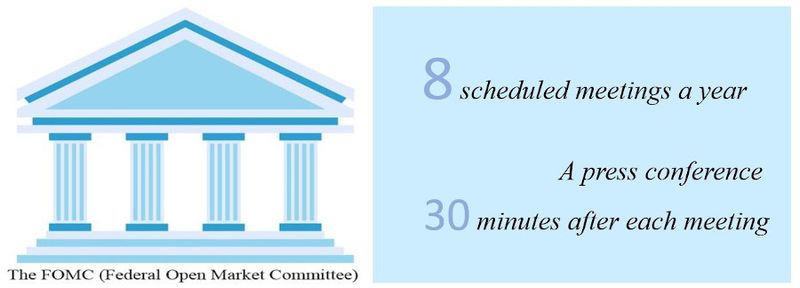
The FOMC meets eight times a year and issues a statement on its projections, its actions, and the target range for the federal funds rate. This is followed by a press conference thirty minutes later.
Given the potential significance of these statements for all markets, it is important to be prepared well in advance if you are thinking of trading FOMC statements.
Check the Economic Calendar
You can find the next date of the FOMC and their relevant announcements on the Federal Reserve site and on most economic calendars.
These calendars often show previous and expected interest rates. The Fed calendar also contains all past statements and previous press conferences.
Read About Expectations
Knowing the general market consensus of what the event will bring is also good because what the statement actually says can significantly impact the price. If the new rate range is widely unexpected, this will generally lead to price volatility.
However, if the rate is as expected, you might see price ranges on the markets being held and price movements fading. The information is already priced in.
Why Market Expectations Matter
Financial markets are forward-looking. In many cases, traders are not reacting to the actual interest rate decision but rather to the difference between expectations and reality.
For example:
- If markets expect a rate cut and the Federal Reserve delivers one, the reaction may be muted.
- If markets expect no change and the Federal Reserve unexpectedly cuts rates, volatility may increase significantly.
- If policymakers signal a different future path than investors expected, markets may react even if the current decision was widely anticipated.
This is why traders often monitor consensus forecasts, economic projections, and market pricing before major Federal Reserve meetings.
Understanding the FOMC Statement vs the Press Conference
Many traders focus exclusively on the interest rate decision itself, but the market often reacts just as strongly to the Federal Reserve’s accompanying statement and the press conference that follows.
The announcement typically contains:
- The target federal funds rate decision
- Economic projections and policy guidance
- Changes to the Federal Reserve’s outlook on inflation, employment, and growth
Thirty minutes later, the Federal Reserve Chair holds a press conference where journalists ask questions about policy decisions and future expectations.
This distinction matters because markets may initially react one way to the written statement and then reverse course after traders interpret comments made during the press conference.
For example:
- A rate decision may match expectations.
- The written statement may appear neutral.
- Comments during the press conference may be interpreted as more hawkish or more dovish than expected.
As a result, many traders wait for both events before forming a directional opinion on the market.
After FOMC Statements
There is a period of initial reaction until the press conference. Sometimes, the movements seen in this time will be reversed when the press conference is underway.
Traders should remain very aware during this post-statement period, and closely watch market reaction and volatility.
Often, just before (up to a few minutes) and just after an important release such as the FOMC statement , you may notice market makers and other larger market participants pulling liquidity as they wait for—and then decipher—what this new information could mean for the market.
This means an increased possibility of volatility and could lead to slippage if you enter or exit with market orders too soon after the news is released or if resting stop orders were too close to the market.
Despite the fact that the relevant facts are in the statement, the widely-watched press conference thirty minutes later can have a significant impact. In particular, the answers to the first two or three questions can cause significant changes in the way the market reacts.
Managing Risk During High-Impact News Events
FOMC announcements are among the most closely watched macroeconomic events in global financial markets.
Common risks during these periods include:
- Wider bid-ask spreads
- Reduced liquidity
- Increased slippage
- Rapid price reversals
- Sudden spikes in volatility
Many traders reduce position size, widen risk parameters appropriately, or wait for volatility to stabilize before entering new positions.
Because liquidity conditions can change rapidly during major announcements, traders should remain flexible and avoid assuming that historical price behavior will repeat exactly.
Opportunities Are There, But Be Prepared for Anything
Financial market prices are not solely dependent upon the performance of an organization or an industry. They are affected by many other factors, and interest rate announcements are one of them.
Economic events like the FOMC can be a source of volatility for traders. However, this volatility doesn’t come without its risks. Hence, if you are going to trade an event like the FOMC, it is essential to get into it with sufficient knowledge of expectations, have a solid plan for the event and, depending on your overall trading strategy, abide by your rules.
One of the best ways to start trading events, or indeed only sort of news, is to run the simulation mode in Bookmap.
FAQ
What time does the Federal Reserve release its economic projections?
The Federal Reserve typically releases its policy statement and economic projections at the same time as the interest rate decision. Traders should always confirm release schedules directly through official Federal Reserve communications because schedules can vary throughout the year.
What is the difference between the FOMC statement and the press conference?
The statement contains the official policy decision and economic outlook. The press conference allows Federal Reserve officials to explain their reasoning and answer questions, which can sometimes create additional market volatility.
How does the US dollar typically react to hawkish comments?
Hawkish comments generally suggest tighter monetary policy or higher interest rates. Historically, this can support the US dollar, although market reactions depend heavily on existing expectations and broader economic conditions.
Are you trading forex, stock indices, treasury bonds, or gold?
Different asset classes often respond differently to Federal Reserve announcements. Currency markets, equity indices, Treasury markets, and precious metals may each react according to how traders interpret future monetary policy.
Do you want to enter positions before the release or react afterward?
Some traders position themselves before the announcement based on expectations, while others prefer to wait until volatility settles and the market establishes a clearer directional bias.
Are you focusing on the initial algorithmic reaction or the subsequent trend development?
The first few minutes after an FOMC release can be dominated by automated trading and liquidity adjustments. Some traders focus instead on the broader trend that develops after the market has fully digested the information.
Do you prefer looking at historical data patterns or real-time order flow dynamics?
Historical reactions can provide context, but every Federal Reserve meeting occurs under unique economic conditions. Many traders combine historical analysis with real-time market observations when evaluating FOMC-related opportunities.
Sign Up Now
Latest Articles