


See crypto market more clearly in real time.
Compare plans to access deeper market visibility for crypto market.
Crypto
January 22, 2026
Who’s Actually Moving the Crypto Market? Spot Traders vs Perps vs Bots

Most traders believe that crypto prices move only because of the “buy low, sell high” strategy. But that’s a myth! In reality, the crypto market moves because of “who’s trading”, and whether they are:
- Spot traders, who set real prices,
- Perp whales, who use leverage to push momentum, or
- Liquidation bots, which create liquidation cascades.
Each group behaves differently and shapes the crypto market structure in distinct ways. By reading it, you can stay aligned with the real flow instead of getting trapped by fakeouts or liquidation spikes.
Read through the five easy-to-understand sections of this article to learn how to spot who’s in control and how to utilize the sophisticated tool Bookmap to your advantage. You will be able to spot major crypto market changes in real time, so you can trade with the movers and not against them. Let’s begin.
1. Spot Traders: Still Relevant, But Less in Control
Spot traders are the foundation of the crypto market. They trade the actual asset, such as Bitcoin or Ethereum, rather than contracts or leverage. Now, this is what we call the “crypto spot market,” and it’s where the real price of a coin is established. Be aware that most spot traders are retail participants using exchanges such as:
- Coinbase,
- Binance, and
- Kraken.
Their orders often appear as “resting liquidity”. Usually, they place buy or sell limits and wait for the price to reach them instead of chasing every move.
How to Track the Behavior of Spot Traders?
You can use real-time order flow analysis tools, such as Bookmap. It offers a “crypto heatmap” using which you can see layers of limit orders stacked around:
- Key price zones
or
- Previous high-volume areas.
However, note that “spot flow” is usually slower and smaller. Why? Spot traders mostly react to momentum instead of creating it. Also, they follow trends rather than set them. As a result, when spot traders are in control:
- The market usually moves smoothly without large price swings.
and
- The presence of “liquidation bots in crypto” is minimal (these bots often trigger massive sell-offs).
However, once perp traders, those trading perpetual futures, take over, the crypto market structure changes. Let’s see how:
Use Bookmap’s crypto heatmap to track liquidity in real time →
2. Perp Whales: The Real Movers on Most Exchanges
In 2025, perp whales are the real power players who dominate the crypto market today. They trade in perpetual futures (perps). For those unaware, these are contracts that let you bet on crypto prices without owning the actual coins. Most of this action happens on major exchanges where leverage and large volumes dominate, such as:
- Binance Futures,
- Bybit, and
- OKX.
Okay, but who are these whales? – They are usually prop firms, hedge funds, or big individual traders.
What is their trading style? They trade with heavy size (sometimes hundreds of millions) using both passive limit orders and aggressive market sweeps.
How do they influence the markets? – Their moves can easily shift prices away from the crypto spot market. This creates what traders call “divergence,” where perps move one way while spot lags behind.
Can I track them? Yes, you can use Bookmap, which is a crypto heatmap order flow tool. On Bookmap, their presence shows up as:
- Sudden spikes in volume,
- Big market orders chasing price, and
- Hidden “iceberg” orders soaking up liquidity near key levels.
How Does a Perp Trade Look Like?
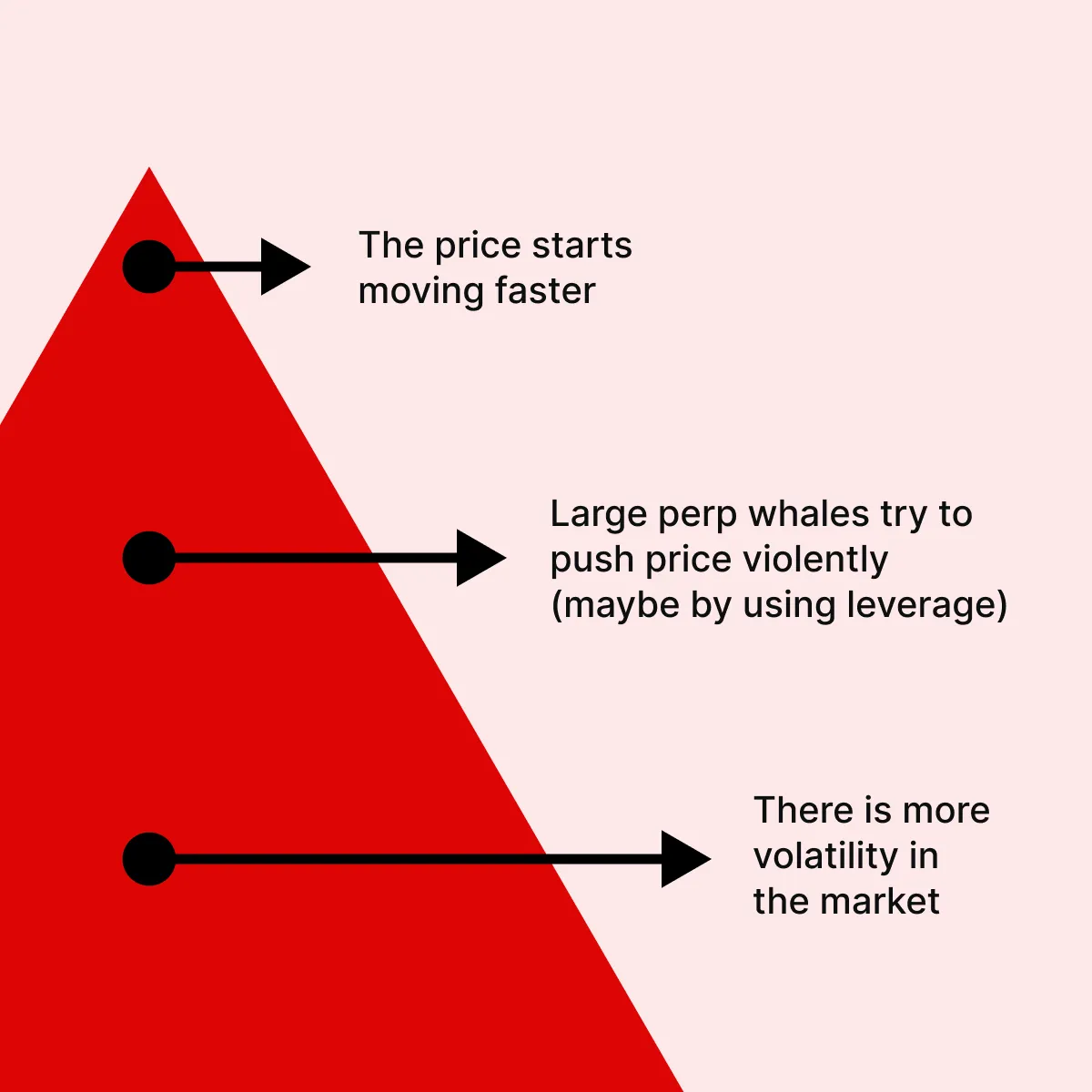
Sometimes, a large trader (a perp whale) places a huge buy order in the perpetual futures market. Due to this:
- The price is aggressively pushed higher
and
- Sometimes, it breaks through a visible resistance level or a “wall” of sell orders.
What’s the impact of this sudden spike? It often triggers FOMO (fear of missing out) among retail traders, who rush in thinking a big breakout has begun. But that’s the wrong approach! You must realize that if the crypto spot market doesn’t show matching buying activity, the price rise isn’t sustainable. It is mostly influenced by leverage and sentiment, not genuine spot buying.
Okay, so what happens next?
- The rally quickly loses strength.
- The market snaps back down.
- The late buyers get trapped.
This quick up-and-down pattern is called a “perp-led false move,” which is particularly visible when perp whales dominate the flow. Additionally, these whales sometimes even spoof the market by:
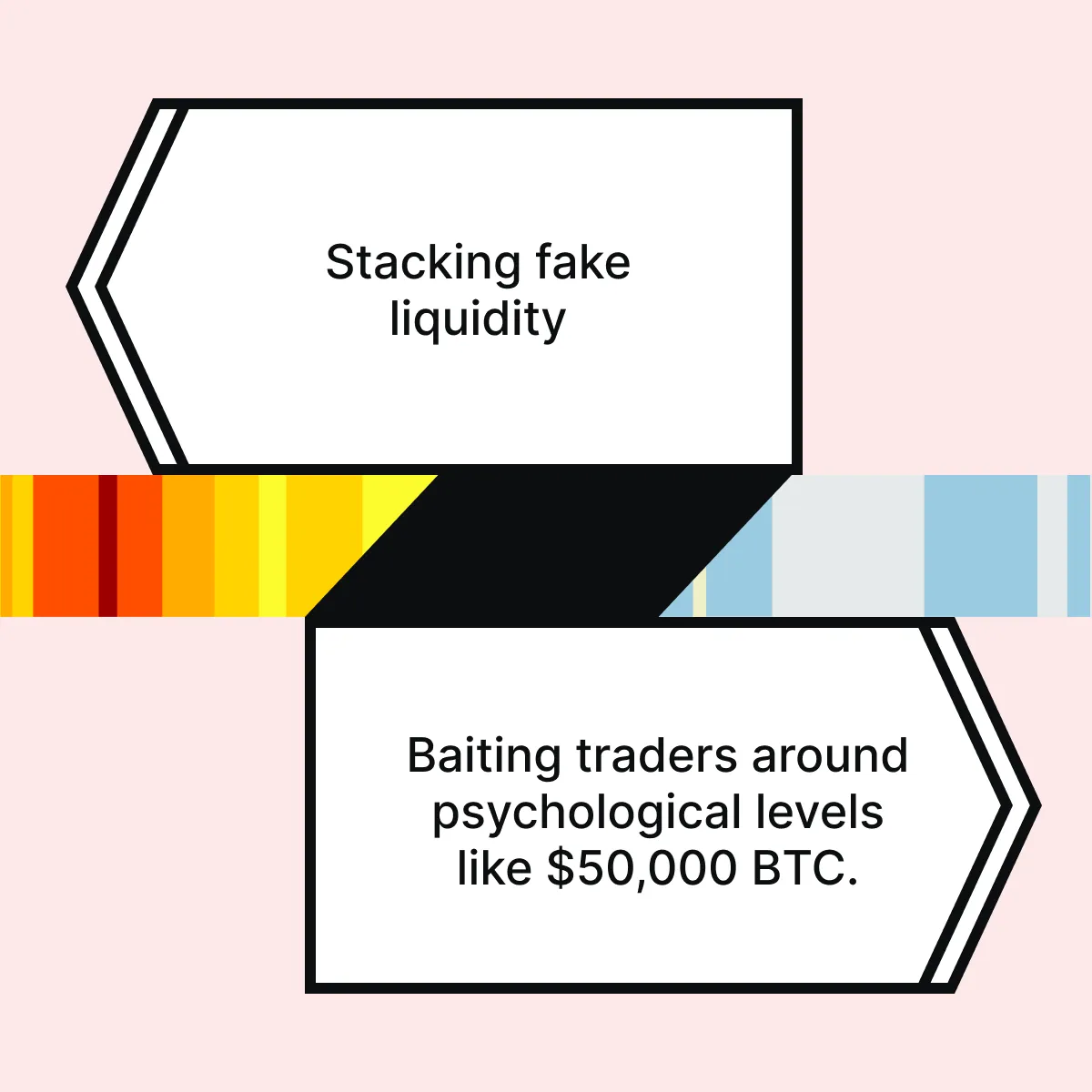
So, what’s your main takeaway? When perp whales dominate, the crypto market structure becomes more volatile and deceptive. It gets heavily influenced by leverage rather than true demand. Compare spot and perp behavior side by side using Bookmap tools →
3. Liquidation Bots: The Invisible Force Behind Cascades
Do you know why the crypto market suddenly crashes or rockets upwards? Is it always because of human traders? Nope! Sometimes, it is the act of liquidation bots in crypto. Let’s see how they operate:
- Many traders use leverage in perp trading. This means they borrow funds to open bigger positions.
- Assume that at some point later, the market moves sharply against them.
- As a result, their margin becomes too small to support those positions.
- Now, that’s when liquidation bots automatically step in to close their trades.
- To watch where margin positions are liquidated in real-time, you can use Bookmap’s liquidity indicator.
- To take advantage of this market situation, liquidity bots try to:
- Sell into bids during crashes
or
- Buy into asks during pumps.
- Always remember that these bots don’t predict price moves. Instead, they react to them.
- But their reactions add fuel to the fire!
- The actions of liquidation bots create chain reactions known as “liquidation cascades,” where one forced exit triggers another.
Want to visualize this? You can use Bookmap’s crypto heatmap. Let’s see how all these activities are visible on it:

Interestingly, liquidation spikes often mark the end of a move (not the start). Skilled traders usually watch for these signs to tell whether the market is:
- Just flushing out over-leveraged players
or
- Showing real directional conviction driven by whales or spot flow.
Replay past liquidation cascades to understand how they develop →
4. Identifying Who’s in Control: Spot vs Perp vs Bot Clues
By now, you can answer this question: Who moves the price in the crypto market? You must be contemplating about:

Yes, you are right! But how can you check for dominance? For that, start using Bookmap, which shows the live crypto heatmap order flow. Through the visualization offered, you can easily see which type of player is in control. Now, let’s understand how you can spot the difference:
A) When Spot Traders Are in Control
A spot-led market moves more naturally. You’ll notice that:
- Volume dots (trades) appear slower and smaller.
- Resting liquidity (the layers of limit orders) holds steady.
- Price moves are stable with no erratic movements.
- There’s little to no divergence between Binance spot and perp trading charts.
These signs usually mean real demand or supply is driving price, not just leverage.
B) When Perp Whales Take Over
A perp-led market looks more aggressive and emotional. Watch for these common signs:
- Big and fast trades sweep through multiple price levels.
- Passive liquidity vanishes just before a move and reappears after stop runs.
- Hidden iceberg orders emerge right before a reversal.
- The crypto spot market lags behind the futures price.
In these market conditions, leverage and large players are steering the price. Genuine spot buyers are absent.
C) When Bots Drive the Chaos
During sharp crashes or vertical pumps, liquidation bots in crypto often take control. You’ll notice:
- Trade speed jumps dramatically with no sign of buyers defending levels.
- Heatmap walls are absorbed instantly with zero reaction.
- Volume clusters appear, but the price doesn’t move much further.
- Once liquidations finish, price movement suddenly stalls.
Thinking about why you should read these crypto market structure patterns? As a trader, if you can spot who’s truly moving the market, you can avoid chasing false breakouts or getting caught in post-liquidation exhaustion zones.
5. Strategy Implications: Trading With, Not Against, the Flow
What is the best way to survive in the crypto market?
- Know who moves the crypto market at any given moment
and
- Then, adjust your strategy to match.
Once you can read whether spot traders, perp whales, or liquidation bots are in control, your approach becomes much safer. Let’s see what to do in three different scenarios when these market participants are usually in control:
| Scenario I: When Spot Traders Lead | Scenario II: When Perp Traders Dominate | Scenario III: During Liquidation Cascades |
or
|
|
and
|
Need A Bonus Tip? Learn from Market Replay
Use Bookmap’s Market Replay Mode to study past perp trading surges or liquidation events. This is how you can do this:
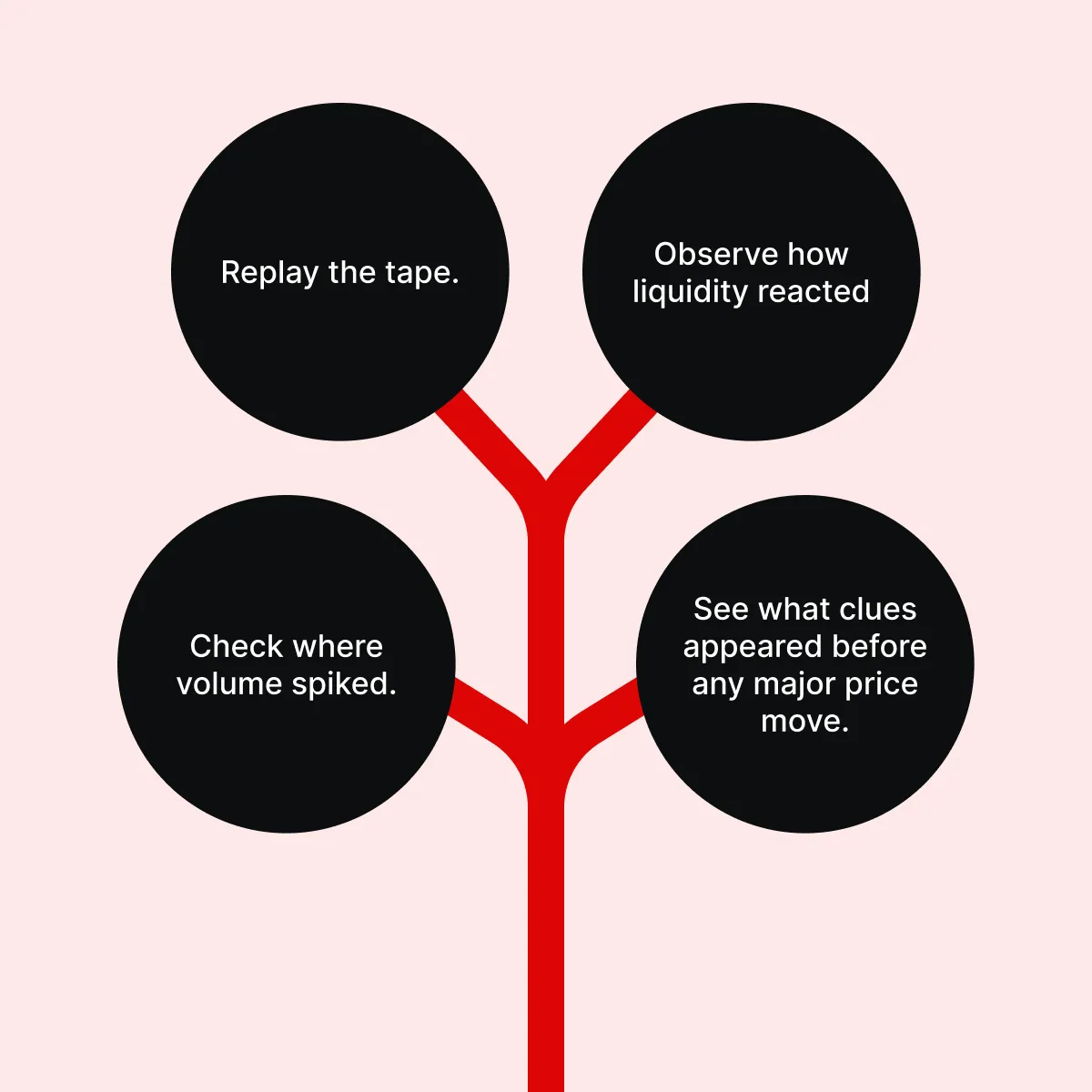
Always remember that these patterns repeat. And spotting them early is what separates reactive traders from strategic ones. Identify spoofing, stacking, and hidden intent with Bookmap’s volume dots and heatmap →
Conclusion
By now, you must have learned the first step towards trading with real confidence. It is understanding who moves/ dominates the crypto market. Sometimes, it’s spot traders creating steady and organic moves. Other times, it’s perp whales using leverage to cause sharp price swings or liquidation bots creating sudden liquidation cascades.
Each group leaves its own signature in the crypto market structure. And as a trader, it is your role to learn and read those clues. Why? This knowledge allows you to avoid traps and trade with the real flow.
Want to make this observation easier? That’s where Bookmap comes in. It’s a real-time crypto heatmap order flow tool. Using it, you can see who’s active, where liquidity sits, and how momentum is shifting. Everything is visible in one visual view. → Start tracking real-time crypto order flow with Bookmap.
FAQs
1. What’s the difference between spot and perp trading in crypto?
In spot trading, you buy or sell the actual crypto asset, such as Bitcoin. But in perp trading, you trade perpetual futures. These are contracts that track price but don’t require owning the coin. These perps allow leverage and have faster price fluctuations.
Usually, they lead to short-term price swings, while spot trading reflects real buying and selling demand.
2. How do liquidation bots work in crypto?
When traders use leverage and prices move sharply against them, their margin balance drops. Now, liquidation bots in crypto automatically close those positions to prevent further losses. These forced market orders usually “snowball” and create strong price fluctuations, both drops and spikes. This event is known as a liquidation cascade, and it increases volatility across exchanges.
3. Can I see liquidation activity on Bookmap?
Yes. While Bookmap doesn’t label trades as “liquidations,” you can recognize them through:
- Sudden bursts of aggressive volume,
- Sweeping of thin liquidity zones, and
- Lack of visible defense from buyers or sellers.
These patterns reveal where liquidation bots are active and let you spot exhaustion points before the market stabilizes.
4. Why do spot and perp markets sometimes diverge?
Spot traders buy or sell real coins and have a long-term horizon. In contrast, perp traders use leverage and try to realize short-term profits by reacting to momentum. That’s why perp prices often move first when traders suddenly turn bullish or bearish. This causes a short gap or mismatch between spot and perp prices, which usually balances out once both markets catch up.
5. Is it better to trade based on spot or perp behavior?
Neither market is always superior. Your approach should be to read the crypto market structure and identify who’s in control:
- Spot traders,
- Perp whales, or
- Liquidation bots.
Post-identification, it is advisable to trade in the same direction as the dominant flow. This allows you to avoid false breakouts and align with real market momentum instead of fighting it.
Sign Up Now
Latest Articles