


See how AI participation is reshaping market structure.
Compare plans to follow liquidity behavior and changing retail conditions in real time.
News & Announcements
May 6, 2026
Will AI Trading Make Markets Harder for Retail in 2026?
Today’s modern markets no longer move only on human decisions. A large share of activity is now influenced by AI trading in financial markets and rule-based systems. This change has led many p articipants to question whether manual trading still has a place.
The question is valid! The growing presence of automation, along with headlines about advanced algorithms, usually creates the impression that markets are now 100% controlled by machines.
However, that’s not completely true, and the reality is more balanced. The algorithmic trading systems are built only for some specific tasks rather than complete market control. Their role is limited to executing predefined functions (such as managing orders and providing liquidity). These systems do not determine the overall market direction.
Read this article to learn how these modern AI systems influence price movement and whether they truly make trading more difficult.
What “AI Trading” Actually Means in 2026
The term AI trading in financial markets creates the impression that machines are predicting price movements with superior intelligence. However, the reality is less speculative! Most systems used nowadays fall under “defined categories” within automated trading models. Each of these models is designed to perform a specific function rather than broad market prediction.
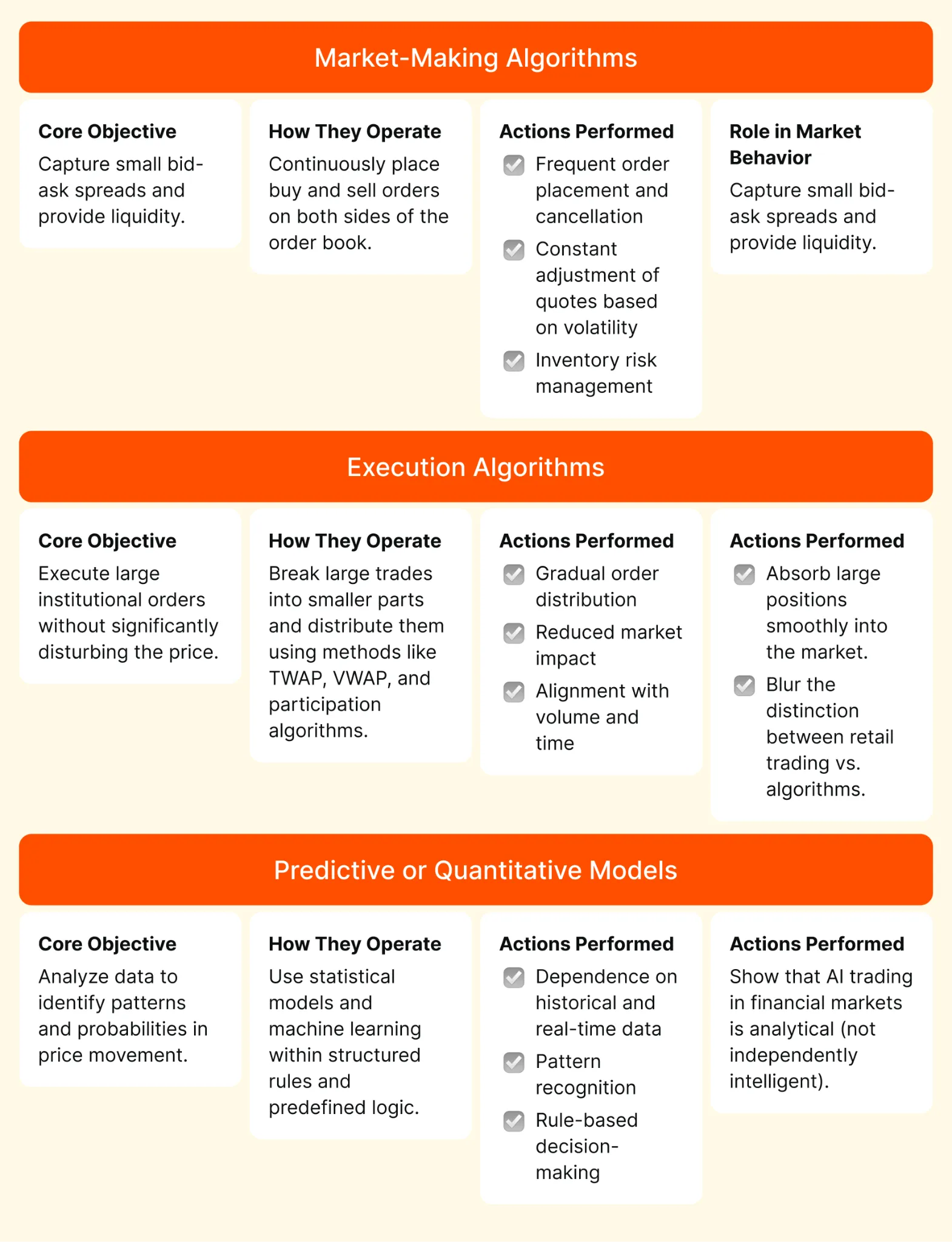
Taken together, these categories show that AI trading in financial markets is not about machines “knowing” where the price will go. Rather, it is a combination of systems designed to provide:
- Liquidity
- Execute large trades, and
- Analyze market data
How Algorithmic Trading Changes Market Behavior
Automation has changed modern markets, not only through prediction, but also through:
- Speed of response, and
- Changing liquidity patterns
As a result, the algorithmic trading impact is most visible in how orders appear, move, and disappear across the market. Over time, this has altered how price behaves and how participants interpret that behaviour.
Let’s understand these changes in detail:
Liquidity Adjusts Faster
In earlier market structures, “visible liquidity” used to remain stable for longer periods. In contrast, current conditions show that liquidity is continuously adjusted by automated trading models.
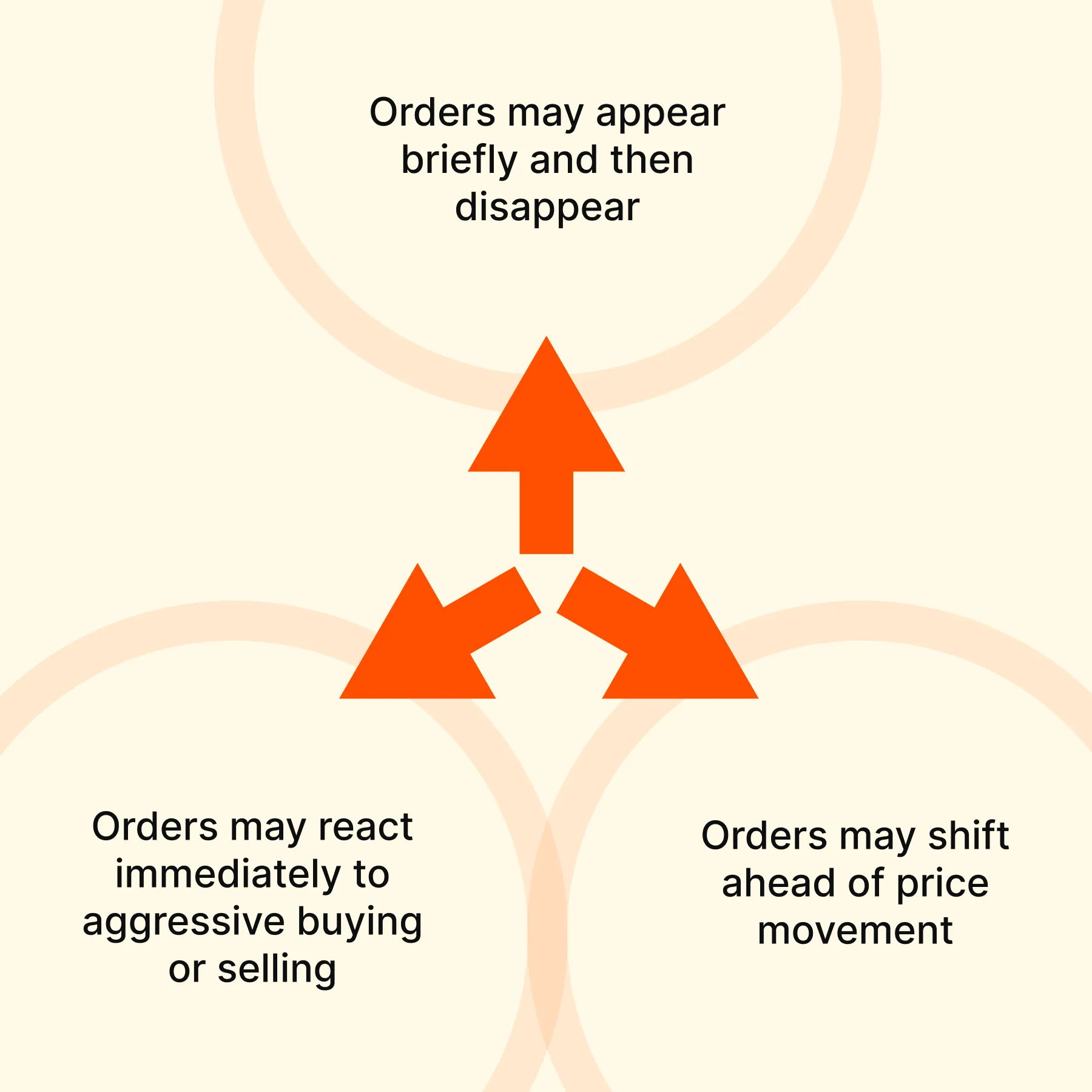
Consequently, liquidity no longer appears fixed, which creates the impression of instability. However, this behaviour also shows “constant recalibration” by systems engaged in AI trading in financial markets, where maintaining adaptability is more important than maintaining static positions.
See how liquidity and participation reveal algorithmic activity → Compare Packages
Price Moves Can Accelerate Quickly
As liquidity becomes dynamic, price movement also changes in character. Most modern algorithms react to buying and selling pressure in the market. An imbalance is created when:
- There are many buyers but very few sellers, or
- Many sellers, but very few buyers
At the same time, if there are not enough orders available (which means liquidity is thin), even a small amount of trading can lead to sharp price fluctuations. This happens because there is not enough opposing interest to slow it down. Such a situation usually leads to:
- Intraday spikes
- Quick price rotations, and
- Sudden bursts of volatility
Therefore, movements that appear “abrupt” are not always driven by new information. Rather, they are a result of automated reactions within the market structure. In many cases, such activity is even misinterpreted as “manipulation,” whereas it is merely the outcome of how automated systems interact with changing liquidity conditions.
Markets React to Liquidity, Not Just Price
Another important change is that price is no longer the only driver of market behaviour. Instead, liquidity structure plays an important role. Today’s modern AI trading systems continuously monitor:
- Order book depth
- Transaction flow, and
- Imbalances between buyers and sellers
As a result, price movements usually begin in areas where liquidity becomes thin or where stop orders are concentrated. Analyze the behavior behind price movement → Compare Packages
Why Retail Traders Often Misunderstand AI Trading
The idea that machines consistently outperform individuals has become a popular narrative in AI trading in financial markets. However, this belief is based on a misunderstanding. Many participants assume that algorithms predict price direction with high accuracy. In reality, most automated trading models are not designed for prediction at all.
Instead, their primary roles are more specific and operational in nature:
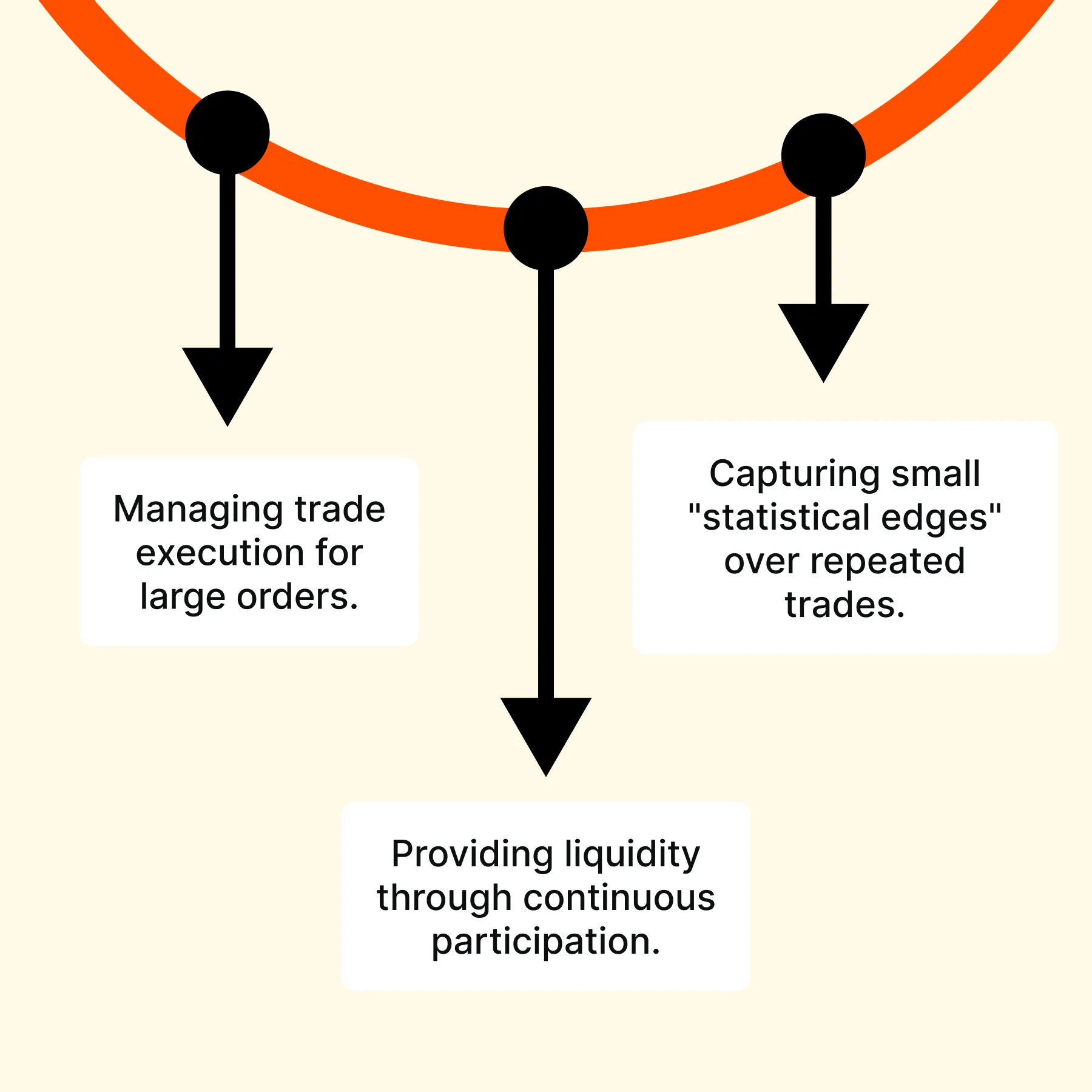
As a result, the algorithmic trading impact is seen more in how markets function than in perfect forecasting. Realize that these systems react to conditions and manage flows, rather than attempting to consistently anticipate direction.
Modern Traders Attributing Trading Losses to AI
Nowadays, several traders attribute losses to algorithms, whereas the underlying causes are more behavioural and structural:
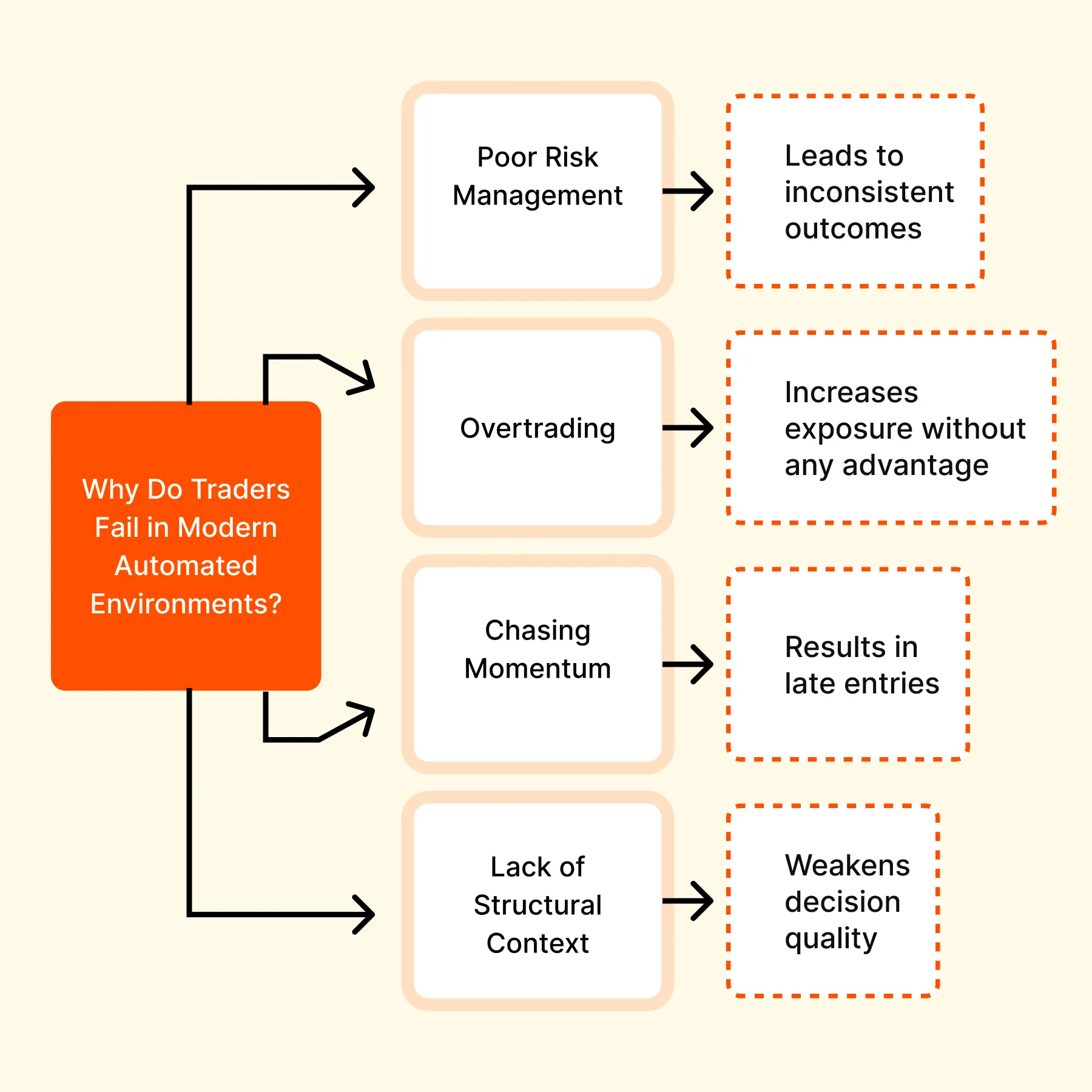
Note that automation does not create these weaknesses. Rather, it amplifies them by making market movements more responsive and less forgiving.
Where Retail Traders Still Have Advantages
Despite the growth of automation, retail participants still retain several structural advantages. Firstly, if we talk about institutional systems, they operate under “strict constraints”. These constraints are built into automated trading models and limit their flexibility.
For example, institutional algorithms must follow:
- Defined risk limits that restrict exposure.
- Inventory management rules that control position size.
- Execution mandates that require order completion regardless of conditions.
As a result, these systems cannot always act selectively. Their actions are usually based on predefined objectives rather than an evolving market context. In contrast, retail participation operates without such rigid constraints.
- Trades can be delayed until conditions appear clearer
- Participation can remain selective rather than continuous
- Strategies can be adjusted as market behaviour changes
Consequently, the algorithmic trading impact has not removed the opportunity. A discretionary approach that recognises how liquidity behaves can still operate profitably within modern market conditions.
How AI Can Actually Create Opportunities
Automation is mostly seen as a challenge! Yet it can also introduce a “degree of consistency” in market behaviour. This happens because AI trading in financial markets is:
- Built on structured rules, and
- AI or algorithm systems usually respond to similar conditions in repeatable ways
As a result, a few patterns appear more frequently, which can make parts of market behaviour easier to interpret. For more clarity, let’s check out some of these patterns:
| Liquidity Vacuum Moves | Stop Cascades | Execution Flow |
|
|
|
Understand what algorithms are actually doing in the market → Compare Plans
What Traders Should Focus on Instead of Competing With AI

Modern traders should not try to outperform machines through prediction. A more relevant approach is to observe the behaviour created by automation itself. In this context, three elements become particularly important:
| Liquidity behaviour | Participation changes | Structural transitions |
|
|
|
Therefore, the comparison of retail trading vs algorithms is not only about tools, but about perspective. Realize that algorithms operate within predefined rules. Traders may observe their impact to identify patterns within market structure. In many cases, these observations provide more insight into direction (than relying on indicators alone).
Conclusion
Automation and AI trading in financial markets have changed how markets behave. Liquidity now adjusts more dynamically, and price movements can become sharp. Additionally, the algorithmic trading impact is highly visible in how markets respond to order flow.
However, these changes do not remove opportunity. Instead, they only change how opportunities appear. At the same time, the idea of retail trading vs. algorithms often overlooks an important point! Nowadays, most automated trading models follow structured rules rather than perfect prediction. As a result, market behaviour still leaves patterns that can be observed.
Therefore, in these modern times, traders should not try to compete with machines directly. Instead, they should shift their attention toward liquidity, participation, and structural context. These elements provide better insight into how prices move. See how traders analyze liquidity and order flow in real time → Compare Packages
FAQs
1. Does AI control the stock market?
No, even though AI trading in financial markets is widespread, the market is still made up of many participants. Institutions, market makers, and individuals all interact with each other.
Algorithms play a role in execution and liquidity, but no single system controls the overall market direction.
2. Are algorithms impossible to compete with?
Most automated trading models are built to only manage execution or provide liquidity. They do not predict direction. This means they are not always “ahead” of the market. Retail and individual traders still have profitable trading opportunities in the market.
3. Why do markets move faster today?
Markets move faster due to the impact of algorithmic trading on execution speed. Automated systems react immediately to changes in buying, selling, and liquidity. As a result, prices adjust more quickly than in the past, particularly during periods of low liquidity or high activity.
4. How can retail traders adapt to algorithmic markets?
To adapt, traders may observe how markets behave rather than trying to out-predict them. AI trading that retail traders see today primarily moves based on two things:
- Liquidity: How many buyers and sellers are available
- Participation: How active buyers or sellers are at a given time
In today’s modern times, prices fluctuate because of activity and available orders (not because AI is predicting direction). Thus, instead of only relying on indicators, traders may also pay attention to these factors, along with changes in market structure.
Sign Up Now
Latest Articles