


See micro contracts more clearly in real time.
Compare plans to access deeper market visibility for micro contracts.
Futures
July 7, 2026
Updated
Trading Micro Futures with Bookmap

Table of Contents
- What Are Micro Futures Contracts?
- Understanding Micro Futures Mechanics
- CME Micro E-Mini Specifications: Tick Values and Multipliers
- E-Mini vs. Micro E-Mini: Liquidity and Slippage Compared
- Margin Requirements and Capital Efficiency
- Day Trading Margins vs. Overnight Maintenance Margins
- Broker Selection and Costs
- Best Retail Futures Brokers: Lowest Commissions and Fees
- Diversifying Beyond Equity Indices
- Micro WTI Crude Oil (MCL), Micro Gold (MGC), and Micro Treasury Yield Sizing
- Micro Bitcoin and Ether Margin Requirements
- Trading Micro Futures with Bookmap
- Trading Strategies and Risk Management
- Scalping vs. Swing Trading the Micro Nasdaq 100 (MNQ)
- Transitioning Safely from Paper Trading to Live Accounts
- Tax Advantages for Retail Traders
- How the Section 1256 60/40 Rule Applies to Micros
What Are Micro Futures Contracts?
A micro futures contract is simply a smaller version of the same futures contract. For example, the Micro E-Mini S&P 500 contract is 1/10 the size of the classic E-Mini S&P 500.
That means that the minimum fluctuation of 0.25 index points with one micro contract results in a $1.25 change in the value of that contract (whereas the same minimum 0.25 index points fluctuation on the classic contract results in a $12.5 change). You can read more about micro contract specs on the CME Group.
This difference in contract size is perfect for smaller traders with less capital, since it allows for greater control of position sizing. It is considered wise to always use a stop loss, especially when trading leveraged products like futures.
Most traders base their position sizing on their stop loss, but the location of a trader’s stop loss changes based on market conditions; sometimes it is wider from the entry price, and sometimes it is closer. When trying to limit risk to the commonly advised 2% of capital, it is not difficult to see how being limited to whole contract increments can mess up position sizing for a trader with an account balance of a few thousand dollars and an always changing stop loss distance. Micro contracts allow for more flexibility in managing risk, and also have the added benefit of more precise scaling in and out of positions.
Micro contracts are a great place for new traders to start without risking too much capital. There is a difference between trading a demo account and trading real money, and micro contracts are the perfect place to add that ever so important psychological element of risk management, without absolutely paralyzing your decision-making process so you can refine your strategy over time.
As we have previously written about, there are many benefits that smaller traders have in terms of liquidity, and micro contracts are a great addition.
The CME’s micro futures lineup now spans equity indices, metals, energy, FX, Treasury yields, and crypto, including both Micro Bitcoin and Micro Ether contracts. This gives traders across nearly every major asset class the same reduced-size, capital-efficient access that made the original Micro E-Mini contracts popular.
What Are Micro Futures Contracts?
Every futures contract, whether standard or micro, works the same way: it’s an agreement to buy or sell the value of an underlying instrument at a future date, settled in cash for products like the E-Minis rather than through physical delivery. What changes with a micro contract is the multiplier applied to that price movement. A standard E-Mini S&P 500 contract multiplies every index point by $50; the Micro E-Mini multiplies it by $5. The market itself doesn’t behave any differently — the price of the S&P 500 futures curve moves identically whether you’re watching the standard or micro version. What changes is how much each tick of that movement is worth to your account.
This matters most when it comes to margin. Margin is not a down payment on the contract’s full value; it’s a performance bond the exchange requires to cover potential losses. Because a micro contract’s notional value is a fraction of its standard counterpart, its margin requirement is proportionally smaller too — which is the entire reason micros exist. They let a trader with a smaller account control a properly-sized position instead of being forced into a single standard contract that risks far more than their account can absorb.
Understanding Micro Futures Mechanics
Every futures contract, whether standard or micro, works the same way: it’s an agreement to buy or sell the value of an underlying instrument at a future date, settled in cash for products like the E-Minis rather than through physical delivery. What changes with a micro contract is the multiplier applied to that price movement. A standard E-Mini S&P 500 contract multiplies every index point by $50; the Micro E-Mini multiplies it by $5. The market itself doesn’t behave any differently — the price of the S&P 500 futures curve moves identically whether you’re watching the standard or micro version. What changes is how much each tick of that movement is worth to your account.
This matters most when it comes to margin. Margin is not a down payment on the contract’s full value; it’s a performance bond the exchange requires to cover potential losses. Because a micro contract’s notional value is a fraction of its standard counterpart, its margin requirement is proportionally smaller too — which is the entire reason micros exist. They let a trader with a smaller account control a properly-sized position instead of being forced into a single standard contract that risks far more than their account can absorb.
CME Micro E-Mini Specifications: Tick Values and Multipliers
The table below covers the four most actively traded CME Micro E-Mini equity index contracts. Multipliers and tick sizes are fixed by the exchange and don’t change with market conditions, unlike margin requirements.
| Contract | Ticker | Tick Size | Tick Value | Multiplier | Trading Hours (Globex) |
| Micro E-Mini S&P 500 | MES | 0.25 index pts | $1.25 | $5 x index | Nearly 24 hrs, Sun–Fri |
| Micro E-Mini Nasdaq-100 | MNQ | 0.25 index pts | $0.50 | $2 x index | Nearly 24 hrs, Sun–Fri |
| Micro E-Mini Dow | MYM | 1.00 index pt | $0.50 | $0.50 x index | Nearly 24 hrs, Sun–Fri |
| Micro E-Mini Russell 2000 | M2K | 0.10 index pts | $0.50 | $5 x index | Nearly 24 hrs, Sun–Fri |
E-Mini vs. Micro E-Mini: Liquidity and Slippage Compared
A common concern among traders moving from standard to micro contracts is whether liquidity will be thin enough to cause slippage. In practice, the flagship Micro E-Mini contracts — MES and MNQ in particular — trade with substantial daily volume and tight bid-ask spreads, often just one tick wide during regular session hours. Liquidity does thin out during off-peak overnight windows and around scheduled maintenance breaks, which is true of the standard contracts as well.
Where the comparison matters more is in execution precision. Because ten micro contracts equal one standard E-Mini in notional exposure, a trader can scale into or out of a position in smaller increments, which reduces the market impact of a single large order relative to working the same size through fewer, larger contracts. For most retail-sized trades, the practical difference in slippage between standard and micro versions of the same index is minimal; the bigger factor is simply avoiding the thinnest liquidity windows regardless of contract size.
Margin Requirements and Capital Efficiency
Futures margin comes in two forms. Initial margin is the amount required to open a position. Maintenance margin is the minimum equity the account must hold to keep that position open; if equity falls below it, the broker will issue a margin call or close the position. Because both figures are set by the exchange and adjusted by brokers based on volatility, they change over time — sometimes significantly during periods of market stress — so any specific dollar figure quickly goes stale. Traders should check their broker’s current margin schedule directly rather than relying on a fixed number from an article.
What doesn’t change is the underlying relationship: micro contracts require a fraction of the margin their standard counterparts do, roughly in line with the size ratio between them. This is what makes micros capital-efficient — a trader can maintain the same percentage-of-account risk exposure with far less capital tied up per position, and can size trades in increments that actually match a stop-loss distance instead of being forced to round up to a full standard contract.
Day Trading Margins vs. Overnight Maintenance Margins
Most futures brokers offer two different margin tiers. Day trading margin — sometimes called intraday margin — is reduced and applies only while a position is opened and closed within the same session. Overnight margin, which is closer to the exchange’s full maintenance margin requirement, applies to any position held past the session’s close.
This distinction matters for capital planning: a trader using the lower day-trading margin can control a larger position size intraday than they could hold overnight with the same account balance. It’s also a meaningful factor in choosing a broker, since day-trading margin policies vary — some brokers offer significantly reduced intraday margin on micros, while others apply a smaller discount. That variation is one of the first things worth comparing before opening an account.
Broker Selection and Costs
Choosing a broker for micro futures trading comes down to four things: total cost per trade, margin policy, execution quality, and platform compatibility. Total cost isn’t just the advertised commission — it includes exchange fees, any data feed subscription, and platform fees layered on top. Two brokers advertising similar per-contract commissions can end up costing very different amounts once those additional fees are added.
Execution quality matters more with micros than it might seem, since active strategies like scalping depend on fast, reliable order routing regardless of contract size. And because Bookmap connects to trading through specific data feeds and broker integrations, platform compatibility is worth checking before committing to an account — confirming that a broker’s data feed supports the level of market depth (DOM) visualization Bookmap is built around.
Best Retail Futures Brokers: Lowest Commissions and Fees
Rather than ranking brokers by advertised commission alone, it’s more useful to break down what actually makes up a “cheap” account. The all-in cost of a trade is the sum of the broker’s per-side commission, the exchange fee CME charges per contract, any market data subscription fee, and any platform or software fee layered on top by the broker. A broker with a low headline commission but a mandatory paid data feed can end up more expensive overall than one with a slightly higher commission but no add-on fees.
For active micro futures traders — particularly scalpers making many trades per session — commission and exchange fees compound quickly, so it’s worth calculating total cost per round-trip trade rather than comparing single numbers in isolation. Bookmap’s supported broker and data feed partners are listed on the Bookmap connectivity guide, which is the most reliable place to compare current fee structures for accounts that work directly with the platform
Diversifying Beyond Equity Indices
Micro contracts aren’t limited to equity indices. The CME has extended the same reduced-size structure to metals, energy, FX, Treasury yields, and crypto, which means a trader can build exposure across asset classes without the capital requirements of standard-size contracts in each one.
Micro WTI Crude Oil (MCL), Micro Gold (MGC), and Micro Treasury Yield Sizing
Micro WTI Crude Oil (MCL) and Micro Gold (MGC) apply the same logic as the equity index micros: a fraction of the standard contract’s notional size, letting traders take energy or metals exposure without the capital commitment of a full-size CL or GC contract. Micro Treasury Yield futures work slightly differently — rather than tracking a price, they track a yield directly, which changes how tick value and directional exposure should be read compared to a standard bond futures contract. In each case, sizing math follows the same principle covered earlier: multiplier and tick value determine the dollar impact of a move, and that multiplier is smaller by design across the entire micro product line.
Micro Bitcoin and Ether Margin Requirements
Micro Bitcoin and Micro Ether futures let traders take regulated, cash-settled crypto exposure at a fraction of the size of the standard CME Bitcoin and Ether contracts. Because crypto markets carry higher volatility than equity indices or metals, margin requirements on these contracts tend to run higher relative to their notional value than the equity index micros do. As with all margin figures, check the current schedule directly with your broker rather than relying on a fixed number, since crypto margin in particular is adjusted more frequently in response to volatility.
Trading Micro Futures with Bookmap
Bookmap displays the same order flow phenomena on micro contracts as it does on their standard-size counterparts — stop runs, absorption, exhaustion, and aggressive buying and selling are all visible identically whether you’re watching MES or the standard ES. Micro contract symbols follow the same tickers as their full-size counterparts with an “M” added to the front. You can find a full list of symbols and month codes on the Bookmap symbol table.
Trading with Rithmic on Bookmap will also allow you to utilize the MBO Bundle suite of indicators, including things like Stops & Icebergs On-Chart / Sub-Chart.
The Same Order Flow Phenomena
The micros display the same order flow phenomena as the classic contracts: stop runs, absorption, exhaustion, aggressive buying and selling etc.
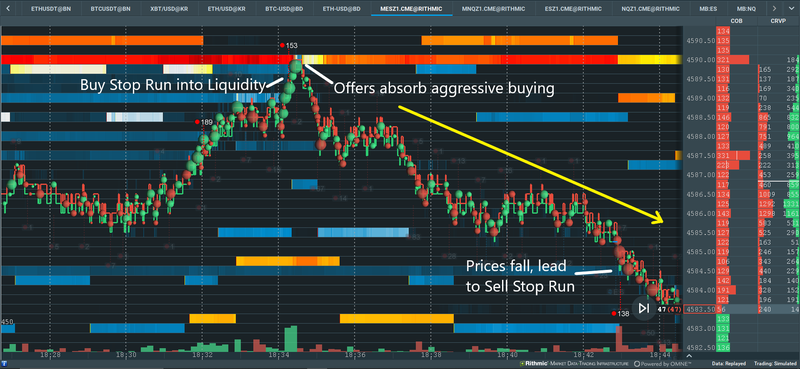
Fig 1 – An example of a buy stop run into liquidity being absorbed and leading to a price reversal.
In Figure 1, we can see a combination of such order flow analysis phenomena on the Micro ES chart. A buy stop run into large offers liquidity at 4590.00 is absorbed, and prices reverse, eventually leading to the triggering of sell stops on the way down.
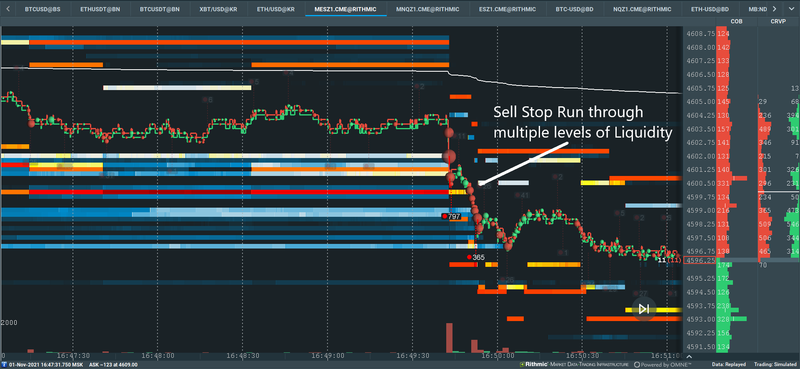
Fig 2 – A Sell Stop Run sends prices through multiple layers of Bids.
Using the MBO indicators can give you insights into what is moving price. In figure 2, we can see that the break lower through multiple layers of large liquidity was caused by a large sell stop run.
Of course, the micro contracts have micro volumes. If you want to see a combination of the traditional and the micro volumes in a single heatmap, you can use Multibook Customizer.
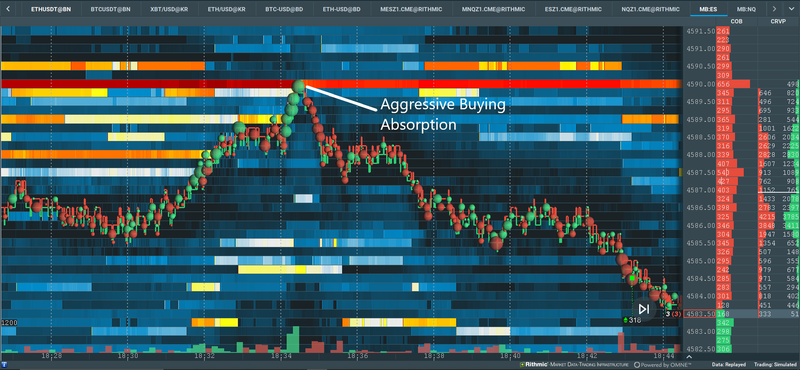
Fig 3 – A Multibook of MES and ES shows aggressive buyers being absorbed by Offers, which are combined visually into a synthetic instrument with Multibook.
In figure 3, we can see how a synthetic Multibook instrument of the combined volume and liquidity of MES and ES shows clear buying absorption on the offers, leading to a price reversal — a pattern closely tied to how traders read overall market structure. Combining these two instruments can give you more insights into the order flow of each, and increase both the quantity and quality of trading opportunities that may be missed when only looking at a single instrument.
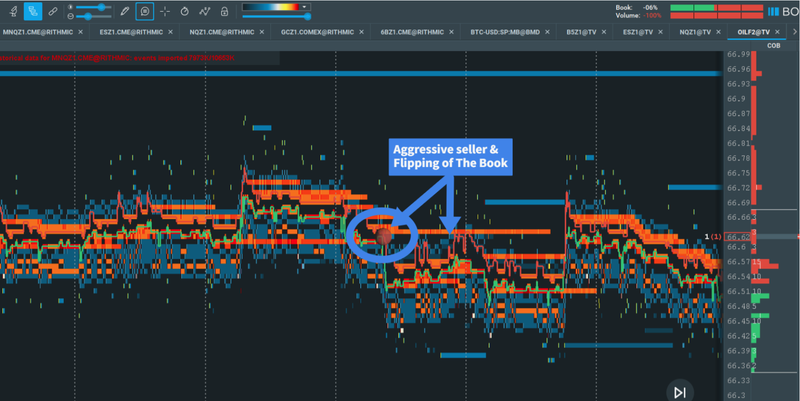
Order flow patterns like these — stop runs, absorption, and book flips — aren’t unique to any one contract. They appear across equity index micros, energy, metals, and crypto futures alike. To see a wider library of real examples across different markets, visit the Bookmap Insights page.
If you prefer to view the larger product but want full control over your position sizing, you could utilize Bookmap’s Cross-Instrument Trading to view the order flow on the larger instrument, but send your trades through the micro contract.
Trading Strategies and Risk Management
Micro contracts support the same range of trading strategies as their standard-size counterparts — day trading, swing trading, hedging, and algorithmic execution — but their smaller size makes them particularly well suited to precise risk management. Because position size can be adjusted in single-contract increments rather than jumping straight to a full standard contract, a trader can size a stop-loss distance to fit their actual risk tolerance instead of rounding up. For a broader look at approaches, risks, and reward expectations across futures generally, see Bookmap’s guide to day trading futures strategies.
Risk management with micros still follows the same fundamentals as any leveraged product: define risk before entering a trade, size positions to a fixed percentage of account equity, and avoid letting a losing trade grow simply because the contract itself is small.
Scalping vs. Swing Trading the Micro Nasdaq 100 (MNQ)
NQ is one of the most actively scalped micro contracts, largely because the Nasdaq-100’s volatility produces frequent, tradable intraday moves. Scalpers typically hold MNQ positions for seconds to minutes, relying on tight spreads and fast execution to capture small, repeated price movements, and they generally use the reduced day-trading margin tier covered earlier since positions rarely stay open past the session.
Swing trading MNQ looks very different. Positions are held for days, aiming to capture larger directional moves tied to broader trend or macro catalysts rather than intraday noise, and they require the account to carry full overnight maintenance margin. Neither approach is inherently better — scalping demands more attention and faster reflexes, while swing trading demands more patience and wider stop placement to avoid getting shaken out by normal overnight volatility. The right approach depends on the time a trader can dedicate to watching the market and their tolerance for holding risk overnight.
Transitioning Safely from Paper Trading to Live Accounts
Paper trading is useful for learning contract mechanics, platform navigation, and order types without financial risk, but it doesn’t replicate the psychological pressure of trading real money — a gap many new traders underestimate. Micro contracts exist specifically to narrow that gap. Because the dollar risk per contract is small relative to standard contracts, a trader can move from simulation to a live account and experience genuine financial consequences for their decisions without risking capital they can’t afford to lose.
A reasonable transition path is to trade a single micro contract live, with a predefined stop-loss and position size based on account equity, before scaling up either the number of micro contracts or moving to standard-size contracts. The goal in this phase isn’t profit — it’s confirming that a strategy that worked in simulation still holds up once real money and real emotion are involved.
Tax Advantages for Retail Traders
Futures contracts, including micros, receive a tax treatment in the United States that differs from short-term equity trading. This is general information, not tax advice — every trader’s situation is different, and this section shouldn’t be used as a substitute for consulting a qualified tax professional about individual circumstances.
How the Section 1256 60/40 Rule Applies to Micros
CME futures contracts, including all Micro E-Mini and other CME micro products, are classified as Section 1256 contracts under the U.S. tax code. Under this rule, 60% of any gain or loss is treated as long-term capital gain or loss and 40% as short-term, regardless of how long the position was actually held — even a trade opened and closed within the same day qualifies for this treatment. This differs meaningfully from equity trading, where holding period determines tax treatment directly.
This 60/40 split applies identically to micro and standard-size contracts; contract size has no bearing on tax classification. As with the previous section, this is general information rather than individual tax advice, and traders should confirm how this applies to their own filing with a tax professional.
If you’re a new trader, a smaller trader, or even an experienced trader looking to test out a new strategy, micro contracts are a great place to start. Bookmap offers two options for trading micro contracts through the platform: on the CME with Rithmic, or on the newly born FairX exchange, both with their own unique advantages.
A trader that wants to access the full potential of the advanced suite of MBO indicators would go with Rithmic, whereas a trader that is looking to really minimize costs should go with commission-free FairX, which even offers Nano contracts, which are even smaller.
Either way, Bookmap has you covered. Start today for free.”
Conclusion
Micro futures give traders of every size the ability to control position size and risk with precision, across an asset lineup that now spans equity indices, metals, energy, FX, Treasury yields, and crypto. That same precision, paired with Bookmap’s order flow visualization, means a trader watching MES or MNQ sees the exact same stop runs, absorption, and liquidity shifts that show up on the standard-size contracts — just scaled to a size that matches their account.
Whether you’re transitioning from paper trading, refining a scalping strategy on MNQ, or diversifying into metals and crypto micros for the first time, the fundamentals stay the same: understand contract specs, manage margin and risk deliberately, and choose a broker and data feed that support the level of market visibility your strategy depends on. Start today for free.
FAQ
What is a micro futures contract?
A micro futures contract is a smaller version of a standard futures contract, typically 1/10th the size for equity indices like the S&P 500, Nasdaq-100, and Russell 2000, or 1/2 the size for products like the Micro Dow. Rather than representing a different market, it tracks the exact same underlying price — what changes is the dollar value of each tick, which lets traders control position size with far less capital per contract than the standard version requires.
How does margin on micro futures compare to standard contracts?
Margin scales down roughly in proportion to contract size, so a micro contract generally requires a fraction of the initial and maintenance margin its standard-size counterpart does. Exact figures are set by the exchange and adjusted by brokers based on market volatility, so they change over time rather than staying fixed — always check your broker’s current margin schedule rather than relying on a number from an article.
Which brokers and data feeds does Bookmap support for trading micro futures?
Bookmap connects to micro futures through the same broker and data feed integrations used for standard contracts, including Rithmic’s CME Market by Order data feed. The current list of supported brokers and data providers is maintained on Bookmap’s connectivity guide, which is the most reliable place to confirm compatibility before opening an account.
Are micro futures suitable for beginners?
Yes — micro contracts are widely considered one of the more accessible entry points into futures trading because they reduce the dollar risk per contract without changing how the market itself behaves. That said, they’re still leveraged products, and beginners should treat them with the same discipline around stop-losses and position sizing that any futures contract requires.
What’s the difference between MES, MNQ, MYM, and their standard-size counterparts?
MES, MNQ, and MYM are the micro versions of the standard E-Mini S&P 500, E-Mini Nasdaq-100, and E-Mini Dow contracts. Each tracks the identical index and moves in exact sync with its standard counterpart — the only difference is the multiplier applied to each tick, which is smaller across the board for the micro versions, making them require less margin and produce smaller dollar swings per contract.
How does the Section 1256 60/40 tax rule apply to micro futures?
Micro futures contracts on the CME are classified as Section 1256 contracts, the same as their standard-size counterparts. This means 60% of any gain or loss is treated as long-term and 40% as short-term for tax purposes, regardless of how long the position was actually held. Contract size has no effect on this classification. This is general information, not tax advice — consult a tax professional for guidance specific to your situation.
What’s the difference between scalping and swing trading micro futures?
Scalping typically involves holding a position for seconds to minutes, aiming to capture small, frequent price movements using the reduced day-trading margin tier most brokers offer. Swing trading holds positions for days at a time, targeting larger directional moves tied to broader trend or macro catalysts, and requires the account to carry full overnight maintenance margin. Neither is inherently better — the right fit depends on the time a trader can dedicate to watching the market and their comfort holding risk overnight.
Can I trade micro futures outside of equity indices?
Yes. The CME’s micro product lineup extends well beyond the equity index micros (MES, MNQ, MYM, M2K) to include Micro WTI Crude Oil, Micro Gold, Micro Treasury Yield futures, and Micro Bitcoin and Ether contracts — giving traders reduced-size exposure across energy, metals, rates, and crypto as well.
Is it safe to go straight from paper trading to live micro futures trading?
Micro contracts are specifically well suited to this transition because the dollar risk per contract is small enough to experience real financial consequences without risking capital you can’t afford to lose. A reasonable approach is starting with a single live micro contract, a predefined stop-loss, and a position size based on account equity, before scaling up.
Sign Up Now
Latest Articles