
Track how AI-driven trading changes market behavior.
Compare plans to follow automation, liquidity shifts, and faster market reactions.
Trading Basics
May 6, 2026
SHARE
How AI and Automation Are Changing Trading Models
 Automation now accounts for a large share of trading activity across equities, futures, and crypto markets. In today’s modern markets, algorithmic trading models and AI trading systems continuously respond to price movements as new information enters the market.
This change has led many participants to believe that discretionary trading no longer has a place in modern markets. But that’s not true! Automation in trading has changed how prices behave, or volatility develops, but it has not removed opportunity.
Read this article to learn how algorithms influence markets, the rise of “dynamic liquidity”, liquidity sweeps, and volatility bursts. Understand how traders can still find trading opportunities in today’s automated market environment.
The Evolution From Human Trading to Algorithmic Execution
Financial markets were once driven largely by human judgment. This was the time when traders placed orders manually, and price quotes stayed visible for longer periods. As a result, price movements usually reflected:
- Individual opinions
- News interpretation, and
- Visible supply-demand imbalances.
However, market structure has now changed with the rise of algorithmic trading models and automation in trading. Today’s markets operate through interconnected systems that continuously analyze data and adjust positions.
The following participants now dominate daily market activity:
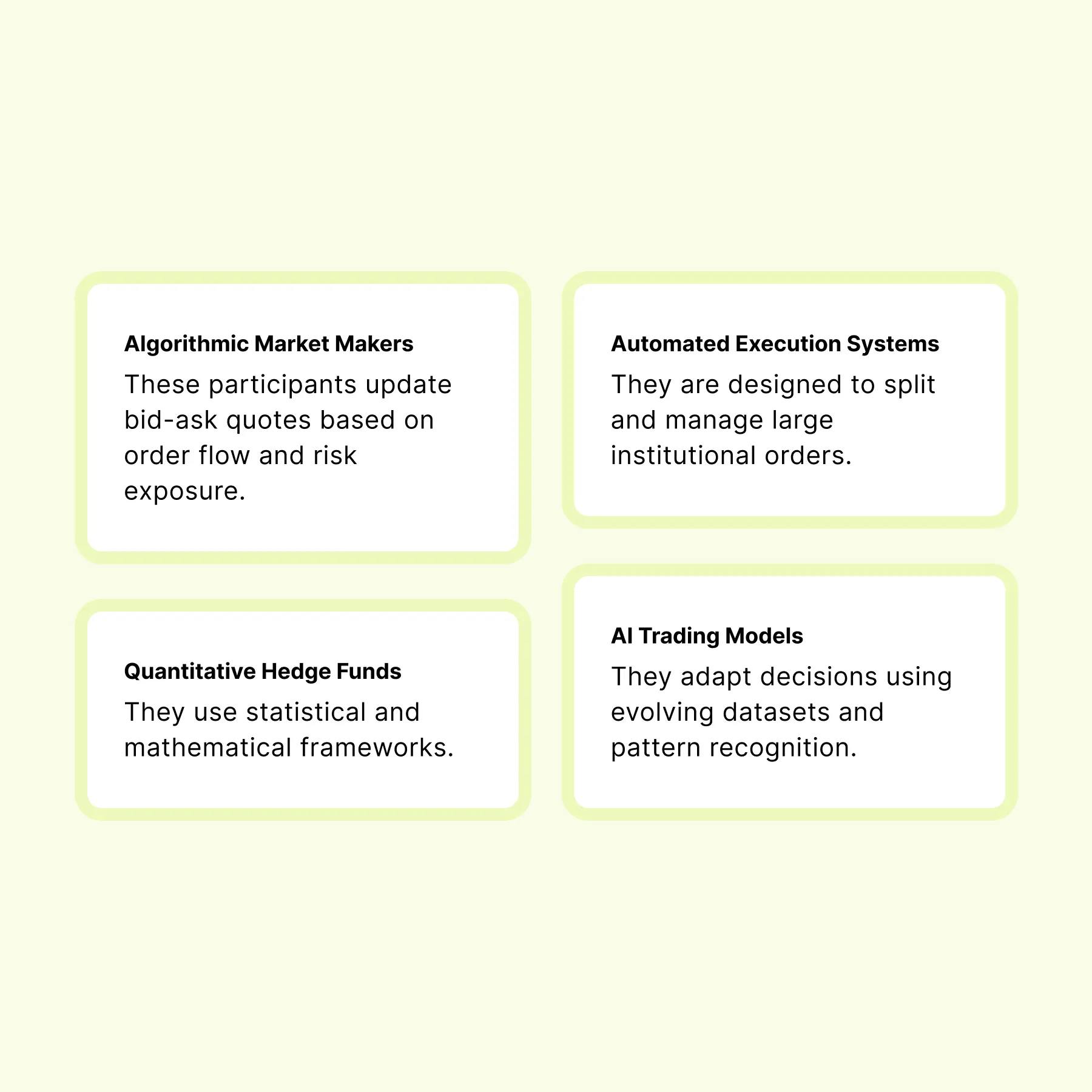
It is worth mentioning that since these systems react to market inputs programmatically, liquidity no longer remains static. Quotes appear and disappear as models:
- Rebalance inventory
- Manage exposure, or
- Respond to volatility conditions
Consequently, price behavior changes based on how “AI trading systems” and “execution algorithms” interpret incoming data rather than discretionary human decisions. This transformation has also changed how algorithms affect markets.
Nowadays, price movements usually emerge from interactions between competing models (which are adjusting simultaneously). Such adjustments significantly influence:
- Liquidity depth
- Short-term volatility, and
- Momentum patterns.
However, most importantly, automation in trading has not removed opportunity. Instead, it has altered the nature of market signals. Traditional cues linked to human hesitation or sentiment now coexist with patterns created by AI trading strategies.
Why Automation Makes Liquidity More Dynamic
A major change in modern markets is liquidity behavior. In earlier market structures, large buy and sell orders remained visible in the order book for extended periods. This allowed participants to observe stable levels of supply and demand before major price movements.
However, the growth of automation in trading has changed how liquidity appears and disappears. Today, markets are largely supported by algorithmic participants. They adjust orders continuously in response to risk conditions and incoming data. As a result, liquidity no longer stays fixed at specific price levels.
Several observable patterns now define modern trading environments:
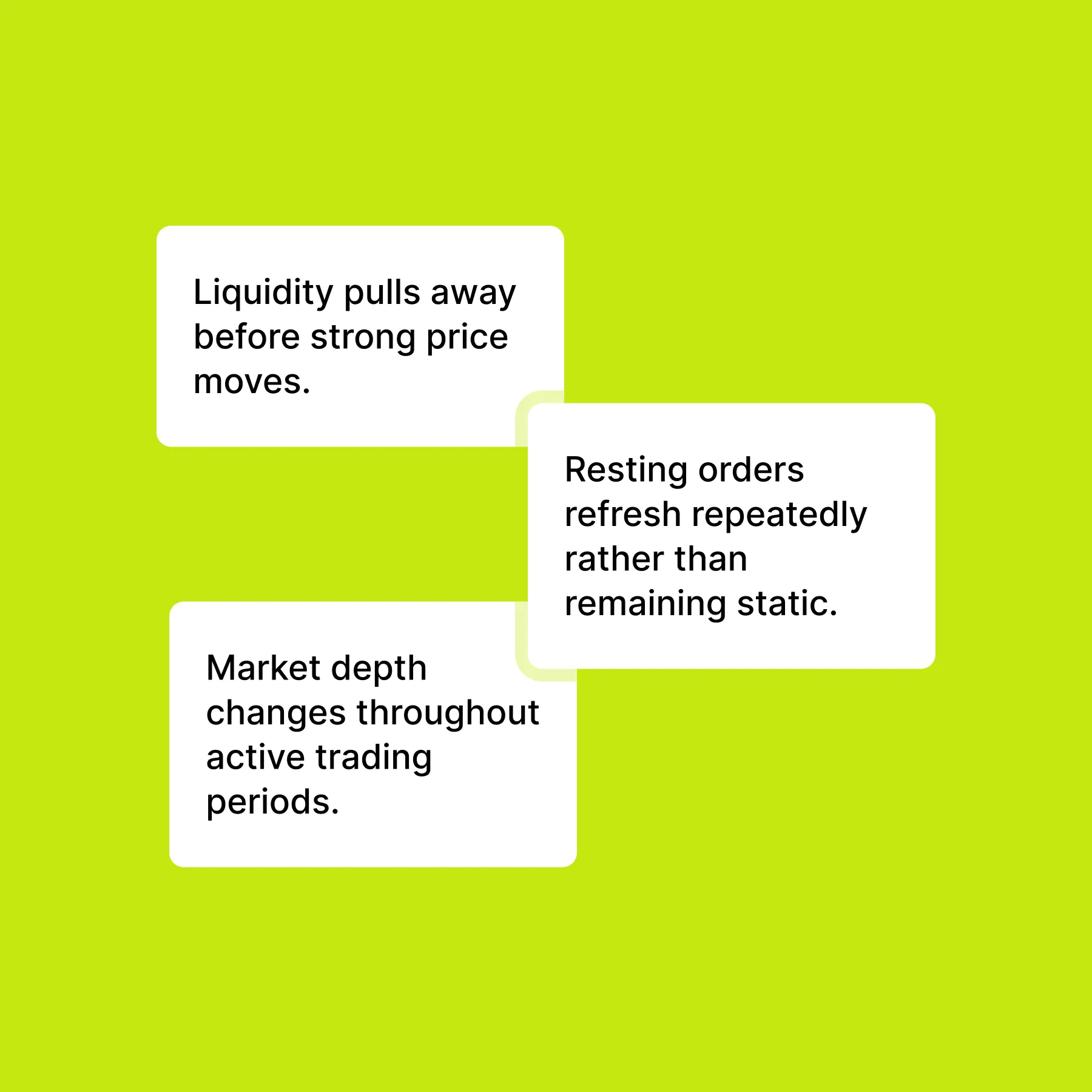
This behavior originates from how algorithmic trading models manage inventory exposure. Nowadays, market makers operate “automated risk systems” that monitor:
- Volatility
- Order flow imbalance, and
- Price acceleration
When price approaches quoted levels under changing conditions, algorithms may cancel existing orders and repost them at new prices to control risk. Consequently, many traders observe liquidity disappearing just before breakouts.
In such situations, large orders may appear and vanish within short intervals. Traders may realise that these actions are not discretionary decisions. Instead, they are programmed responses within AI trading systems designed to maintain balanced exposure.
Understand how modern trading models react to liquidity shifts → Compare Plans
Automation and the Rise of Liquidity Sweeps
Modern markets increasingly operate around liquidity rather than pure price direction. Many algorithmic trading models are designed to locate areas where large volumes of orders are likely to exist. Such models allow institutions to enter or exit positions without excessive market impact.
Note that these liquidity zones develop where market participants place predictable orders. Some of these areas are:
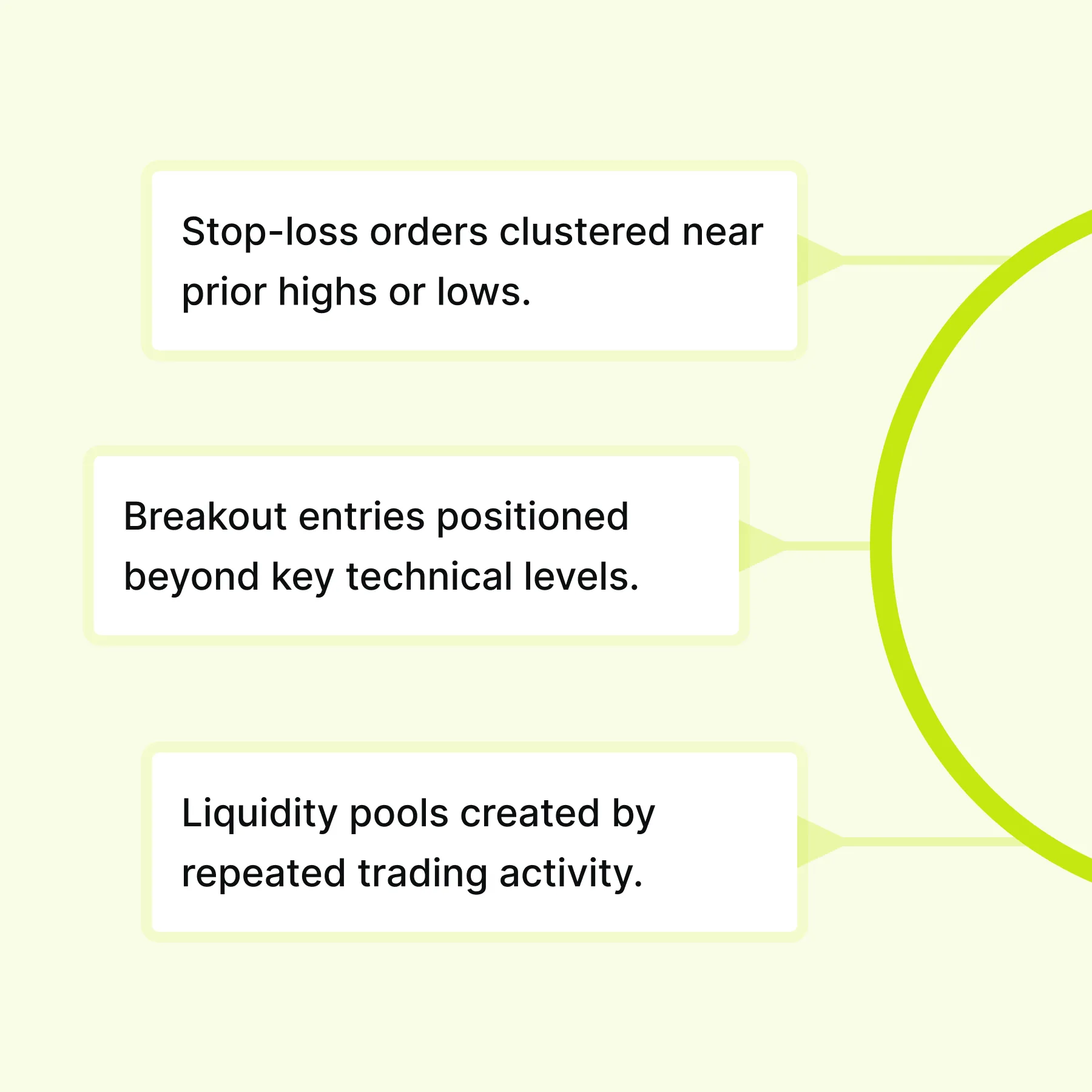
As automation in trading expanded, many AI trading systems began identifying these areas through “statistical patterns” in order flow and market structure. When the price approaches such zones, automated participation usually increases.
Such an increase in participation happens because available liquidity becomes attractive to large trading models. Let’s see how a market sequence may occur:
- Price approaches a previously established high.
- Stop orders accumulate above that level.
- Liquidity begins to thin as price advances into the zone.
- Automated momentum logic activates within AI trading strategies.
- Price moves sharply through the level as multiple systems execute simultaneously.
This chain reaction produces “liquidity sweeps”. In such a situation, clustered orders are triggered in a short interval. The resulting volatility does not only come from directional conviction. Instead, it also appears from interacting algorithms, which are responding to the same liquidity event.
Consequently, discretionary observers may interpret these moves as strong trend confirmation. But in reality, the movement only shows that algorithms are prioritizing execution opportunities around liquidity concentrations. This is not an expression of a long-term market view.
AI Does Not Predict Markets: It Reacts to Data
A common misconception in modern trading is that artificial intelligence predicts market direction in the same way humans form expectations. However, in reality, most AI trading models do not forecast markets through intuition or foresight.
Instead, they operate by “reacting to incoming data” according to predefined rules and statistical relationships. These systems continuously process multiple market inputs, such as:
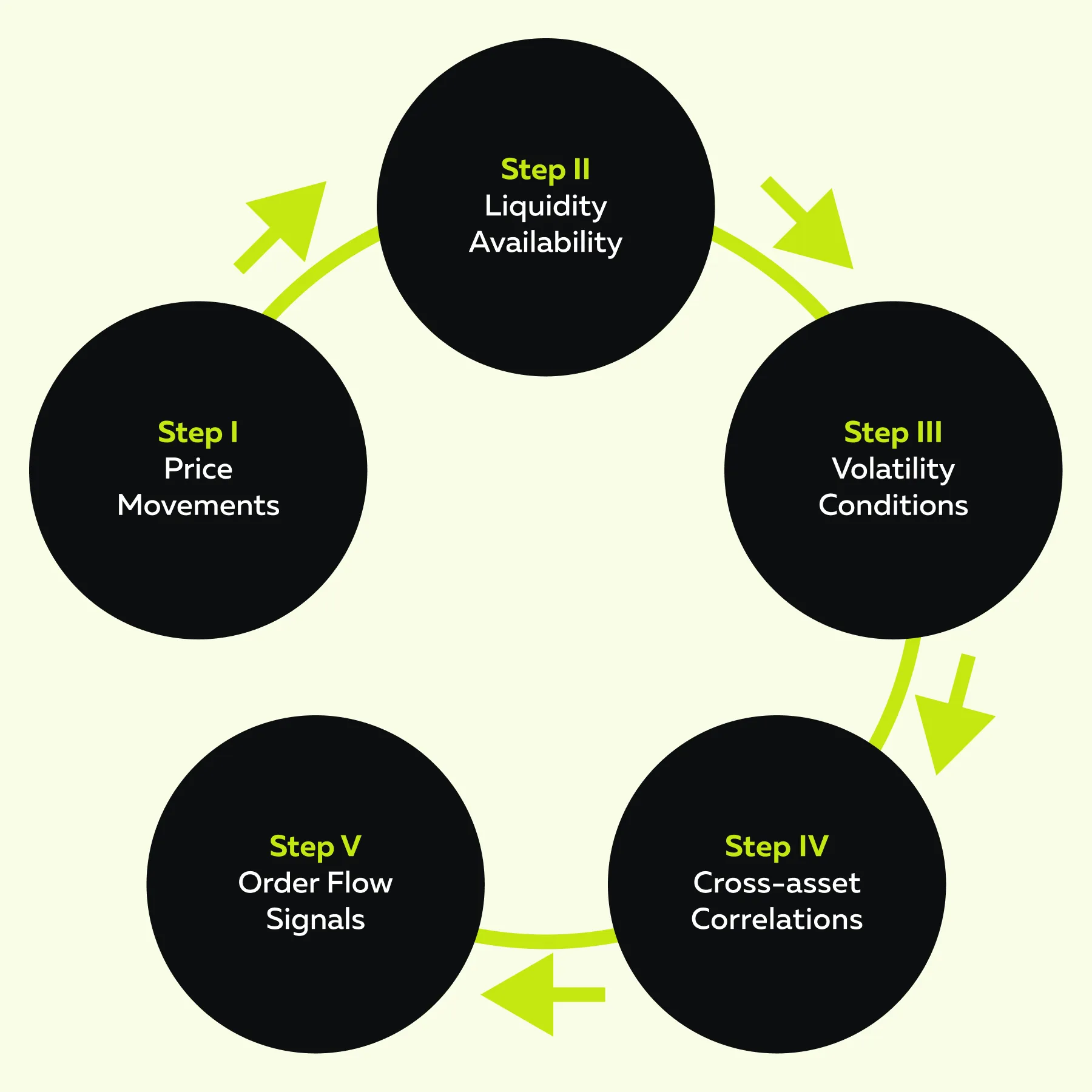
Through automation in trading, these inputs trigger programmed responses whenever market conditions change. Thus, traders must realize that the logic behind many AI trading systems is “conditional” rather than “predictive”.
Whenever specific parameters are met, the model executes an action. For example,
- Suppose liquidity suddenly disappears above current price levels.
- In this situation, momentum-based AI trading strategies increase participation automatically.
Here, the resulting price movement does not represent a prediction about future direction. Instead, it only reflects a reaction embedded within the algorithm’s design.
What This Means for Discretionary Traders
Due to the expansion of automation in trading, machines now dominate:
- Execution speed, and
- Data processing capacity
Both alter how participation occurs in financial markets. However, traders must note that market competition is not defined only by execution speed. While algorithms respond instantly to defined signals, their logic only remains rule-based. Human participants, by contrast, evaluate broader context beyond immediate data inputs. This difference creates areas where discretionary analysis continues to matter.
For more clarity, let’s check out some major observational advantages that still remain visible:
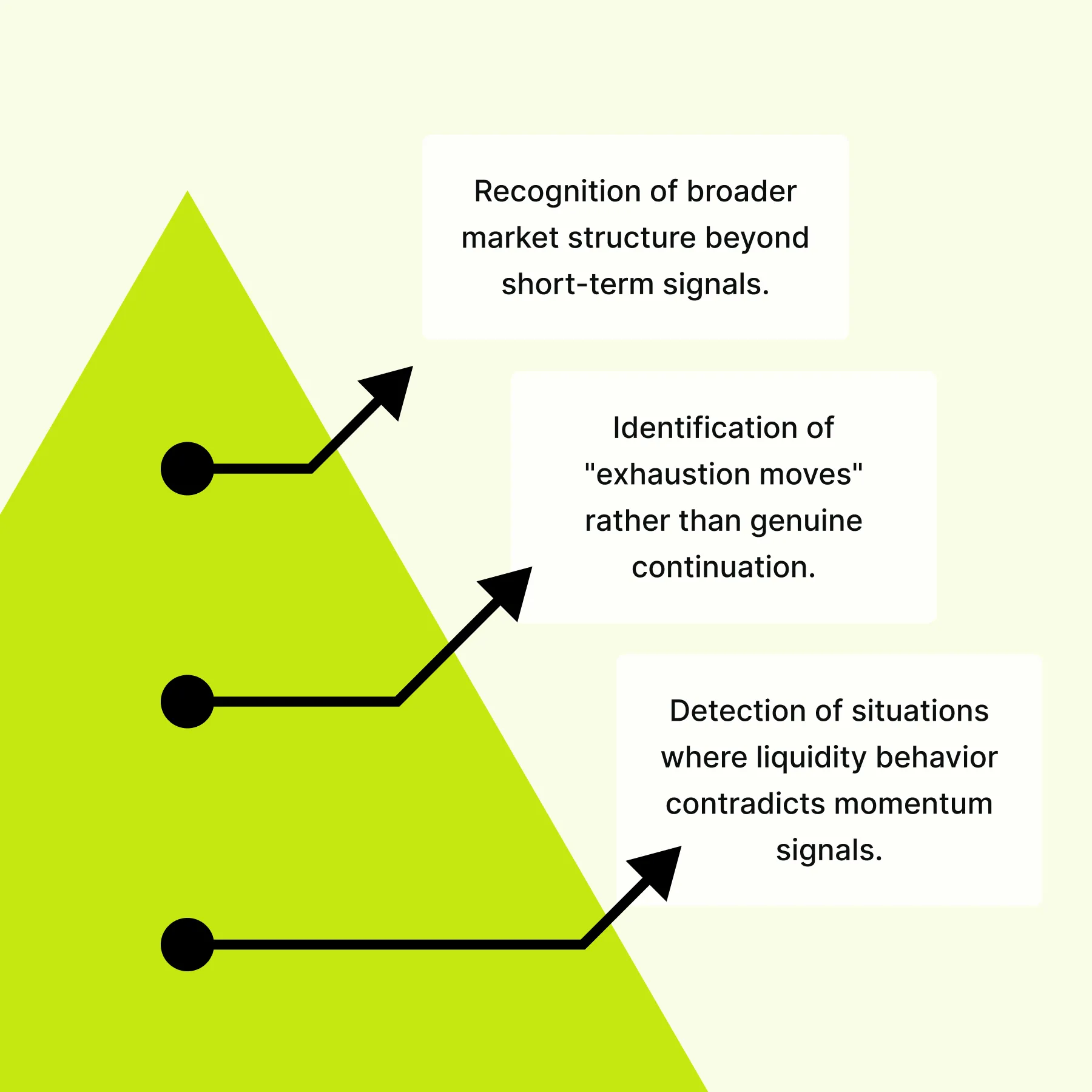
These distinctions are a reason why opportunity persists even in markets heavily influenced by algorithmic trading models. See how real-time liquidity and participation reveal algorithmic behavior → Compare Packages
How Automation Changes Volatility Patterns
Modern financial markets usually display:
- Sudden volatility bursts
- Sharp reversals, and
- Aggressive liquidity sweeps
These changes arise from the widespread adoption of algorithmic trading models and automation in trading. It is worth mentioning that many automated systems monitor similar market variables, such as:
- Breakouts
- Volatility expansion, and
- Order flow imbalance
As a result, when identical conditions appear, multiple AI trading systems may respond at the same moment. For a better understanding, let’s study a common sequence that illustrates this behavior:
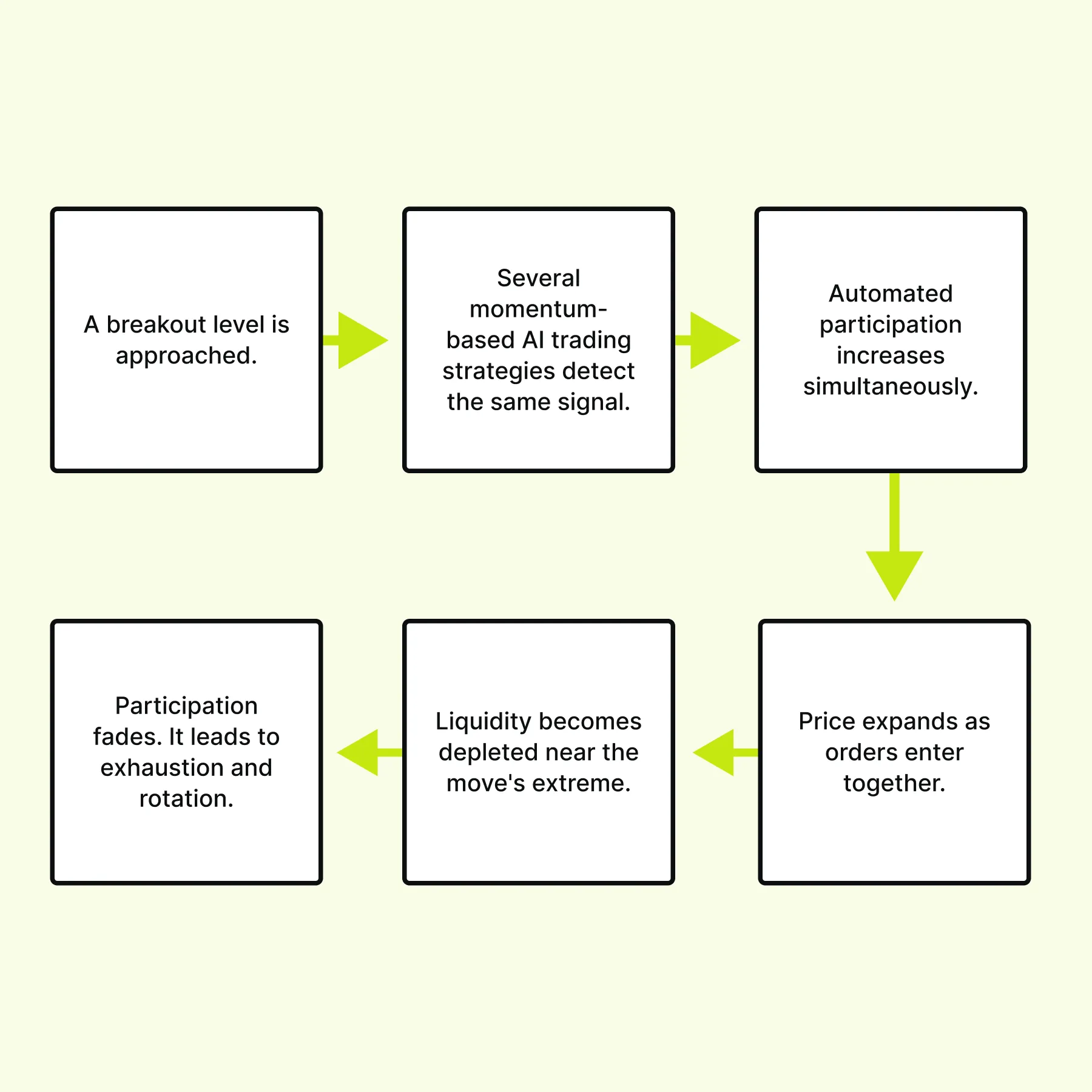
Since these reactions occur collectively, volatility usually appears in “short bursts” (and not as sustained directional movement). As a result, price expansion may be followed by immediate reversals. Such an appearance of volatility in short bursts may even create market conditions that differ from traditional trend expectations.
Analyze market behavior shaped by automated trading → Compare Packages
Adapting Trading Models to Automated Markets
The growth of automation in trading has not eliminated market structure. Today’s modern market participants do not compete with machine execution. Instead, they base their trade on price movement and liquidity behaviour as influenced by automated systems.
Furthermore, today’s traders make the following market observations to better execute their trades:
- Liquidity behaviour
- Order absorption
- Structural price levels (where participation concentrates)
- Changes in market participation (particularly during expansions and reversals)
- The relationship between effort (volume and activity) and the resulting price movement
At the same time, reliance on several traditional assumptions has become less effective, such as:
- Simple breakout signals are treated as standalone confirmation
- Indicator-based momentum entries detached from liquidity context
- The belief that support and resistance remain static over time
To better understand how traders can adapt their trading styles in automated markets, let’s check out an example from Bookmap Insights.
Example: Algorithmic Liquidity Behavior in Practice
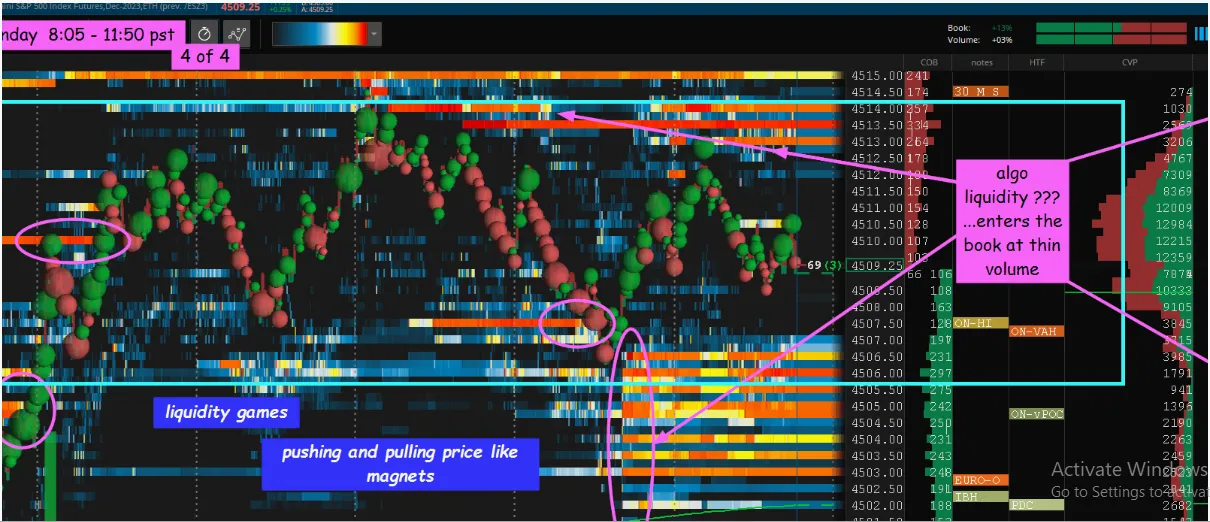
The above Bookmap Insight example shows how modern markets behave when AI trading models and automated execution dominate intraday activity. During the session shown (in the above image), the price did not develop a directional trend. Instead, it rotated within a range, and liquidity continuously shifted around important price levels.
Additionally, liquidity appeared and disappeared as trading systems adjusted quotes in response to changing order flow and risk exposure. Let’s understand this Bookmap Insight example in detail:
What the Chart Shows
The price action can be explained as follows:
- Liquidity stacking and pulling occurred repeatedly near key levels. This is visible as “bright bands” appearing and fading in the order book.
- Aggressive market orders interacted with passive limit orders. This interaction created short bursts of movement.
- Liquidity pockets attracted price. Such an attraction caused repeated rotations within the range.
Such a market situation can be considered as “liquidity games,” where price responds more to order placement than directional opinion.
Liquidity Acting as a Magnet
Large liquidity clusters visible on the chart functioned as attraction points. Price moved toward these areas because they contained sufficient volume for execution. Note that such a behavior is common in markets influenced by algorithmic trading models. That’s because in such markets, execution quality depends on “available liquidity” rather than prediction.
At the same time, aggressive orders pushed into these clusters and created temporary imbalances.
The Role of Thin Liquidity
A key moment occurs when price enters an area with thin volume and limited resting orders. Due to minimal resistance in the order book, the price moved sharply downward.
Conclusion
Automation and AI trading models are now a permanent part of financial markets. Their presence has changed how liquidity moves, how volatility forms, and how prices respond to changing conditions.
Nowadays, modern price action represents interactions between algorithmic trading models rather than individual human decisions. As a result, markets may appear more reactive and less predictable.
However, the trading opportunity has still not disappeared. Instead, it now belongs to those who analyze liquidity behaviour and structural levels. Additionally, traders who recognize how AI trading systems influence the market can better interpret volatility and identify quality market signals. See how modern tools reveal liquidity behavior shaped by automated trading → Compare Packages
FAQs
1. How much of trading today is automated?
A significant share of modern market activity comes from:
- Algorithmic trading models, and
- Automated execution systems
Nowadays, institutions, market makers, and quantitative funds rely on automation in trading to manage orders and liquidity. Thus, modern price movements are a result of “system responses” rather than manual trading decisions.
2. Does AI predict price direction?
Most AI trading systems do not forecast markets like humans. Instead, they react to changing data such as:
- Price movement
- Liquidity conditions
- Volatility, and
- Order flow
Note that AI trading strategies follow predefined rules that trigger actions when “pre-fed” market conditions appear.
3. Does automation make markets harder to trade?
Automation in trading only changes market behaviour. They do not make trading impossible! Due to automation, price moves may appear more sudden and liquidity shifts more often.
However, traders who analyze structure, participation, and liquidity behavior can still find opportunities within automated market environments.
4. What is the biggest change automation has created in markets?
The biggest change is dynamic liquidity. Nowadays, orders no longer remain fixed at price levels. Instead, AI trading models continuously add, remove, and reposition orders as risk conditions change. Such adjustments cause the price to react more strongly around liquidity zones and structural levels.
Sign Up Now