


See why good trade setups can look wrong at first.
Compare plans to track liquidity, absorption, and market structure before the move develops.
Trading Basics
September 11, 2026
Why the Best Trades Often Look Wrong at First
The most dangerous trade can feel like the safest one, particularly when the entire market seems to agree.
- A breakout becomes tempting after price has already moved
- A trend feels reassuring once it is widely visible
- A reversal appears safer after confirmation arrives
Yet, by that stage, much of the initial opportunity may already be priced into the market. In contrast, “high-quality trading setups” usually emerge when uncertainty remains high. This creates an important distinction between “emotional confidence” and “objective evidence”.
Market participants may realize that a professional trading mindset does not require a trade to feel safe. Instead, it requires the market conditions to support the trade idea. This article explains why trading feels uncomfortable and how market structure and market psychology influence these reactions.
Also, you will learn how trading confirmation, order flow trading, and objective evidence can distinguish genuine opportunities from emotional decisions.
Comfortable Trades Are Often Comfortable Because Everyone Already Sees Them
A trade can feel safest when the market signal has already become obvious to most participants. However, that comfort can also indicate that much of the opportunity has already been priced into the market.
Generally, markets constantly react to new information through price, volume, and order flow. Therefore, when a breakout becomes widely visible, or several indicators confirm the same trend, many traders may already have entered. As more participants take the same position, the original buying or selling imbalance can weaken. This may leave less room for the next move.
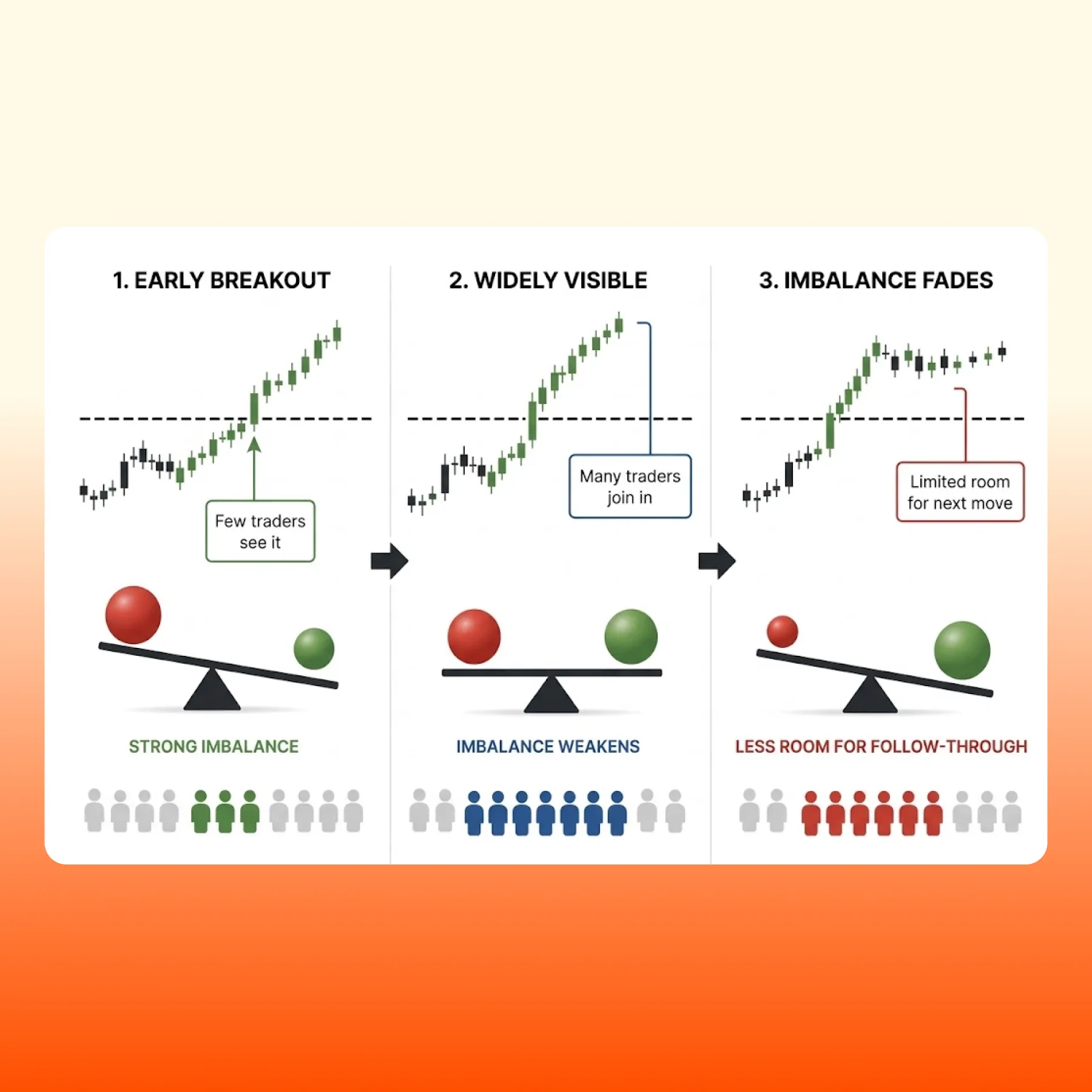
This creates an important difference between trading confirmation and chasing. “Confirmation” adds evidence that a setup may have a higher probability of working. In contrast, “chasing” occurs when an entry is delayed until the move has already become extended (simply because it feels safer).
A simple analogy is buying concert tickets.
- Months before an event, demand may be uncertain, so tickets usually cost less.
- Once everyone wants to attend, the decision feels safer because the event is clearly popular.
- But at this time, ticket prices may be much higher, or availability may disappear.
Markets behave in a similar way. A greater certainty usually arrives after part of the opportunity has already passed. This does not mean that obvious breakouts or strongly confirmed trends cannot produce high-probability trades.
Rather, market psychology shows that “certainty” and “opportunity” are not always aligned. The best trading setups are based on favorable probabilities and supporting evidence (not on the feeling that a trade is completely safe).
The Market Often Looks Most Uncertain Right Before It Moves
Price discovery requires buyers and sellers to disagree about what an asset is worth. If everyone immediately agreed on the direction, prices would adjust almost at once (leaving little room for new trading opportunities).
For this reason, many high-probability trades begin in situations that initially look unclear. Let’s understand better through three different scenarios:
| Scenarios | Explanation |
| Breakout |
|
| Uptrend |
|
| Pullback |
|
| A Failed Breakout |
|
| Downtrend |
|
Therefore, market psychology plays an important role in interpreting uncertainty. What feels bearish or bullish at first may represent only one stage of a larger price process. Thus, trading confidence should ideally come from evidence and probabilities rather than from the absence of doubt.
Why Professional Traders Rely on Evidence Instead of Emotion
Professional traders do not become fearless with experience. Uncertainty can still exist before a trade. However, their decisions are less dependent on whether the trade feels comfortable. Usually, trading confidence comes from preparation, evidence, and a pre-defined trading process (rather than from predicting exactly what the market will do).
Before the market opens, a professional trading mindset usually includes specific conditions for a trade. The plan identifies:
- What would support the trade idea
- What would invalidate it, and
- Where the position would be exited if the idea proves wrong
Therefore, the trade does not need to feel certain. It’s just that the required evidence needs to be present. However, markets rarely provide such certainty until a large part of the price move has already taken place. This creates another problem! Waiting for complete comfort can therefore turn trading confirmation into late entry or even chasing.
A potential solution could be: Instead of asking whether a trade feels safe, market analysis can rely on several objective questions such as:
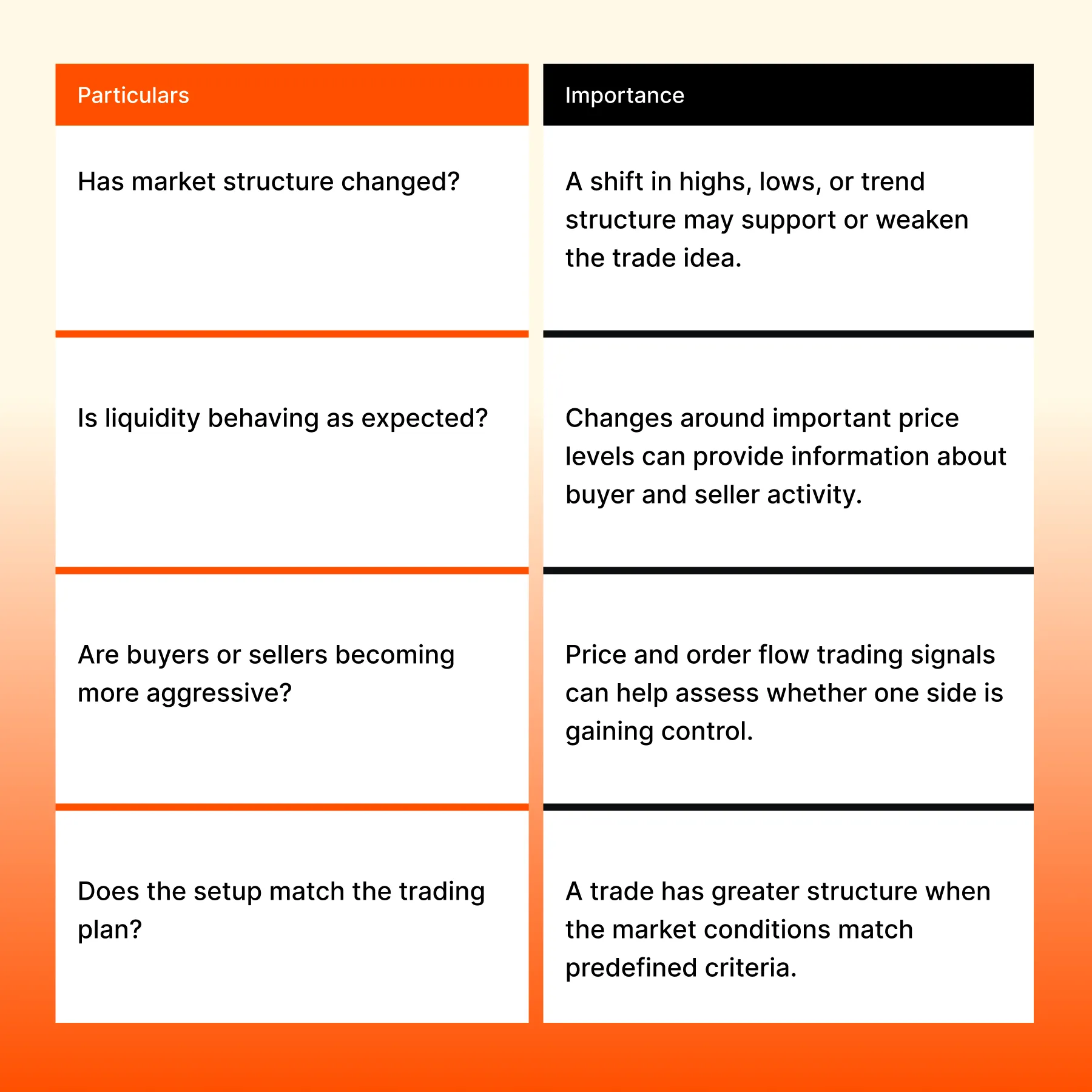
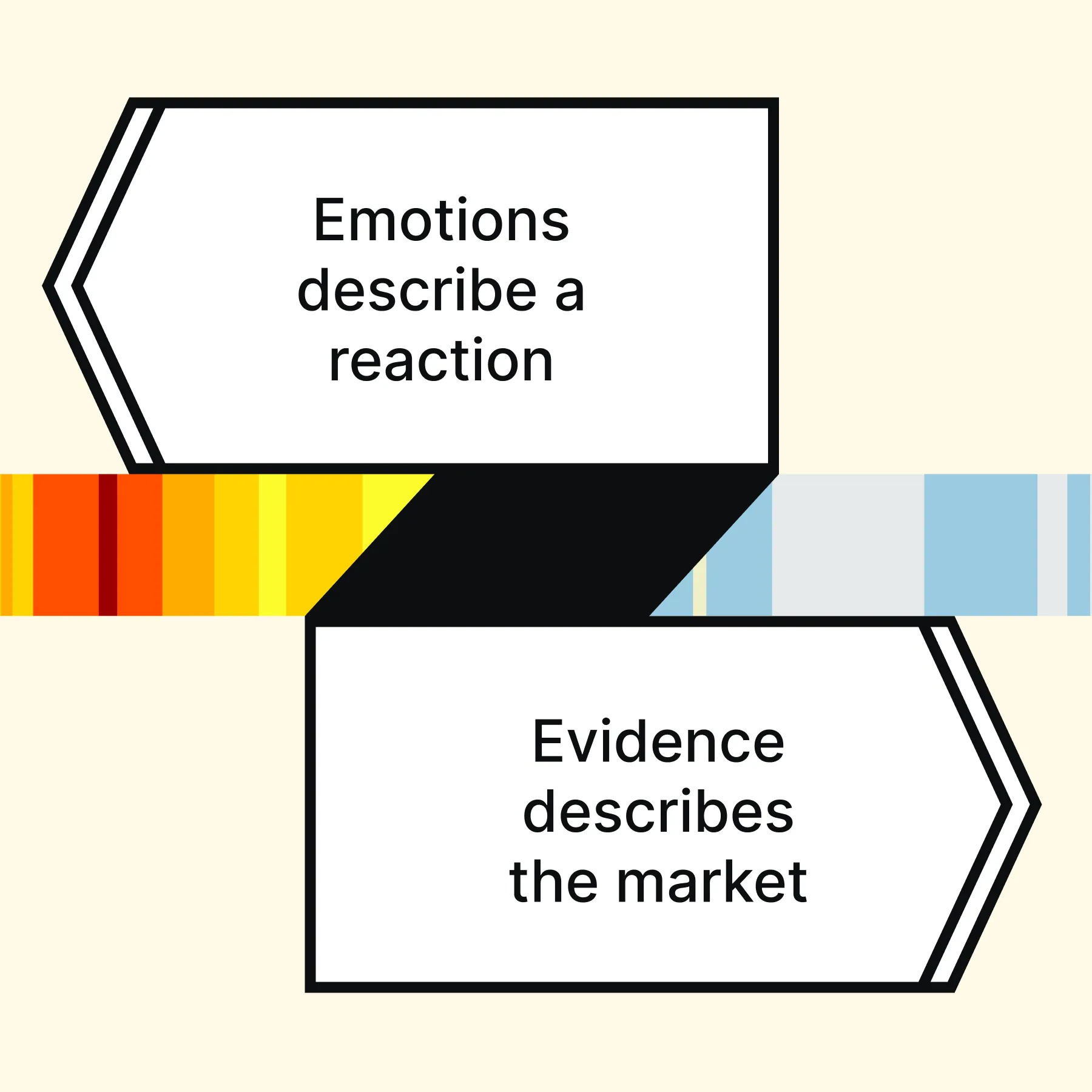
As a result, professional traders do not need emotion to confirm that a trade is correct. They need evidence that the conditions for the trade are present and a defined response if those conditions fail. Therefore, the right way to view this relationship is:
- Evidence creates trading confidence, rather than trading confidence creating evidence.
This approach also supports better trading psychology, because decisions are based on observable market behavior instead of temporary fear, excitement, or the desire for certainty.
Not Every Uncomfortable Trade Is a Good Trade
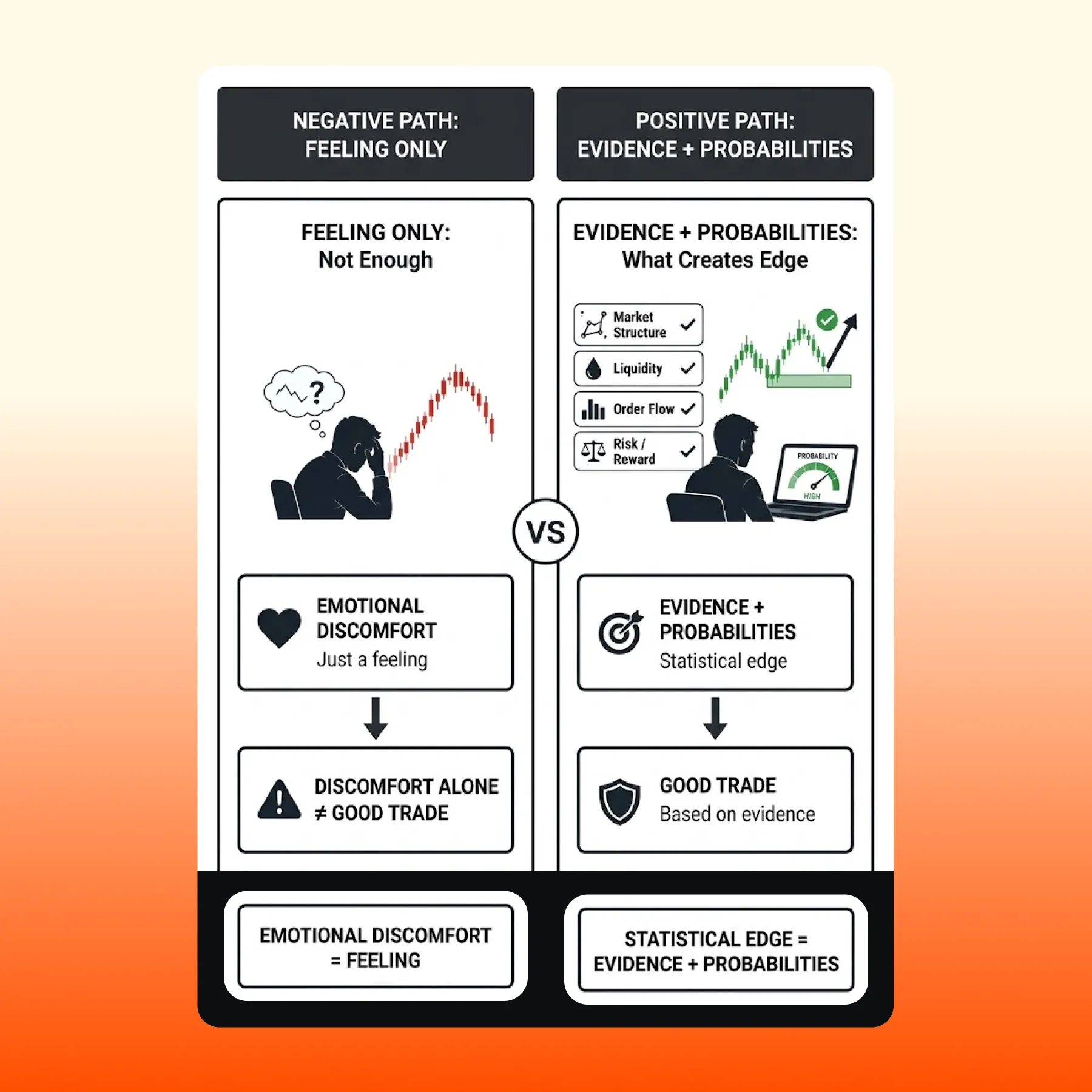
Discomfort by itself is not a trading edge. A poor trade can feel uncomfortable because:
- The market conditions are genuinely weak
- The risk is too high, or
- The trade idea lacks supporting evidence.
Therefore, feeling nervous does not automatically indicate that a setup has strong potential. At the same time, high-quality trades can involve temporary uncertainty because markets do not reveal all information at once. The important difference is whether that uncertainty exists alongside objective evidence. This is where market psychology and disciplined analysis become important.
For example, buying during heavy selling because the trade feels “scary” is not a strategy. However, the situation changes when analysis shows several supporting signals, such as:
- Seller exhaustion: Selling pressure begins to lose strength.
- Absorption: New selling is met by sufficient buying interest near an important price level.
- Improving Order Flow: Buyer activity starts to gain strength relative to sellers.
- Favorable Risk-Reward: The potential reward justifies the defined risk.
Together, these factors can provide a stronger basis for a high-probability trade (than discomfort alone). The same principle applies to breakouts. Fading every breakout because it looks too obvious can be as dangerous as chasing every breakout because it looks strong. Traders may note that a breakout requires context, such as market structure, liquidity, volume, and trading confirmation, before its quality can be assessed.
Therefore, market context comes before psychology. A professional trading mindset does not treat fear as a buy signal or excitement as a sell signal. Instead, trading confidence comes from evidence that supports a defined setup.
Confidence comes from understanding what’s happening beneath price. See how Bookmap visualizes order flow and liquidity.
Order Flow Helps Traders See What Emotions Cannot
A traditional price chart shows where the market traded, but it provides limited information about what is happening between buyers and sellers at each price. For example,
- A candlestick may show a strong move.
- But it does not display whether:
-
- Aggressive buyers are truly gaining control, or
- Available liquidity is absorbing that activity.
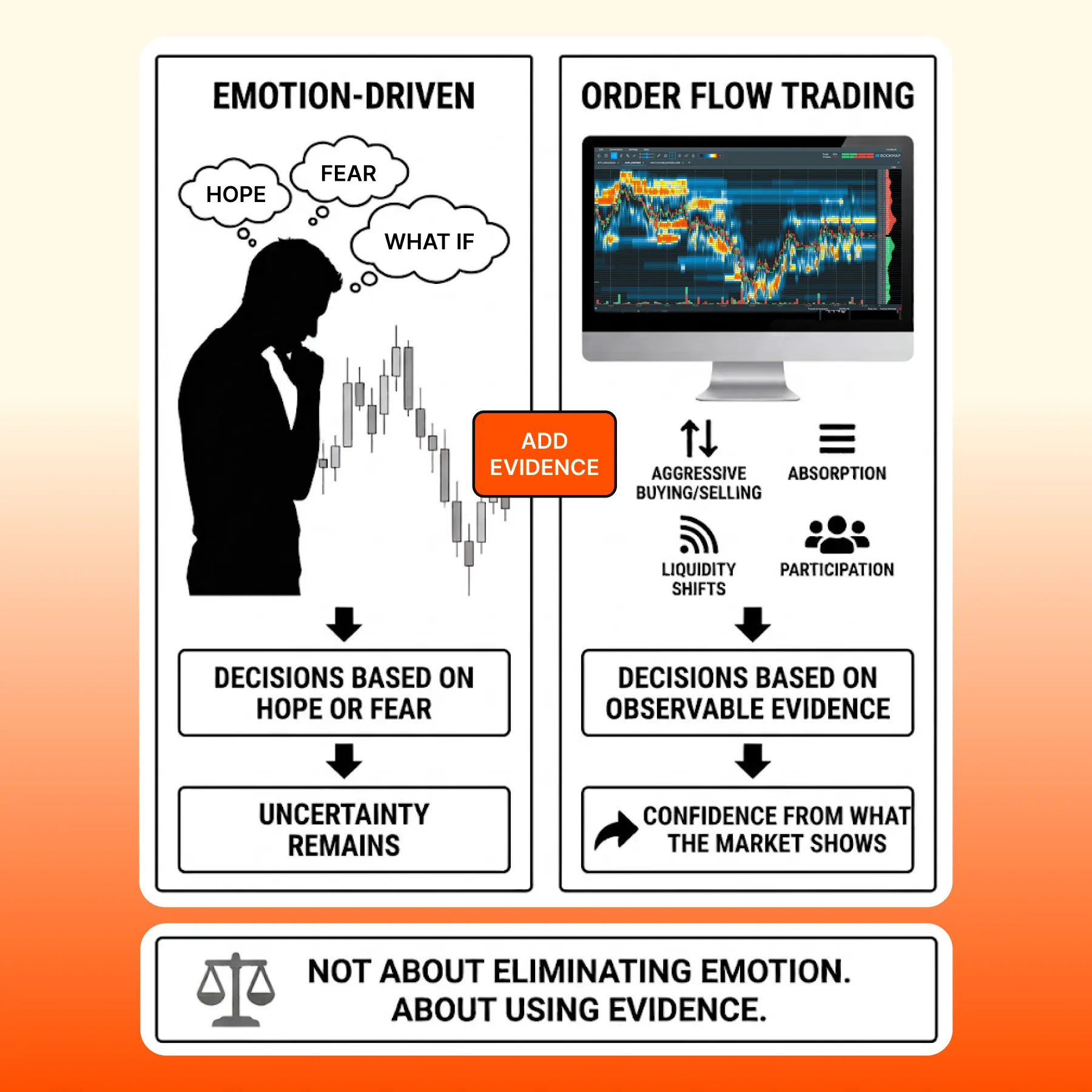
Here, order flow trading adds another layer of market information by showing how participants interact with available liquidity. It can provide various clues about:
- Aggressive Buying and Selling: Whether buyers or sellers are actively taking available orders.
- Absorption: Whether strong buying or selling is being met by opposing liquidity.
- Liquidity Changes: Whether available orders are appearing, disappearing, or moving around important price levels.
- Participation: Whether market activity is increasing or weakening around a price move.
As a result, order flow can replace assumptions with observable market behavior. This can support trading confirmation because a price setup can be compared with what buyers and sellers are actually doing. Let’s understand better through three different examples:
| Example I | Example II | Example III |
|
|
|
Thus, order flow provides “additional evidence” that can help separate an emotional reaction from actual changes in market behavior. Now, this is where Bookmap can add value. Bookmap has several visual tools that can help traders observe liquidity, order flow, and trading activity as they develop.
However, Bookmap does not remove uncertainty or predict every market move. Instead, it can provide additional evidence for assessing whether actual market behavior supports a trade idea.
Learn to identify participation, absorption, and liquidity instead of relying on emotions alone with Bookmap.
Conclusion
One of the biggest misconceptions in trading is that the best opportunities should feel obvious and safe. In reality, markets never provide complete certainty. By the time a trade feels comfortable, much of the price move may have already taken place. However, this does not mean that discomfort itself signals a good trade.
The real difference lies between emotion and evidence. A professional trading mindset accepts uncertainty while relying on market context, preparation, and repeatable processes. Usually, trading confidence comes from evidence and not from the absence of fear. Tools such as order flow trading can add valuable context by showing changes in liquidity, participation, and buyer or seller activity.
Ultimately, a trade should not be judged by how comfortable it feels. Its quality depends on whether the supporting evidence justifies the risk involved and offers a favorable probability of success. The best trades aren’t always obvious – but understanding order flow can make them easier to recognize. Compare Bookmap packages.
FAQs
1. Why do good trades often feel uncomfortable?
Good trades can feel uncomfortable because they usually appear before the market direction becomes obvious. At that stage, uncertainty is still high, so there is no complete sense of safety.
Thus, professional traders do not depend on comfort. Instead, they assess market structure, liquidity, trading confirmation, and other evidence to determine whether the setup has a favorable probability.
2. Should every uncomfortable trade be taken?
No, discomfort does not mean that a trade has an edge. A weak setup can also create fear or hesitation. Usually, professional traders execute trades when discomfort is supported by evidence such as:
- Market structure
- Liquidity
- Order flow trading signals, and a
- Favorable risk-reward ratio
As per general market understanding, market context should always carry more weight than emotion.
3. Why does a trade often feel like it was entered too late?
A trade can feel late when entry occurs only after the market direction becomes obvious. By that stage, other participants may have already acted on the available information, and part of the price move may have occurred.
This is why trading confirmation and timing must be balanced. Sometimes even waiting for perfect certainty can reduce the available opportunity.
4. How do professional traders build confidence before entering a trade?
Professional traders build trading confidence through preparation rather than prediction.
- A trade plan defines the market conditions required for an entry.
- The evidence supports the trading idea.
- The point where that trading idea becomes invalid.
This process creates a professional trading mindset, where confidence comes from a repeatable method rather than from expecting the trade to feel safe.
5. How can order flow help identify high-probability setups?
Order flow trading provides additional information about buyer and seller activity that may not be visible on a basic price chart. It can show:
- Aggressive buying or selling
- Absorption
- Liquidity changes
- Shifts in participation
These signals can assess whether a price move has genuine support. As a result, order flow can add evidence when evaluating high-probability trades.
Sign Up Now
Latest Articles