


See why VWAP matters even when price moves away from it.
Compare plans to track VWAP alongside liquidity, volume, and institutional market behavior.
Education
September 11, 2026
Why Institutions Care About VWAP Even When Price Ignores It
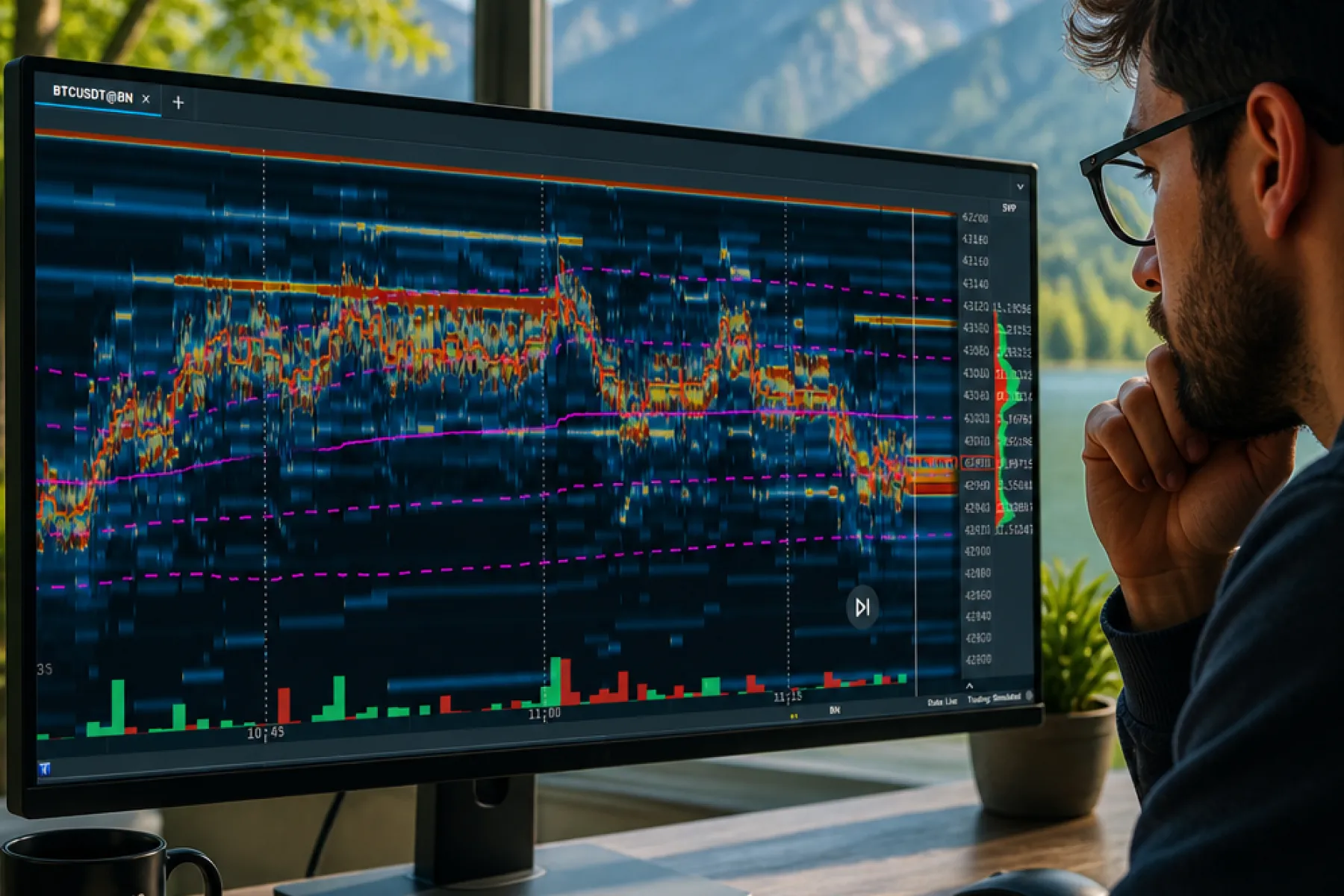
VWAP does not tell where price will go next. It only shows where significant business has already taken place. This perspective explains why institutional VWAP is far more than another line on a trading chart. While retail traders usually look for price to cross, touch, or reverse around VWAP, institutions use it as a reference for value and an execution benchmark.
This article explains what VWAP is used for, why institutions use VWAP, how market conditions change its behaviour, and how order flow and liquidity add context around it.
The Biggest Misconception About VWAP Is Thinking It’s Just Another Trading Indicator
Usually, it has been observed that VWAP appears alongside moving averages, RSI, MACD, and Bollinger Bands on charting platforms. As a result, it is often treated like a VWAP trading indicator that produces simple buy or sell signals. For example,
- A move above VWAP may be labelled bullish, whereas
- A move below it may be labelled bearish.
- Similarly, a touch of VWAP may be interpreted as a possible reversal signal.
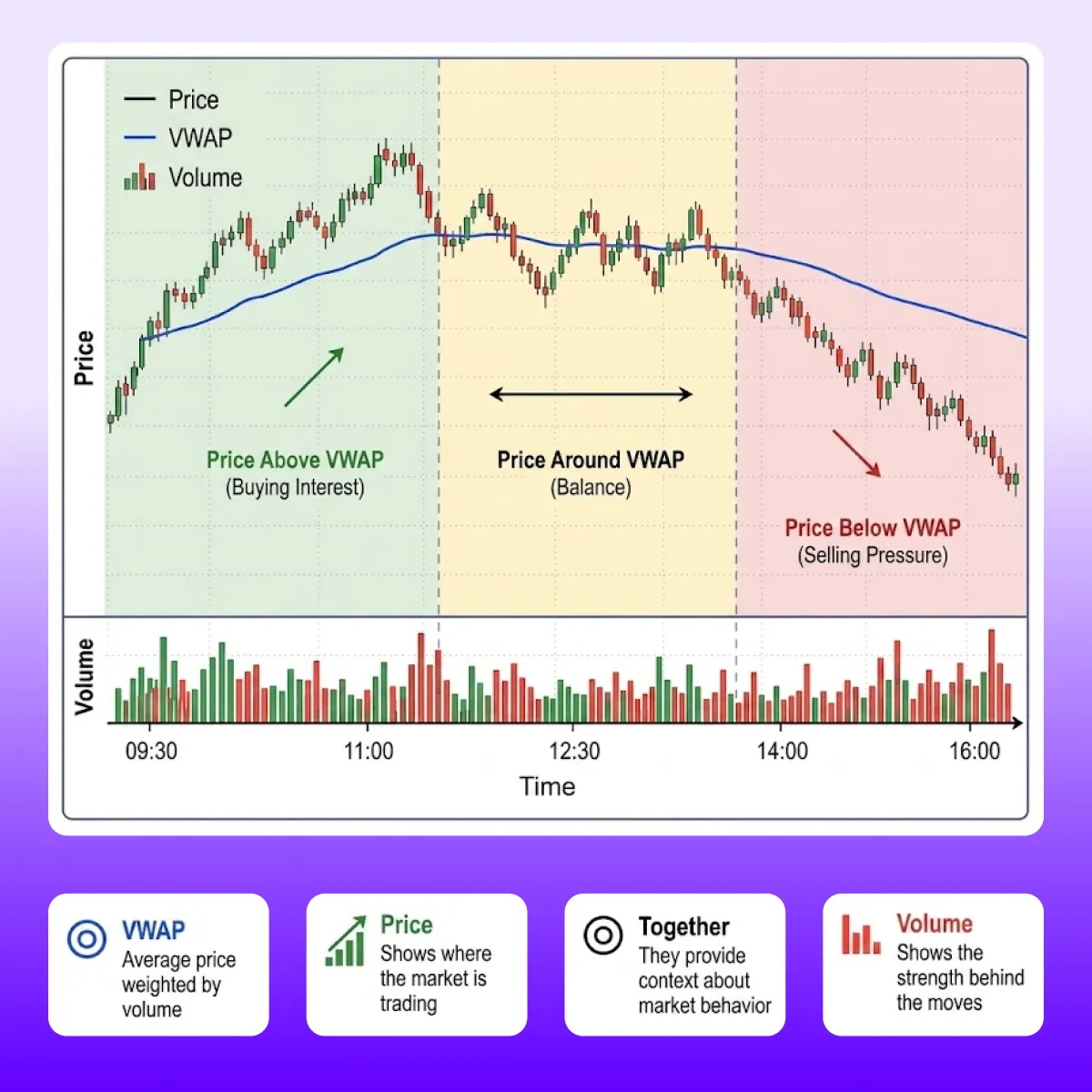
However, this interpretation misses the original purpose of volume-weighted average price. VWAP was not designed to predict where price will move next. Instead, it measures the average price at which trading has taken place during a session, while giving greater importance to prices at which higher trading volume occurred.
VWAP Measures Where the Market Has Done Most of Its Business
A simple moving average gives equal importance to each price observation. VWAP works differently because volume is part of the calculation. Therefore, a price level with substantial trading activity has a greater influence on VWAP than a price level where little volume was traded.
This makes VWAP more than a simple average. It acts as a running estimate of where significant market activity has taken place during the session. Since every transaction represents an agreement between a buyer and a seller at a particular price, VWAP provides a reference for the level around which substantial trading has occurred.
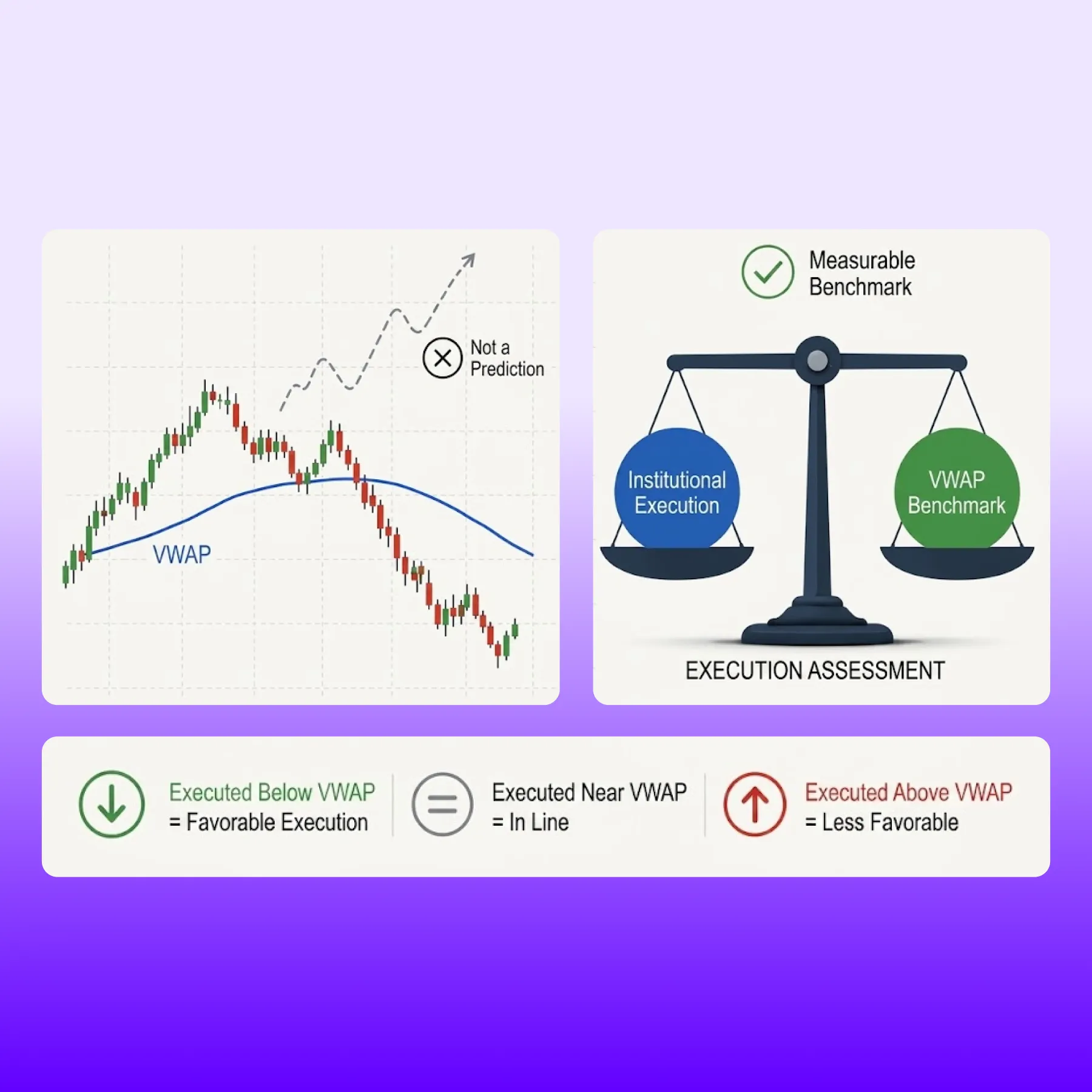
Consequently, VWAP support/resistance should not be viewed as an automatic reversal indicator. Price moving above or below VWAP does not, by itself, predict the next market move.
Why VWAP Matters to Institutional Trading
This distinction explains why institutions use VWAP. Institutional trading usually involves large orders, where execution quality matters as much as the final market price. VWAP can serve as a VWAP execution benchmark, allowing an institution to compare the average price achieved for an order with the session’s volume-weighted average price.
Therefore, VWAP institutional trading is less about treating VWAP as a standalone signal and more about assessing execution and market value. How institutions use VWAP can include:
- Comparing executed prices with the benchmark, and
- Assessing whether an order was completed at prices that were favourable relative to the broader day’s trading activity.
The distinction can be illustrated with a simple real estate example.
- An average selling price for homes in a city does not predict the price of the next house sold.
- Instead, it provides a benchmark against which an individual property’s price can be assessed.
In the same way, VWAP becomes a reference for evaluating where considerable trading activity has occurred.
Institutions Use VWAP to Solve a Completely Different Problem
Institutional trading involves a very different challenge from retail trading. A retail order may involve a small number of shares and can be completed without having a noticeable effect on the market. In contrast, an institution may need to buy or sell hundreds of thousands or even millions of shares. Such a large order cannot always be placed at once because the order itself can move the market. Let’s understand in detail:
Large Orders Create an Execution Problem
Suppose an institution needs to purchase one million shares. Buying all the shares at once could create strong demand and push the stock price higher. As the price rises, the remaining shares become more expensive. Therefore, institutions divide large orders into many smaller orders and execute them across the trading session.
Execution algorithms may help manage several objectives at the same time:
- Complete the required order within the available time.
- Limit the effect of the institution’s own order on market price.
- Reduce the amount of information revealed to other market participants.
- Achieve an average execution price that meets the desired standard.
This is where VWAP institutional trading becomes important. Instead of treating VWAP only as a line that may generate a trading signal, institutions can use it as an objective measure of execution quality.
VWAP Acts as an “Execution Benchmark”
The key question in institutional use is not whether price bounced from VWAP. Instead, the question is whether the institution’s average execution price was better or worse than the VWAP execution benchmark.
For example, consider an institution that needs to purchase one million shares before the market closes. After the order is completed, the execution desk can compare the institution’s average purchase price with the session’s VWAP. Now, there could be three different scenarios:
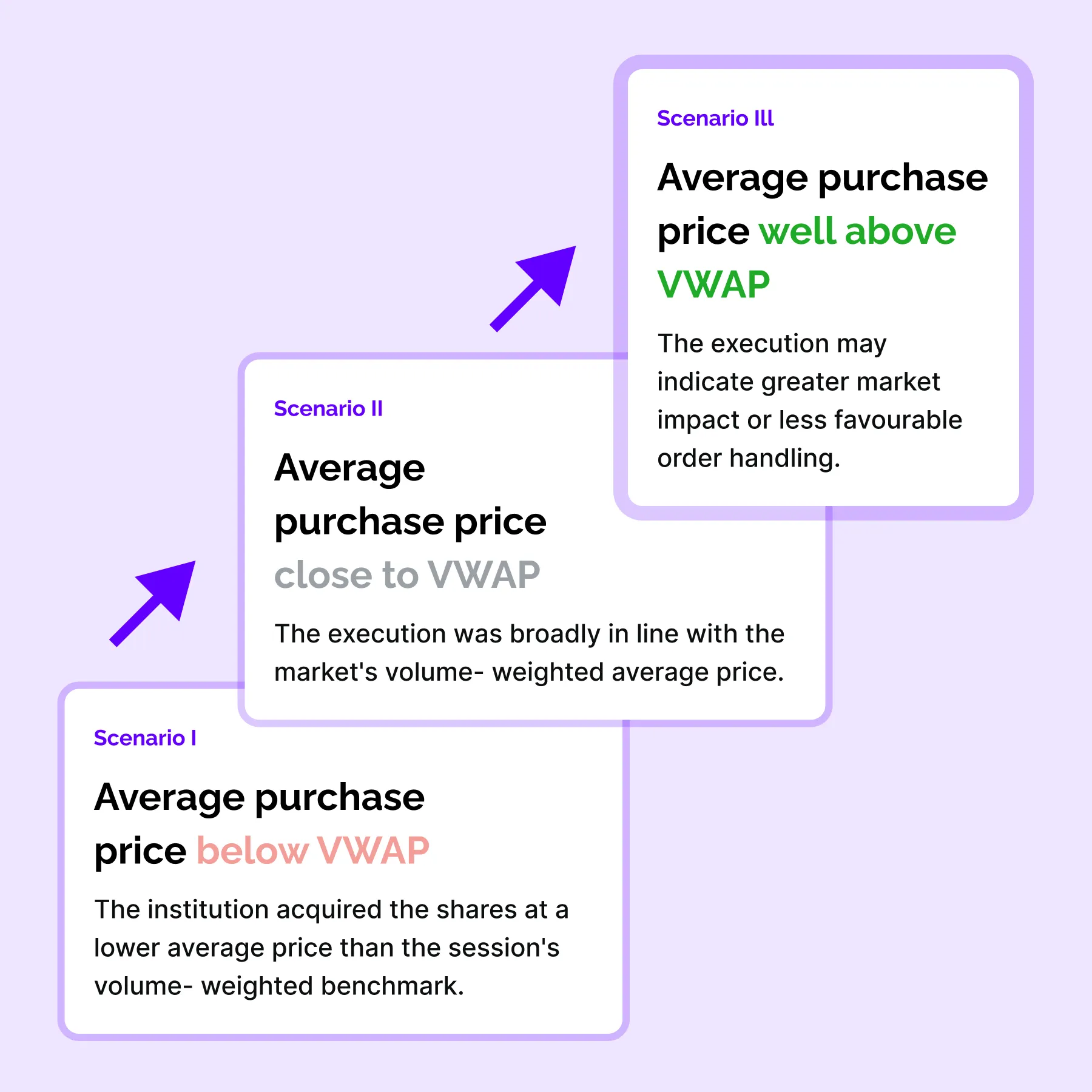
In this way, the VWAP benchmark provides a common reference for evaluating how an order performed against the broader trading activity of that session. VWAP becomes even more meaningful when combined with real-time order flow and liquidity. Learn how Bookmap helps traders see both.
VWAP Is a Benchmark, Not Just a Trading Signal
Several institutions continue to use VWAP even when the stock price does not return to the VWAP level. A benchmark does not lose its value simply because price does not touch it. For example, an athlete’s average pace remains useful even when the current pace is above or below that average.
Similarly, VWAP remains useful as a reference even when the market trades away from it. Therefore, what is VWAP used for extends beyond identifying possible entries or reversals. In institutional markets, its importance comes from providing an objective reference for participation and execution.
Order flow often provides more context than VWAP alone. See how Bookmap visualizes liquidity and execution in real time.
Price Can Ignore VWAP All Day; That Doesn’t Mean Institutions Are Ignoring It
A common mistake in VWAP trading strategy is to assume that VWAP must act like a magnet. When price moves in one direction for several hours without returning to VWAP, some traders may conclude that the indicator has stopped working. However, this is not what VWAP is designed to do.
VWAP, or volume-weighted average price, does not predict that price will return to its average. Instead, it shows the “average price” of trading during the session after giving greater weight to prices where more volume was traded. Therefore, VWAP provides a reference point rather than a destination.
VWAP Provides Context, Not a Price Target
The relationship between price and VWAP depends on the type of market activity taking place. Price can remain significantly above or below VWAP while VWAP continues to provide useful information about the session.
Let’s understand this better through an analogy related to the average selling price of homes in a city.
- Suppose the average price is $500,000.
- Now, luxury homes may sell for several million dollars.
- Smaller apartments may sell for much less than $500,000.
- Neither transaction makes the average price irrelevant.
The same principle applies to VWAP. Individual trades can occur far away from the session’s average. Thus, VWAP cannot be reduced to predicting reversals or identifying points where price must return.
Strong Trends Can Move Value Away From VWAP
During a strong trend, if institutions continue buying aggressively, demand can remain strong for several hours. As a result, prices may keep moving higher instead of repeatedly returning to the earlier VWAP level.
In such a market, the session’s perception of value can shift upward as new transactions take place at higher prices. The market is, in effect, discovering and accepting a new area of value. Therefore, a strong trend may produce a pattern such as:
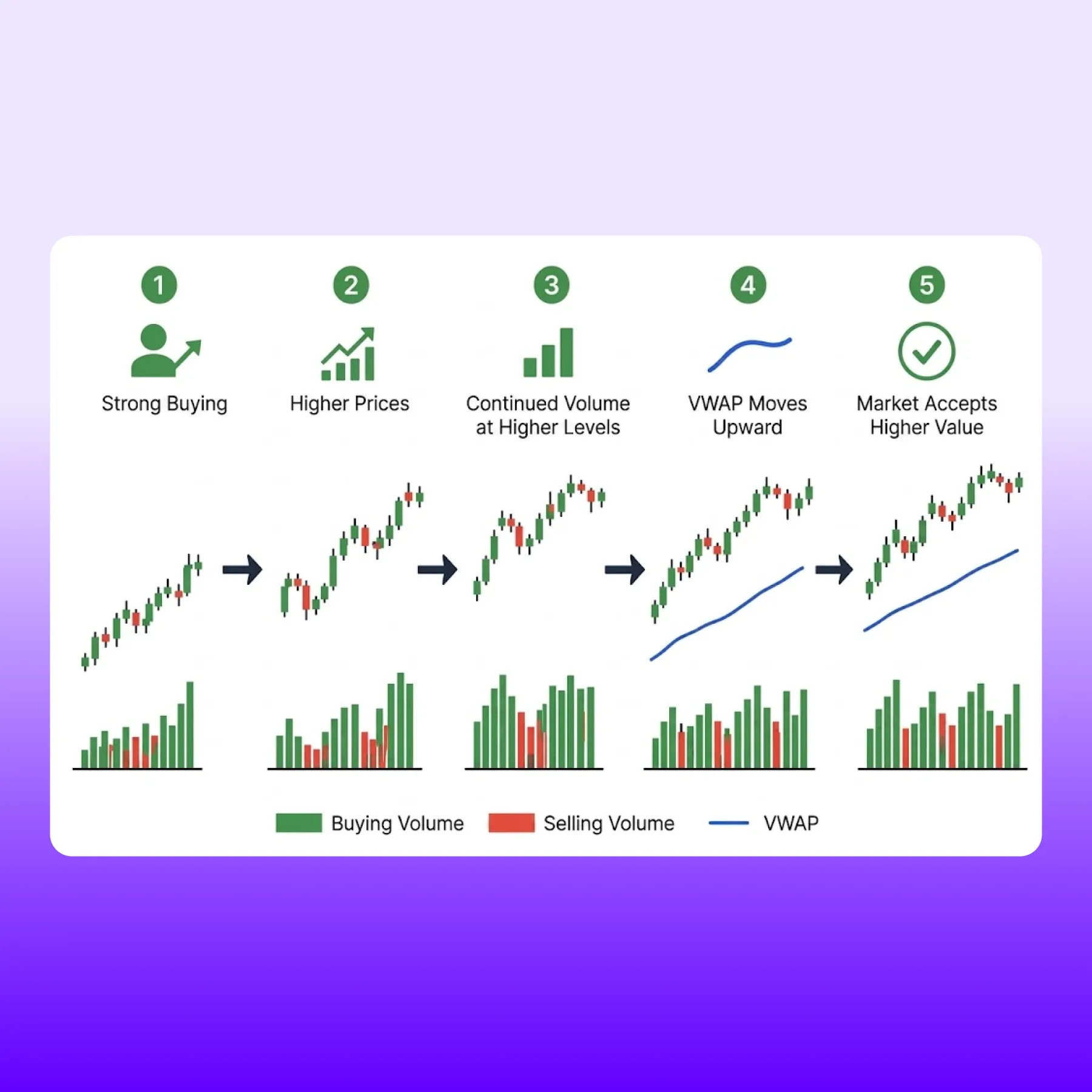
In this environment, repeatedly expecting price to return to VWAP can lead to repeated attempts to trade against the prevailing trend. Thus, the better question about trading using VWAP is not, “Why has price not returned to VWAP?” Instead, it is:
- What does the day’s auction indicate about the market’s acceptance of value away from VWAP?
That distinction separates mechanical use of VWAP from VWAP institutional trading. VWAP’s value comes from showing where significant trading has occurred and providing context for how the market is accepting value throughout the session.
VWAP Doesn’t Mean the Same Thing Every Trading Day
VWAP can behave differently because market conditions change from one trading session to another. Therefore, VWAP trading strategy works best when the type of market auction is considered rather than treating a move above or below VWAP as a fixed signal.
Markets generally move between two broad environments: balance and imbalance. This distinction explains why VWAP may act as a “central reference” on one day and appear far from price on another. Let’s understand in detail:
VWAP Changes with the Type of Market Auction
On a balanced day, buyers and sellers are relatively evenly matched. Neither side has enough conviction to sustain a strong directional move. As a result, price repeatedly moves around areas where substantial trading has already occurred.
In this environment, VWAP usually sits near the centre of the day’s trading activity. Price may:
- Move above VWAP.
- Fall below VWAP.
- Return to VWAP several times.
- Rotate between higher and lower prices around the benchmark.
This is the market environment most commonly associated with VWAP support/resistance or VWAP-based reversals. However, the repeated interaction with VWAP is a result of balanced market conditions. It is not a rule that VWAP must always attract price.
A trend day presents a different picture.
- Instead of buyers and sellers repeatedly agreeing around existing value, one side remains in control.
- Buyers may continue accepting higher prices.
- Sellers may continue accepting lower prices.
- Consequently, the market begins to discover new price levels.
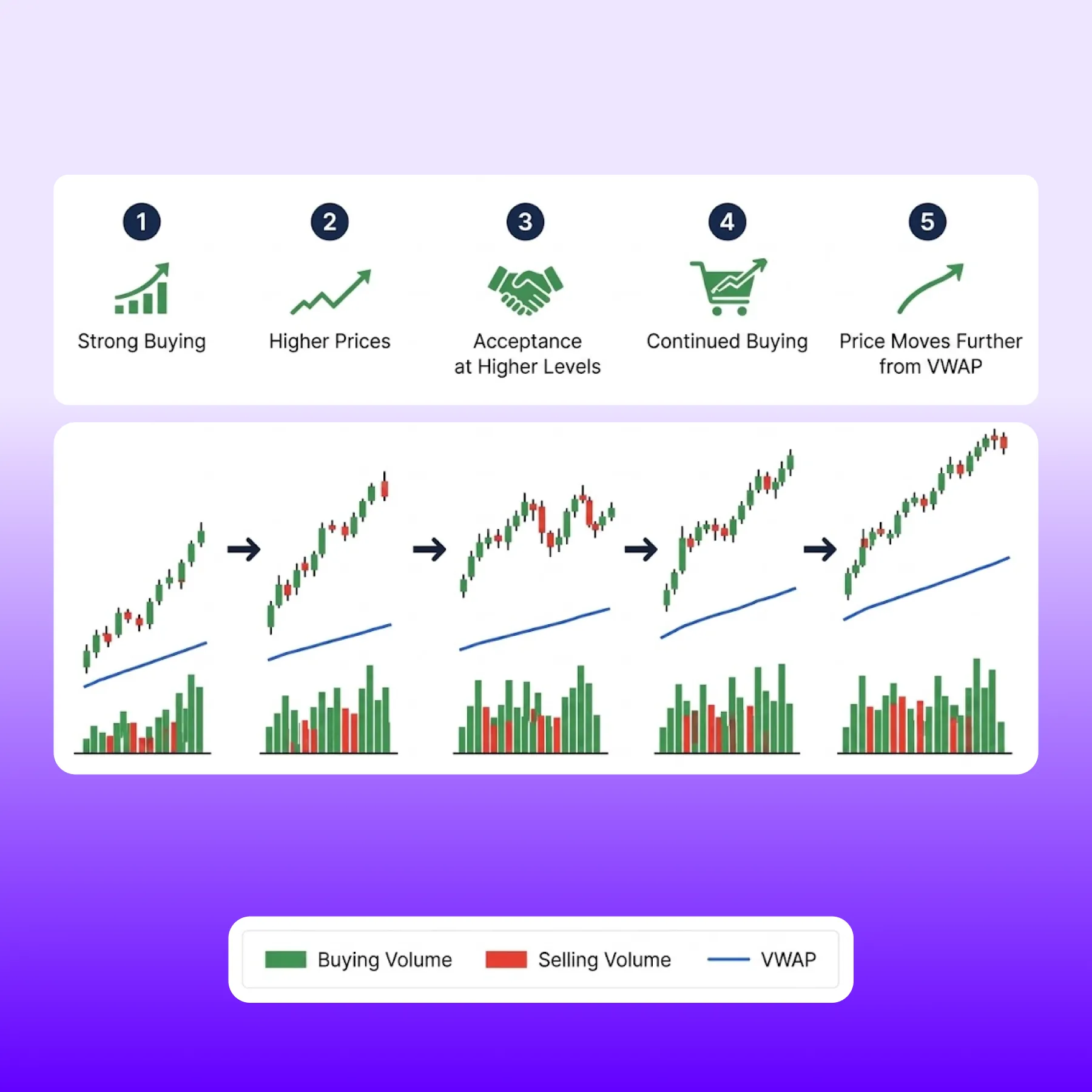
In such conditions, price may spend much of the session above VWAP without returning to it. The same can happen below VWAP during sustained selling. Importantly, this does not make volume-weighted average price less useful. Instead, the distance between price and VWAP can provide information about how the market’s perception of value is changing.
A sustained move away from VWAP indicates that a large part of current trading is taking place away from where most of the session’s earlier business occurred. Therefore, what VWAP is used for goes beyond identifying whether price is above or below a line. VWAP helps show how value develops during the trading session.
VWAP Shows Where Value Is. Order Flow Explains Why Price Is Staying There.
VWAP shows where a large amount of trading has taken place during a session. However, VWAP does not show what buyers and sellers are doing around that price. That is where order flow adds another layer of information. Let’s understand how:
VWAP Provides the Context; Order Flow Adds the Reason
Consider two situations where price is trading well above VWAP. On a normal price chart, both situations may look similar because price is above the volume-weighted average price. However, the activity behind the price can tell two very different stories.
| First Situation | Second Situation |
|
|
Therefore, being above VWAP does not automatically explain whether the market is strong or weak. VWAP support/resistance can show an important reference level, but order flow provides information about the behavior taking place around that level.
Combining VWAP With Order Flow
Note that in VWAP institutional trading, professional market analysis rarely depends on one indicator alone. Different tools answer different questions. Bookmap can complement VWAP rather than replace it. Let’s see how:
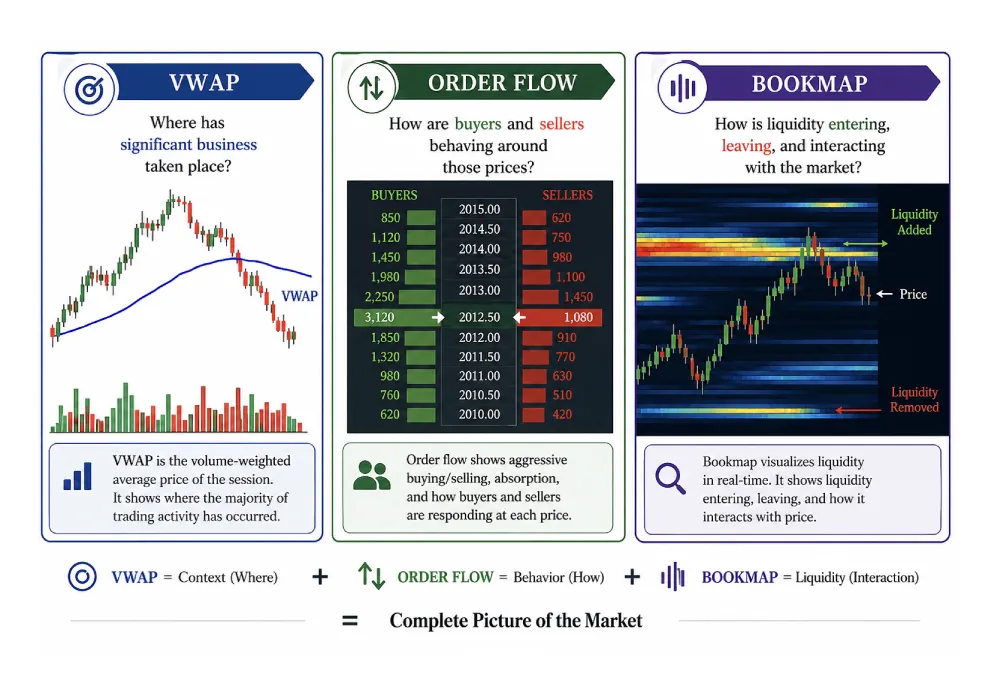
Bookmap allows market activity around VWAP to be viewed through liquidity, aggressive buying and selling, and absorption. This can help show whether market participants appear to be accepting higher prices or beginning to reject them.
Consequently, VWAP is broader when combined with order flow. VWAP provides the market-value context, while order flow provides information about participant behaviour around that context.
Conclusion
VWAP has become one of the most widely followed tools in financial markets, yet it remains widely misunderstood. Many traders judge its usefulness by asking whether price returns to VWAP, holds above it, or reverses after touching it. However, these price reactions alone do not explain the real purpose of volume-weighted average price.
For institutions, VWAP is more than a VWAP trading indicator. It can serve as an execution benchmark, a reference for market value, and a way to assess how trading activity evolves throughout the session. Its importance does not depend on price touching the line repeatedly. Instead, its value comes from showing where significant business has taken place and providing a benchmark against which current market activity can be assessed.
This perspective also changes the way institutions use VWAP can be viewed. Rather than treating VWAP as a “mechanical source” of buy and sell signals, it can be used as context for interpreting the day’s market auction. When VWAP is combined with liquidity and order flow, the analysis goes beyond where price is trading and provides greater insight into how buyers and sellers are behaving around key levels.
Ultimately, the more useful question is not, “Is price respecting VWAP?” but rather, “What is today’s auction revealing about value, participation, and institutional activity around VWAP?” Want to see how institutional participation develops around VWAP? Compare Bookmap packages.
FAQs
1. Why do institutions use VWAP?
Institutions use VWAP primarily as a VWAP execution benchmark. Large orders can influence market prices, so institutions can divide them into smaller trades. After execution, the average purchase or selling price can be compared with VWAP.
Buying below VWAP or selling above it can indicate favorable execution compared with the session’s average volume-weighted price.
2. Why doesn’t price always return to VWAP?
VWAP is not a price level that attracts or pulls price back. It represents the average traded price after considering volume. On balanced days, price may move around VWAP several times. However, during strong trends, buyers or sellers may continue accepting higher or lower prices. As a result, price can remain far from VWAP for most of the session.
3. Is VWAP the same as a moving average?
No, both may appear as lines on a chart, but they calculate averages differently. A moving average generally gives equal importance to each price observation. In contrast, VWAP gives greater importance to prices where more trading volume occurred and shows where a larger share of the session’s trading activity took place.
4. Can traders use VWAP as support and resistance?
VWAP can sometimes act as support or resistance when buyers and sellers react around it. However, this behaviour is not guaranteed. The reaction depends on factors such as:
- Market trend
- Liquidity
- Trading volume
- Order flow
Therefore, VWAP support/resistance is best viewed as a possible market behavior rather than a fixed trading rule.
5. How does order flow improve VWAP analysis?
VWAP shows where the market has traded on average, but it does not show how buyers and sellers are behaving there. Order flow adds this information by showing aggressive buying, selling pressure, liquidity, and absorption.
As a result, combining VWAP with order flow can provide greater insight into whether market participants are accepting or rejecting prices around VWAP.
Sign Up Now
Latest Articles