


See what overnight price action reveals before the open.
Compare plans to track overnight liquidity, key levels, and positioning before regular trading.
Education
August 25, 2026
Why Overnight Price Action Matters More Than Most Traders Realize
Markets never stop processing information. They only hand the responsibility from one time zone to another.
While many traders pay close attention to the U.S. regular session, a significant part of the market story is written long before the opening bell. Overnight futures trading shows how institutions and global participants respond to economic data, earnings announcements, central bank decisions, and geopolitical developments.
These reactions create important price levels and reveal early market positioning that can influence the following session. However, overnight price action is valuable not because it predicts the next move, but because it provides context for interpreting market behaviour after the open.
This article explains the Globex session, overnight highs and lows, and overnight inventory. Also, learn how overnight market analysis may help traders place the regular trading session within a broader market structure.
The Market Doesn’t Sleep Just Because You Do
Modern financial markets operate across multiple futures market sessions that span different time zones around the world. As a result, trading does not stop when U.S. Regular Trading Hours (RTH) end. Instead, futures contracts continue trading through the Globex session, where institutions, hedge funds, and international market participants react to new information that emerges overnight.
This activity is often called overnight futures trading. During this period, the following events/ factors can influence prices before the U.S. market opens:
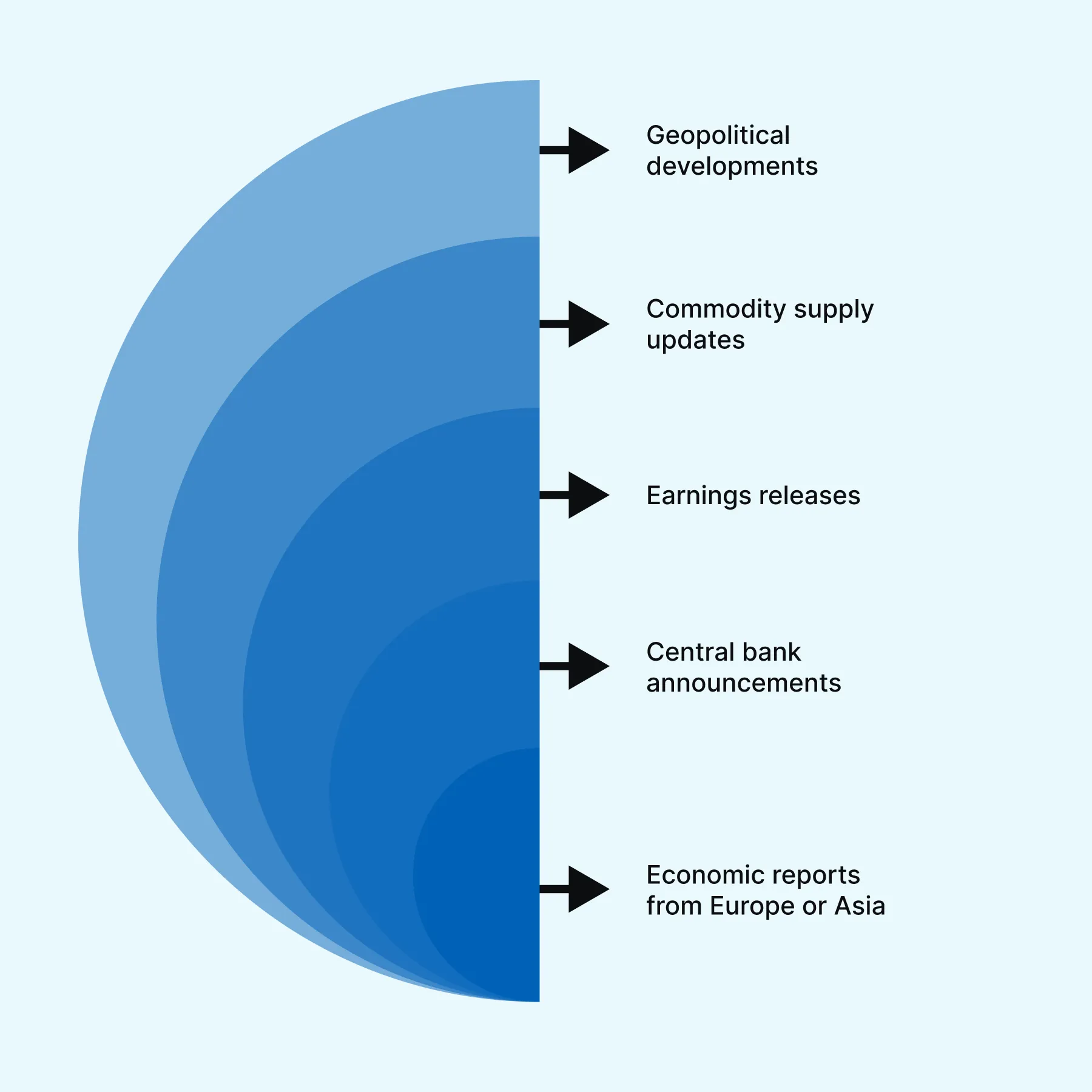
Consequently, overnight price action provides an early indication of how traders are interpreting new events. Although the ES overnight session usually has fewer participants than the main U.S. trading session, lower liquidity does not make it less important.
In fact, when fewer orders are present in the market, individual transactions can have a greater impact on price movement. Therefore, the overnight session frequently establishes significant reference points that remain relevant during the next trading day.
Furthermore, as per general industry understanding:
- The European market open may bring an increase in trading activity
- The Asian session can create directional moves in response to regional economic data.
- Similarly, unexpected geopolitical developments may trigger sharp moves in futures prices even when U.S. cash markets are closed.
As a result, traders commonly monitor overnight highs and lows because these levels can act as support, resistance, or breakout areas during the following session. In addition, analysts examine overnight inventory to evaluate whether overnight participants were predominantly buying or selling futures contracts.
Therefore, overnight market analysis becomes an important part of market preparation. Let’s see how you may perform it:
Why Overnight Highs and Lows Become Important Reference Levels
Among all forms of overnight market analysis, the overnight highs and lows are some of the most closely watched price levels. These levels mark the highest and lowest prices reached during overnight futures trading [even before most U.S. participants enter the market during Regular Trading Hours (RTH)].
However, these levels are not important simply because they exist. Their significance comes from how market participants respond when price revisits them. As a result, they become reference points for evaluating:
- Momentum
- Continuation
- Rejection, or
Let’s understand how most market participants analyze overnight highs and lows while trading:
| Overnight Highs | Overnight Lows |
|
|
Meanwhile, liquidity usually builds around these reference levels during the Globex session and before the U.S. market opens. Since many market participants monitor the same price zones, buying and selling interest may increase when the price approaches them.
Therefore, overnight highs and lows should be viewed as “reference levels” that reflect market behavior (and not as fixed trading signals). Don’t just watch the open. Understand what happened overnight first.
Understanding Overnight Inventory
Overnight inventory represents the “directional positioning” created during overnight futures trading, before the U.S. Regular Trading Hours (RTH) begin. For example,
- Suppose market participants continue buying throughout the Globex session.
- Now, the market enters the regular session with long overnight inventory.
- In contrast, if selling dominates the overnight session, the market begins the day with short overnight inventory.
This positioning becomes highly important because it can influence overnight price action after the U.S. market opens. Let’s see how this happens under different scenarios:
| Overnight Positioning | What Happens After the U.S. Open (RTH)? | Possible Market Reaction |
| Long Overnight Inventory (overnight traders mostly bought futures) | New buyers continue entering the market after the open. | Buying momentum remains strong, and the upward move may continue. |
| Long Overnight Inventory | Few or no new buyers appear after the open. Overnight buyers begin closing their positions. | Selling pressure increases, which can cause prices to fall even without negative news. |
| Short Overnight Inventory (overnight traders mostly sold futures) | Selling continues after the open with new sellers joining the market. | Downward momentum remains strong, and the decline may continue. |
| Short Overnight Inventory | Buyers enter aggressively after the open. Short sellers begin closing their positions. | Buying pressure increases as short positions are covered, which can push prices higher (short covering). |
Traders may observe from the above scenarios that overnight inventory does not predict future price direction. Instead, it provides context by showing:
- How the market was positioned before the regular session, and
- How those positions may influence early-session price action.
Overnight Liquidity Often Shapes the Following Session
The Globex session may have lower trading activity than Regular Trading Hours (RTH). But it still creates important areas of liquidity that remain relevant after the U.S. market opens. As a result, overnight market analysis extends beyond price movement. It also examines where buying and selling interest developed during the overnight session.
Importantly, this liquidity does not disappear when RTH begins. Instead, resting orders, heavily traded price zones, and levels where buyers or sellers previously defended the market continue attracting attention as new participants enter.
For example,
- A price range where the market moved sideways during overnight futures trading can later act as a support or resistance area.
- Similarly, liquidity may build just above overnight highs and lows. This happens because many market participants place orders around these widely watched reference points.
In addition, areas where overnight buyers or sellers absorbed aggressive orders can remain significant during the next session. When price revisits these levels, market participants usually watch whether the same side continues defending the area or whether control shifts to the opposite side.
Likewise, the market may return to overnight high-volume areas before choosing a direction. These zones usually reflect a previous agreement between buyers and sellers. That’s why several traders consider them as important reference points, particularly during the early stages of the regular trading session.
In this way, overnight liquidity may provide valuable context for interpreting overnight price action. Bookmap helps traders connect overnight activity with the regular trading session.
Why Context Matters More Than the Overnight Move Itself
Many traders assume that the direction of overnight price action will automatically continue after the U.S. market opens. However, market behavior does not always follow that pattern. Instead, overnight activity only provides context for the upcoming session (and does not offer a “definite prediction”).
Let’s understand this through two scenarios:
| Scenario I: Price Continuation | Scenario II: Price Reversal |
|
|
Therefore, overnight market analysis should be viewed as one part of a broader market assessment rather than a standalone trading signal.
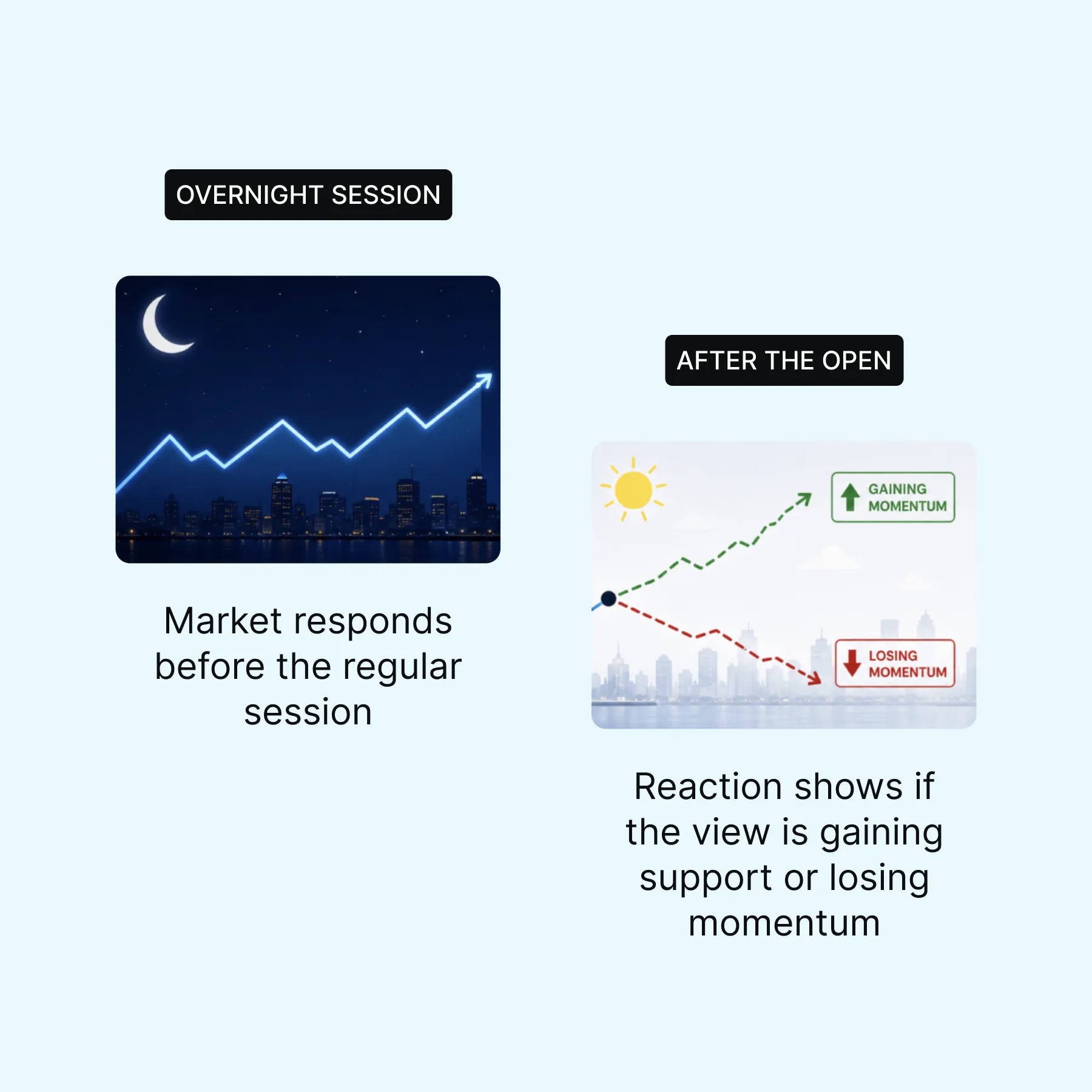
Note that several factors help place the overnight move into context. Generally, these include:
- Whether the move was supported by broad market participation
- Whether major economic or geopolitical news triggered the price change, and
- Where most trading activity occurred during the Globex session.
In addition, traders may examine whether liquidity supports continuation or indicates rejection, along with how the price behaves once the regular session begins. Thus, the “value of overnight price action” lies in the context it provides and not in the direction of the move alone.
Seeing Overnight Structure in Real Time
To increase the accuracy of overnight price action interpretation, traders may view the market structure as it developed during the Globex session. Instead of relying only on end-of-session price levels, traders can examine the following:
- Where liquidity appeared
- Where trading activity increased, and
- How buyers and sellers responded at different prices.
Bookmap makes this process more visual by displaying the overnight auction and areas where liquidity accumulated. Also, traders can use Bookmap to view price zones with heavy trading activity.
Additionally, Bookmap allows traders to compare the market structure created during overnight futures trading with the behavior that develops after the U.S. market opens. As a result, overnight highs and lows become more than simple lines on a chart. By observing how market participants interacted with these levels, it becomes easier to see whether they acted as areas of support, resistance, rejection, or acceptance.
How to Gain Additional Context?
While reviewing overnight inventory, traders may also include liquidity and trading activity in their analysis. This provides additional context for the regular session and may explain:
- Whether overnight positioning continues to influence price, or
- Whether market sentiment changes after new participants enter.
Therefore, overnight market analysis delivers the greatest value when it is combined with current market behavior. When used this way, it serves as a source of context that can be compared with real-time price action after the open.
Conclusion
Usually, overnight price action receives less attention because it takes place outside the hours when many retail traders actively follow the market. However, the Globex session generally lays the foundation for the next trading day. It establishes overnight highs and lows and builds overnight inventory. Also, it creates important liquidity zones and reflects how market participants responded to news and events before Regular Trading Hours (RTH) began.
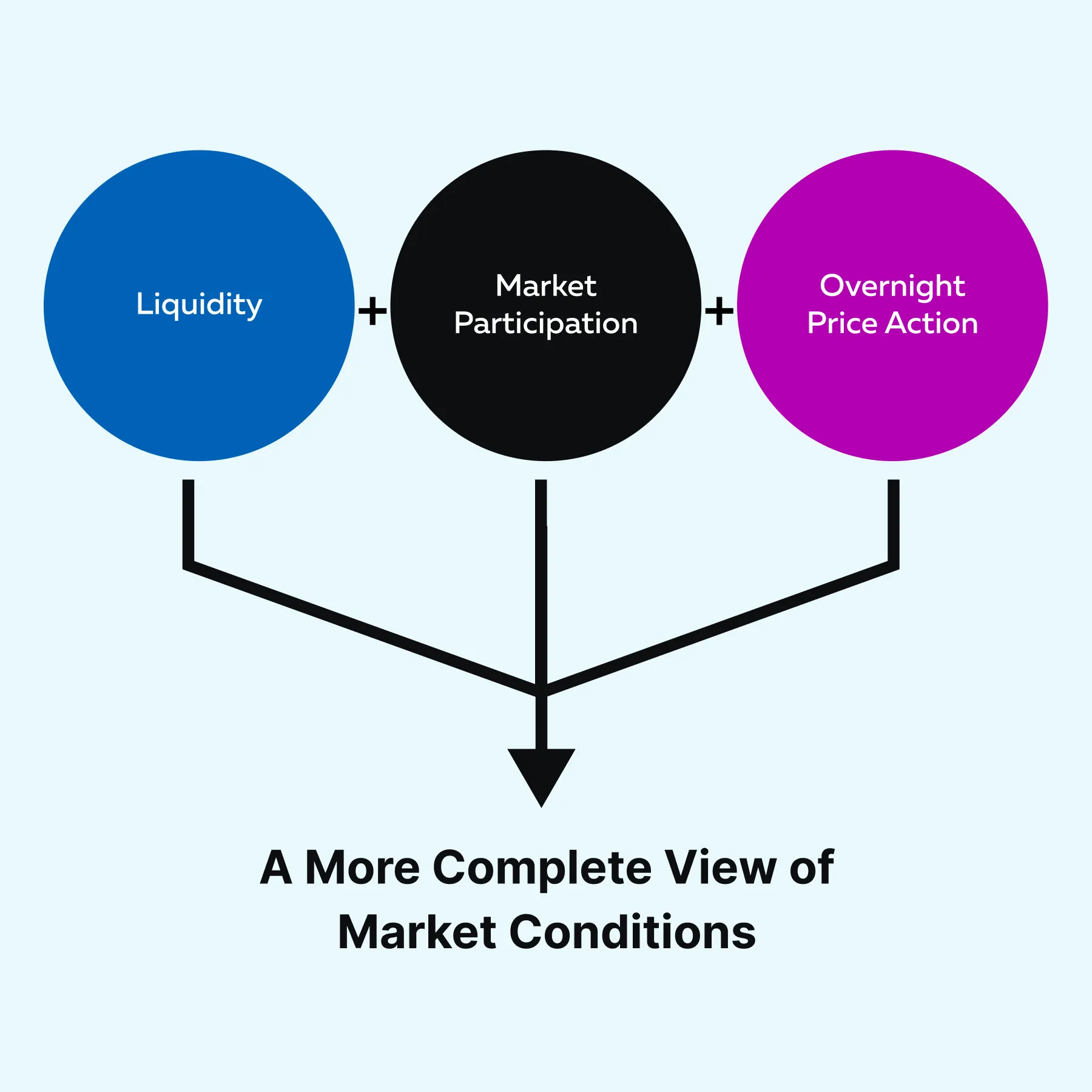
Therefore, overnight market analysis is not about predicting what will happen after the open. Instead, it provides context for interpreting market behavior as new participants enter the session. To gain a more complete view of market conditions, traders may view it alongside real-time price action, liquidity, and participation.
See how overnight liquidity develops and carries into the regular session with Bookmap.
FAQs
1. Why does overnight price action matter?
Overnight price action shows how the market reacted to news and events before the U.S. regular session opened. As per general industry understanding:
- It creates important price levels
- Builds liquidity, and
- Reflects early market sentiment
Usually, these factors influence how the market behaves after the opening bell. This makes the overnight session an important source of context rather than a prediction.
2. What are overnight highs and lows?
Overnight highs and lows are the highest and lowest prices reached during overnight futures trading. These levels attract attention during the next trading session because many market participants place orders around them. As a result, the price may pause, reverse, or continue when it returns to these areas.
3. What is overnight inventory?
Overnight inventory refers to the buying or selling positions built during the overnight session.
- If buying dominated, the market has “long” overnight inventory.
- If selling dominated, it has “short” overnight inventory.
By using this information, traders may understand how overnight participants were positioned before the regular trading session began.
4. Does overnight direction predict the next trading day?
No, a move during the overnight session does not guarantee that the same direction will continue after the market opens. The regular session brings new participants with different views. This can either support the overnight trend or reverse it.
Therefore, overnight price action provides context, not certainty.
5. How can Bookmap help analyze overnight trading?
Bookmap allows traders to review how the market behaved during the overnight session by displaying liquidity, trading activity, and order flow. This makes it easier to identify important price levels and observe where buyers and sellers were active.
Sign Up Now
Latest Articles