


See why strong economic data can still send markets lower.
Compare plans to track liquidity and order flow as traders react to major economic releases.
Trading Basics
September 11, 2026
Why Strong Non-Farm Payrolls Can Send Markets Lower: Understanding What Traders Are Really Reacting To

A strong jobs report is released. Financial headlines call it good news for the U.S. economy. Yet within seconds, stocks begin to fall. This apparent contradiction can leave even experienced traders asking:
- If the economy is doing well, why are stocks falling?
The reaction, however, is not irrational. Financial markets do not price the present alone; they continuously adjust to what new information could mean for the future. A strong Non-Farm Payrolls report may signal economic strength, but it can also raise concerns about inflation, delay expectations for Federal Reserve rate cuts, and push interest rates higher.
Besides, market positioning can add another layer to the reaction. This article explains the NFP market reaction, why stocks can fall after strong jobs data, how inflation and interest rates influence valuations, and how order flow can reveal the market’s actual response.
What Is Non-Farm Payrolls and Why Does the Market Care So Much?
Non-Farm Payrolls (NFP) is a monthly employment statistic. It provides a broad view of labor market strength and offers clues about:
- Consumer demand
- Inflation
- Economic growth
- Future Federal Reserve policy
As a result, the NFP market reaction usually extends across stocks, bonds, currencies, and interest-rate expectations. Let’s understand in detail:
More Than Just a Jobs Report
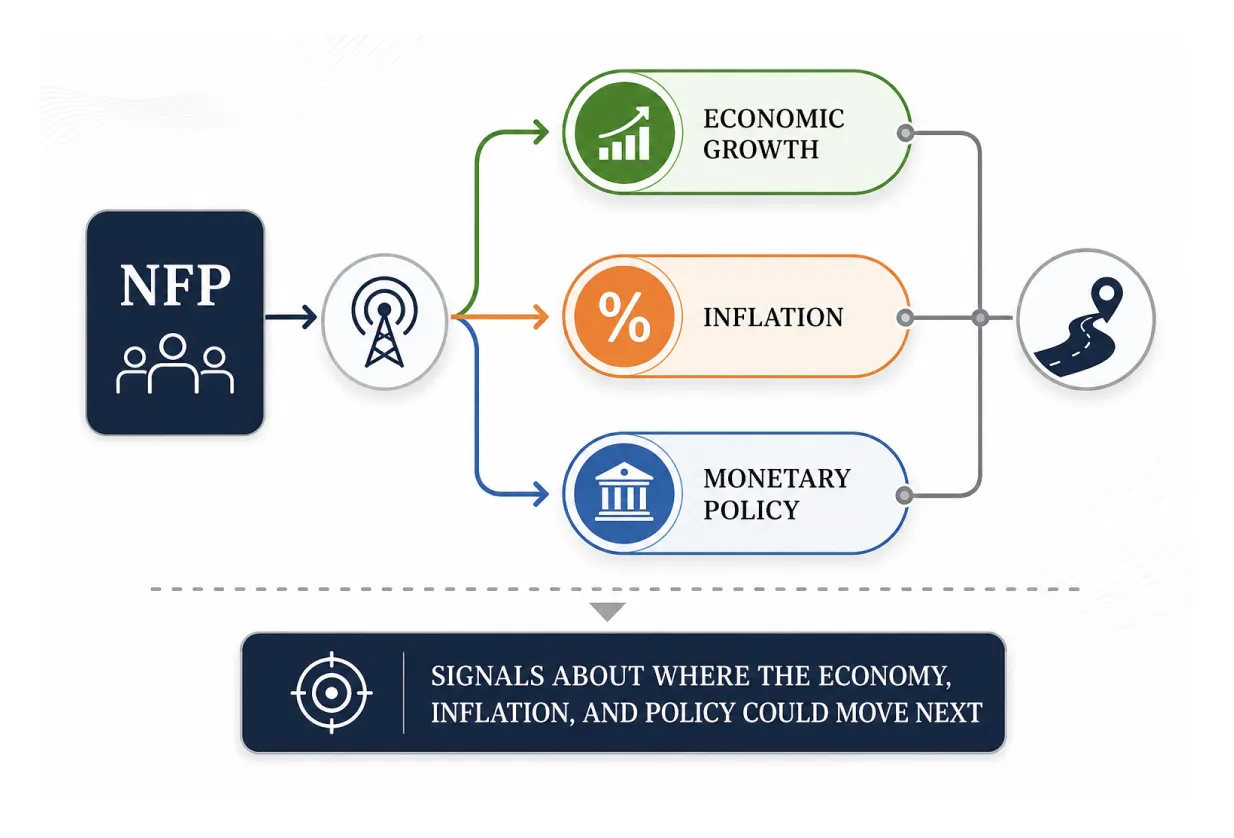
Non-Farm Payrolls measures the change in employment across most major sectors of the U.S. economy (excluding farm workers and a few other categories). However, its importance goes beyond the number of jobs added or lost.
Employment is closely linked to overall economic health because people with jobs generally have income to spend. Therefore, stronger employment can support consumer spending, which can increase demand for goods and services. At the same time, healthy employment can strengthen business confidence, as companies may see stronger demand and greater scope for expansion.
Besides, employment also affects wage growth. When labor demand remains strong, wages can rise as businesses compete for workers. Higher wages can support household spending, and at the same time they can also add to inflation when demand grows faster than the supply of goods and services. Consequently, employment trends can provide clues about future economic expansion. This is why several market participants pay close attention to NFP data.
Why the Federal Reserve Watches Employment Closely
As per general market understanding, the Federal Reserve has a dual mandate:
- Promote maximum employment
and
- Maintain price stability
Therefore, employment data plays an important role in decisions about monetary policy, particularly when inflation remains a concern. This connection becomes clearer through wages and spending. Let’s see how:
- Strong hiring can support wage growth.
- Higher wages can increase consumers’ purchasing power.
- As spending rises, demand for goods and services can also increase.
- If demand grows faster than supply, businesses may raise prices.
- This potentially adds to inflationary pressure.
For this reason, a strong non-farm payrolls market reaction does not always mean higher stock prices. A strong jobs report can signal a healthy economy, but it can also raise expectations that the Federal Reserve may keep interest rates higher for longer to control inflation.
This relationship explains why stocks fall after jobs report surprises on the upside in some situations. When markets expect tighter monetary policy, higher interest rates can:
- Reduce the present value of future corporate earnings, and
- Make borrowing more expensive.
Thus, even good economic news can be interpreted as negative for stocks when it changes expectations about Federal Reserve policy.
NFP isn’t just one number
The headline payroll figure usually gets the most attention, but it does not provide the complete picture of the U.S. labor market. The NFP market reaction depends on several employment indicators and, importantly, on how the reported data compares with what financial markets had already expected.
Let’s check them out:
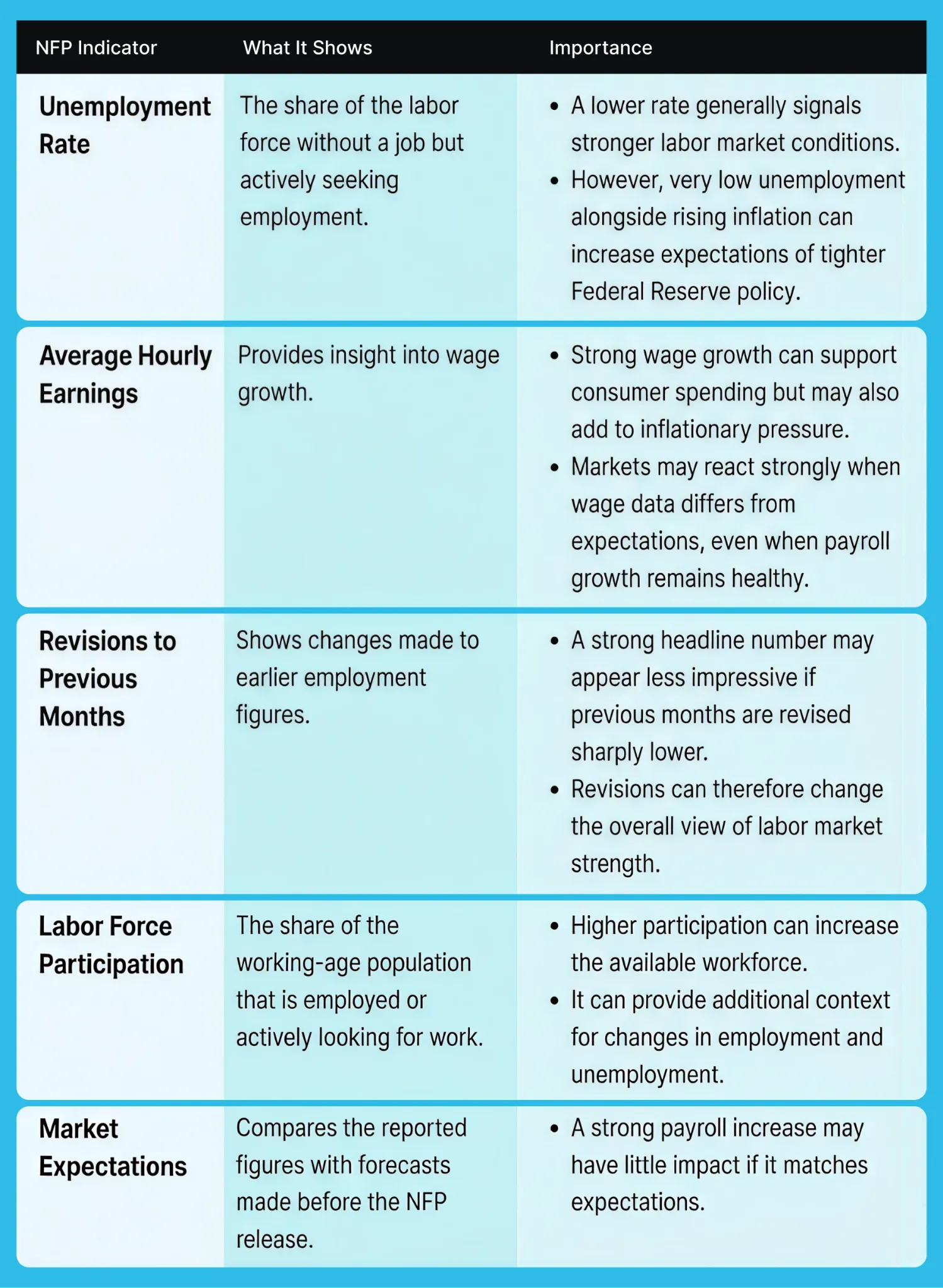
As a result, the headline figure and supporting data can sometimes tell different stories. A strong payroll number may be accompanied by weak revisions, softer participation, or unexpected wage trends. This is why NFP in isolation does not fully capture the market’s response.
Why Strong Jobs Data Doesn’t Automatically Mean Higher Markets
Strong employment data is usually a sign of economic health. But stock prices reflect more than current economic conditions. Generally, markets react to expectations about:
- Future growth
- Inflation, and
- Interest rates
Therefore, a strong NFP report can sometimes lead to falling stock prices when it changes expectations about Federal Reserve policy and future borrowing conditions. Let’s gain more clarity:
The Economy and the Stock Market Are Not the Same Thing
A common assumption is good economy = a higher stock market. While stronger economic growth can support corporate earnings over the long term, stock prices do not only respond to whether the economy looks healthy today. Instead, markets continuously price expectations about the future. For example,
- Strong employment may support company revenues today.
- But if it also raises expectations of higher inflation and interest rates, stock valuations may come under pressure.
This creates an important difference between economic data and market pricing. A company may report strong earnings today, but its stock can fall if investors expect weaker earnings next year. Similarly, a strong NFP report may indicate a healthy economy while creating concerns about future interest rates.
Therefore, why stocks fall after the jobs report usually comes down to what the report changes about the future (rather than whether the employment data itself is positive).
Visualize liquidity shifts and order flow during high-impact news events.
Strong Economic Data Changes Future Expectations
A “stronger-than-expected” jobs report can set off a series of changes in market expectations. The pattern may develop as follows:
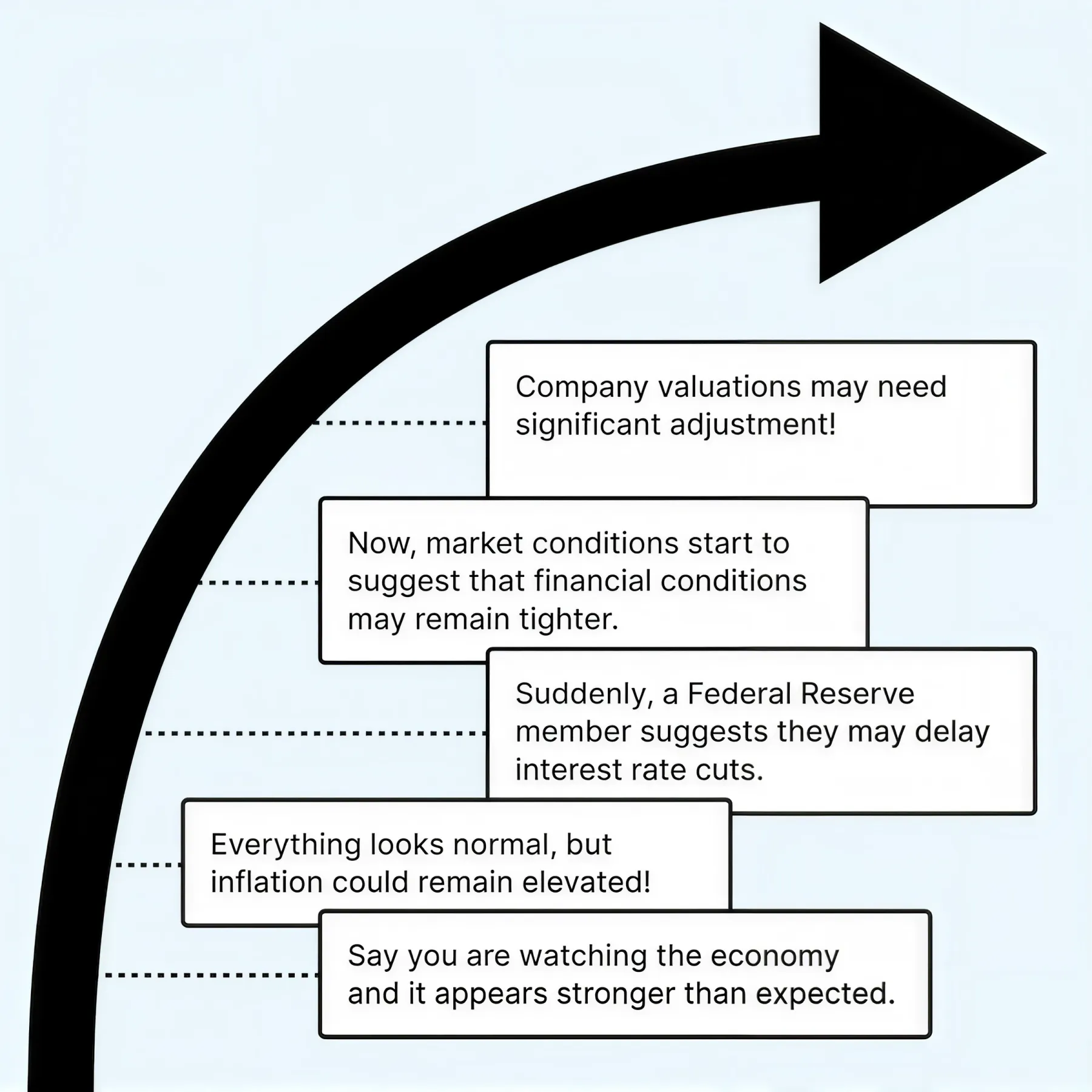
The connection starts with stronger employment. If businesses continue to hire at a strong pace and wages remain firm, consumer spending may stay resilient. That can keep demand strong and make inflation more persistent. As a result, markets may reduce expectations for near-term Federal Reserve rate cuts.
However, this does not mean the market considers strong employment negative. Rather, the primary question behind the strong non-farm payrolls market reaction is:
- What does this data mean for the next 6 to 12 months?
Markets Constantly Reprice Probabilities
Financial markets operate on probabilities rather than certainty. A stronger NFP report does not guarantee higher inflation, another rate hike, or a decline in stock prices. Instead, it changes the perceived likelihood of these outcomes.
For example,
- Suppose that before an NFP release, markets may assign a high probability to a Federal Reserve rate cut.
- If employment comes in much stronger than expected, that probability may fall.
- At the same time, the probability of rates remaining higher for longer may rise.
This shift in expectations can affect bond yields, borrowing costs, and stock valuations even when the underlying economic data remains positive.
The Chain Reaction: Why Strong Employment Can Lead to Lower Stock Prices
A strong jobs report can create a chain of market reactions that reaches far beyond employment. When hiring and wages appear stronger than expected, traders may reassess:
- Inflation
- Federal Reserve policy, and
- Interest rates
Those changes can then affect borrowing costs, corporate earnings, and stock valuations, sometimes creating a negative NFP market reaction. Let’s understand this chain reaction step-by-step:
Step 1: Strong Employment Increases Inflation Concerns
Stronger employment can indicate that businesses continue to need workers and that the labor market remains tight. When demand for workers is high, wages may rise as companies compete for available employees.
Higher wages can support consumer spending because households have higher income. If spending remains strong while the supply of goods and services cannot keep pace, businesses may face greater pressure to raise prices.
Therefore, strong employment does not automatically create inflation. However, it can make persistent inflation more likely in the eyes of financial markets. After a stronger-than-expected NFP report, traders may therefore pay greater attention to:
- Wage growth
- Consumer demand
- Other signs of inflation.
Thus, the answer to the question “why markets fall after non-farm payrolls” cannot be answered by looking at the payroll figure alone. The market is also assessing what strong employment could mean for inflation in the months ahead.
Step 2: Higher Inflation Expectations Affect Federal Reserve Policy
If stronger employment increases concerns that inflation may remain elevated, expectations for Federal Reserve policy can change. Persistent inflation can make policymakers more cautious about reducing interest rates.
As a result, markets may begin to expect higher-for-longer interest rates or delayed rate cuts. Such expectations can keep monetary policy restrictive for a longer period, which can:
- Reduce excessive demand, and
- Prevent the economy from overheating.
This repricing can occur immediately after the jobs report because financial markets trade on expectations. A strong NFP figure may therefore reduce expectations of near-term rate cuts even though the employment data itself is positive.
Understand how institutional participants respond after NFP releases.
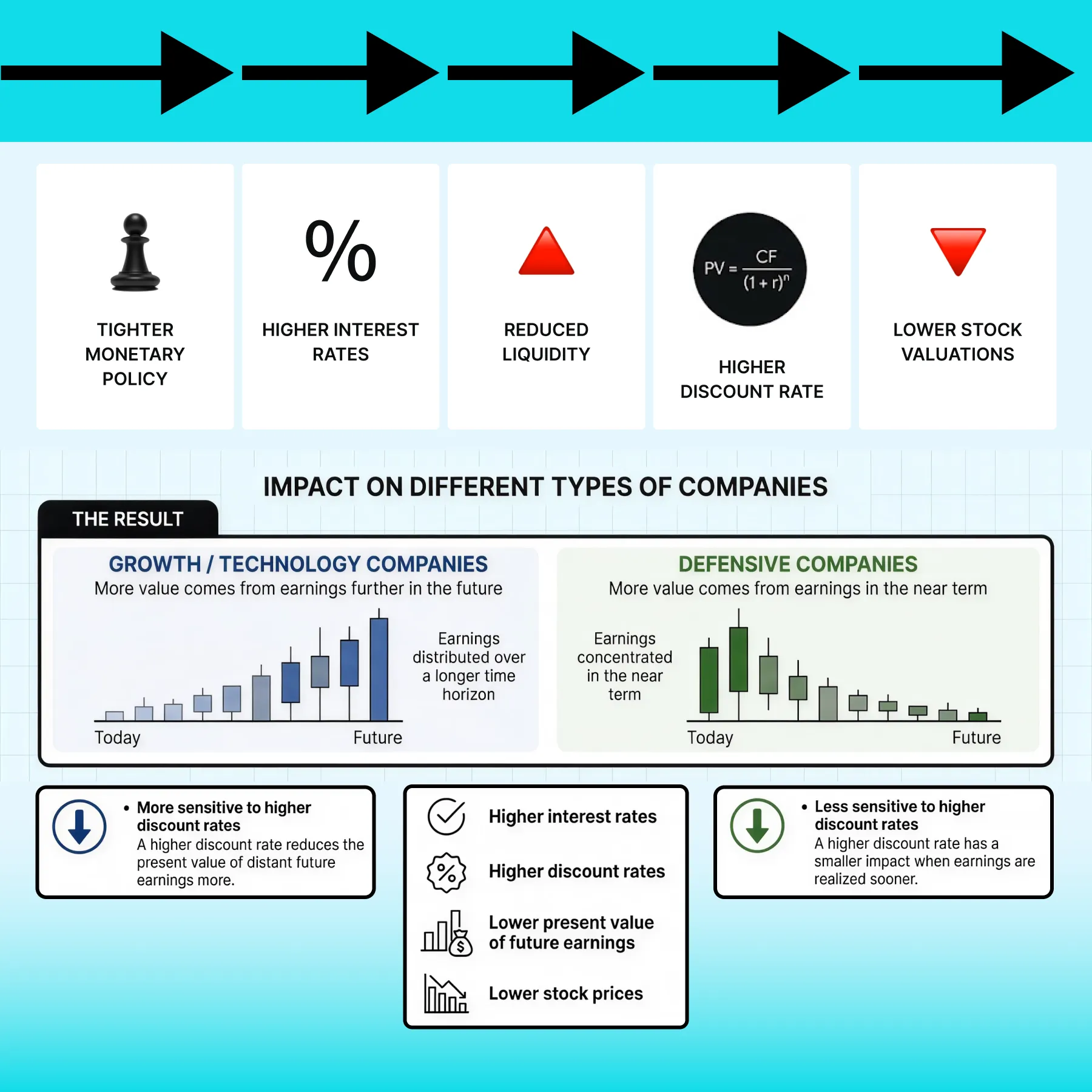
Step 3: Higher Interest Rates Pressure Asset Prices
Once expectations for higher interest rates increase, the impact can spread to stocks. Higher rates generally increase borrowing costs for companies, which can raise financing expenses and put pressure on corporate profitability.
At the same time, tighter monetary policy can reduce liquidity in financial markets. Higher interest rates also increase the discount rate used to value future corporate earnings. When future earnings are discounted at a higher rate, their present value falls.
The effect can be more visible in technology and other growth companies because a larger share of their expected value may come from earnings projected further into the future. Defensive sectors, with relatively stable earnings and cash flows, may be less sensitive to these changes.
See whether buyers or sellers actually take control after major economic news.
It’s Not About Good or Bad News—It’s About Expectations
Financial markets do not react to economic data in isolation. Instead, prices reflect what traders already expect and how new information compares with those expectations. Therefore, the same employment result can produce very different market moves depending on what was already priced in before the NFP release.
Why Expectations Matter More Than Headlines
Before every NFP release, economists and financial institutions publish forecasts for payroll growth, unemployment, and wage growth. These estimates give markets a broad idea of what the employment report may show.
Institutional traders then position portfolios based on these expectations. As more market participants prepare for a particular outcome, that expectation becomes reflected in:
- Stock prices
- Bond yields
- Currency values, and
- Interest-rate markets.
Therefore, much of the expected outcome may already be reflected in prices before the report arrives. This is why a strong jobs report does not automatically produce a strong stock market. If the result matches what markets expected, there may be little new information to reprice.
What “Priced In” Actually Means
“Priced in” means that market participants have already considered a particular outcome when setting asset prices. For example,
-
- Suppose economists expect payroll growth to be very strong.
- Traders may already expect a resilient economy and fewer near-term Federal Reserve rate cuts.
- Stock and bond prices may therefore reflect those expectations before the report is released.
- If the actual payroll figure is exactly as expected, there may be little reason for prices to change.
- The information is not new enough to alter market expectations.
However, suppose payroll growth is much stronger than forecasts. That surprise could increase concerns about persistent inflation and higher-for-longer interest rates. Markets may then adjust expectations for Federal Reserve policy, which can create a larger move in stocks and bonds. The same principle works in the opposite direction. A modestly weaker report can produce a significant market move if it increases expectations of rate cuts.
Several Examples of Expectation-Driven Reactions
Different employment outcomes can produce different market responses because each one changes expectations in a different way. For a better understanding, let’s check out different examples:
| NFP Scenario | Market Interpretation | Potential Stock Market Reaction |
| Strong Report Matching Expectations |
|
Limited reaction as much of the news may already be priced in. |
| Extremely Strong Report Surprising Markets |
|
Stocks may fall as traders reassess interest-rate expectations and stock valuations. |
| Slightly Weaker Report Increasing Hopes for Rate Cuts |
|
Stocks may rise, particularly when economic growth remains healthy and lower rates support valuations. |
| Weak Report During Recession Fears |
|
Stocks may fall despite higher expectations for rate cuts, as recession concerns outweigh the benefit of lower rates. |
Therefore, there is no single formula for the NFP market reaction. See whether buyers or sellers actually take control after major economic news.
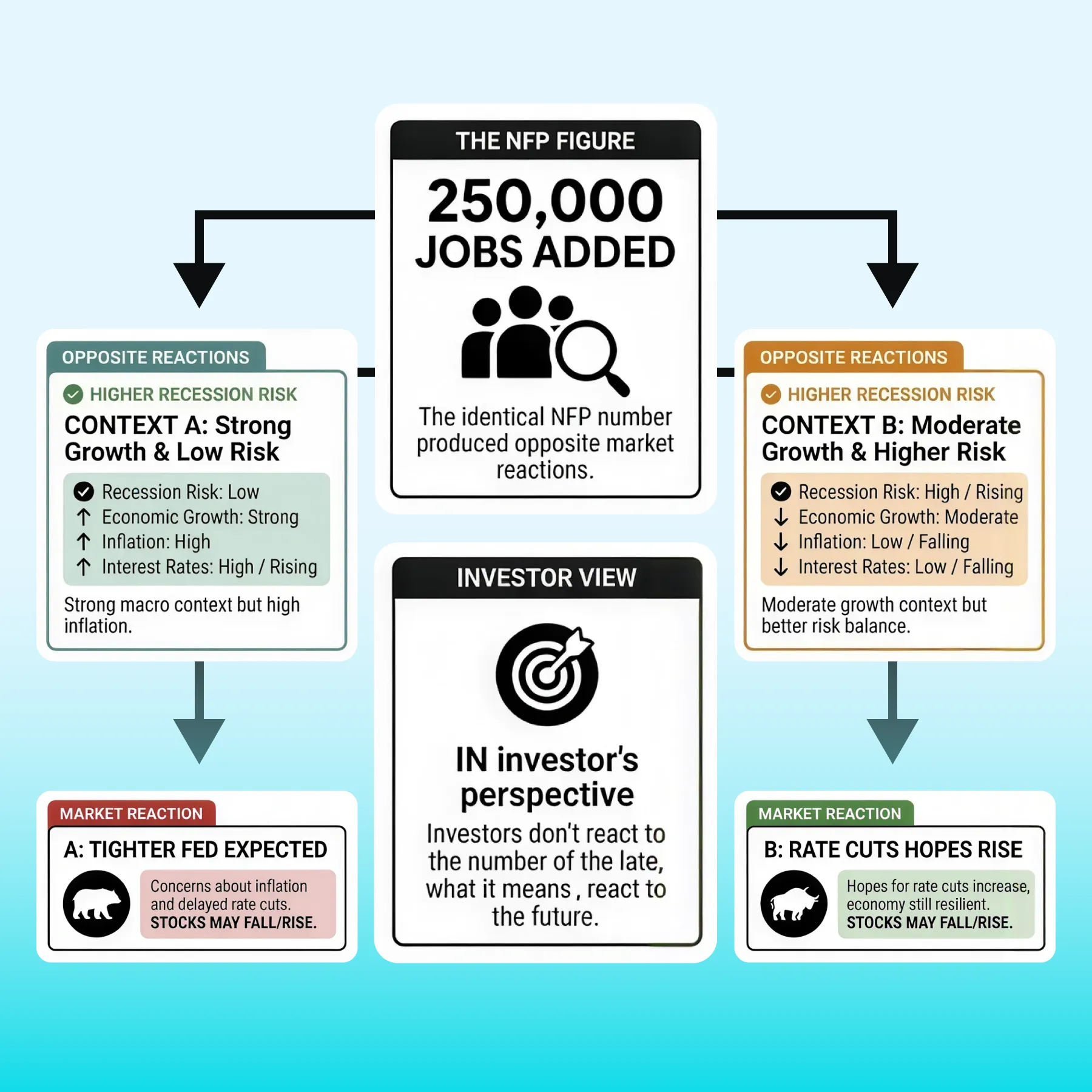
Why the Same NFP Report Can Produce Completely Different Market Reactions
As per general industry understanding, the impact of an NFP report depends on:
- Inflation
- Economic growth
- Federal Reserve policy, and
- Investor expectations at the time of release
Therefore, the same payroll figure can support stocks in one environment and pressure them in another. Let’s check out the various reasons why the same NFP report can produce different market reactions:
Inflationary Environments
When inflation remains elevated, strong employment can create greater concern in financial markets. A strong labor market can support wage growth and consumer spending, which may keep demand firm.
If demand remains strong while inflation is already high, traders may become concerned that price pressures will remain stubbornly elevated. As a result, expectations for higher-for-longer interest rates may increase (particularly if wage growth also remains strong).
This can create a “negative” NFP market reaction for stocks. Even though the employment data signals economic strength, markets may interpret it as a reason for the Federal Reserve to delay rate cuts or maintain restrictive policy.
Soft Landing Environments
The same strong employment report can have a more positive effect when inflation is already under control. In a soft-landing environment, strong hiring can indicate that economic activity remains healthy without creating significant additional inflation pressure.
Consequently, investors may welcome continued economic resilience. Companies can benefit from steady consumer spending, while lower inflation can leave more room for the Federal Reserve to maintain or gradually ease monetary policy.
In this setting, strong NFP data may “support” stocks because the report confirms economic strength without creating major concerns about interest rates.
During Recession Fears
The interpretation can change again when recession concerns dominate markets. Strong employment data may reduce fears that economic growth is weakening. If consumers continue to earn income and spend, expectations for corporate earnings may improve (which can support risk assets such as stocks).
However, weak employment data can have the opposite effect during recession fears. A significant deterioration in jobs may raise concerns about:
- Weaker consumer spending
- Lower business activity
- Declining corporate earnings
Consequently, stock selling can intensify even if weaker employment increases expectations for Federal Reserve rate cuts.
Why Order Flow Reveals More Than the Economic Headline
An economic headline explains what the data says, but it does not show how market participants respond to it. Order flow provides a view of that response, revealing whether buyers or sellers are gaining control. Let’s understand in detail:
News Creates Uncertainty Before Direction
Major economic releases such as NFP can create uncertainty before the data becomes available. As the release approaches, some market participants may:
- Reduce their exposure, and
- Pull resting liquidity from the order book.
With less liquidity available, spreads can become wider, and even modest orders can produce larger price movements. At the same time, volatility may increase as traders adjust positions around the expected announcement.
However, this initial volatility does not necessarily reveal the final direction. Many participants wait for confirmation from the actual data and the market’s response before committing to a stronger view.
This is highly important for the NFP market reaction because the first price movement after the report may not represent sustained buying or selling pressure.
Watching the Real Reaction Unfold
Once the NFP data reaches the market, order flow can show how participants respond to the new information. Instead of relying only on the economic headline, market behavior can be examined through several signals.
Aggressive buying shows buyers actively lifting available offers, while aggressive selling shows sellers hitting available bids. However, strong market orders do not always lead to sustained price movement. For example,
- Absorption occurs when substantial buying or selling is met by enough opposing liquidity to prevent the price from continuing in the same direction.
- Similarly, a failed breakout can show that an initial price move did not attract enough follow-through.
As the release settles, liquidity may return to the market. Price behavior can then provide clues about acceptance or rejection.
- Acceptance suggests that the market is comfortable trading at new price levels, whereas
- Rejection suggests that participants are not willing to sustain those levels.
Therefore, order flow is most useful as a way to observe the market’s response rather than predict the immediate outcome.
Why Reaction Matters More Than Prediction
- No trader can control the NFP headline.
- No trader knows exactly how institutions will interpret the employment data before the market reacts.
The important information emerges after the announcement, when participants begin placing orders and adjusting positions. Let’s understand through two different scenarios:
| Scenario I: Strong Jobs Report | Scenario II: Weaker Jobs Report |
|
|
However, whether those expectations are translating into sustained buying or selling pressure can be confirmed only via actual order flow. This is where Bookmap fits naturally into the analysis. Bookmap visualizes liquidity and order flow. It allows market participants to observe how buyers and sellers respond after major economic announcements.
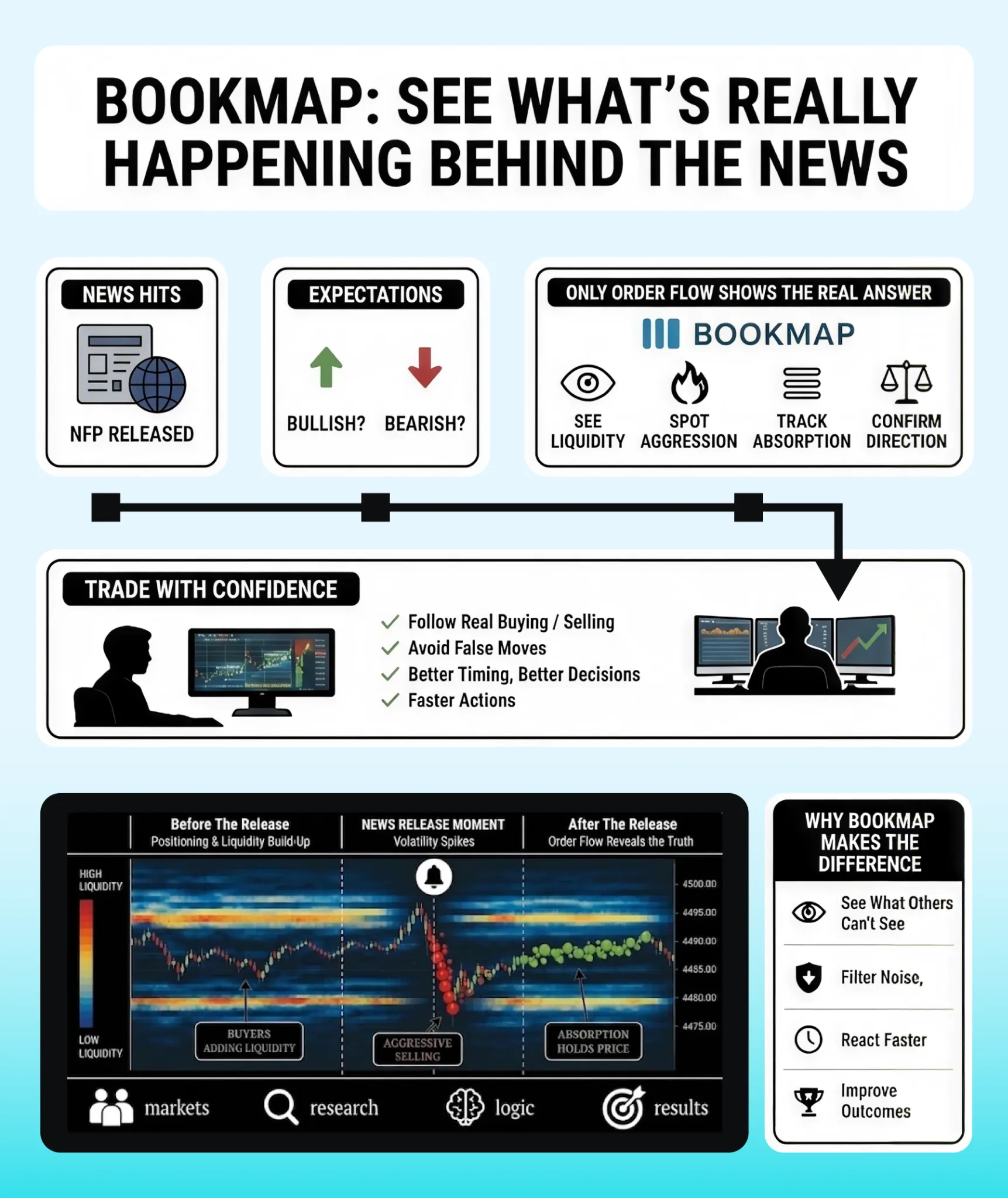
Thus, the headline may provide the “information”, but it is market reaction that provides the “evidence”. By observing liquidity, order flow, absorption, and price acceptance, market participants can understand whether buyers or sellers are truly taking control after an NFP release.
Conclusion
A strong Non-Farm Payrolls report is neither inherently bullish nor bearish for financial markets. Its impact depends on what markets already expected and how the new data changes those expectations.
When inflation remains high, strong employment may reduce hopes for rate cuts and increase concerns about higher-for-longer interest rates. In a healthier inflation environment, the same report may signal economic resilience and support stocks. At the same time, institutional participants may interpret the data differently based on their expectations for growth, inflation, and Federal Reserve policy.
Therefore, the NFP market reaction cannot be judged by the headline alone. The core lesson is: Stop asking whether the jobs report was “good” or “bad.” Start asking “what it changed” and observe how the market responds. Watch how the market reacts to Non-Farm Payrolls in real time with Bookmap.
FAQs
1. Why do markets sometimes fall after a strong Non-Farm Payrolls report?
A strong NFP report can raise concerns that inflation may remain high because employment, wages, and consumer spending remain strong. This may potentially:
- Reduce expectations of Federal Reserve rate cuts, and
- Increase the possibility of higher-for-longer interest rates
Thus, higher rates can raise borrowing costs and pressure stock valuations (particularly growth stocks).
2. Does a strong Non-Farm Payrolls report always cause stocks to fall?
No, the market reaction depends on expectations and the broader economic environment.
- If strong employment was already expected, stock prices may barely move.
- Whereas, if the report shows unexpected economic strength, stocks may fall because of higher rate expectations.
In a healthy economy with controlled inflation, strong employment may instead support stocks.
3. What does “priced in” mean when discussing Non-Farm Payrolls?
“Priced in” means that markets have already reflected expected NFP results in asset prices before the report is released. For example,
- Suppose strong job growth is widely expected.
- Consequently, traders may already position for it.
Now, if the actual result matches forecasts, prices may move by a minimal amount. At the same time, a significant surprise can create a larger reaction.
4. Besides the headline payroll number, what should traders watch during an NFP release?
The headline payroll figure is only one part of the report. Some other important indicators are:
- Unemployment rate
- Average hourly earnings
- Labor force participation, and
- Revisions to previous payroll figures
Market reactions in Treasury yields, the U.S. dollar, and stock index futures also provide clues about how investors are interpreting the report.
5. How can order flow help traders after a Non-Farm Payrolls release?
Order flow shows how market participants respond after the NFP data is released. It can potentially reveal the following:
- Whether buyers or sellers are more aggressive
- Where liquidity enters or leaves the market
- Whether large orders absorb price movement
This also explains whether the initial price move is gaining acceptance or being rejected.
Sign Up Now
Latest Articles