


See dark pools more clearly in real time.
Compare plans to access deeper market visibility for dark pools.
Education
October 14, 2024
Updated
Dark Pools and Dark Pool Transactions: What Traders Need to Know
Ever wondered how big trades happen without making headlines? Thank Dark Pools! These are venues where institutional investors can buy and sell large amounts of stock without showing their orders to the market first.
But how does it impact me? The trade-off is transparency: orders in dark pools are not displayed, so the order book you see does not show all of the interest in a stock. What you see might not be a true reflection of the market!
To learn more, read this article, where we will break down what dark pools are and why they matter to traders like you. You’ll learn about the different types of dark pools, how they work, and the pros and cons of hidden transactions. Then, we will see some real-life examples, like the GameStop short squeeze, to show how off-exchange trading can affect what you see.
You’ll also discover how dark pool activity affects retail traders and often leaves them in the dark about real supply and demand. But don’t worry! We will also explain ways to monitor these hidden trades using our tools like Bookmap, helping you spot potential market movements before they happen. Let’s begin.
Table of Contents
- What Are Dark Pools?
- Alternative Trading Systems in Equity Markets
- How US Equity Orders Get Executed
- How Do Dark Pool Transactions Work?
- Off-Exchange Private Securities Matching
- How Do Institutional Brokers Execute Block Orders Anonymously?
- How Do Dark Pools Affect Retail Traders?
- Risks and Oversight in Private Venues
- Conclusion
- FAQs
What Are Dark Pools?
Dark pools are private trading venues, formally called alternative trading systems (ATSs), that allow large-volume transactions outside public stock markets. These platforms are specifically designed for institutional investors (such as hedge funds and pension funds) so that they can conduct trades without revealing the details to the public.
If large trades were made on public exchanges, they could move the stock price unfavorably. Therefore, by using dark pools, these investors buy or sell shares discreetly, ensuring they don’t distort the market. Want to learn more? Check out our blog post, ‘What Are Dark Pools?’ for detailed information.
Are Dark Pool Transactions Executed Over-the-Counter (OTC)?
Yes, dark pool transactions are over-the-counter (OTC) trades. This means they occur outside traditional stock exchanges. Dark pools allow large investors to trade without public visibility. This keeps their actions hidden from the general market. These OTC platforms are mostly used for stock trading, allowing institutions to trade discreetly without impacting stock prices.
Here “OTC” means off-exchange. In the US, trades in listed stocks that happen away from an exchange are reported to a FINRA trade reporting facility and carried on the consolidated tape. It does not refer to the OTC markets for penny stocks.
What are the Different Types of Dark Pools?
Dark pools can be categorized into three main types:
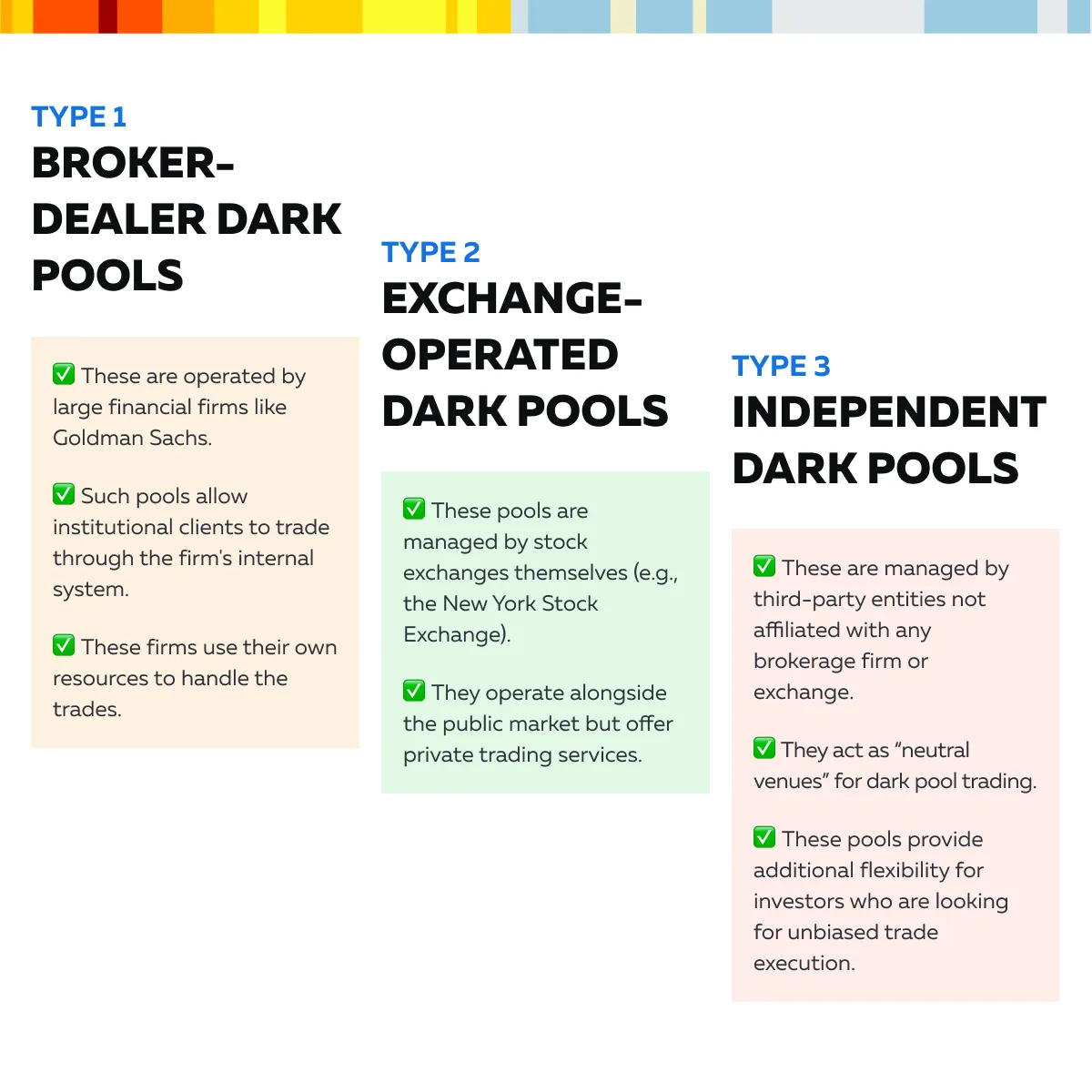
Broker-Dealer Owned Crossing Networks vs. Independent ATS
ATSs differ mainly in who runs them and what else that operator does. The Congressional Research Service groups US dark pools into three broad types:
| Type | Who operates it | What to know |
| Broker-dealer owned | Banks and brokers, such as Goldman Sachs’s Sigma X and Morgan Stanley’s MS Pool | Crosses client orders, and the operator may also trade for its own account. Conflicts of interest are the main concern |
| Agency or independent | Agency brokers with no proprietary trading, such as Liquidnet | Built for institutional block trading, with the operator’s interests kept apart from its clients’ |
| Exchange-owned | Exchange groups that run dark or block venues, such as Cboe’s BIDS | Pairs an exchange group’s regulatory profile with a non-displayed block-matching venue |
The difference matters because of conflicts of interest. A broker-dealer that runs a crossing network can see the order flow, may route client orders to its own pool first, and may trade against that flow. An independent operator has fewer of those conflicts, though it still earns fees from trades. The 2016 enforcement cases involved bank-owned pools, and Form ATS-N now requires the operator to disclose how it and its affiliates trade and use order information.
Ownership and names change with mergers and closures, and Barclays LX and Credit Suisse CrossFinder, the venues in those cases, are historical examples. FINRA’s ATS list shows the venues currently operating.
Stay ahead of market moves by understanding dark pool transactions. Join Bookmap now!
Alternative Trading Systems in Equity Markets
An alternative trading system (ATS) is a trading venue that matches buyers and sellers but is not registered as a national securities exchange. In the US, an ATS is run by a registered broker-dealer under the SEC’s Regulation ATS. Dark pools are the ATSs that do not display their orders before they trade.
Three terms are often used as if they meant the same thing:
- Off-exchange trading is any execution that takes place away from a national securities exchange.
- Dark pools are one part of that: ATSs that match orders without displaying quotes.
- Wholesaler internalization is the other large part: market makers that fill retail orders from brokers against their own inventory.
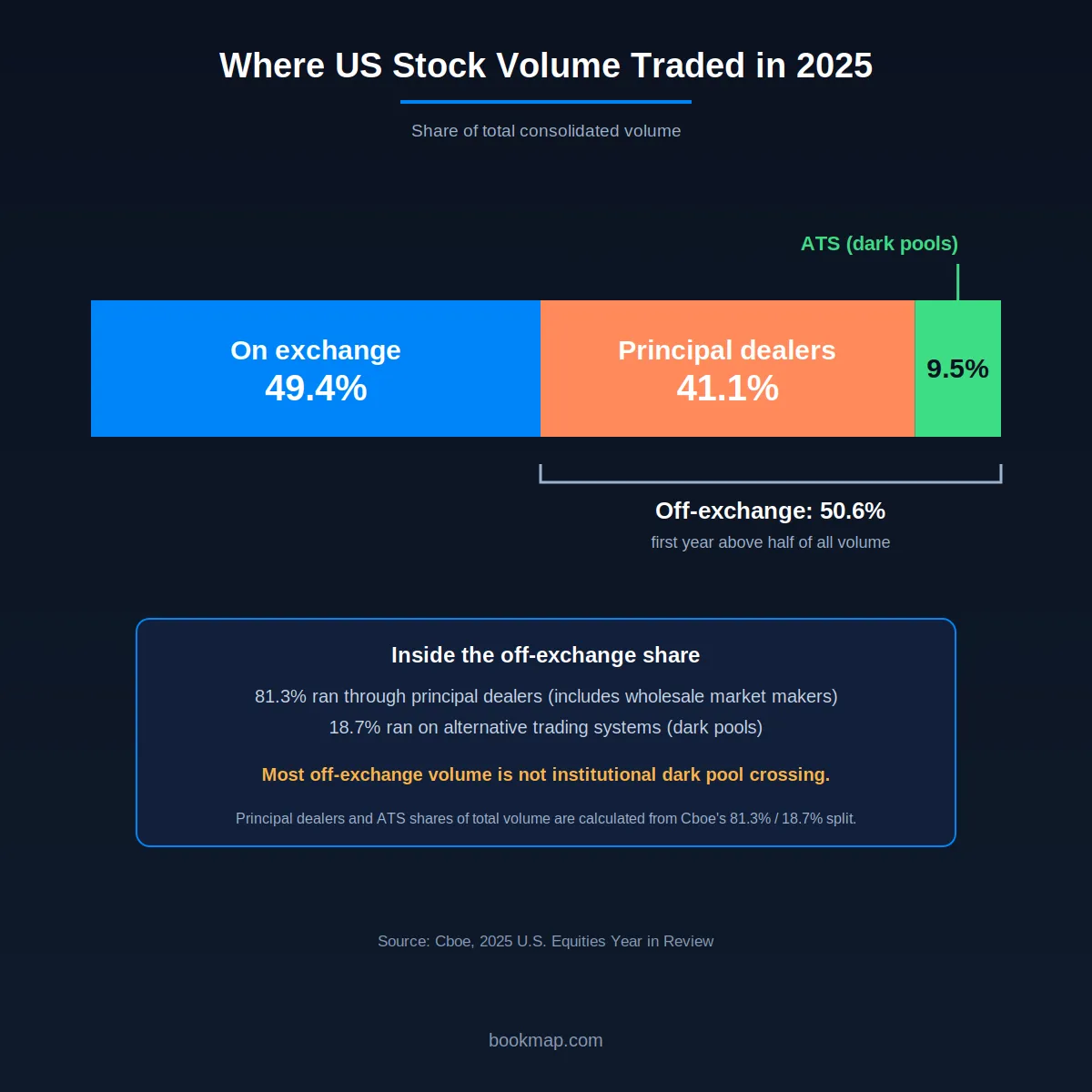
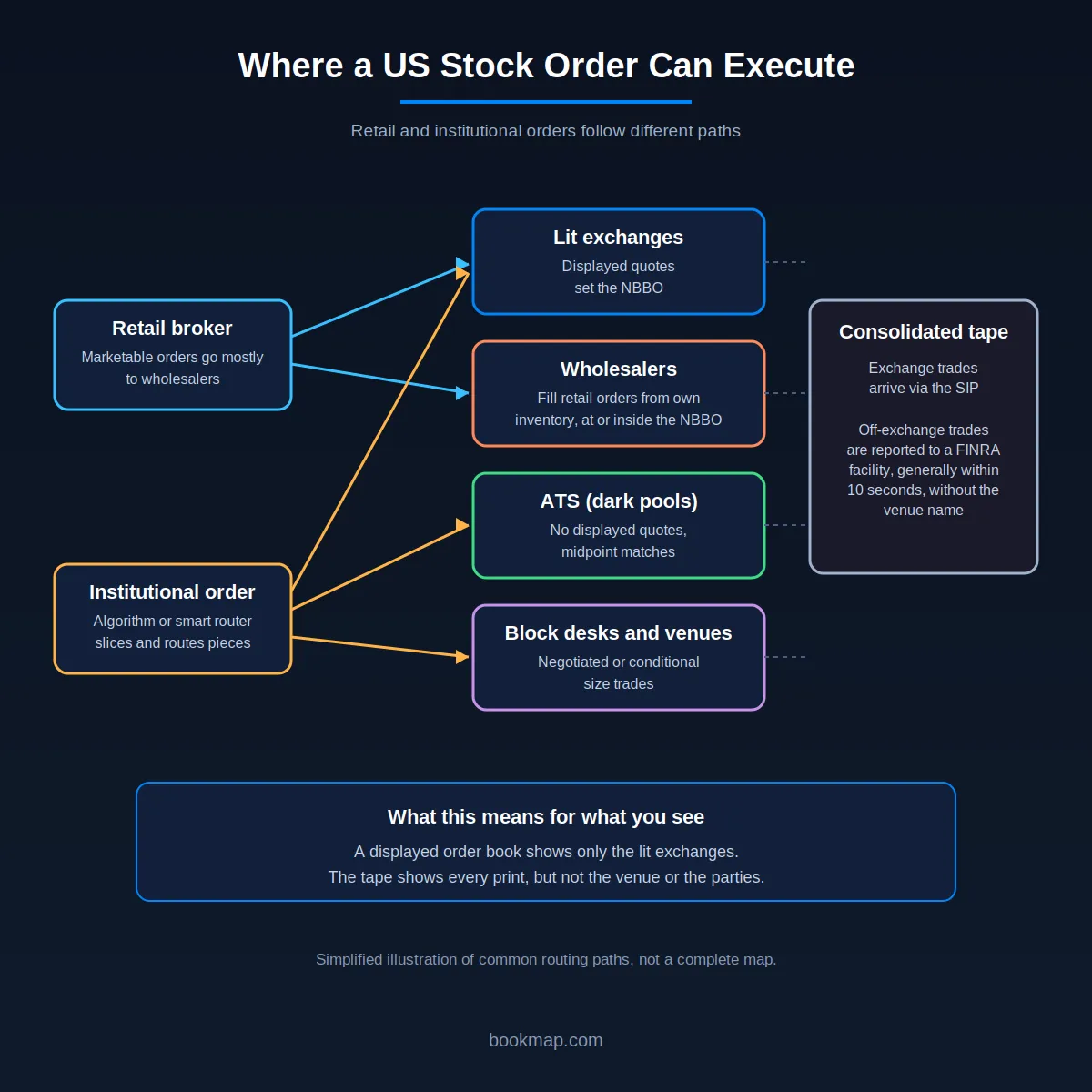
The split matters. Cboe reports that off-exchange trading reached 50.6% of total US equity volume in 2025, the first year it passed half. Only 18.7% of that off-exchange volume ran on ATSs, and 81.3% ran through principal dealers, which include the wholesalers that fill retail orders. Worked through, ATSs handled roughly 9% to 10% of total US stock volume, and principal dealers about 41%. Most off-exchange volume is not institutional dark pool trading.
Regulation ATS also adds obligations as a venue grows. An ATS that reaches 5% or more of the average daily volume in an NMS stock faces additional requirements, including fair access.
How US Equity Orders Get Executed
Dark pools only make sense inside the wider system they sit in. This section covers how that system fits together.
Financial Market Microstructure Overview
Market microstructure is the study of how orders turn into trades: where orders go, how they are matched, who sees them and how prices form. In US equities the answer has several layers:
- Lit exchanges display quotes and set the national best bid and offer (NBBO), the reference price for most executions. A securities information processor (SIP) combines quotes and trades from all exchanges into a single consolidated feed.
- ATSs match orders without displaying them, using the lit market’s prices as a reference.
- Wholesalers and other principal dealers fill orders from retail brokers and others against their own capital.
- The consolidated tape records trades from all of them. Exchange trades arrive through the SIP. Off-exchange trades are reported to a FINRA trade reporting facility and carried on the tape without the venue’s name.
No single venue shows the whole market. A heatmap or order book from one venue, or even from all the exchanges, shows displayed interest only. For how fragmentation looks in practice, see Bookmap’s guide to what has changed in market microstructure.
Institutional Securities Exchange Mechanisms
Exchanges match orders by price and then by time of arrival, and they offer order types that institutions use to manage their footprint:
- Reserve (iceberg) orders display only part of their size.
- Hidden orders are not displayed at all and rank behind displayed orders at the same price.
- Midpoint peg orders rest unseen and execute at the midpoint of the NBBO.
- Auctions at the open and close pool large volume at a single price. The NYSE closing auction matched a record 3.57 billion shares on March 20, 2026.
- Periodic auctions gather size at set intervals, an on-exchange alternative to a dark pool.
Non-displayed orders are part of the lit exchanges themselves. Cboe reports that 17.2% of the volume executed on its venues in 2025 was non-displayed. For how icebergs show up on a heatmap, see Bookmap’s guide to how to read and trade iceberg orders.
Wholesale Equity Market Routing Architectures
Most retail stock orders never reach an exchange. A retail broker typically sends marketable orders to a wholesale market maker, which fills them against its own inventory, usually at or slightly better than the NBBO. The broker is often paid for that order flow. In January 2021, Citadel Securities and Virtu accounted for about 50% and 26% of internalized GameStop volume, according to the SEC’s staff report.
Brokers publish quarterly Rule 606 reports showing where they route orders, and the SEC’s amended Rule 605 requires more detailed execution quality reports from larger broker-dealers, with a compliance date of August 1, 2026. Institutional orders follow a different path. An execution algorithm or smart order router slices the order and sends pieces to lit exchanges, ATSs and block venues based on cost, fill rates and the risk of information leakage. For how routing incentives work, see Bookmap’s guide to payment for order flow.
How Do Dark Pool Transactions Work?
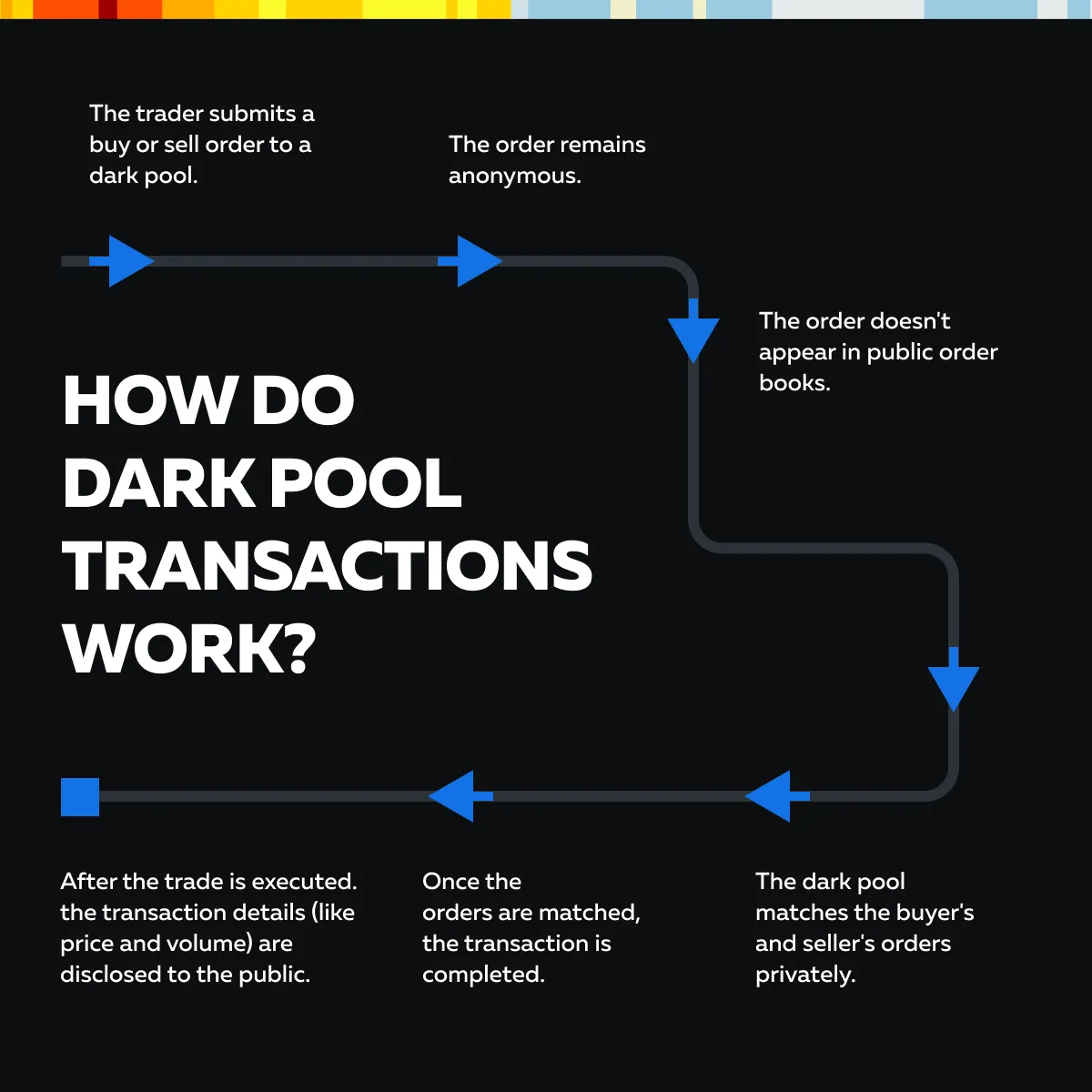
To execute dark pool transactions, traders place orders that keep both the buyer and seller anonymous. An order placed in a dark pool is not visible in the public order book. The trade only becomes public after the transaction is executed. This provides privacy and minimizes the chance of influencing the stock’s price. For more clarity, understand the process through the graphic below:
What are the Pros of Dark Pools?
One of the biggest advantages of dark pools is that they allow institutional investors to “avoid price slippage”. For those unaware, price slippage occurs when large trades on public exchanges shift the stock price. If a big order is placed publicly, it can cause the price to rise (for buys) or fall (for sells). This makes it more expensive or less profitable for the investor, respectively.
In a dark pool, since the order remains hidden, large trades can be executed without influencing the stock’s market price. This allows investors to get a better deal. With this anonymity, investors can execute large-volume transactions discreetly without moving the market or signaling their intentions.
What are the Cons of Dark Pools?
On the negative side, dark pools “reduce market transparency”. They obscure the true supply and demand of a stock. This lack of visibility makes price discovery less efficient and leaves everyday traders with less information to make informed decisions. Hence, we can state that dark pools contribute to a less transparent and balanced market for retail investors.
Track market transparency with real-time insights on dark pool activity. Sign up for Bookmap today!
Off-Exchange Private Securities Matching
Private matching means two orders meet inside a venue that never displays them, and a trade is created only when they cross. The mechanics are simple:
- A participant, usually a broker’s algorithm acting for a client, sends an order to the ATS with limits such as a minimum fill size.
- The ATS holds the order unseen.
- When a matching order arrives, the ATS executes the trade at a price taken from the public market, usually the midpoint of the NBBO.
- The trade is reported to FINRA, generally within 10 seconds, and appears on the tape without identifying the venue or the parties.
Because the ATS borrows its price from the lit market, dark trading depends on exchanges for price formation.
Unlit Order Book Stock Execution
An unlit order book is the list of orders inside a dark venue. Nobody outside the operator sees it, and participants usually see only their own orders and fills. A few features control how it executes:
- Reference price. Most executions are pegged to the NBBO midpoint, so buyer and seller each save half the spread.
- Minimum quantity. Many orders carry a minimum fill size, which stops small orders from probing the book for large ones.
- Conditional orders. Some venues let a participant signal interest first and commit the full size only when a match appears.
- Priority. Venues rank orders by price and time, or by size, and the rules are disclosed in the operator’s Form ATS-N.
- Execution reports. Participants learn of a fill only when it happens. There is no way to see unfilled resting size, which is the point of the design.
Hidden Liquidity Trading Venues
Hidden liquidity does not live only in dark pools. It sits in several places:
| Venue type | Quotes displayed? | Typical users | How trades show up |
| Lit exchange, displayed orders | Yes | All participants | Exchange trade on the SIP |
| Lit exchange, hidden or reserve orders | Partly or no | Institutions and algorithms | Exchange trade on the SIP, but the resting size was never shown |
| ATS (dark pool) | No | Institutions and brokers | FINRA print without a venue name |
| Wholesaler or principal dealer | No | Retail brokers and institutions | FINRA print without a venue name |
| Block desk (high-touch) | No | Large institutions | Print on the tape after the block trades |
Because hidden size also sits on lit exchanges, “dark” is not only about trading away from exchanges. For how to infer hidden size from lit-market behavior, see Bookmap’s guides to hidden liquidity in large-cap stocks and trading around iceberg orders.
Equity Dark Pools vs. Crypto Off-Exchange Liquidity
Crypto has no consolidated tape, so “dark” liquidity works differently:
- OTC desks and request-for-quote platforms. Large crypto trades commonly go through desks that quote a price privately, so the trade settles away from the public order book.
- Hidden and iceberg orders on exchanges. Many centralized exchanges support them, as lit equity exchanges do.
- Private transaction routing on-chain. On decentralized exchanges, pending trades can be seen by bots that trade ahead of them, and some traders send transactions through private relays to avoid that.
- No single record of where a trade executed. Each exchange has its own book and its own trade feed.
The practical lesson is the same as in equities: a visible order book shows displayed interest on one venue only. Bookmap’s crypto page covers the venues it connects to.
How Do Institutional Brokers Execute Block Orders Anonymously?
Institutions rarely send a large order to one venue in one piece. Their brokers combine several techniques to hide size and identity:
| Technique | How it works | Trade-off |
| Algorithmic slicing (VWAP, TWAP, implementation shortfall) | Splits the order into small pieces released over time | Reduces impact, but takes time and can leave a footprint across the day |
| Dark pool crossing | Matches against other institutional orders at or near the NBBO midpoint | Saves spread and hides size, but fills are uncertain |
| Block venues and conditional orders | Signals interest first and trades only when a large counterparty is found | Finds size, but needs a counterparty at the same time |
| High-touch block desks | A trader negotiates privately, sometimes committing the bank’s capital | Moves large size quickly, at a negotiated price and fee |
| Hidden and reserve orders on exchanges | Shows little or none of the order on a lit book | Keeps size off the screen, but ranks behind displayed orders |
Anonymity comes from three layers. The venue does not reveal who is on the other side. The order is not displayed before it trades. And the print on the tape carries no venue name or participant identity. The size of the trade still becomes public after execution, so block prints can be read after the fact. For how to read institutional footprints on the tape and the heatmap, see Bookmap’s guide to trading like an institutional trader.
Example: GameStop and Off-Exchange Trading in January 2021
During the GameStop short squeeze in January 2021, a large share of retail buying was executed away from public exchanges. The SEC’s 2021 staff report on the episode found that wholesale market makers bought much of the retail order flow in GameStop and executed it off exchange. Citadel Securities and Virtu accounted for about 50% and 26% of internalized GameStop volume that month. That made some of the trading less visible to the wider market.
Two points keep the example in proportion. First, most of that activity was wholesalers filling retail orders, not institutions crossing blocks in dark pools. Second, the staff found no evidence that off-exchange trading, payment for order flow or wholesale market making caused the volatility. The report said that short covering added upward pressure on the price, and it listed dark pools and wholesalers among the areas for further study.
The lesson for traders is narrower than it is often told: the public order book showed only part of the activity in GameStop, and the volume that traded away from exchanges was large enough to matter.
How Do Dark Pools Affect Retail Traders?
As mentioned above, dark pools are designed to let large players execute big trades without causing market disruptions or price swings. These trades don’t appear in public order books, which creates several disadvantages for retail traders. Let’s check them out:
- Lack of Transparency
Dark pools shield large trades from public view. Retail traders cannot see these activities until after they’re completed; hence, they miss out on crucial signals, like large buy or sell orders. Under normal circumstances, these signals would have influenced their trading decisions.
- Delayed Information
The orders behind a dark pool trade are never visible beforehand, and the print reaches the tape without the venue’s name. This causes price changes that seem “sudden” or “unexplainable”. This lag in information puts retail traders at a disadvantage in understanding real-time market position.
- Skewed market perception
Since dark pools hide transactions, the amount of liquidity visible to the public appears smaller than it actually is. Retail traders looking at a stock’s order book might assume there’s less buying or selling interest than there really is.
- False signals
Let’s understand this point through an example. Say a retail trader believes there is a low demand for a stock based on public data. However, at the same time, institutional investors were trading significant volumes in dark pools. Now, this creates a misleading picture of supply and demand and makes it harder for retail traders to make informed decisions.
Discover how dark pools influence market trends using advanced trading tools. Get started with Bookmap here!
Can Retail Investors Access Dark Liquidity Pools?
Not directly. ATSs are open to subscribers, mostly broker-dealers and institutions, and an individual cannot connect to one. Retail investors reach off-exchange liquidity in three indirect ways:
- Through the broker’s routing. Many brokers send marketable retail orders to wholesalers, and some smart order routers also reach ATSs. Your broker’s Rule 606 report shows where it routes orders.
- Through order types. Midpoint pegged and hidden orders let you rest an order unseen on a lit exchange, and some brokers offer midpoint order types.
- Overnight. Four ATSs (Blue Ocean ATS, Bruce ATS, IBKR Eos ATS and MOON ATS) already carry overnight trading, and some retail brokers’ overnight sessions execute on them.
The more useful question for a retail trader is whether the broker’s executions are good. Execution quality reports under Rule 605 show price improvement and spreads, and the amended rule makes them more detailed from August 1, 2026.
What Impact Does Unlit Trading Have on Public Price Discovery?
Price discovery is the process by which displayed orders and trades turn into prices that reflect available information. Unlit trading touches it in two opposing ways:
- It borrows from the lit market. Dark pools and wholesalers price trades off the NBBO, so they depend on exchanges for the quote. If more volume leaves the exchanges, fewer orders contribute to that quote.
- It can improve it. Dark pools can pull uninformed order flow out of the lit market, which can leave exchange prices more informative. A well-known 2014 paper by Haoxiang Zhu in the Review of Financial Studies found that dark pools can improve price discovery on exchanges under certain conditions.
The evidence is mixed. Studies find both benefits and costs depending on how much trading goes dark, which stocks are involved and how the data are measured. With off-exchange trading above 50% of volume in 2025, regulators and exchanges continue to debate it, and the SEC’s 2021 staff report listed dark pools and wholesalers among the areas for further study. For traders, the practical point is that displayed depth and displayed volume show only part of the market, and large off-exchange prints around a move are context to check on the tape.
How to Monitor Dark Pool Activity?
Dark pool trades are private and hide large trades from the public order books. This makes them difficult for traders to monitor in real-time. It must be noted that dark pools operate differently from traditional stock exchanges, where data on bids, offers, and trades is public. Dark pools don’t report transactions until the trade is completed.
However, still there are ways for traders to gather information and spot dark pool activity. This can be done using specialized tools and reports. Let’s understand in detail:
FINRA OTC Transparency Data and the Consolidated Tape
Every off-exchange trade in a listed stock is reported to a FINRA trade reporting facility, generally within 10 seconds of execution, and appears on the consolidated tape marked as an off-exchange print without the name of the venue. That means the price and size of dark pool trades show up on a time and sales feed almost immediately. What stays hidden is the order before it trades, the venue and the identity of the parties.
FINRA also publishes weekly volume by ATS and by stock in its OTC Transparency data, on a two-week delay for the most liquid stocks and a four-week delay for the rest. It shows how many shares each venue traded in a stock, but not the direction or the prices. These sources tell you how much trading happened and where. They do not tell you who was buying or selling, so they work as context and not as a trading signal.
Bookmap and MBBO Data
Bookmap is our advanced market analysis tool. It offers real-time market visualization and allows traders to see the liquidity heatmap and order flow.
Bookmap’s US equities data shows the best bid (the highest price buyers are willing to pay) and the best offer (the lowest price sellers are willing to accept) across US exchanges. Dark pools do not display quotes, so their resting orders are not part of that view. Dark pool orders are not visible before they trade, but their effects can show up on lit venues. Using Bookmap, traders can watch for changes in the market that are consistent with large off-exchange activity, although those changes can have other causes. For example, they might see sudden shifts in the order flow, such as:
- Unusual increases in buying or selling activity
or
- Price movements that indicate a large trade occurred.
These signs can be consistent with large institutional activity, but they cannot be attributed to a dark pool with certainty. Treat them as context, and check them against the tape and FINRA’s weekly data.
How to Spot Dark Pool Activity Using Bookmap?
Let’s understand the two primary ways:
| Way I: Spot Sudden Liquidity Shifts | Way II: Visualize Through Liquidity Heatmap |
|
|
Both signals are inferences. A sudden liquidity shift or a gap on the heatmap can come from many sources, such as a large lit order, a market maker adjusting quotes or news, and nothing on the screen can attribute it to a dark pool. Confirm with the tape and with FINRA’s volume data before drawing a conclusion.
Risks and Oversight in Private Venues
Dark pools are regulated, and the risks inside them are known. This section covers the rules and the main conflict-of-interest risks.
What Regulatory Scrutiny Exists Under SEC ATS Rules?
An ATS is operated by a registered broker-dealer under Regulation ATS, and its operator is subject to SEC and FINRA oversight. The main layers:
- Regulation ATS. The framework for ATSs, with extra requirements, including fair access, once an ATS reaches 5% or more of the average daily volume in an NMS stock.
- Form ATS-N. Under the SEC’s 2018 amendments, ATSs that trade national market system stocks file detailed public disclosures on Form ATS-N. The SEC reviews them and can declare a filing ineffective.
- FINRA reporting and transparency. Off-exchange trades are reported to FINRA facilities, and FINRA publishes weekly volume by ATS and stock.
- Execution quality reporting. Amended Rule 605 requires broker-dealers that operate ATSs to publish separate reports for that activity, with a compliance date of August 1, 2026.
- Enforcement. In 2016, Barclays and Credit Suisse paid a combined $154.3 million to settle SEC and New York Attorney General charges over what they told clients about protections in their dark pools.
Not everything proposed has become a rule. The SEC withdrew proposed changes to Regulation ATS and to the definition of an exchange in June 2025, and in June 2026 it proposed repealing the trade-through rule. Bookmap’s guide to what has changed in market microstructure covers that timeline.
Form ATS-N Disclosure Requirements for Investment Banks
Investment banks that operate crossing networks file the same Form ATS-N as other broker-dealers, and the form is aimed squarely at their conflicts of interest. The disclosures cover:
- How the ATS operates: order types, how orders interact and are prioritized, fees, the market data it uses and any segmentation of order flow.
- The activities of the broker-dealer operator and its affiliates: including whether they trade in the ATS and what risk of information leakage that creates.
The filings are public on the SEC’s EDGAR system. For a trader or an institution choosing where to route, the form is a free way to compare how venues handle orders.
Predatory HFT Latency Arbitrage Inside Private Venues
Latency arbitrage happens when a faster trader acts on information before a slower participant’s order can update. In a dark pool the risk centers on prices pegged to a reference quote. If the NBBO moves and the pool’s reference price lags by a moment, a fast participant can trade against a stale price, and the slower side, often an institution’s order resting at the old midpoint, takes the loss.
The issue has produced enforcement. In 2014 the New York Attorney General sued Barclays, alleging it misled investors about protections against “predatory” high-frequency traders in its LX pool. In 2016 Barclays admitted to misrepresentations and settled for $70 million. Credit Suisse settled related charges over its CrossFinder and Light Pool venues for $84.3 million, including disgorgement tied to 117 million sub-penny orders.
Venues and institutions respond with minimum quantity and conditional orders, counterparty controls that limit interaction with order flow that tends to move prices against them, and faster or protected reference prices. High-frequency firms also provide liquidity and narrow spreads, and the label “predatory” describes one set of strategies, which is contested.
Conclusion
Dark pools are private exchanges. They allow institutional investors to execute large trades without revealing their intentions to the public. This hidden trading significantly impacts stock prices and market transparency. Dark pools not only help large players avoid price slippage but also reduce visibility for everyday traders. For them, it becomes harder to gauge real demand and supply. Also, this means less information to base decisions on and greater difficulty in understanding market movements.
Dark pool orders are not displayed anywhere, so no platform can show them directly. Bookmap can show how the lit market behaves around large activity, which helps traders put off-exchange prints in context. For this purpose, Bookmap offers several modern features like MBBO data analysis, order flow analysis, liquidity heatmaps, and much more. Don’t be a victim! Join our trading platform Bookmap today and optimize your trading like never before.
FAQs
What is an alternative trading system?
An alternative trading system (ATS) is a trading venue run by a registered broker-dealer that matches buyers and sellers but is not a national securities exchange. Dark pools are ATSs that do not display their orders before they trade.
How do dark pools work?
A participant sends an order to the dark pool, which holds it unseen. When a matching order arrives, the trade executes at a price taken from the public market, usually the midpoint of the national best bid and offer. The trade is reported to FINRA, generally within 10 seconds.
Are dark pools legal and regulated?
Yes. Dark pools are ATSs operated by registered broker-dealers under the SEC’s Regulation ATS, with public Form ATS-N disclosures and FINRA reporting. The SEC and New York have also brought enforcement cases, including a combined $154.3 million settlement with Barclays and Credit Suisse in 2016.
How much US stock trading happens in dark pools?
Cboe reports that off-exchange trading was 50.6% of US equity volume in 2025. Only 18.7% of that ran on ATSs, which works out to roughly 9% to 10% of total volume. Most of the rest ran through principal dealers, including wholesalers that fill retail orders.
Can you see dark pool trades?
After they happen, yes. Off-exchange trades appear on the consolidated tape, generally within 10 seconds, without the venue’s name. FINRA also publishes weekly volume by ATS and stock on a two-week delay for the most liquid stocks. You cannot see dark pool orders before they trade.
Can retail investors trade in dark pools?
Not directly. ATSs are open to broker-dealers and institutions. Retail investors reach off-exchange liquidity through their broker’s order routing and, in some cases, midpoint order types or overnight sessions that run on ATSs.
How do institutions execute block orders without moving the price?
They combine techniques: algorithms that slice the order over time, crossing in dark pools at the midpoint, block venues and conditional orders, high-touch block desks, and hidden or reserve orders on exchanges.
What is the difference between a dark pool and a wholesaler?
A dark pool is an ATS that matches orders from multiple participants. A wholesaler is a market maker that fills retail orders from brokers against its own inventory. Both trade off exchange, but wholesalers handle far more volume than dark pools.
Do dark pools hurt price discovery?
The evidence is mixed. Dark pools price trades off the public quote, so they depend on exchanges, and a large off-exchange share raises concerns. Some research finds dark pools can improve price discovery by moving uninformed order flow away from exchanges.
What is Form ATS-N?
It is a public disclosure that ATSs trading national market system stocks file with the SEC. It describes how the ATS operates and what the broker-dealer operator and its affiliates do, so market participants can assess conflicts of interest.
What is the difference between equity dark pools and crypto off-exchange liquidity?
Equity dark pools operate within a regulated framework with a consolidated tape and public disclosures. Crypto has no consolidated tape, and large trades commonly go through OTC desks, hidden orders on exchanges or private on-chain routing.
Sign Up Now
Latest Articles